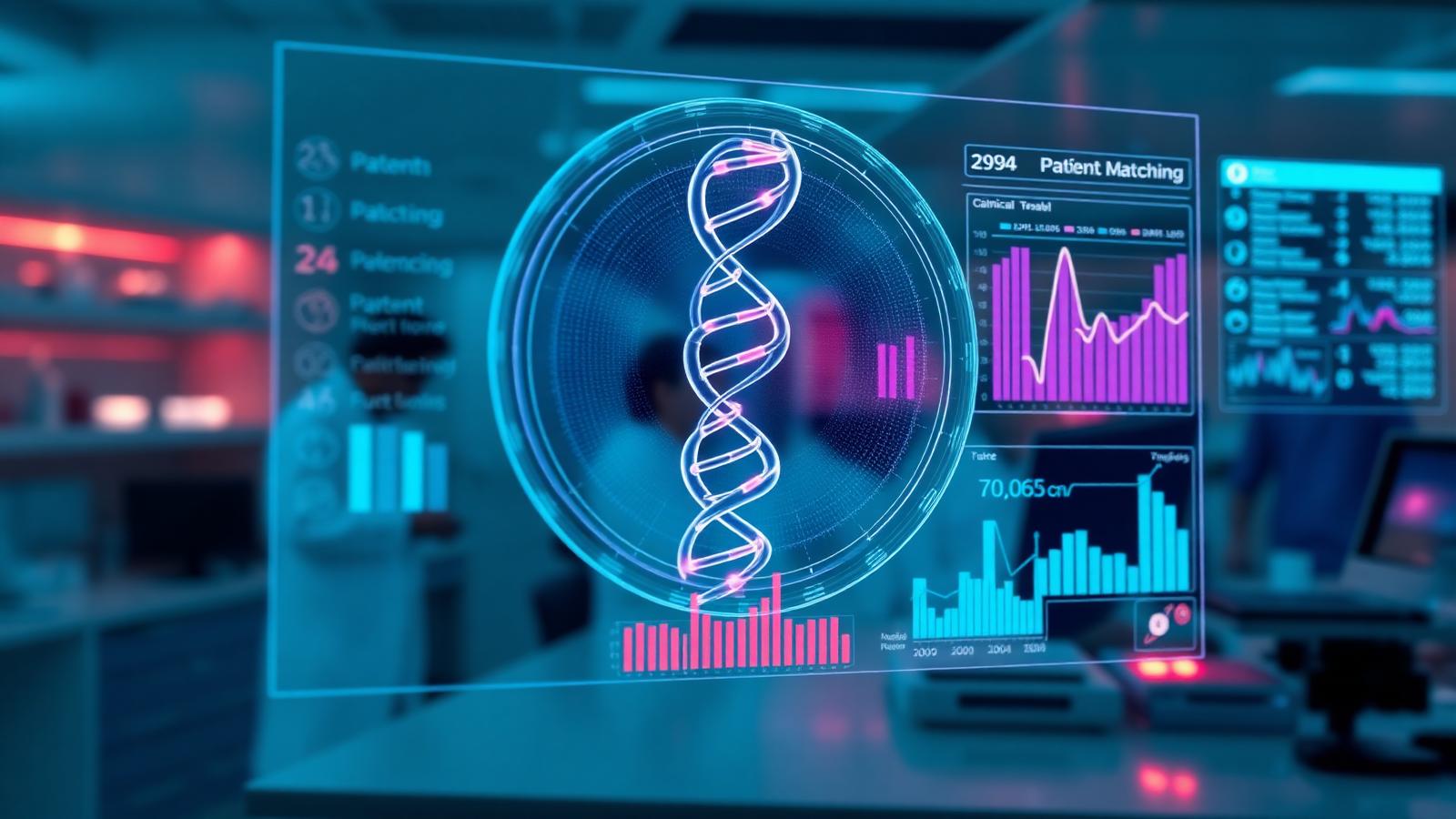
- Traditional drug development takes 10-15 years and costs $2.6 billion with a 90%+ failure rate - AI is compressing this to 3-5 years
- Generative AI designs novel molecular structures optimized for binding affinity, bioavailability, and synthesizability in hours instead of months
- Clinical Trial AI reduces patient enrollment time by 40% and optimizes trial design to require fewer patients
- Three AI-designed drugs are currently in Phase II clinical trials, with FDA approval expected by 2027
AI-driven drug discovery is compressing the pharmaceutical development timeline, with AI-designed molecules already entering clinical trials.
The Drug Discovery Crisis: Why Innovation Is Failing Patients
It takes an average of 10-15 years and $2.6 billion to bring a new drug to market. The failure rate exceeds 90% - meaning that for every drug that reaches patients, nine others failed somewhere in the development pipeline, consuming billions in R&D investment. This is not just a business problem - it is a human crisis. Patients with rare diseases, treatment-resistant cancers, and emerging infections wait years or decades for therapies that may never arrive. AI Drug Discovery is fundamentally changing these economics and timelines.
The pharmaceutical industry's productivity has been declining for decades - a phenomenon known as "Eroom's Law" (Moore's Law spelled backwards). Despite increasing R&D spending, the number of new drugs approved per billion dollars invested has halved roughly every nine years since 1950. AI represents the first technology capable of reversing this trend by simultaneously increasing the probability of success at each stage and compressing the timeline from years to months.
Key Statistic: AI-first drug discovery companies report a 4x improvement in the hit-to-lead success rate and a 60% reduction in preclinical development timelines compared to traditional approaches.
AI in Every Stage of Drug Discovery
AI Drug Discovery is not a single technology - it is an integrated approach that applies machine learning, generative AI, and computational biology across the entire drug development pipeline. Each stage benefits differently:
Target Identification and Validation
The first step in drug discovery is identifying a biological target - a protein, gene, or pathway whose modulation could treat a disease. Traditionally, this process relied on laborious experimental biology, taking 2-5 years and yielding targets with uncertain druggability. AI transforms this:
- Multi-omics analysis - AI integrates genomics, transcriptomics, proteomics, and metabolomics data to identify targets with the strongest disease association and druggability potential
- Knowledge graph mining - Graph neural networks traverse vast biomedical knowledge graphs linking genes, proteins, diseases, drugs, and clinical outcomes to discover non-obvious target-disease relationships
- Causal inference - Machine learning distinguishes causal disease drivers from correlative bystanders, focusing drug discovery efforts on targets most likely to produce therapeutic benefit
- Target druggability prediction - AI predicts whether a target's three-dimensional structure has binding sites amenable to small molecule or biologic intervention, filtering out undruggable targets early
Molecular Design and Lead Optimization
Once a target is validated, the next challenge is designing molecules that interact with it effectively. This is where generative AI is delivering its most dramatic impact:
- De novo molecular generation - Generative models (variational autoencoders, generative adversarial networks, and diffusion models) design entirely novel molecular structures from scratch, optimized simultaneously for binding affinity to the target, drug-likeness, synthesizability, and predicted safety
- Multi-parameter optimization - Drug molecules must satisfy dozens of competing requirements: potency, selectivity, solubility, metabolic stability, permeability, and absence of toxicity. AI optimizes across all parameters simultaneously, finding solutions in vast chemical spaces that no human chemist could navigate
- Retrosynthesis planning - AI plans synthetic routes for novel molecules, predicting which chemical reactions will work and identifying the most efficient, scalable synthesis pathways
- Structure-activity relationship (SAR) modeling - Machine learning models predict how structural modifications to a molecule will affect its biological activity, enabling rapid iterative optimization
"In traditional medicinal chemistry, we might synthesize and test 5,000 compounds over 3 years to find one clinical candidate. With AI-driven molecular design, we identified our lead compound after testing fewer than 200 molecules in 8 months. The efficiency gain is staggering." - Head of Drug Discovery, AI-First Biotech Company
Preclinical Optimization with AI
Before a drug candidate enters human clinical trials, it must pass extensive preclinical testing for safety, efficacy, and pharmaceutical properties. AI Drug Discovery accelerates this phase by predicting outcomes before expensive laboratory experiments:
- ADMET prediction - AI predicts Absorption, Distribution, Metabolism, Excretion, and Toxicity properties from molecular structure alone, filtering out 80% of candidates that would fail in lab testing. This saves months of experimental work and millions in testing costs
- Toxicity prediction - Deep learning models trained on decades of toxicology data predict specific toxicity risks: hepatotoxicity, cardiotoxicity, genotoxicity, and organ-specific damage. Compounds with predicted toxicity concerns are deprioritized before any animal testing
- Formulation optimization - AI predicts optimal drug formulations (tablets, capsules, injectables) based on the compound's physicochemical properties, accelerating the pharmaceutical development phase
- Biomarker identification - Machine learning identifies biomarkers that predict drug response, enabling patient stratification and personalized treatment approaches
Clinical Trial AI: Reimagining the Most Expensive Phase
Clinical trials consume 60-70% of total drug development costs and 50% of the timeline. Clinical Trial AI is addressing every major inefficiency in this critical phase:
- Patient recruitment and matching - AI analyzes electronic health records (EHRs) across health systems to identify eligible patients who match complex trial criteria. Natural language processing extracts relevant clinical information from unstructured medical notes. This reduces enrollment time by 40% and improves the quality of enrolled populations
- Site selection and performance prediction - Machine learning models predict which clinical sites will recruit fastest and produce the highest-quality data, based on historical performance, geographic demographics, and investigator characteristics
- Adaptive trial design - AI enables adaptive trial protocols that modify treatment arms, sample sizes, and endpoints based on interim results, reducing the total number of patients required while maintaining statistical rigor
- Adverse event prediction and monitoring - Real-time AI monitoring detects safety signals earlier than traditional pharmacovigilance methods, potentially preventing serious adverse events and enabling faster regulatory reporting
- Digital endpoints - AI analyzes data from wearable devices and digital biomarkers to create objective, continuous endpoints that supplement traditional clinical assessments, improving sensitivity and reducing trial duration
The Economics of AI-Accelerated Clinical Trials
The financial impact of Clinical Trial AI optimization is substantial:
- Enrollment acceleration - Each day of enrollment delay costs $600,000-$8 million in opportunity cost (depending on the drug's market potential). Reducing enrollment time by 40% translates to tens of millions in savings
- Reduced sample sizes - Adaptive designs and enriched populations can reduce required sample sizes by 20-30%, with proportional reductions in cost
- Fewer failed trials - Better patient selection and adaptive monitoring reduce late-stage failure rates, the single most expensive event in drug development
- Faster regulatory submission - Compressed timelines mean earlier market entry and extended effective patent life
Pharmaceutical AI Solutions: An Integrated Platform Approach
The most successful Pharmaceutical AI Solutions deployments take an integrated platform approach rather than deploying point solutions:
- Unified data layer - A single data platform that integrates biological data (omics, assay results), chemical data (compound libraries, SAR data), clinical data (trial results, real-world evidence), and literature (publications, patents)
- AI model marketplace - A curated collection of validated AI models for each stage of drug discovery, from target identification through clinical development
- Experiment management - Systems that track AI predictions alongside experimental results, creating continuous feedback loops that improve model accuracy
- Regulatory documentation - Automated generation of regulatory-required documentation for AI-assisted drug development, ensuring compliance with FDA and EMA guidelines
Case Study: AI-First Biotech Achieves 3-Year Development Timeline
A mid-size biotechnology company partnered with NeoBram to build an end-to-end AI Drug Discovery platform targeting a novel oncology indication. The results demonstrate the transformative potential of integrated AI:
- Target identification - AI analysis of multi-omics data and biomedical knowledge graphs identified a novel target in 4 months, compared to the typical 2-3 year timeline
- Lead compound identification - Generative AI designed and screened candidates in silico, with the lead compound identified after testing fewer than 200 molecules in 8 months (vs. typical 3-4 years and 5,000+ compounds)
- Preclinical candidate selection - AI-predicted ADMET and toxicity profiles matched experimental results with 85% accuracy, reducing the preclinical phase from 18 months to 7 months
- Clinical trial enrollment - AI-powered patient matching and site selection accelerated Phase I enrollment by 35%, with the first patient dosed 14 months after preclinical candidate selection
- Overall development cost - Projected total development cost reduced by 40% compared to traditional approaches
Milestone: Three AI-designed drug candidates from various companies are currently in Phase II clinical trials. Industry analysts predict the first AI-discovered drug will receive FDA approval by 2027, marking a watershed moment for the industry.
Challenges and Considerations in AI Drug Discovery
Despite its promise, AI Drug Discovery faces real challenges:
- Data quality and availability - AI models are only as good as their training data. Biological data is noisy, incomplete, and often siloed across organizations. Solution: Data consortiums, federated learning, and synthetic data generation are expanding available training sets
- Validation and reproducibility - AI predictions must be validated experimentally, and not all predictions translate to real-world results. Solution: Rigorous experimental validation protocols and transparent reporting of prediction accuracy
- Regulatory acceptance - Regulatory agencies are still developing frameworks for evaluating AI-assisted drug development. Solution: Early engagement with FDA and EMA, transparent documentation of AI methods, and participation in regulatory pilot programs
- Interpretability - Regulators and scientists need to understand why an AI model makes specific predictions. Solution: Explainable AI techniques (SHAP values, attention visualization) and physics-informed models that incorporate known biology
Getting Started with AI in Drug Discovery
For pharmaceutical companies beginning their AI journey:
- Start with data infrastructure - Invest in unified data platforms that integrate biological, chemical, and clinical data. AI cannot deliver value without accessible, high-quality data
- Pilot with repurposing - Drug repurposing (finding new indications for existing drugs) offers the fastest path to value because it leverages existing safety data and shortened development timelines
- Build or partner - Assess whether to build internal AI capabilities or partner with AI-focused drug discovery companies. Most pharma companies benefit from a hybrid approach
- Invest in computational chemistry - Molecular simulation and generative chemistry are the highest-impact AI applications in early-stage discovery. Ensure your team includes computational chemists who can bridge AI and medicinal chemistry
"AI Drug Discovery is not a future technology - it is here, producing real drug candidates in real clinical trials. The pharmaceutical companies that embrace AI now will define the next generation of therapeutics. Those that wait will find themselves unable to compete on cost, speed, or innovation." - NeoBram Pharma Team
Written by
Karthick RajuChief of AI at NeoBram. Helps enterprises move from AI experimentation to production-grade deployment across manufacturing, BFSI, pharma, and energy.
Connect on LinkedIn