Key takeaways
- The global AI in healthcare market reaches $50.7 billion in 2026, with average ROI of $3.20 for every $1 invested and payback periods of just 14 months.
- AI scribes are cutting clinical documentation time by up to 70%, with one health system saving 15,791 hours of physician documentation in a single deployment.
- AI-powered cardiac monitoring (DeepRhythmAI) achieved a 0.3% false-negative rate vs 4.4% for human technicians, making it 14x less likely to miss a diagnosis.
- AI is reducing drug discovery timelines by up to 70%, compressing the traditional 10-15 year process to as little as 1-2 years for some programmes.
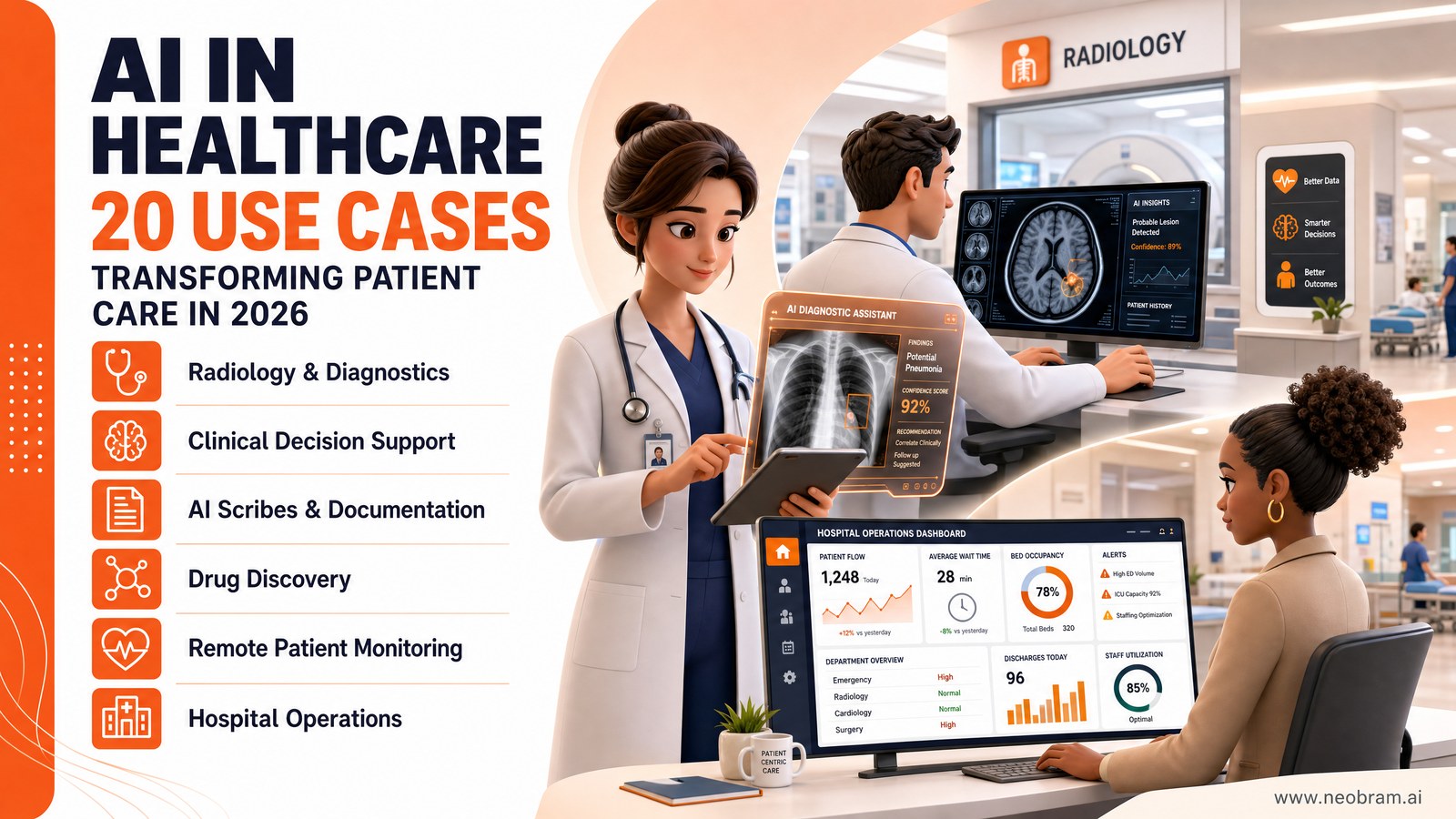
AI in Healthcare: 20 Use Cases Transforming Patient Care in 2026
Healthcare is one of the most data-intensive industries on the planet, and for decades that data sat largely untapped. Patient records, imaging scans, lab results, clinical notes — enormous volumes of information that could, in theory, tell clinicians exactly what a patient needs before they even ask. AI is finally making that potential real.
The global AI in healthcare market is projected to reach $50.7 billion in 2026, growing toward $505 billion by 2033 at a compound annual growth rate of 38.9%. That's not speculative growth driven by hype. It's investment following demonstrable results: hospitals reducing readmissions, radiologists catching cancers earlier, pharmaceutical companies cutting drug discovery timelines by years.
This guide covers 20 concrete AI use cases already transforming patient care in 2026, with the data to back each one up.
The ROI case is clear. The average return on AI investment in healthcare is $3.20 for every $1 spent, with typical payback periods of just 14 months. 85% of healthcare executives say AI is helping increase revenue, and 80% say it's reducing costs, according to NVIDIA's 2026 State of AI in Healthcare survey.
The State of AI Adoption in Healthcare Right Now
Before diving into specific use cases, it's worth understanding where the industry actually stands. Adoption has accelerated sharply. In 2023, 38% of physicians used AI tools. By 2024, that figure had risen to 66%, a 78% increase in a single year. Today, 79% of healthcare organisations report using some form of AI technology.
That said, adoption is uneven. Large hospitals are 1.48 times more likely to adopt AI than smaller facilities. Geographic variation is stark: hospitals in New Jersey lead US adoption at nearly 49%, while some states report near-zero uptake. The technology is proven; the challenge now is scaling it equitably.
The use cases below span the full spectrum of healthcare operations, from clinical diagnostics to back-office administration. They're organised by function to help you identify where AI can deliver the fastest impact in your organisation.
Clinical Diagnostics and Imaging
1. Radiology and Medical Imaging Analysis
Radiology was the first clinical specialty to see large-scale AI deployment, and for good reason. Imaging generates enormous volumes of data, pattern recognition is central to the work, and the cost of a missed finding is high.
AI-assisted radiology tools now demonstrate 95.3% sensitivity for detecting critical radiographic findings, according to research published in Radiology. A 2025 study found that AI-assisted reporting shortened reporting time by 45% while simultaneously improving diagnostic accuracy. Northwestern University research showed a 15.5% average boost in radiograph report completion efficiency, with some radiologists achieving gains as high as 40%.
Over 340 FDA-approved AI tools are currently in clinical use, primarily for diagnosing strokes, brain tumours, and breast cancer. The practical implication: radiologists using AI catch more findings, faster, with fewer errors.
2. Pathology and Histology
Digital pathology is following radiology's trajectory. AI models trained on millions of histology slides can now identify cancer subtypes, grade tumours, and flag ambiguous cases for specialist review with accuracy that matches or exceeds experienced pathologists.
The technology is particularly valuable in regions with pathologist shortages. A single AI model can screen slides at scale, flagging high-priority cases and allowing human pathologists to focus their attention where it matters most.
3. Cardiac Monitoring and Arrhythmia Detection
DeepRhythmAI, an AI-powered cardiac monitoring system, achieved a false-negative rate of just 0.3% in a study of 14,606 patients. Human technicians, by comparison, missed cases at a rate of 4.4%, making them 14.1 times more likely to miss a diagnosis. For conditions like atrial fibrillation, where early detection directly reduces stroke risk, that difference is clinically significant.
Wearable ECG devices paired with AI interpretation are now enabling continuous cardiac monitoring outside hospital settings, catching arrhythmias that would previously have gone undetected between clinical visits.
4. Early Disease Detection and Risk Stratification
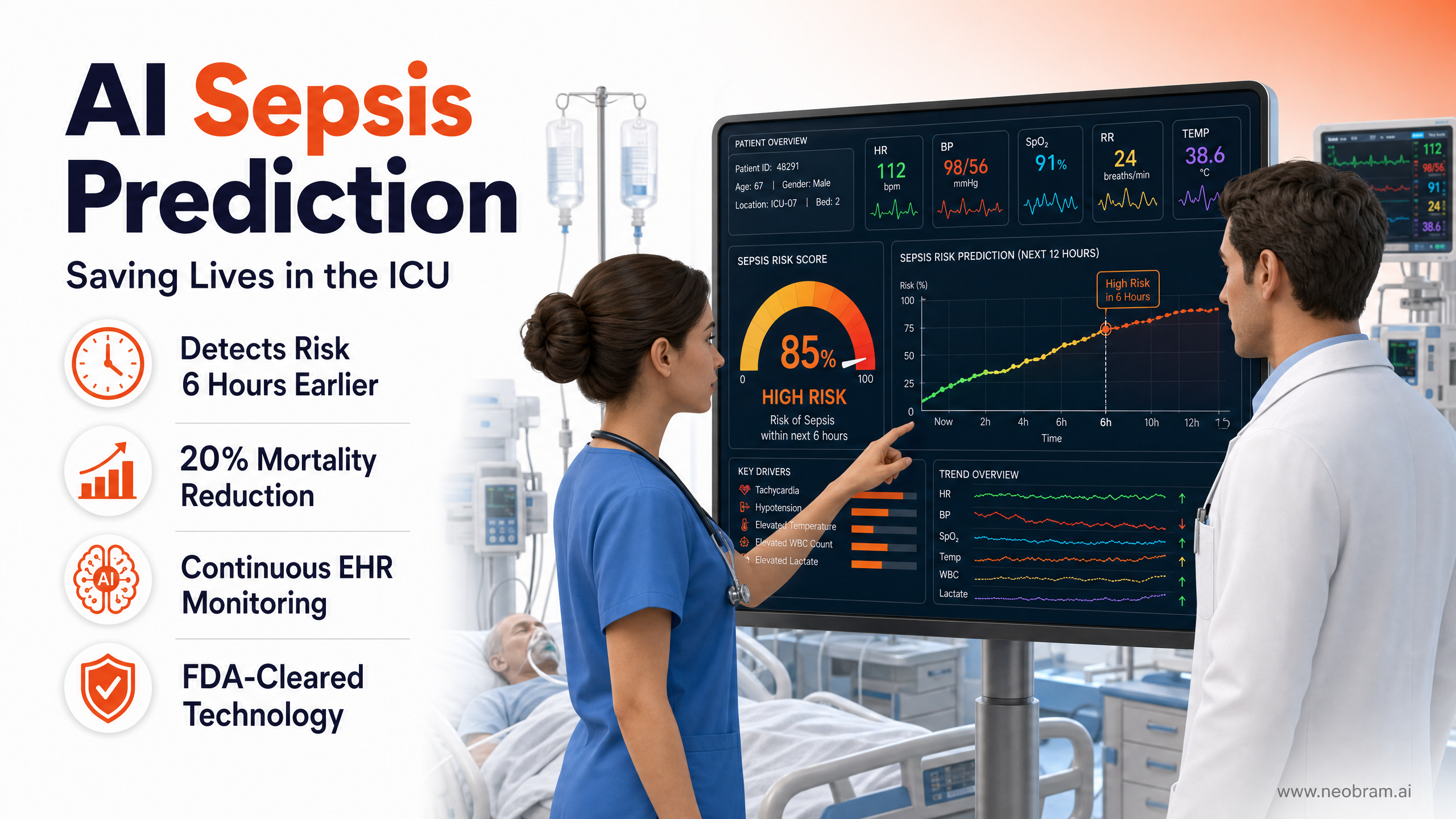
AI models trained on electronic health record (EHR) data can identify patients at elevated risk of developing conditions like sepsis, acute kidney injury, or deteriorating respiratory function hours before clinical signs become obvious. Sepsis detection algorithms deployed in hospital settings have demonstrated the ability to flag at-risk patients 6 to 12 hours before traditional clinical criteria would trigger an alert.
Sepsis kills 270,000 Americans annually. AI-powered early warning systems are demonstrating 20-30% reductions in sepsis mortality in hospitals that have deployed them at scale, by enabling earlier intervention before the condition becomes critical.
Clinical Documentation and Workflow
5. Ambient Clinical Documentation (AI Scribes)
Documentation burden is one of the leading drivers of physician burnout. Doctors spend an estimated 2 hours on administrative tasks for every 1 hour of direct patient care. AI scribes are changing that equation.
Ambient AI documentation tools record physician-patient conversations and generate structured clinical notes automatically. A large multi-centre study across five academic medical centres found that AI scribes saved physicians approximately 16 minutes per 8-hour shift. The American Medical Association documented a case where AI scribes saved 15,791 hours of documentation time across a single health system, equivalent to 1,794 eight-hour workdays.
Generative AI documentation tools are cutting charting time by up to 70% in some deployments, and clinicians using them consistently report saving two or more hours per day. Ambient clinical documentation now has 100% adoption among health systems that have trialled it, with 53% reporting high success.
6. Clinical Decision Support
AI-powered clinical decision support systems (CDSS) analyse patient data in real time and surface relevant recommendations to clinicians at the point of care. These range from drug interaction alerts and dosing recommendations to evidence-based treatment pathway suggestions.
The key distinction from older rule-based systems is that modern AI-driven CDSS learns from outcomes data. It doesn't just flag a known interaction; it contextualises the risk based on the specific patient's history, comorbidities, and current medications.
7. Medical Coding and Revenue Cycle Management
Medical coding is error-prone and time-consuming. Incorrect codes lead to claim denials, delayed payments, and compliance risk. AI tools trained on clinical documentation can assign ICD-10 and CPT codes with accuracy rates exceeding 95%, reducing manual review time and improving first-pass claim acceptance rates.
Healthcare organisations implementing AI-driven revenue cycle management are reporting administrative cost reductions of 20-40% across key functional areas. One hospital system documented a 40% reduction in claims processing time and $1.5 million in annual savings after deploying an AI-driven RPA system.
Patient Monitoring and Engagement
8. Remote Patient Monitoring
As of 2025, over 71 million Americans, representing 26% of the population, are using some form of remote patient monitoring (RPM) service. AI is what makes RPM clinically useful at scale.
Raw biometric data from wearables and home monitoring devices generates far too much information for human review. AI filters the signal from the noise, identifying patterns that warrant clinical attention and suppressing false alarms that would otherwise overwhelm care teams. RPM with AI interpretation reduces hospitalisations by up to 25% for chronically ill patients and increases medication adherence by 15-20%.
9. Predictive Readmission Prevention
Hospital readmissions cost the US healthcare system over $26 billion annually. AI models trained on discharge data, social determinants of health, and post-acute care patterns can identify patients at high risk of readmission before they leave the hospital.
Hospitals deploying these models are using them to trigger targeted interventions: follow-up calls, medication reconciliation, care coordination with community health workers. The result is measurable reductions in 30-day readmission rates, with some programmes reporting 15-20% improvements.
10. Virtual Health Assistants and Patient Chatbots
AI-powered virtual assistants handle appointment scheduling, medication reminders, symptom triage, and post-discharge follow-up at scale. For digital healthcare providers, virtual health assistants and chatbots represent the top ROI use case, cited by 37% of respondents in NVIDIA's 2026 survey.
These tools don't replace clinical care. They handle the high-volume, low-complexity interactions that currently consume significant nursing and administrative time, freeing staff for work that genuinely requires human judgment.
67% of clinicians now use AI daily, according to a 2026 LinkedIn analysis, not because it's mandated but because it demonstrably improves their ability to do their jobs. The shift from AI as an experiment to AI as a standard clinical tool is well underway.
Drug Discovery and Life Sciences
11. AI-Accelerated Drug Discovery
Traditional drug discovery takes 10-15 years and costs over $2 billion per approved compound. AI is compressing that timeline dramatically. Generative AI models can screen billions of potential molecular structures, predict binding affinities, and identify promising candidates in days rather than years.
The numbers are striking: AI is reducing drug discovery timelines by up to 70%, with some programmes moving from target identification to clinical candidate in 1-2 years rather than the industry average of 4-6 years. 57% of pharmaceutical and biotechnology respondents in the NVIDIA 2026 survey said drug discovery is being driven by AI, and 46% cited it as their top ROI use case.
12. Clinical Trial Optimisation
AI is improving clinical trial efficiency at multiple stages. Patient recruitment, historically one of the most time-consuming phases, can be accelerated by AI models that match eligible patients to trials based on EHR data. Protocol design can be optimised using historical trial data to identify the study designs most likely to demonstrate efficacy. Adverse event monitoring can be enhanced with real-time signal detection.
The practical impact: faster trials, lower costs, and better-designed studies that are more likely to succeed.
13. Pharmacovigilance and Drug Safety
Post-market drug safety monitoring generates enormous volumes of adverse event reports, literature data, and real-world evidence. AI systems can process this data continuously, identifying safety signals that might take months to surface through manual review. Regulatory agencies including the FDA are increasingly incorporating AI tools into their pharmacovigilance workflows.
Surgical and Procedural Applications
14. Surgical Planning and Assistance
AI is entering the operating theatre in several forms. Pre-operative AI tools analyse imaging data to generate detailed surgical plans, identifying optimal approaches and flagging anatomical variations that could complicate the procedure. Intraoperative AI systems provide real-time guidance, overlaying relevant information on the surgeon's field of view.
Robotic surgical systems increasingly incorporate AI components that assist with tremor reduction, instrument tracking, and procedural guidance. The goal isn't to replace surgical judgment but to augment it with data that no human could process in real time.
15. Post-Operative Complication Prediction
AI models trained on surgical outcomes data can identify patients at elevated risk of post-operative complications including infection, bleeding, and anastomotic leak. Early identification enables targeted monitoring and prophylactic intervention, reducing complication rates and length of stay.
Mental Health and Behavioural Health
16. Mental Health Support and Triage
Mental health services face a severe capacity crisis. Wait times for therapy can stretch to months, and the gap between need and available care is widening. AI-powered mental health tools are addressing part of this gap.
Conversational AI tools providing cognitive behavioural therapy (CBT) techniques have shown positive trends in reducing anxiety, stress, and depression symptoms in multiple studies. 47% of psychologists believe AI will make mental health professionals more effective in treating patients, and 40% feel optimistic about AI's role in the field.
The appropriate framing is augmentation rather than replacement: AI tools handling initial triage, psychoeducation, and between-session support, with human therapists focusing on complex cases and therapeutic relationships that require genuine human connection.
17. Substance Use and Addiction Support
AI-powered tools are being deployed to support addiction recovery through continuous monitoring, personalised intervention, and connection to resources. Predictive models can identify patients at elevated risk of relapse based on behavioural patterns, enabling proactive outreach from care teams.
Population Health and Public Health
18. Population Health Management
Health systems managing large patient populations use AI to identify at-risk cohorts, optimise care management resources, and measure the effectiveness of population health interventions. AI models can stratify populations by risk level, identify care gaps, and prioritise outreach to patients most likely to benefit from intervention.
For payers and providers, administrative tasks and workflow optimisation represent the top AI ROI use case, cited by 39% of respondents in the NVIDIA survey. Population health management sits at the intersection of clinical and administrative AI, delivering value on both dimensions.
19. Infectious Disease Surveillance
The COVID-19 pandemic demonstrated both the importance of early infectious disease detection and the limitations of traditional surveillance systems. AI-powered surveillance tools can analyse data from multiple sources, including social media, emergency department visits, pharmacy sales, and laboratory results, to detect outbreak signals weeks before traditional reporting systems.
Several health agencies now operate AI-driven surveillance platforms that provide real-time monitoring of respiratory illness, foodborne disease, and emerging pathogen threats.
Administrative and Operational AI
20. Hospital Operations and Capacity Management
AI is transforming hospital operations through predictive capacity management. Models trained on historical admission patterns, seasonal trends, and real-time data can forecast patient volumes, optimise bed allocation, predict staffing needs, and reduce emergency department wait times.
Hospitals deploying AI-driven operations management are reporting meaningful improvements in patient flow, staff satisfaction, and cost efficiency. The technology is particularly valuable in high-pressure environments where small improvements in throughput have significant downstream effects on patient outcomes and financial performance.
Key Challenges and Considerations
AI in healthcare is not without its challenges. Several factors are slowing adoption and creating real risks that healthcare organisations need to manage carefully.
Data quality and interoperability remain significant barriers. AI models are only as good as the data they're trained on, and healthcare data is notoriously fragmented, inconsistently coded, and siloed across incompatible systems. Organisations investing in AI need to invest equally in data infrastructure.
Regulatory compliance is complex and evolving. The FDA's framework for AI-enabled medical devices is still developing, and healthcare AI systems must navigate HIPAA requirements, state privacy laws, and increasingly, specific AI governance regulations. Getting this right requires legal and compliance expertise alongside technical capability.
Algorithmic bias is a genuine concern. AI models trained on historical healthcare data can perpetuate and amplify existing disparities in care. Rigorous validation across diverse patient populations, ongoing monitoring for performance disparities, and diverse development teams are all essential safeguards.
Clinician trust and adoption requires active management. AI tools that are technically excellent but poorly integrated into clinical workflows, or that generate too many false alarms, will be ignored or worked around. Successful deployment requires clinician involvement from the design stage, not just at the point of rollout.
How to Prioritise AI Investment in Healthcare
With 20 use cases on the table, the question is where to start. The answer depends on your organisation's specific pain points, data maturity, and strategic priorities. That said, some principles apply broadly.
Start with use cases where the data already exists and is reasonably clean. Clinical documentation and revenue cycle management typically meet this bar and deliver fast, measurable ROI. Use the early wins to build organisational confidence and data infrastructure for more complex clinical applications.
Prioritise use cases where the cost of failure is manageable. Diagnostic AI for rare conditions or high-stakes surgical planning requires extensive validation and should come after you've built internal AI governance capabilities. Administrative AI, remote monitoring, and patient engagement tools carry lower clinical risk and are good places to build experience.
Think about integration from day one. AI tools that require clinicians to leave their existing workflows to consult a separate system will see poor adoption. The most successful deployments embed AI into the tools clinicians already use, surfacing insights at the point of care without adding friction.
How NeoBram Can Help
NeoBram works with healthcare organisations at every stage of the AI adoption journey, from initial readiness assessment through to full-scale deployment and ongoing optimisation.
Our healthcare AI practice combines deep clinical domain knowledge with technical expertise in machine learning, data engineering, and enterprise integration. We understand that healthcare AI is not just a technology challenge. It's a change management challenge, a data governance challenge, and a regulatory compliance challenge, all at the same time.
We've helped health systems implement ambient clinical documentation tools that genuinely reduce physician burnout, not just in pilots but at scale. We've built predictive readmission models that integrate with existing EHR workflows and deliver measurable reductions in 30-day readmission rates. We've supported pharmaceutical clients in deploying AI-assisted drug discovery platforms that compress timelines without compromising scientific rigour.
Our approach starts with your specific context: your patient population, your data infrastructure, your clinical workflows, and your strategic priorities. We don't sell generic AI solutions. We build AI systems that work in your environment, with your data, for your clinicians.
Whether you're taking your first steps with AI or scaling from pilot to enterprise deployment, we can help you move faster and avoid the mistakes that slow most healthcare AI programmes down.
Ready to explore what AI can do for your organisation? Book a free strategy call with the NeoBram team and let's talk about where to start.