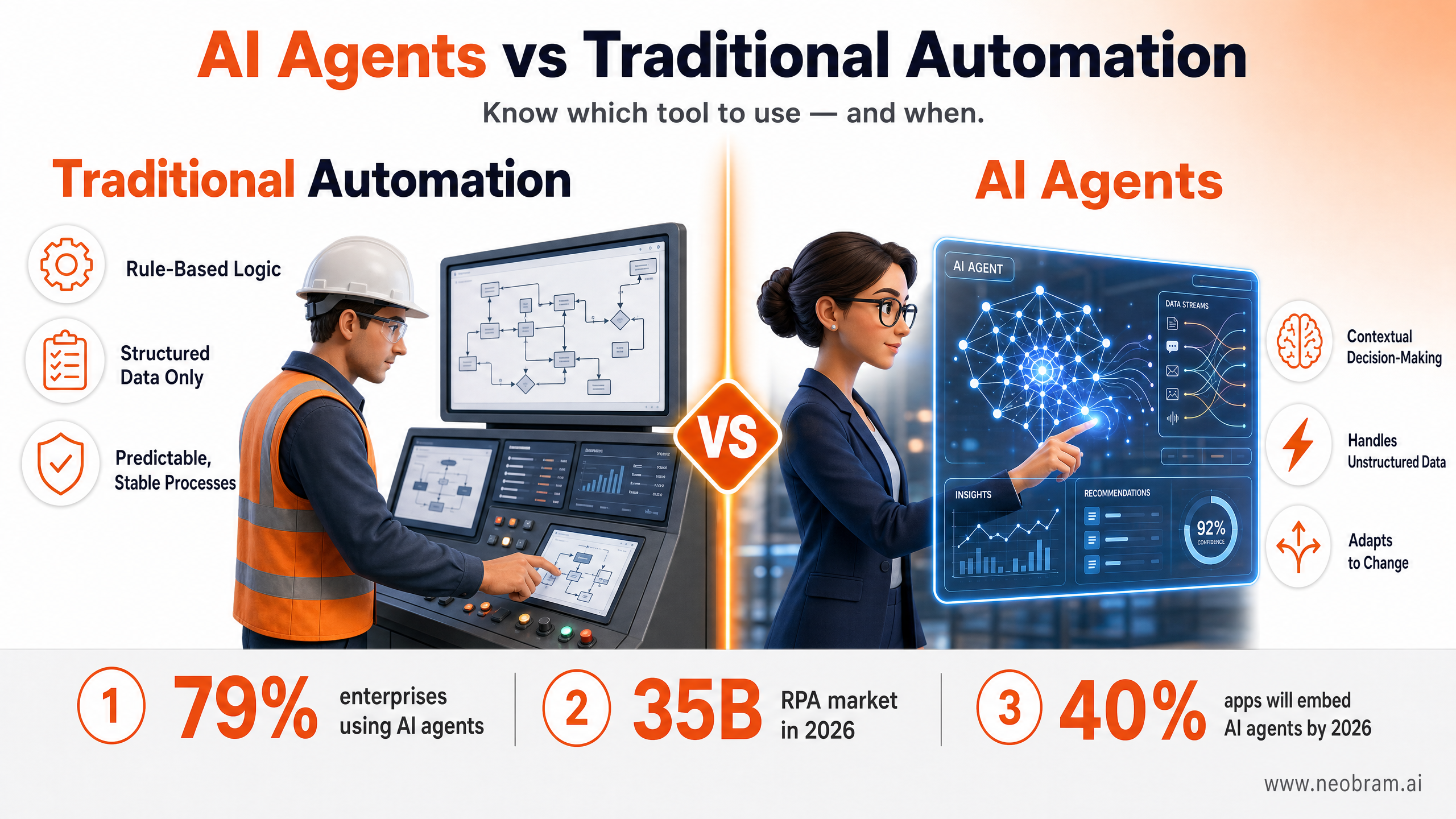
Key takeaways
- The global RPA market reached USD 35.27 billion in 2026, proving traditional automation still delivers real value for structured, high-volume processes.
- 79% of enterprises are already using AI agents, with 66% reporting measurable productivity gains, according to PwC's 2026 AI Agent Survey.
- Gartner predicts 40% of enterprise applications will feature task-specific AI agents by end of 2026, up from less than 5% in 2025.
- A hybrid approach works best: RPA for stable structured workflows, AI agents for variable and judgment-required tasks, agentic AI for complex multi-step processes.
AI Agents vs Traditional Automation: When to Use Each
Automation has been a boardroom priority for over a decade. Most enterprises have invested heavily in robotic process automation (RPA), workflow tools, and rule-based scripts. Those investments delivered real value. But now a new category has arrived: AI agents. And the question every operations and IT leader is asking is whether to replace what they have, layer on top of it, or start fresh.
The honest answer is: it depends on what you're trying to automate.
This guide breaks down the real differences between AI agents and traditional automation, shows you where each one wins, and gives you a practical decision framework for choosing the right approach for each use case in your organisation.
What Is Traditional Automation?
Traditional automation covers any system that executes tasks based on predefined rules. The most common form in enterprise settings is RPA, which uses software bots to mimic human actions in digital interfaces: clicking buttons, copying data between systems, filling forms, and triggering workflows.
The core logic is if-then: if invoice arrives, extract the data; if data matches the template, post to the ERP; if not, flag for human review. Every possible scenario must be mapped in advance. Every exception must be coded.
This approach works well when:
- The process is stable and rarely changes
- Data arrives in a consistent, structured format
- Volume is high and the task is repetitive
- Speed and accuracy matter more than judgment
Common examples include payroll processing, invoice matching, compliance report generation, scheduled data transfers, and IT ticket routing based on keywords.
The global RPA market reached USD 35.27 billion in 2026, up from USD 28.31 billion in 2025, and is projected to hit USD 247.34 billion by 2035. That growth reflects the genuine value traditional automation delivers for structured, high-volume work.
The global RPA market reached USD 35.27 billion in 2026, growing at roughly 25% year-on-year. Despite the rise of AI agents, traditional automation remains a core enterprise infrastructure layer for structured, rules-based processes.
The Limitations of Rule-Based Systems
Traditional automation's biggest weakness is brittleness. Change the format of an incoming document and the bot breaks. Update a vendor portal's UI and the workflow fails. Introduce a new exception type and someone has to recode the logic.
Maintenance costs for RPA deployments are often underestimated. Studies consistently show that 30 to 50 percent of RPA projects require significant rework within 18 months due to process changes. The more complex the process, the higher the maintenance burden.
The other limitation is scope. Traditional automation can execute tasks. It can't reason about them. It can't handle ambiguity. It can't read an unstructured email and decide what to do with it. It can't look at a customer complaint and determine whether to escalate, refund, or respond.
What Are AI Agents?
AI agents are software systems that use large language models (LLMs), machine learning, and natural language processing to understand context, make decisions, and take actions toward a defined goal. Unlike traditional automation, they don't need every scenario pre-coded. They reason through situations they haven't seen before.
A single AI agent might:
- Read an unstructured customer email, understand the intent, check the account history in your CRM, determine the appropriate resolution, draft a personalised response, and log the interaction
- Analyse a supplier invoice with an unusual format, extract the relevant fields, cross-reference against the purchase order, flag discrepancies with a plain-English explanation, and route to the right approver
- Monitor a production line's sensor data, identify an anomaly pattern, cross-reference with maintenance history, and raise a work order with a recommended action
The key difference is adaptability. AI agents can handle inputs that vary in format, language, and structure. They can make judgment calls within defined boundaries. They can improve over time through feedback.
According to PwC's 2026 AI Agent Survey, 79% of companies report that AI agents are already being adopted within their organisations, and 66% have seen measurable productivity gains as a result. Adoption has moved well beyond experimentation for most large enterprises.
Agentic AI: When One Agent Isn't Enough
Agentic AI takes things further. Rather than a single agent handling one task, agentic systems coordinate multiple specialised agents to complete end-to-end workflows. One agent might gather data, another analyse it, a third draft a response, and an orchestrator manages the whole sequence.
Think of it this way: an AI agent is a skilled specialist. Agentic AI is the project manager coordinating a team of specialists, setting priorities, routing work, and adapting the plan when something unexpected happens.
Gartner predicts that 40 percent of enterprise applications will feature task-specific AI agents by the end of 2026, up from less than 5 percent in 2025. That's a dramatic shift in how enterprise software is being built and deployed.
The Core Differences: A Direct Comparison
Understanding where each approach excels requires looking at several dimensions.
| Dimension | Traditional Automation (RPA) | AI Agents | Agentic AI |
|---|---|---|---|
| Input type | Structured, consistent | Structured and unstructured | Any format, any source |
| Flexibility | None (rigid rules) | Moderate (adapts within task) | High (adapts entire workflow) |
| Decision-making | None (pre-coded logic) | Goal-directed within scope | Autonomous, multi-step planning |
| Handles exceptions | No (breaks or flags) | Yes, within defined limits | Yes, and reroutes dynamically |
| Learning over time | No | Limited (feedback loops) | Continuous improvement |
| Setup complexity | Medium (process mapping) | Medium-high (LLM config, tools) | High (orchestration layer) |
| Ongoing cost | Low (stable processes) | Medium (API calls per task) | High (multiple agents, API volume) |
| Best for | High-volume, stable, structured | Variable, judgment-required tasks | Complex, multi-step end-to-end workflows |
When to Use Traditional Automation
Traditional automation is still the right choice for a large class of enterprise tasks. Don't replace it just because AI agents exist.
High-Volume, Structured Data Processing
If you're processing 50,000 invoices a month that all arrive in the same PDF format, RPA is faster, cheaper, and more reliable than an AI agent. The task is predictable. The format is consistent. There's no judgment required.
Compliance and Audit Trails
Rule-based systems produce deterministic, auditable outputs. Every action is logged against a specific rule. For regulated industries like financial services, pharma, or healthcare, this traceability is often a compliance requirement. AI agents introduce probabilistic decision-making, which can complicate audit trails.
System Integration and Data Transfer
Moving data between systems on a schedule, syncing records between a CRM and ERP, or triggering downstream actions based on database events: these are classic RPA use cases. They're stable, well-defined, and don't require intelligence.
When Budget Is Constrained
Traditional automation has lower ongoing operational costs for stable processes. If you're running the same workflow thousands of times a day and it never changes, the per-execution cost of an AI agent (which involves LLM API calls) will be significantly higher than a rule-based bot.
When to Use AI Agents
AI agents earn their place when the process involves variability, judgment, or unstructured data.
Customer Service and Support
Customer enquiries arrive in every format imaginable: emails, chat messages, support tickets, social media posts. They use different language, reference different products, and require different responses. A rule-based system can only handle the scenarios it was programmed for. An AI agent can read the intent, check account history, determine the right action, and respond appropriately, even for edge cases it hasn't seen before.
Document Processing with Variable Formats
Contracts, supplier invoices, regulatory submissions, and clinical notes all arrive in inconsistent formats. Traditional OCR and RPA struggle with variability. AI agents can extract the right information regardless of layout, language, or structure, and flag anything that needs human review with a plain-English explanation.
Research, Summarisation, and Knowledge Work
Tasks that involve reading, synthesising, and acting on information are natural fits for AI agents. Competitive intelligence gathering, regulatory change monitoring, internal knowledge base queries, and report drafting all benefit from an agent's ability to reason across large amounts of text.
Sales and Marketing Operations
Lead qualification, personalised outreach sequencing, CRM data enrichment, and campaign performance analysis all involve variable inputs and judgment calls. AI agents can handle these workflows at scale without the brittleness of rule-based systems.
A 2026 McKinsey analysis found that organisations deploying AI agents in knowledge-work processes achieved 30 to 45% reductions in task completion time and 20 to 30% lower error rates compared to manual or rule-based approaches. The gains were largest in document-intensive and customer-facing workflows.
When to Use Agentic AI
Agentic AI is for complex, multi-step workflows that span multiple systems, require coordination between different types of tasks, and need to adapt dynamically as the process unfolds.
End-to-End Procurement Workflows
A procurement agentic system might monitor supplier performance data, identify a risk signal, cross-reference with contract terms, draft a supplier communication, schedule a review meeting, and update the risk register, all without human intervention until a decision point is reached.
Autonomous Financial Reporting
Monthly close processes involve data gathering from multiple systems, reconciliation, variance analysis, commentary drafting, and distribution. An agentic system can coordinate all of these steps, flag anomalies for human review, and compress a multi-day process into hours.
Complex IT Operations
Incident detection, root cause analysis, remediation steps, stakeholder communication, and post-incident review can all be coordinated by an agentic AI system. Each step requires different capabilities, and the system needs to adapt based on what it finds at each stage.
The Hybrid Approach: Most Enterprises Will Use Both
The real-world answer for most enterprises isn't "AI agents instead of RPA." It's "AI agents and RPA, each doing what they do best."
A well-designed automation architecture might look like this:
- RPA layer: handles high-volume, structured data ingestion, system integrations, and scheduled transfers
- AI agent layer: handles exceptions, unstructured inputs, customer-facing interactions, and judgment-required decisions
- Agentic orchestration layer: coordinates complex end-to-end workflows that span both layers
This hybrid approach maximises the value of existing RPA investments while extending capability into areas where rule-based systems can't reach.
The key is to audit your current automation portfolio and categorise each process by its variability, exception rate, and data structure. Processes with high variability and frequent exceptions are candidates for AI agents. Processes that are stable and structured should stay on RPA.
Common Mistakes to Avoid
Replacing RPA with AI agents everywhere. AI agents cost more to run per task. For stable, high-volume processes, replacing RPA with AI agents will increase your operational costs without improving outcomes.
Using traditional automation for judgment-required tasks. If a process has a high exception rate and your team spends significant time handling those exceptions manually, that's a signal the task needs AI, not more rules.
Underestimating orchestration complexity. Multi-agent systems are powerful but complex to build, test, and maintain. Start with single-agent deployments before moving to full agentic orchestration.
Ignoring data quality. AI agents are only as good as the data they work with. Incomplete, inconsistent, or siloed data is the most common reason AI agent deployments underperform. Data hygiene is a prerequisite, not an afterthought.
Skipping the governance layer. AI agents make decisions. Those decisions need guardrails, audit trails, and human review checkpoints, especially for regulated industries. Build governance in from the start.
A Practical Decision Framework
Use this framework when evaluating any automation candidate:
Step 1: Assess data structure. Is the input data consistently structured? If yes, traditional automation is viable. If the data is unstructured or variable, you need AI.
Step 2: Assess exception rate. What percentage of cases require human judgment or fall outside the standard process? If it's above 10 to 15 percent, rule-based automation will create more work than it saves.
Step 3: Assess process stability. How often does the process change? Frequently changing processes are expensive to maintain in RPA. AI agents are more resilient to change.
Step 4: Assess workflow complexity. Does the task involve multiple steps across multiple systems, with decisions that depend on earlier outputs? If yes, consider agentic AI.
Step 5: Assess cost tolerance. What's the volume and what's the budget? High-volume, stable processes should stay on RPA. Lower-volume, higher-value processes justify the cost of AI agents.
How NeoBram Can Help
Choosing between traditional automation and AI agents isn't just a technology decision. It's a strategic one. The wrong choice leads to wasted investment, brittle systems, or missed opportunities.
NeoBram works with enterprise teams to audit existing automation portfolios, identify where AI agents will deliver the highest ROI, and design hybrid architectures that protect existing investments while extending capability.
Our approach starts with a structured automation assessment: mapping every automated and semi-automated process against the decision framework above, quantifying the cost of current exceptions and failures, and building a prioritised roadmap for AI agent deployment.
We've helped manufacturers reduce exception-handling time by over 60 percent by replacing brittle RPA workflows with AI agents in document processing and supplier communication. We've helped financial services firms deploy agentic systems that compress multi-day reporting cycles into hours.
The right automation strategy isn't about choosing one technology over another. It's about matching the right tool to the right task, at every layer of your operations.
Ready to audit your automation portfolio and find the highest-value opportunities for AI agents? Book a free strategy call with the NeoBram team.