Key takeaways
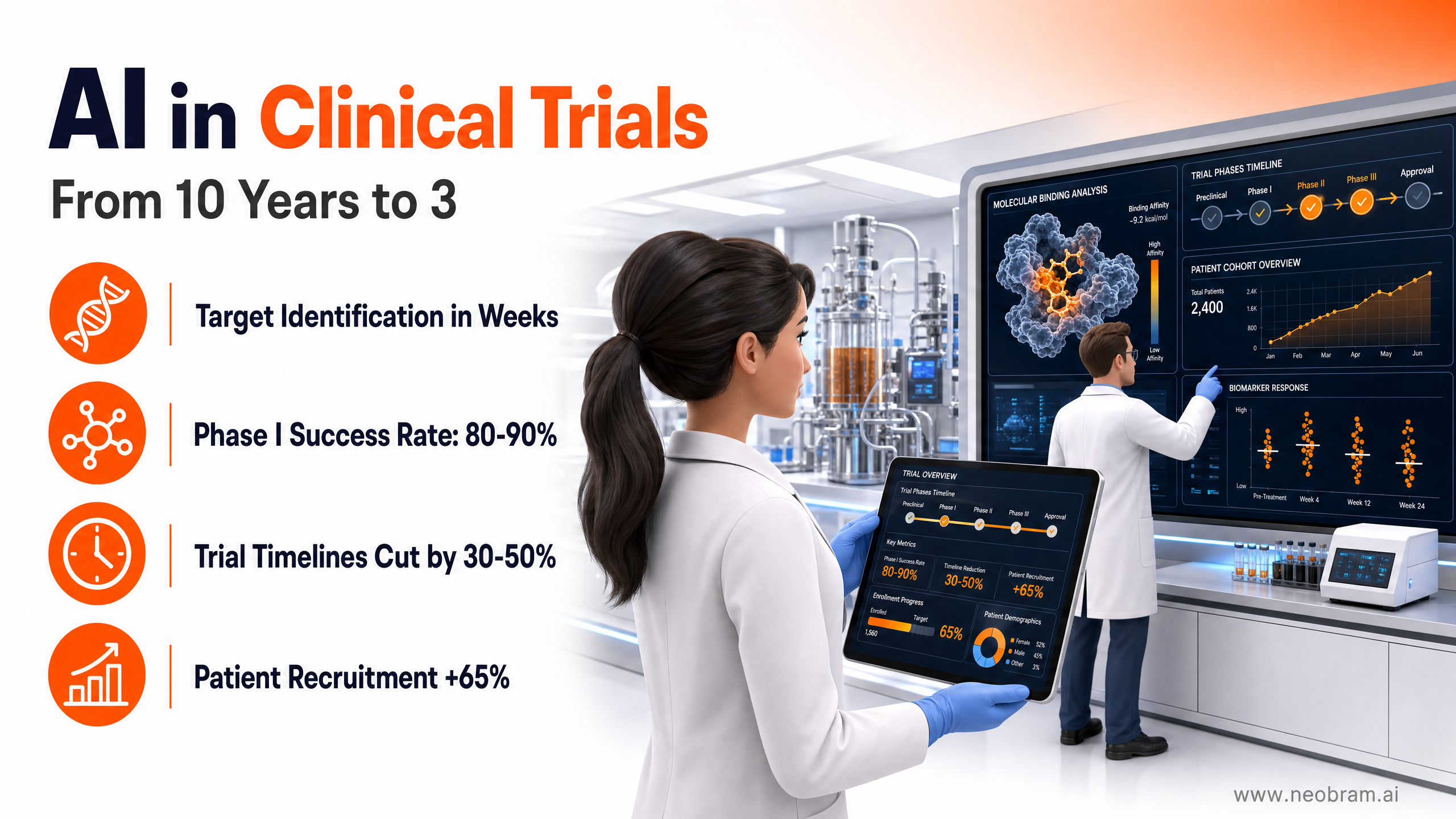
- Phase I clinical trials for AI-discovered drugs show success rates of 80-90%, versus the historical industry average of 40-65%.
- AI-powered patient recruitment tools have improved clinical trial enrollment rates by up to 65%, addressing one of the most common causes of trial failure.
- Insilico Medicine designed a clinical candidate for idiopathic pulmonary fibrosis in under 18 months using AI, versus the typical 4-5 years by conventional methods.
- AI can reduce clinical trial timelines by 30-50% through optimised design, adaptive monitoring, and smarter site selection.
Why Drug Discovery Takes So Long (And Why That's Finally Changing)
The traditional drug development pipeline is one of the most expensive, time-consuming processes in any industry. From the first hypothesis about a disease target to a drug reaching patients, the average timeline stretches 10 to 14 years. The average cost per approved drug, accounting for failures along the way, runs between $1 billion and $2.6 billion. And the failure rate? Roughly 90% of compounds that enter clinical trials never reach approval.
Those numbers represent more than wasted money. They represent patients who waited years for treatments that never arrived. They represent rare diseases that never attracted investment because the economics didn't work. They represent a system that, despite brilliant scientists and enormous resources, has been running at a fraction of its potential.
AI is changing that calculus. Not by replacing scientists, but by doing the parts of drug discovery that machines are better at: processing enormous datasets, identifying patterns across millions of compounds, predicting molecular behaviour, and flagging which trial designs are most likely to succeed. The results are starting to show up in real clinical pipelines.
The AI drug discovery market is projected to grow from $4.6 billion in 2025 to $49.5 billion by 2034, a compound annual growth rate of 30%. Phase I clinical trials for AI-discovered drugs are showing success rates of 80-90%, compared to the historical industry average of 40-65%.
The Five Stages Where AI Is Making the Biggest Difference
AI doesn't just speed up one part of drug development. It's compressing timelines at every stage of the pipeline, from identifying disease targets to running smarter clinical trials.
Stage 1: Target Identification and Validation
Before any drug can be designed, researchers need to identify the right biological target: a protein, gene, or pathway that plays a meaningful role in a disease. This used to mean years of literature review, hypothesis testing, and lab experiments.
AI systems can now analyse multi-omics data (genomics, proteomics, metabolomics) alongside clinical health records and published research to surface target candidates in weeks rather than years. Natural language processing tools mine millions of scientific papers, patents, and clinical reports to identify connections that human researchers would likely miss. Bayesian inference models build causal networks that distinguish genuine disease drivers from incidental associations.
The impact is significant. AI-guided target identification is reducing the time to a validated preclinical candidate by 30-40% compared to traditional approaches, according to recent analysis from Drug Target Review.
Stage 2: Protein Structure Prediction
One of the most fundamental challenges in drug design is understanding the 3D structure of a protein. Without knowing how a protein folds, it's extremely difficult to design a molecule that binds to it precisely. Traditionally, protein structure determination required X-ray crystallography or cryo-electron microscopy, processes that could take months to years per protein.
AlphaFold changed this. DeepMind's protein structure prediction model, now in its third generation, can predict the structure of virtually any protein with near-experimental accuracy in minutes. AlphaFold 3 extended this capability to protein-DNA, protein-RNA, and protein-small molecule complexes, making it directly useful for drug design rather than just structural biology.
The practical result: researchers can now screen thousands of potential binding sites on a target protein computationally, before running a single lab experiment. This alone can compress the lead identification phase from years to months.
Stage 3: Molecular Design and Virtual Screening
Once a target is validated, the next challenge is finding or designing a molecule that interacts with it in the right way. Traditional high-throughput screening tests hundreds of thousands of compounds against a target, a process that's expensive, slow, and generates enormous amounts of data to interpret.
Generative AI is transforming this stage. Models trained on vast chemical libraries can propose entirely novel molecular structures optimised for a specific target, with predicted properties for binding affinity, selectivity, toxicity, and bioavailability built in. Instead of screening what already exists, researchers can generate candidates designed from scratch to meet precise criteria.
AI-guided molecular screening achieves hit rates of 22-46%, compared to approximately 2% for random screening. Multi-round AI optimisation can yield 10-fold improvements in compound potency within weeks rather than years.
Insilico Medicine demonstrated this concretely. Their AI platform identified a novel drug target for idiopathic pulmonary fibrosis (IPF) and designed a clinical candidate in under 18 months, a process that typically takes four to five years by conventional methods. That compound, INS018_055, completed Phase I trials with positive topline results and is now in Phase II.
Exscientia (now merged with Recursion Pharmaceuticals) cut the average timeline from candidate identification to clinical candidate from 4.5 years to 12-15 months across multiple programmes. Their AI-designed drug for obsessive-compulsive disorder reached Phase I trials in just 12 months from project start.
Stage 4: Preclinical Testing and ADMET Prediction
Before a compound can enter human trials, it must pass extensive preclinical testing for absorption, distribution, metabolism, excretion, and toxicity (ADMET). This phase is responsible for a significant proportion of late-stage failures: compounds that looked promising in the lab turn out to have unacceptable toxicity or poor pharmacokinetics in humans.
AI models trained on historical ADMET data can now predict these properties with increasing accuracy before any animal testing takes place. This doesn't eliminate preclinical testing, but it allows researchers to filter out likely failures much earlier, focusing resources on candidates with the best predicted profiles.
The downstream effect is fewer compounds entering expensive Phase II and III trials only to fail on safety or pharmacokinetic grounds. Given that a failed late-stage trial can cost between $800 million and $1.4 billion in sunk development costs, earlier failure prediction has enormous economic value.
Stage 5: Clinical Trial Design, Recruitment, and Execution
Clinical trials are where most of the time and money in drug development is spent. Phase I through Phase III trials typically take six to eight years and consume the majority of a drug's development budget. They're also where most drugs fail: only about 12% of compounds entering clinical trials gain FDA approval.
AI is attacking this problem from multiple angles simultaneously.
Trial design optimisation: AI models trained on historical trial data can identify design flaws before a trial launches. They can suggest optimal dosing regimens, predict which patient subgroups are most likely to respond, and flag potential safety signals based on the compound's mechanism of action. McKinsey analysis suggests AI can reduce clinical trial timelines by up to 30% through better design alone.
Patient recruitment: Recruitment failure is one of the leading causes of trial delays and terminations. Studies show that 80-85% of clinical trials fail to meet initial enrollment projections, and nearly 30% of trial sites enrol zero patients. AI-powered recruitment tools that analyse electronic health records, genomic databases, and real-world data to identify eligible patients have improved enrollment rates by up to 65% in published studies.
Site selection: Choosing the wrong trial sites is costly and slow to fix mid-trial. Machine learning models that incorporate historical site performance data, local patient population characteristics, and real-world recruitment patterns can predict which sites are most likely to meet enrollment targets, significantly reducing the risk of under-performing sites.
Adaptive trial designs: AI enables real-time analysis of incoming trial data, allowing researchers to modify dosing, patient selection criteria, or trial endpoints while a trial is running, within pre-specified parameters. This adaptive approach can reduce the number of patients needed to reach statistical significance and allows early termination when a treatment is clearly effective or clearly ineffective.
AI can accelerate clinical trial timelines by 30-50% through optimised design, improved patient recruitment, and adaptive monitoring. Patient recruitment tools powered by AI have improved enrollment rates by 65% in peer-reviewed studies, directly addressing one of the most common causes of trial failure and delay.
Real-World Results: What the Data Shows
The proof is moving from research papers into clinical pipelines. As of 2025, multiple AI-designed drugs are in Phase II and Phase III trials, with the first approvals expected in the next few years.
The numbers are striking. Phase I success rates for AI-discovered drugs are running at 80-90%, compared to the historical industry average of 40-65%. This suggests that AI is not just accelerating drug discovery but improving the quality of candidates entering clinical development.
Between 2010 and 2022, 20 AI-focused biotech startups collectively discovered 158 drug candidates, 15 of which advanced to clinical trials. That pipeline has grown substantially since then. Insilico Medicine now serves 13 of the top 20 global pharmaceutical companies, with software revenue growing approximately 24% year-over-year in 2025.
The major pharmaceutical companies are not standing on the sidelines. Pfizer, Novartis, AstraZeneca, Roche, and Sanofi all have active AI partnerships and internal AI programmes. Pfizer used AI to compress COVID-19 antiviral development timelines. AstraZeneca has partnered with multiple AI platforms for oncology target identification.
The Regulatory Dimension
Faster drug discovery creates a new challenge: regulatory frameworks designed for traditional development timelines. The FDA and EMA are both actively developing guidance for AI-assisted drug development, but the landscape is still evolving.
The FDA's Centre for Drug Evaluation and Research (CDER) has issued draft guidance on AI in drug development and is actively engaging with sponsors who use AI in their development programmes. The key questions regulators are asking are around explainability (can the AI's decisions be understood and audited?), validation (has the model been tested on independent data?), and bias (does the model perform equally well across different patient populations?).
Pharmaceutical companies using AI in regulated contexts need to think carefully about documentation, model governance, and change management. An AI model that improves over time as it sees more data is a powerful tool, but it also creates regulatory complexity if the model used to design a trial is different from the model used to analyse it.
This is an area where experienced AI implementation partners add significant value. Getting the technical implementation right is necessary but not sufficient; the regulatory strategy needs to be built in from the start.
Challenges That Remain
AI is genuinely transforming drug discovery, but it's worth being clear-eyed about what it can and can't do.
Data quality and availability: AI models are only as good as the data they're trained on. Pharmaceutical data is often siloed, inconsistently formatted, and subject to publication bias (failed experiments are less likely to be published, which means models trained on published data may have a skewed view of what works). Building high-quality training datasets is a significant investment.
Biological complexity: Predicting how a molecule will behave in a test tube is much easier than predicting how it will behave in a living human being. The human body is an extraordinarily complex system, and AI models trained on in vitro or animal data don't always generalise well to human clinical outcomes. This is why Phase II and Phase III failure rates remain high even as Phase I success rates improve.
Integration with existing workflows: Most pharmaceutical companies have decades of legacy systems, processes, and organisational structures. Integrating AI tools into these environments requires significant change management, not just technical implementation.
Talent: The intersection of deep biological expertise and AI/ML capability is genuinely rare. Building or accessing this talent is a constraint for many organisations.
None of these challenges are insurmountable, but they do mean that successful AI implementation in pharma requires more than buying a software licence. It requires a thoughtful strategy, the right technical infrastructure, and experienced partners who understand both the science and the operational realities.
What This Means for Pharma Companies Right Now
The competitive dynamics are shifting. Companies that build effective AI capabilities in drug discovery and clinical development will be able to run more programmes with the same resources, fail faster and cheaper on bad candidates, and bring successful drugs to market years ahead of competitors who haven't made the investment.
The window for building competitive advantage is open now, but it won't stay open indefinitely. As AI tools become commoditised and the talent pool expands, the advantage will shift from having AI to using it better than everyone else.
For pharma companies assessing where to start, the highest-value applications are typically:
Target identification and validation: This is where AI has the most mature tooling and the clearest ROI. Reducing the time to a validated preclinical candidate by 30-40% has compounding benefits through the rest of the pipeline.
Clinical trial design and patient recruitment: These are areas with enormous inefficiency and well-defined AI solutions. The 65% improvement in enrollment rates cited in published studies translates directly to faster, cheaper trials.
ADMET prediction: Filtering out likely failures before they enter expensive clinical development is one of the clearest cost-reduction opportunities in the pipeline.
Pharmacovigilance and post-market surveillance: AI tools that monitor real-world safety signals can identify issues faster than traditional adverse event reporting systems, reducing regulatory risk and protecting patients.
How NeoBram Can Help
NeoBram works with pharmaceutical and life sciences companies to design and implement AI strategies that deliver measurable results across the drug development pipeline.
Our approach starts with an honest assessment of where you are: what data you have, what processes are most amenable to AI augmentation, and where the highest-value opportunities lie given your specific pipeline and competitive position. We don't sell generic AI platforms; we build solutions tailored to your regulatory environment, your data infrastructure, and your scientific priorities.
In clinical development specifically, we have experience implementing AI-powered patient recruitment tools, adaptive trial monitoring systems, and regulatory-ready model governance frameworks. We understand the FDA and EMA guidance landscape and can help you build AI systems that will withstand regulatory scrutiny.
[Book a free strategy call with the NeoBram team](https://neobram.ai/contact)