Key takeaways
- AI-powered quality monitoring can reduce manufacturing error rates from ~1.15% to as low as 0.00001%, a reduction of more than 99.9%.
- Digitising and streamlining batch release processes can reduce overall review cycle time by more than 90%, according to SAP internal research.
- The global AI in pharmaceutical market is projected to grow from $1.94 billion in 2025 to $18.99 billion by 2035 at a CAGR of 27%.
- FDA's January 2025 draft guidance requires AI models in manufacturing to be validated, monitored for drift, and managed under change control.
AI in Pharma Manufacturing: Quality Control, Compliance and Batch Release
The pharmaceutical industry has always operated under one of the strictest quality regimes in the world. A single contaminated batch, a missed deviation, a mislabelled vial: the consequences reach far beyond financial loss. They reach patients.
For decades, quality control in pharma manufacturing has relied on manual inspection, paper-based batch records, and siloed laboratory systems. Skilled QA professionals spend hours reviewing data that could be checked in seconds. Batch release cycles that should take days stretch into weeks. And despite all that effort, recalls still happen.
AI is changing this. Not by replacing human judgment, but by giving QA teams better information, faster, with fewer errors. In 2026, the question is no longer whether AI belongs in pharma manufacturing. It's how quickly your organisation can implement it responsibly.
The global AI in pharmaceutical market was valued at $1.94 billion in 2025 and is projected to reach $18.99 billion by 2035, growing at a CAGR of 27%. Pharma manufacturing quality and compliance applications represent one of the fastest-growing segments within this market.
This guide covers the key AI applications transforming pharma manufacturing quality control, what the regulatory landscape looks like in 2026, how batch release is being accelerated, and what it takes to implement AI in a GMP-compliant environment.
Why Traditional Quality Control Is Breaking Down
Pharmaceutical manufacturing generates enormous volumes of data. A single batch record for a complex biologic can run to hundreds of pages. QA reviewers must check every value, every signature, every deviation note before a batch can be released. In many facilities, this process still involves printing documents, physically routing them between departments, and manually cross-referencing results from LIMS, MES, and ERP systems that don't talk to each other.
The numbers tell the story. Research from SAP found that 48% of life sciences companies still use manual processes for batch release, and 35% check data across multiple siloed systems during the review cycle. The same research found that streamlining and digitising batch release processes can reduce overall batch review cycle time by more than 90%.
That's not a marginal improvement. That's a structural transformation.
The problems with the current approach are well understood:
Data fragmentation. Quality data sits in LIMS, MES, ERP, and RIMS systems that were often built independently and are difficult to integrate. Qualified Persons have to manually pull information from multiple sources to make a release decision.
Human error in high-volume reviews. When a QA reviewer is checking the 400th batch record of the month, attention drifts. AI doesn't get tired. It applies the same rules consistently, every time.
Slow deviation management. Identifying the root cause of a deviation, investigating it, and closing the CAPA can take weeks. AI can flag anomalies in real time, before they become deviations, and suggest probable causes based on historical patterns.
Regulatory pressure. The FDA and EMA are both pushing for more data integrity, more traceability, and more real-time visibility into manufacturing processes. Paper-based systems make this increasingly difficult to demonstrate during inspections.
Key AI Applications in Pharma Manufacturing Quality Control
Real-Time Process Monitoring and Anomaly Detection
Traditional quality control is largely retrospective: you check the batch after it's made. AI enables a shift to real-time monitoring, where deviations are caught during production rather than discovered in the QA lab.
IoT sensors on manufacturing equipment feed continuous data streams into AI models that have been trained on historical process data. When a parameter drifts outside its normal range, the system flags it immediately. This is particularly valuable in continuous manufacturing, where the volume of data generated is too large for any human team to monitor manually.
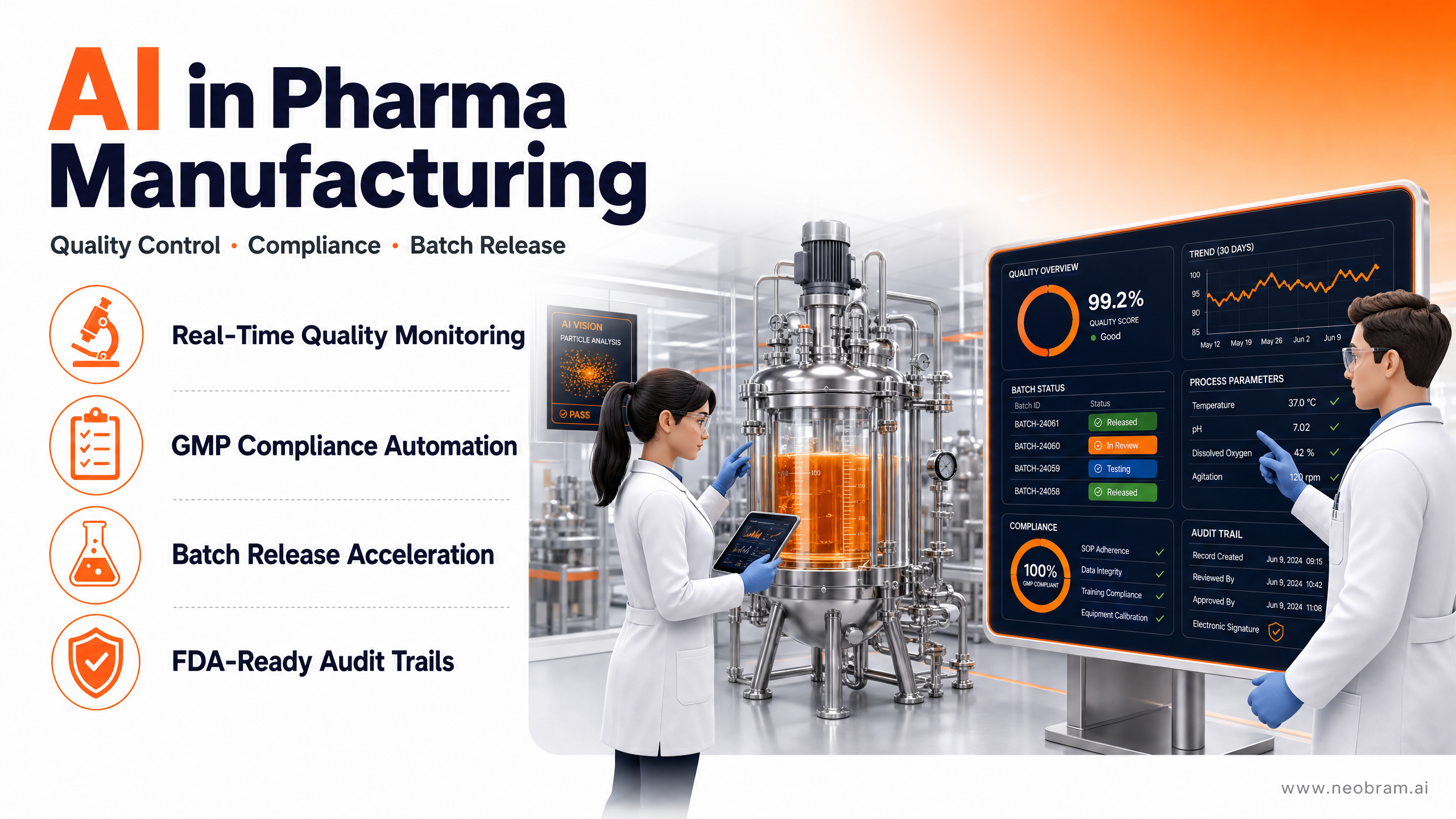
The impact on error rates is significant. Studies show that intelligent quality systems can reduce manufacturing error rates from approximately 1.15% in typical manual processes to as low as 0.00001%. For a facility producing millions of units, that difference translates directly into fewer rejected batches, fewer recalls, and lower cost of quality.
AI-powered quality monitoring systems can reduce manufacturing error rates from ~1.15% (typical manual processes) to as low as 0.00001%, according to research published in peer-reviewed manufacturing journals. This represents a reduction in defect rates of more than 99.9%.
Computer Vision for Visual Inspection
Visual inspection of tablets, capsules, vials, and packaging has traditionally been performed by trained human inspectors. It's slow, expensive, and subject to fatigue-related errors. Computer vision systems using deep learning can inspect products at line speed, detecting defects that human eyes would miss.
AI models are trained on thousands of images of acceptable and defective products. They learn to identify cracks, chips, discolouration, particulate contamination, incorrect fill levels, and packaging errors with high accuracy. Körber Pharma, a leading equipment manufacturer, reports that AI-powered inspection systems significantly increase detection rates while minimising false rejection rates, which is a persistent problem with older automated inspection systems.
The technology is now mature enough for GMP-regulated environments. Validation approaches for computer vision systems have been developed in line with FDA's Computer Software Assurance (CSA) guidance, which was updated in early 2026 to provide clearer direction on qualifying AI-based quality systems.
Predictive Maintenance for Manufacturing Equipment
Equipment failure during a production run is one of the most disruptive events in pharma manufacturing. An unexpected breakdown can invalidate a batch, trigger an investigation, and delay product release by weeks.
AI-driven predictive maintenance analyses sensor data from manufacturing equipment to identify patterns that precede failures. Vibration signatures, temperature trends, pressure fluctuations: these signals, invisible to human operators, are detectable by machine learning models trained on historical failure data.
Pfizer used AI in its EBR systems during COVID-19 vaccine production to predict equipment maintenance needs, helping the company release batches faster while maintaining quality across multiple geographies. Merck (Germany) has used AI-driven maintenance predictions to avoid costly breakdowns and ensure seamless production processes.
The business case is straightforward. Planned maintenance is far cheaper than unplanned downtime. And in pharma, where a single batch of a biologic can be worth millions of dollars, preventing one equipment failure can pay for an entire AI implementation.
AI-Powered Batch Record Review
Electronic batch records (EBRs) have replaced paper in many facilities, but the review process has often remained manual. A QA reviewer still has to go through every field, check every value against specification, and sign off on every step.
AI changes this through review-by-exception. Instead of checking every data point, the reviewer focuses only on the exceptions that the AI has flagged: values outside specification, missing signatures, unusual process parameters. Everything that meets expectations is pre-verified automatically.
Mareana's AI-powered manufacturing intelligence platform, for example, scans and digitises handwritten batch records, assigns confidence scores to recognised data, and flags only uncertain entries for human review. This approach significantly reduces review time while improving accuracy, because the AI applies consistent rules that don't vary with reviewer fatigue or experience level.
Alvarez and Marsal documented a case where a pharma business transformed its batch release process using AI-powered document mining, reducing time-to-market for critical products from weeks to days.
Deviation Management and CAPA Automation
CAPA (Corrective and Preventive Action) management is one of the most time-consuming quality processes in pharma manufacturing. When a deviation occurs, the investigation must identify root cause, assess impact, implement corrective action, and verify effectiveness. This process can take weeks or months.
AI accelerates deviation management in two ways. First, it can identify deviations earlier, before they escalate, by detecting subtle process anomalies in real time. Second, it can assist with root cause analysis by searching historical data for similar events and suggesting probable causes based on pattern matching.
Sanofi uses generative AI to process production data instantaneously, flagging potential deviations before they escalate and streamlining decision-making. AstraZeneca has implemented AI-driven workflow management that enables production lines to adapt to changing requirements, reducing the frequency of deviations caused by process rigidity.
Accelerating Batch Release with AI
Batch release is the final quality gate before a product can be shipped to market. It's also one of the biggest bottlenecks in pharmaceutical supply chains. In many organisations, the average batch release cycle takes 10 to 30 days. For time-sensitive products, this delay has real consequences.
AI addresses the batch release bottleneck in several ways.
Automated data aggregation. Instead of a QA reviewer manually pulling data from LIMS, MES, and ERP systems, an AI-powered batch release platform aggregates all relevant data automatically, creating a complete digital dossier for each batch.
Intelligent exception flagging. Rather than reviewing every data point, the system flags only the values that require human attention. Everything within specification is pre-verified. The Qualified Person focuses on exceptions, not routine checks.
Regulatory document automation. Generative AI can parse jurisdictional regulations and compliance requirements, helping QPs quickly identify what documentation is needed for each market and flagging any gaps.
Predictive release decisions. Advanced systems are beginning to use predictive models to estimate the probability that a batch will pass release testing based on in-process data, enabling earlier intervention when a batch is at risk.
The results are measurable. SAP's internal research found that digitising and streamlining batch release can reduce cycle time by more than 90%. An SAP value analysis study found that a 5% reduction in quality costs for a company with operating expenses of $80 to $100 million can result in an average of $5 million in sustainable cost savings. Shorter fulfilment lead times can cut inventory carrying costs by up to 25%.
Digitising and streamlining batch release processes can reduce overall batch review cycle time by more than 90%, according to SAP internal research. For a company with $80-100 million in operating expenses, a 5% reduction in quality costs translates to approximately $5 million in sustainable annual savings.
The Regulatory Landscape in 2026
Implementing AI in a GMP-regulated environment requires careful attention to the regulatory framework. The good news is that both the FDA and EMA have been actively developing guidance to support AI adoption in pharmaceutical manufacturing.
FDA's Position on AI in Drug Manufacturing
In January 2025, the FDA published draft guidance on the use of AI to support regulatory decision-making for drug and biological products. The guidance emphasises that AI models used in manufacturing must be validated, monitored for performance drift, and incorporated under change control procedures.
The FDA's Framework for Regulatory Advanced Manufacturing Evaluation (FRAME) initiative is specifically designed to support the adoption of advanced manufacturing technologies, including AI-based process control and quality systems. The framework acknowledges that AI models may need to be updated as manufacturing processes evolve, and provides a pathway for managing these changes without triggering full revalidation.
Key regulatory requirements for AI in GMP environments include:
Validation. AI models must be validated for their intended use. This includes demonstrating that the model performs as intended across the range of inputs it will encounter in production.
Data integrity. All data used to train, validate, and operate AI models must meet ALCOA+ principles: Attributable, Legible, Contemporaneous, Original, Accurate, and complete, consistent, enduring, available.
Change control. Any significant change to an AI model, including retraining on new data, must go through change control. The impact on validated state must be assessed.
Auditability. AI-assisted decisions must be traceable. Regulators must be able to understand how a decision was made, what data was used, and what the model's confidence level was.
Human oversight. For critical quality decisions, AI provides decision support, not autonomous decision-making. A qualified human must remain accountable for release decisions.
EU GMP Annex 11 and AI
In Europe, Annex 11 of the EU GMP guidelines governs computerised systems in pharmaceutical manufacturing. An updated revision is expected in 2026 that will provide more specific guidance on AI and machine learning systems. The current version already requires validation, access controls, audit trails, and data integrity measures that apply to AI systems.
The EMA has also been developing guidance on AI in clinical development and manufacturing, with a focus on ensuring that AI tools used in regulated environments are transparent, explainable, and subject to appropriate oversight.
ICH Q13 and Continuous Manufacturing
ICH Q13, the international guideline on continuous manufacturing of drug substances and drug products, provides a framework for real-time release testing (RTRT). RTRT uses in-process data, including AI-analysed sensor data, to release batches without traditional end-product testing. This approach is gaining regulatory acceptance and represents one of the most significant opportunities for AI to transform pharma quality.
Challenges in Implementing AI for Pharma Quality
Understanding the benefits is one thing. Implementing AI in a GMP-regulated environment is another. The challenges are real, and organisations that underestimate them tend to struggle.
Data quality. AI models are only as good as the data they're trained on. In many pharma facilities, historical manufacturing data is incomplete, inconsistent, or stored in formats that are difficult to use for machine learning. A data remediation programme is often a prerequisite for AI implementation.
System integration. Connecting AI platforms to LIMS, MES, ERP, and RIMS systems requires careful planning. Legacy systems may not have the APIs needed for real-time data exchange. Integration projects can be complex and time-consuming.
Validation burden. Validating AI systems for GMP use requires more effort than validating traditional software. The probabilistic nature of machine learning models means that validation must demonstrate performance across a representative range of inputs, not just a fixed set of test cases.
Change management. QA teams that have spent careers reviewing batch records manually may be sceptical of AI-assisted review. Building confidence in the system, demonstrating its reliability, and training staff to use it effectively are all essential for successful adoption.
Regulatory uncertainty. While the regulatory landscape is becoming clearer, there is still uncertainty about how inspectors will evaluate AI systems during GMP inspections. Organisations need to document their AI governance frameworks thoroughly and be prepared to explain their approach.
Building a Roadmap for AI in Pharma Quality
A successful AI implementation in pharma manufacturing doesn't happen overnight. It requires a phased approach that builds capability progressively while managing regulatory risk.
Phase 1: Data Foundation
Before implementing AI, organisations need to assess the quality and completeness of their manufacturing data. This means auditing data sources, identifying gaps, and establishing data governance processes that ensure ongoing data quality. For many facilities, this phase involves digitising paper records and integrating siloed systems.
Phase 2: Pilot Applications
Start with lower-risk AI applications that can demonstrate value quickly without requiring extensive validation. Predictive maintenance and process monitoring are good candidates for early pilots. These applications provide clear ROI and build organisational confidence in AI without touching the critical path of batch release.
Phase 3: Batch Record Review Automation
Once the data foundation is in place and the organisation has experience with AI tools, move to batch record review automation. Implement review-by-exception workflows and measure the impact on cycle time and reviewer workload. Validate the system in line with FDA CSA guidance.
Phase 4: Advanced Quality Applications
With a validated AI infrastructure in place, expand to more advanced applications: real-time process control, predictive quality models, and eventually real-time release testing. These applications require more sophisticated validation and closer regulatory engagement, but they offer the greatest potential for transforming quality operations.
How NeoBram Can Help
NeoBram works with pharmaceutical manufacturers to design and implement AI-powered quality systems that are built for GMP environments from the ground up. Our approach combines deep domain knowledge in pharma manufacturing with expertise in AI/ML, data engineering, and regulatory compliance.
Our pharma manufacturing AI services include:
Quality data assessment and remediation. We audit your manufacturing data landscape, identify gaps and inconsistencies, and build the data infrastructure needed to support AI applications. This includes integrating LIMS, MES, ERP, and other systems into a unified data platform.
AI model development and validation. We develop and validate AI models for your specific manufacturing processes, following FDA CSA guidance and ICH Q13 principles. Our validation documentation is designed to withstand regulatory scrutiny.
Batch release automation. We implement review-by-exception workflows that reduce batch review cycle times by 50 to 90%, while maintaining full audit trails and regulatory compliance.
Regulatory readiness support. We help you prepare for GMP inspections involving AI systems, including developing AI governance frameworks, training QA teams, and preparing inspection-ready documentation.
Ongoing model monitoring. AI models need to be monitored for performance drift as manufacturing processes evolve. We provide ongoing monitoring services and manage model updates through your change control process.
Results reported across the industry for comparable deployments include shorter batch release cycle times, lower quality investigation costs, and improvements in right-first-time batch release rates. These are estimated ranges drawn from industry experience, not verified NeoBram client outcomes; the achievable improvement depends on your baseline, data quality and adoption.
AI in pharma manufacturing quality control isn't a future aspiration. It's happening now, at Pfizer, GSK, Novartis, Sanofi, and hundreds of smaller manufacturers who have recognised that the old way of doing quality is no longer sustainable.
The regulatory framework is in place. The technology is proven. The business case is clear.