Key takeaways
- 85% of construction projects experience cost overruns, averaging 28% above budget.
- AI-powered computer vision detects safety hazards in real-time, preventing incidents.
- Predictive models identify schedule delays weeks before they impact the critical path.
- Generative design and automated clash detection in BIM reduce expensive rework.
Why Construction Still Loses Billions Every Year
Construction is one of the world's largest industries, and one of the least efficient. McKinsey research found that large infrastructure projects take 20% longer to finish than planned and run up to 80% over budget. A separate analysis covering 85% of projects across 20 countries found the average cost overrun sits at 28%. Only 31% of projects come within 10% of their original budget.
These aren't fringe cases. They're the norm.
The causes are well understood: inaccurate estimates, poor communication, late design changes, supply chain disruptions, and safety incidents that halt work for days at a time. What's changed in the past few years is that AI now gives construction teams the tools to attack each of these problems directly, before they become expensive.
The global AI in construction market was valued at USD 4.86 billion in 2025 and is forecast to reach USD 35.53 billion by 2034, growing at a CAGR of 24.8%. That growth reflects real adoption, not hype. Contractors who have deployed AI for risk management, safety monitoring, and cost forecasting are reporting measurable results. Those who haven't are watching their margins erode.
This guide covers where AI is making the biggest difference in construction today, with specific use cases, real numbers, and a practical framework for getting started.
The Core Problem: Data Without Visibility
Construction projects generate enormous amounts of data. Site cameras, equipment sensors, scheduling software, procurement systems, safety inspection reports, BIM models, and financial dashboards all produce information continuously. The problem isn't a lack of data. It's that most of it never reaches the right person at the right time.
A hazard builds in a corner of the site that nobody is watching. A cost overrun accumulates quietly for three weeks before a finance report surfaces it. A design change gets approved without anyone calculating its downstream impact on the schedule.
AI doesn't solve construction problems by replacing experienced project managers. It solves them by closing the visibility gap, making sure that the people making decisions have complete, current information rather than lagging reports and gut feel.
Industry reality check: According to a PMI study, poor communication is the root cause of project failure one third of the time. A separate report found that 35% of construction professionals' time is spent on non-productive activities like searching for project information, resolving conflicts, and managing rework. That's over 14 hours per week per person.
AI for Project Risk Management
Predictive Risk Identification
Traditional risk management in construction is largely reactive. A delay happens, then the team scrambles to recover. A subcontractor underperforms, and the schedule slips before anyone notices the pattern.
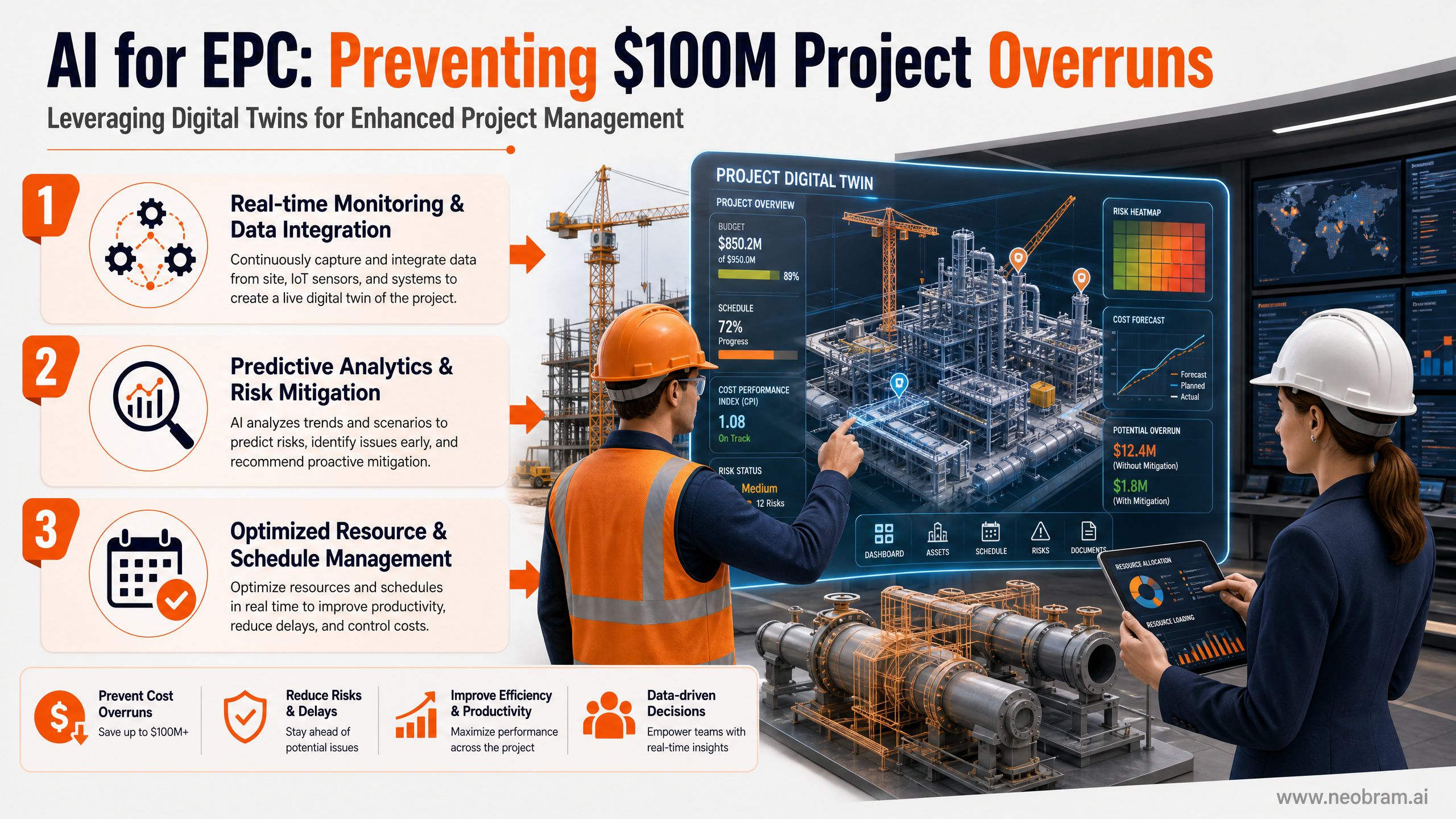
AI flips this. Machine learning models trained on historical project data, combined with live inputs from the current project, can identify elevated risk weeks before it materialises. These models analyse labour output, material delivery history, subcontractor performance records, weather forecasts, and site conditions simultaneously. When the combination of factors matches patterns that preceded delays in past projects, the system flags it.
The practical result is that project managers get a warning early enough to act. They can adjust sequencing, bring in additional resources, or renegotiate delivery windows before the schedule is already broken.
Schedule Risk and Delay Forecasting
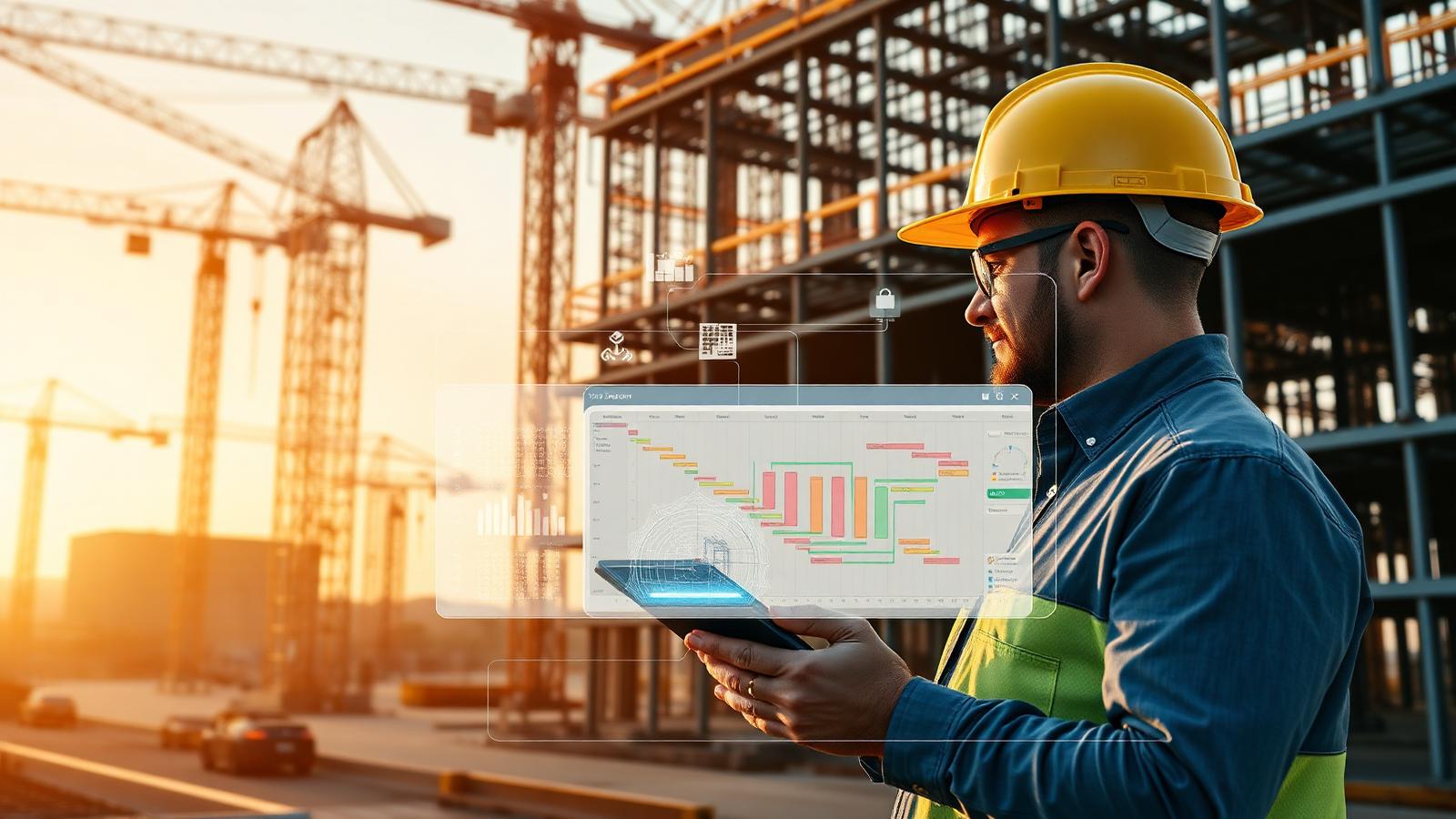
AI delay forecasting tools assess the critical path in near real-time, not just at the start of the project. They model the probability of delay for each task based on current conditions, and they highlight which tasks carry the greatest risk to the overall delivery date.
This is fundamentally different from traditional Gantt chart management, where the schedule is updated manually and often lags reality by days or weeks. With AI, the schedule reflects what's actually happening on site, and the team can see the downstream consequences of any change before it's made.
Change Order Risk
Change orders are one of the most consistent drivers of cost overrun in construction. They're often unavoidable, but their financial impact is frequently underestimated at the time of approval. AI tools can model the full cost and schedule impact of a proposed change order, including knock-on effects to other work packages, before the change is approved.
This gives project owners and contractors a much clearer picture of what they're agreeing to, and it reduces the frequency of disputes that arise when the true cost of a change only becomes apparent months later.
Key statistic: Research covering construction projects over a 70-year period found that 85% experienced cost overrun, with an average overrun of 28%. McKinsey estimates that boosting construction productivity through digitisation could save the industry USD 1.63 trillion per year globally.
AI for Safety Monitoring
The Scale of the Problem
Construction is one of the most dangerous industries in the world. The International Labour Organization estimates that at least 108,000 construction workers are killed on site every year, representing approximately 30% of all occupational fatalities globally. In the United States, construction accounts for nearly 20% of all fatal work injuries despite employing a fraction of the total workforce.
Beyond the human cost, safety incidents are expensive. A serious injury stops work, triggers investigations, affects insurance premiums, and can delay a project by weeks. Preventing incidents isn't just an ethical obligation; it's a direct financial priority.
Computer Vision for Real-Time Hazard Detection
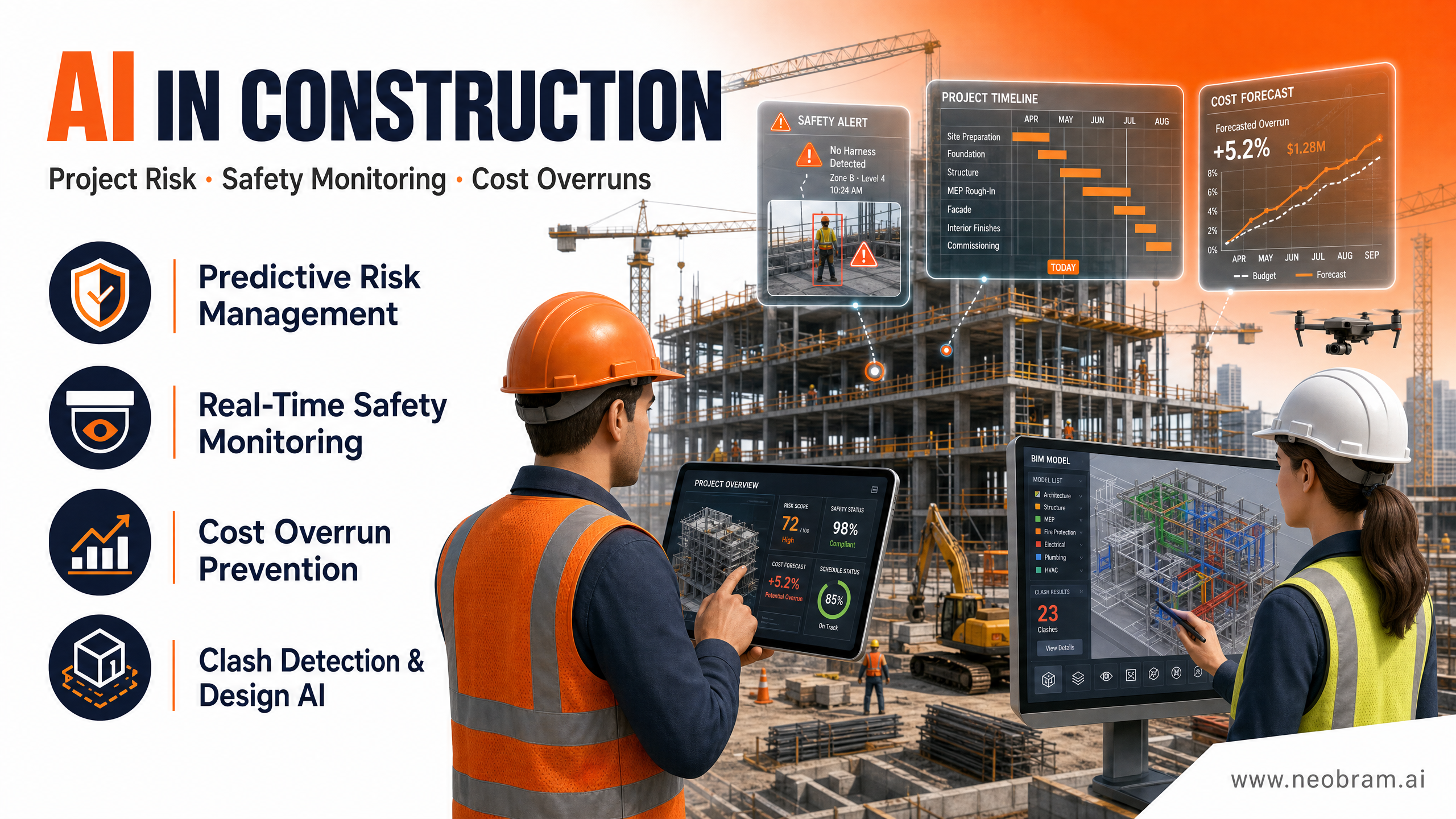
AI-powered computer vision systems analyse live video feeds from fixed cameras, mobile equipment, and drones across the construction site. These systems are trained to recognise specific hazards: workers without required PPE, people entering restricted zones, equipment operating too close to workers, structural instability in active work areas, and dozens of other risk conditions.
When a hazard is detected, the system sends an alert to the relevant supervisor immediately, tied to the exact location and time. This is categorically different from periodic safety inspections, which can only capture a snapshot of conditions at a single moment. Computer vision provides continuous monitoring across the entire site, simultaneously.
Over time, the data from these systems reveals where risk concentrates. Certain tasks, certain crews, certain times of day, and certain site conditions consistently produce more near-misses. That pattern data allows safety managers to target training and intervention where it will have the most impact.
Wearable Technology and Worker Monitoring
Smart helmets and connected vests now monitor workers continuously throughout the workday. Sensors track environmental exposure (gas levels, heat, noise), physical strain (movement patterns, fatigue indicators), location relative to hazardous equipment, and sudden impacts.
When a worker enters a danger zone or shows signs of heat stress, the system alerts both the worker and their supervisor through sound, vibration, or visual cues that cut through site noise. This real-time feedback loop is particularly valuable for preventing the "Fatal Four" causes of construction deaths: falls, being struck by objects, electrocution, and caught-in/between incidents.
Drones for Site Inspection
Drones reduce worker exposure to hazardous inspection tasks. Roof inspections, facade assessments, bridge surveys, and large infrastructure checks that previously required workers to access dangerous heights or confined spaces can now be completed remotely.
A drone inspection that would have taken a crew two days can be completed in a few hours, with higher-quality visual and thermal data than manual inspection typically produces. The footage is automatically analysed by AI to flag anomalies, structural concerns, or safety issues that require follow-up.
Safety data point: The ILO estimates 108,000 construction fatalities per year globally, roughly 30% of all occupational deaths. AI-powered computer vision and wearable monitoring systems are now being deployed on major projects to provide continuous, real-time hazard detection across entire sites, a capability that periodic manual inspections simply cannot match.
AI for Cost Overrun Prevention
Real-Time Cost Forecasting
One of the most common ways cost overruns develop is through delayed visibility. Monthly financial reports tell project teams what happened four weeks ago. By the time a budget problem is visible in a report, it's already a crisis.
AI cost forecasting tools connect to live project data, including actual spend, committed costs, production rates, and schedule progress, and update forecasts continuously. When actual costs start diverging from the plan, the system flags it immediately. Project teams can investigate and respond while the variance is still small, rather than discovering a six-figure problem at month-end.
Estimating Accuracy
AI is also improving the accuracy of initial project estimates. Machine learning models trained on thousands of historical projects can identify patterns in how certain project types, locations, and conditions affect final costs. They can flag when a current estimate is inconsistent with comparable projects, prompting estimators to review specific line items before the bid goes out.
Research published in 2025 found that AI-augmented cost estimation systems demonstrated an 82.96% agreement rate with experienced quantity surveyor estimates on complex high-rise projects, while completing the analysis in a fraction of the time.
Supply Chain Risk and Materials Management
Supply chain disruption has been one of the biggest drivers of cost overrun in recent years. Material delays, supplier failures, and logistics breakdowns remove margin from projects that were otherwise well-managed.
AI supply chain tools monitor supplier reliability, logistics conditions, commodity pricing, and regional disruption indicators continuously. When a risk signal appears, the system alerts procurement teams early enough to source alternatives or adjust delivery schedules before the project schedule is affected.
AI-supported inventory planning also reduces the cost of carrying excess materials on site, while ensuring that critical materials arrive when they're needed. The result is tighter cash flow management and fewer delays caused by material shortages.
AI in BIM: Clash Detection and Design Risk
Building Information Modelling has been standard practice on major construction projects for years. What AI adds to BIM is the ability to process and analyse the model far more quickly and comprehensively than human reviewers can.
Automated Clash Detection
A complex building project involves structural, mechanical, electrical, and plumbing systems that all need to coexist in the same physical space. Clashes between these systems, where a duct runs through a beam or a pipe conflicts with a structural element, are one of the most common sources of rework and cost overrun in construction.
AI-powered clash detection tools analyse BIM models automatically and identify conflicts across all systems simultaneously. They prioritise clashes by severity and impact, allowing design teams to focus on the issues that matter most. Resolving clashes in the model before construction begins is orders of magnitude cheaper than discovering them on site.
Generative Design and Value Engineering
Generative AI tools can now produce multiple design options based on specified parameters: budget, structural requirements, energy performance targets, and spatial constraints. Design teams can evaluate dozens of configurations in the time it would previously take to develop one, and they can see the cost and performance implications of each option in real time.
This capability is particularly valuable for value engineering exercises, where the goal is to maintain project performance while reducing cost. AI can identify which design choices are driving cost without proportionate benefit, and suggest alternatives that achieve the same outcome more efficiently.
Practical Implementation: Where to Start
Assess Your Data Foundation First
AI delivers reliable results only when it has reliable data to work with. Before investing in AI tools, construction firms need to assess the quality and consistency of their project data. If schedules, costs, and site records are maintained in disconnected spreadsheets and email threads, AI will amplify the inconsistencies rather than resolve them.
The first step is establishing a single source of truth for project data: a unified platform where scheduling, cost control, procurement, and safety records are maintained consistently. Once that foundation exists, AI tools can be layered on top to generate genuine insight.
Start with High-Impact, High-Visibility Use Cases
The most effective way to build internal confidence in AI is to start with use cases where the impact is visible and measurable. Safety monitoring with computer vision, cost variance alerting, and schedule delay forecasting all produce results that project teams can see and verify quickly.
Starting with these use cases builds the organisational familiarity and data discipline that more sophisticated applications require later.
Prioritise Integration Over Point Solutions
The construction technology market is crowded with point solutions that each address one specific problem. The risk of adopting too many disconnected tools is that data ends up fragmented across systems, which is precisely the problem AI is supposed to solve.
Prioritise platforms that integrate scheduling, cost, procurement, safety, and document management into a connected workflow. When data flows between these functions automatically, AI can analyse the full picture rather than isolated slices.
| AI Application | Primary Benefit | Typical Time to Value |
|---|---|---|
| Computer vision safety monitoring | Reduced incident rate, continuous hazard detection | 4-8 weeks post-deployment |
| Predictive schedule risk | Earlier delay identification, schedule recovery | 1-2 project cycles |
| Real-time cost forecasting | Faster variance detection, reduced overrun | Immediate on live projects |
| AI clash detection in BIM | Reduced rework, fewer design-phase surprises | Per-project, pre-construction |
| Supply chain risk monitoring | Fewer material delays, better procurement decisions | 2-4 weeks post-deployment |
| Wearable safety monitoring | Reduced fatigue and PPE incidents | 2-6 weeks post-deployment |
Common Barriers and How to Address Them
"Our data isn't clean enough"
This is the most common objection, and it's often valid. But it's also a reason to start, not a reason to wait. The process of preparing data for AI use forces organisations to standardise their project management practices, which delivers value independently of any AI tool. Start with one project type or one data domain, establish clean practices there, and expand from there.
"Our teams won't adopt new tools"
Adoption is a change management challenge, not a technology challenge. The construction firms that have successfully deployed AI have done so by involving field teams in the selection process, starting with tools that solve problems people actually experience, and demonstrating results quickly. When a site manager sees that a computer vision alert prevented an incident on their site, adoption tends to follow.
"The upfront cost is too high"
The relevant comparison isn't the cost of AI versus the cost of no AI. It's the cost of AI versus the cost of the overruns, incidents, and delays that AI prevents. A single serious safety incident can cost more than a year of AI platform fees. A 5% reduction in cost overrun on a $50 million project saves $2.5 million.
How NeoBram Can Help
NeoBram works with EPC and construction firms to design and deploy AI solutions that address the specific challenges of project risk, safety monitoring, and cost control. Our approach starts with a structured AI readiness assessment that identifies where your data, processes, and technology are ready for AI, and where gaps need to be addressed first.
From there, we design and implement AI solutions that integrate with your existing project management workflows rather than replacing them. Whether you're looking to deploy computer vision safety monitoring on active sites, build predictive risk models for your project portfolio, or improve the accuracy of your cost forecasting, we bring the technical capability and construction industry knowledge to make it work.
We've worked with construction and EPC firms across manufacturing, infrastructure, and industrial projects, and we understand the operational realities that generic AI vendors often miss.
Book a free strategy call with the NeoBram team to discuss where AI can have the biggest impact on your projects.