Key takeaways
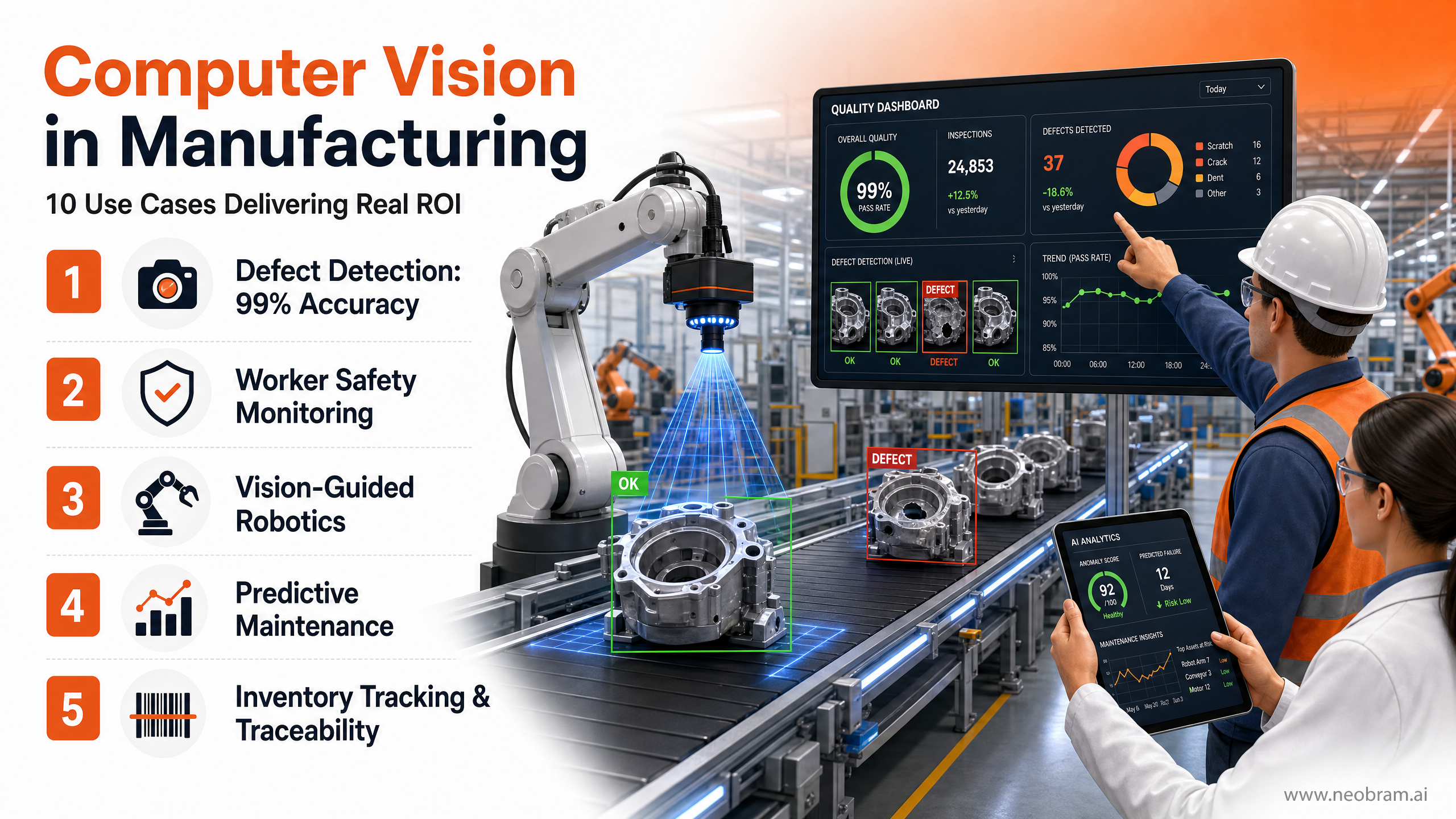
- AI visual inspection achieves 95-99% defect detection accuracy, reducing escape rates by up to 90% versus manual inspection.
- The global machine vision market reached $23 billion in 2025 and is growing at 13% annually, with manufacturing commanding 26% of all spending.
- Computer vision safety monitoring delivers $4-$6 saved for every $1 invested, with documented 98% reductions in near-miss incidents within 6 months.
- Most manufacturers achieve full ROI payback within 6-18 months, with high-value sectors like automotive and aerospace often seeing payback under 6 months.
What Is Computer Vision in Manufacturing?
Computer vision is the branch of artificial intelligence that enables machines to interpret and act on visual information: images, video feeds, and real-time camera data. In a manufacturing context, it means your production lines, assembly stations, and warehouse floors can "see" what's happening and respond without waiting for a human to notice.
The technology is no longer experimental. The global machine vision market reached $23 billion in 2025 and is projected to hit $41.7 billion by 2030, growing at 13% annually. Manufacturing accounts for roughly 26% of all computer vision spending, making it the single largest adopter by industry. Nearly 75% of large manufacturers now run some form of AI-powered visual inspection, according to the 2026 Enterprise Vision AI Adoption Report.
What changed? Three things converged: camera hardware got cheaper, edge computing got powerful enough to process video in real time, and deep learning models got accurate enough to outperform human inspectors on repetitive tasks. The result is a technology that delivers measurable ROI across a surprisingly wide range of factory applications.
This guide covers 10 of those use cases, with real numbers attached to each one.
The global computer vision market is projected to reach $32.88 billion in 2026, growing at 19.8% annually. Manufacturing remains the largest vertical by spending, with AI-powered visual inspection now deployed at nearly 75% of large manufacturers worldwide.
Use Case 1: Automated Defect Detection on Production Lines
This is where most manufacturers start, and for good reason. Manual visual inspection is slow, inconsistent, and expensive. A trained inspector working an eight-hour shift will miss more defects in hour seven than in hour one. Computer vision doesn't fatigue.
Modern AI inspection systems achieve 95-99% defect detection accuracy in controlled manufacturing environments. In semiconductor wafer inspection and pharmaceutical blister pack verification, accuracy exceeds 98%. A typical deployment replaces two to three inspectors per shift while inspecting every single unit rather than sampling.
The ROI math is direct. Consider a line producing 100,000 units per month with a 0.5% escape rate. At $200 per escaped defect (returns, warranty, customer goodwill), that's $100,000 per month in downstream costs. A computer vision system reducing escapes to 0.05% saves $90,000 per month. Most systems pay back within 6 to 18 months.
One case study from the barrel inspection industry illustrates the point: a manufacturer replaced manual surface inspection for dents, cracks, and coating defects, cutting missed defect rates from 12% to under 2%. In high-value sectors like automotive and aerospace, a single prevented recall can justify the entire system cost.
AI visual inspection systems can reduce defect escape rates by up to 90%, cutting downstream costs from returns, warranty claims, and potential recalls. In automotive manufacturing, a single undetected defect can trigger a recall costing millions.
Use Case 2: Quality Control for Packaging and Labelling
Packaging errors are a quiet but costly problem. Wrong labels, missing barcodes, incorrect fill levels, damaged seals: these defects reach customers, trigger regulatory action, and damage brand reputation. Manual label checks at line speed are unreliable.
Computer vision handles packaging inspection at production speed, checking every unit for label presence, correct placement, barcode readability, fill level (via weight estimation from image), and seal integrity. In food and beverage manufacturing, vision systems also detect foreign material contamination that human inspectors routinely miss.
A U.S. packaging manufacturer reported a 50% reduction in inspection time and a 10% decrease in labour costs after deploying AI visual inspection. For regulated industries like pharma, the compliance value is equally significant: serialisation requirements under DSCSA and EU FMD mandate 100% barcode verification, something only automated vision can reliably deliver at scale.
Use Case 3: Dimensional Measurement and Geometric Verification
Traditional coordinate measuring machines (CMMs) are accurate but slow. They're used for sampling, not 100% inspection. Computer vision-based dimensional measurement changes that equation.
Modern vision systems measure part dimensions, angles, hole positions, and surface profiles in milliseconds, directly on the production line. AI-assisted computer vision is reshaping how manufacturers verify dimensional accuracy, moving quality assurance from periodic sampling to continuous, 100% inspection.
The automotive sector uses this extensively. Engine components, body panels, and precision fasteners all require dimensional verification. Vision systems catch out-of-tolerance parts before they're assembled into higher-value sub-assemblies, where the cost of rework multiplies.
The economic case: catching a dimensional defect at the machining stage costs roughly $5 to $15 to fix. Catching the same defect after assembly costs $150 to $500. Catching it in the field costs $2,000 or more. Earlier detection is exponentially cheaper.
Use Case 4: Worker Safety Monitoring and PPE Compliance
Workplace injuries cost U.S. employers $58.61 billion in direct costs annually, according to the Liberty Mutual Workplace Safety Index. Computer vision addresses this by monitoring compliance continuously, not just during scheduled audits.
Safety monitoring systems use existing camera infrastructure to detect PPE violations (missing hard hats, safety vests, goggles), workers entering restricted zones, ergonomic risk postures, and proximity hazards near moving machinery. AI systems now achieve 92%+ mean average precision in PPE detection, according to peer-reviewed research using YOLO-based architectures.
The ROI is compelling. OSHA-cited studies show effective workplace safety programmes deliver $4 to $6 saved for every $1 invested. One cold storage facility documented a 98% reduction in near-miss incidents within six months of deploying AI safety monitoring. Beyond the direct cost savings, manufacturers in regulated industries avoid OSHA fines, workers' compensation claims, and the operational disruption of incident investigations.
Manufacturing commands 24.3% of the global workplace safety market, the largest single industry segment, precisely because the hazard density in factory environments makes continuous monitoring so valuable.
Use Case 5: Vision-Guided Robotics and Pick-and-Place Automation
Traditional industrial robots are precise but rigid. They work well when parts arrive in exactly the same position every time. Real manufacturing isn't that tidy. Parts arrive in bins, on conveyors, in random orientations. Without vision, robots need expensive fixtures and feeders to standardise part presentation.
Vision-guided robotics solves this. A camera mounted on or near the robot arm identifies part location, orientation, and type in real time. The robot adjusts its path accordingly. This enables bin picking, flexible assembly, and handling of variable or deformable materials that fixed-path robots can't manage.
The productivity gains are significant. Vision-guided systems can handle 30-50% more part variety than fixed-path robots without retooling. They also reduce setup time when switching between product variants, which is critical for manufacturers running high-mix, low-volume production. In automotive assembly, vision-guided robots verify component presence and orientation before fastening, eliminating assembly errors at the source.
Use Case 6: Predictive Maintenance Through Visual Monitoring
Equipment failure is expensive. Unplanned downtime costs manufacturers an average of $260,000 per hour in lost production, according to industry estimates. Traditional predictive maintenance relies on vibration sensors, temperature probes, and oil analysis. Computer vision adds a visual layer that catches failure modes those sensors miss.
Visual predictive maintenance monitors equipment for early signs of wear: belt fraying, bearing discolouration, seal leaks, corrosion, and abnormal vibration patterns visible to a camera. Thermal imaging cameras detect heat signatures indicating electrical faults or friction. Drone-mounted cameras inspect hard-to-reach assets like overhead conveyors, roof-mounted HVAC, and elevated storage systems.
The value compounds over time. A single prevented unplanned failure on a critical production line can save more than the entire annual cost of the vision system. Manufacturers using predictive maintenance report 25-30% reductions in maintenance costs and 70-75% reductions in equipment breakdowns, according to Deloitte research on industrial AI adoption.
Unplanned equipment downtime costs manufacturers an average of $260,000 per hour. Computer vision-based predictive maintenance, combined with thermal imaging and vibration analysis, can reduce unplanned breakdowns by up to 75% and cut maintenance costs by 25-30%.
Use Case 7: Inventory Management and Parts Tracking
Manual inventory counts are slow, error-prone, and disruptive. Computer vision automates this at multiple levels: reading barcodes and QR codes on parts and pallets, counting items on shelves or in bins, tracking work-in-progress through production stages, and verifying kitting completeness before assembly.
Barcode and 2D code reading via computer vision is faster and more reliable than handheld scanners. Vision systems read codes at line speed, in any orientation, even on damaged or partially obscured labels. This is the foundation of automated traceability: knowing exactly where every part is, where it came from, and where it's going.
For manufacturers under regulatory scrutiny (pharma, medical devices, aerospace), complete traceability isn't optional. Computer vision makes it economically viable at scale. The operational benefit is equally real: accurate inventory data reduces safety stock requirements, cuts expediting costs, and prevents production stoppages from missing components.
Use Case 8: Assembly Verification and Error-Proofing
Assembly errors are among the most expensive quality problems in manufacturing. A missing fastener, a wrongly-oriented component, or a connector plugged into the wrong port can cause field failures that are difficult to trace and expensive to fix.
Computer vision provides real-time assembly verification at each workstation. The system captures an image of the assembly at defined checkpoints, compares it against a reference model, and flags discrepancies before the product moves to the next stage. This is poka-yoke (error-proofing) implemented through software rather than physical fixtures.
The applications span industries. In electronics manufacturing, vision systems verify PCB component placement and solder joint quality. In automotive assembly, they confirm that every bolt is present and torqued. In medical device manufacturing, they verify that sterile packaging is intact before shipment. Detection accuracy for assembly verification typically exceeds 99% in well-implemented systems.
The ROI case is particularly strong when you consider the cost of field failures. In automotive, a recall costs an average of $500 per vehicle. In medical devices, a field failure can trigger regulatory action and litigation. Preventing even a small number of these events justifies significant investment in assembly verification technology.
Use Case 9: Process Monitoring and Statistical Process Control
Quality control has traditionally been reactive: inspect the output, find the defects, investigate the cause. Computer vision enables a proactive approach by monitoring the process itself, not just the product.
Vision systems track process variables that correlate with quality outcomes: weld pool geometry, coating thickness uniformity, injection moulding fill patterns, print registration accuracy. When a process parameter drifts outside acceptable limits, the system alerts operators before defective product is produced.
This is statistical process control (SPC) implemented visually. The data generated by continuous visual monitoring feeds directly into SPC charts, giving quality engineers the information they need to identify and correct process drift before it becomes a quality problem. Manufacturers using real-time process monitoring report 20-40% reductions in scrap rates, according to industry benchmarks.
The data value extends beyond immediate defect prevention. Correlating visual process data with supplier batches, operator shifts, environmental conditions, and equipment age enables root cause analysis that would be impossible with periodic sampling.
Use Case 10: Autonomous Material Handling and AGV Navigation
Automated guided vehicles (AGVs) and autonomous mobile robots (AMRs) are increasingly common in manufacturing facilities. Computer vision is what makes them genuinely flexible. Early AGVs followed fixed magnetic tape paths. Modern vision-guided AMRs navigate dynamically, avoiding obstacles, reading floor markings, and adapting to changing facility layouts.
Vision-guided material handling reduces the labour cost of moving materials between production stages, receiving docks, and storage areas. It also reduces the risk of forklift accidents, which account for 85 fatalities and 34,900 serious injuries annually in the U.S., according to OSHA data.
The business case for vision-guided AMRs has improved dramatically as hardware costs have fallen. A typical AMR system now costs $30,000 to $80,000 per unit, with ROI periods of 18 to 36 months in high-throughput facilities. The flexibility advantage over fixed automation is significant: when production layouts change, AMRs adapt through software updates rather than physical reconfiguration.
What Does Computer Vision Implementation Actually Cost?
The honest answer is: it depends on the application, the scale, and the vendor. A single-camera inspection system for a specific defect type might cost $15,000 to $50,000 installed. A comprehensive multi-line deployment with edge computing infrastructure, integration with MES and ERP systems, and ongoing model maintenance can run $600,000 to $1.5 million over five years.
The key cost components are:
| Component | Typical Range |
|---|---|
| Camera hardware and lighting | $5,000 - $30,000 per station |
| Edge computing hardware | $10,000 - $50,000 per deployment |
| Software and AI model development | $20,000 - $150,000 |
| Integration with existing systems | $15,000 - $80,000 |
| Annual maintenance and support | 15-20% of initial investment |
Most manufacturers see measurable returns within 6 to 18 months for inspection applications. The payback period is shorter for high-value products (automotive, aerospace, medical devices) where the cost of escaped defects is high, and longer for commodity manufacturing where margins are thin.
The critical success factor is not the technology itself: it's implementation quality. Poorly designed lighting, insufficient training data, and weak integration with production workflows undermine ROI regardless of how good the underlying AI is. Starting with a focused pilot on a high-impact application, proving ROI, then scaling is consistently more successful than attempting a facility-wide transformation from day one.
Common Implementation Mistakes to Avoid
Underestimating data requirements. AI models need labelled examples of defects to learn from. For rare defect types, collecting sufficient training data takes time. Factor this into your implementation timeline.
Ignoring lighting design. Inconsistent lighting is the most common cause of poor vision system performance. Industrial lighting design is a specialist skill; don't treat it as an afterthought.
Skipping integration with production systems. A vision system that flags defects but doesn't connect to your MES, reject mechanisms, or quality management system creates manual work rather than eliminating it.
Setting unrealistic accuracy expectations. 99% accuracy sounds impressive until you're running 500,000 units per month and 5,000 units are still incorrectly classified. Define acceptable performance thresholds before deployment, not after.
Neglecting model maintenance. Products change, lighting conditions drift, and camera lenses get dirty. Vision models need periodic retraining and maintenance to sustain performance. Budget for this ongoing cost.
How NeoBram Can Help
Deploying computer vision in manufacturing is not a software project: it's an operational transformation. The technology decisions (which camera, which model architecture, edge vs. cloud inference) matter less than the process decisions: which use cases to prioritise, how to integrate with existing quality systems, and how to build internal capability to sustain and scale the deployment.
NeoBram works with manufacturers across discrete and process industries to design and implement computer vision solutions that deliver measurable ROI. Our approach starts with a structured assessment of your current quality processes, defect costs, and inspection bottlenecks. We identify the two or three use cases where computer vision will deliver the fastest and largest return, then build and deploy those systems with full integration into your production environment.
We don't hand you a model and walk away. We stay involved through commissioning, operator training, and the first production runs, ensuring the system performs as designed before we consider the project complete. And we build your internal team's capability to manage and improve the system over time.
If you're evaluating computer vision for your manufacturing operations, or if you've had a previous deployment that didn't deliver expected results, we'd welcome the conversation.
Book a free strategy call with our manufacturing AI team