
Key takeaways
- A pilot should name one decision, one accountable process owner and one operating boundary before the team expands the use case.
- Evaluation must include representative normal conditions, abnormal conditions, missing data, delayed labels, human corrections and safe abstention—not only a single accuracy score.
- The production record should connect inputs, outputs, versions, approvals, overrides, incidents and later outcomes without exposing more sensitive information than the workflow requires.
- Human oversight is a designed control: people need the context, authority, time and fallback procedure to challenge or stop an AI-supported workflow.
- Cross-border delivery from India requires client-specific review of data transfer, contracts, licences, security, tax, employment, privacy and sector obligations by qualified professionals in the relevant jurisdictions.
A pilot proves possibility, not permission
An industrial AI pilot can answer an important question: can a system produce a useful recommendation from the available evidence? That is different from asking whether the recommendation belongs inside a live operational workflow.
The move from pilot to production should therefore begin with a boundary, not a larger model. Write down the decision the system supports, the people who remain accountable, the evidence it may use, the actions it may suggest and the actions it must never take. A clear boundary makes evaluation meaningful and gives the operating team a way to recognise when the system is outside its approved purpose.
This guide uses “production” to mean a controlled workflow with named owners, monitored behaviour, documented changes and a usable manual fallback. It is not a claim that every use case should be automated or that one operating design satisfies every jurisdiction.
Define the decision and the authority boundary
Start with a one-sentence decision statement: who needs to decide what, using which evidence, and within what time window? Avoid starting with a model type or a generic promise to transform operations.
Then define four boundaries:
- Observation: - which approved data sources can the system read, and what quality or freshness conditions apply?
- Recommendation: - what output may it produce, and how must uncertainty or missing evidence be shown?
- Action: - which steps remain human-approved, and which low-consequence workflow steps can be automated under written controls?
- Fallback: - how does the team continue the work when the system is unavailable, uncertain, out of scope or under review?
For an inspection workflow, the system may highlight a possible anomaly and organise evidence for a reviewer. For a maintenance workflow, it may assemble relevant history and draft a work request. For a document workflow, it may classify or route material while preserving human responsibility for the official record. The boundary should be specific enough that a new operator can tell what the system is allowed to do.
Build an evaluation set that resembles the work
A demonstration with clean examples is not a production evaluation. Build a controlled set that represents the operating envelope and includes difficult cases that could change the decision.
Include normal observations, rare but consequential conditions, incomplete records, conflicting signals, changed formats, new product or asset variants, noisy inputs, delayed outcomes and examples where the correct response is to abstain. Keep the expected decision, evidence available at decision time and reason for the result separate from the system being evaluated.
Measure more than model output quality. Review false alerts, missed conditions, abstentions, time to review, correction patterns, evidence traceability, user workload and the consequences of an incorrect recommendation. If labels arrive later, record when they become available and keep the original decision context intact.
An evaluation is also a scope statement. If the evidence covers one line, document type, shift pattern or operating condition, do not present it as evidence for every other context.
Treat monitoring as an operating control
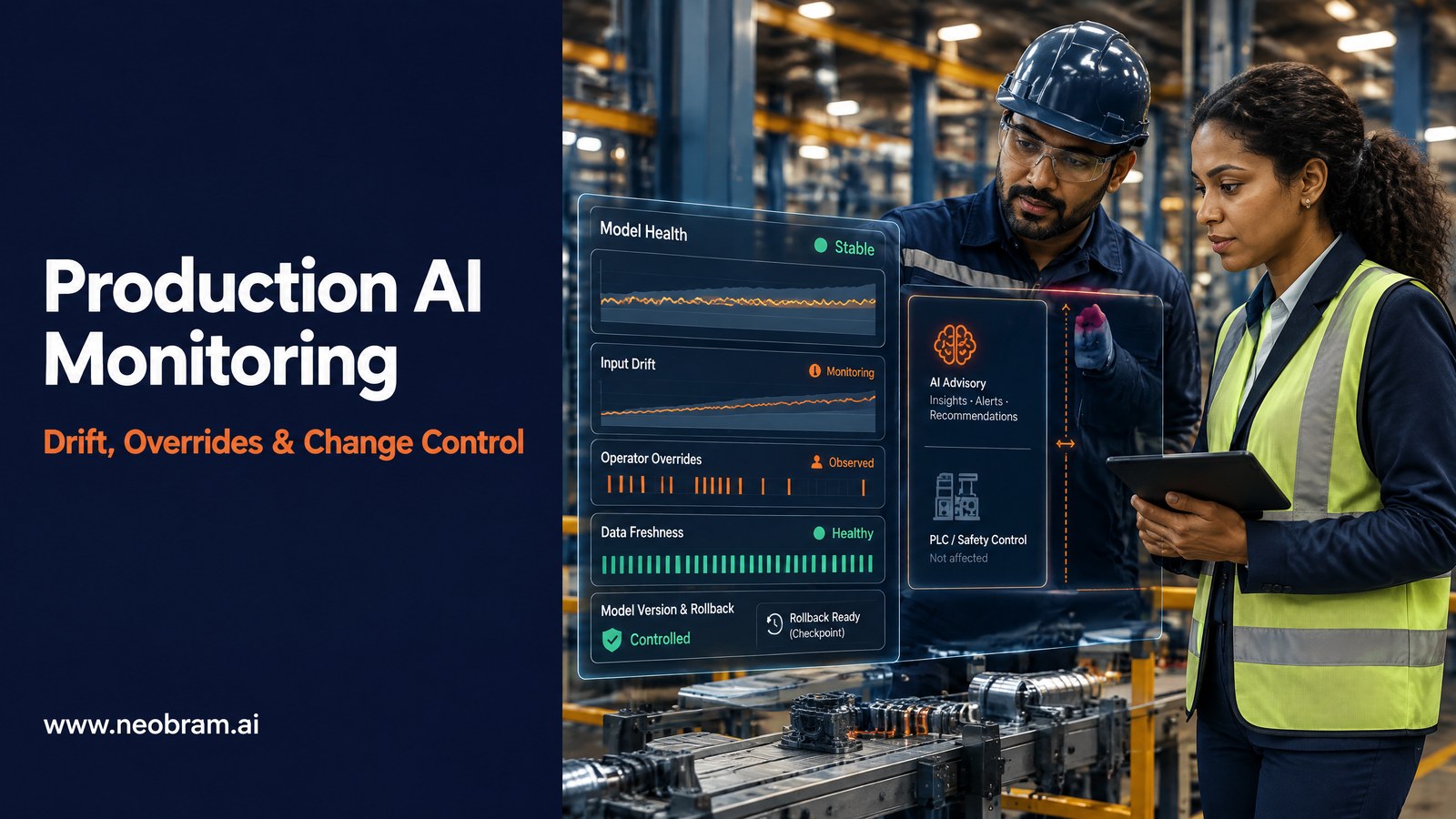
Monitoring should cover the whole workflow rather than a single model score. A useful control set has at least five layers:
- Data health: - freshness, completeness, schema changes, missing identifiers, time alignment and unexpected ranges.
- System health: - availability, latency, queues, permissions, storage and interface errors.
- AI behaviour: - output distribution, confidence or uncertainty signals, retrieval quality where relevant, abstentions and version identity.
- Human interaction: - approvals, overrides, corrections, reasons for rejection and cases where people stop using the recommendation.
- Operational outcome: - the later result that shows whether the supported decision helped, failed, or remained unknown.
Define the response before the alert fires. Possible responses include continue with observation, investigate, restrict the workflow, require additional approval, revert to a previous version, use the manual process or retire the capability. An alert without an owner and response path is only a notification.
Make human oversight practical
Human oversight does not mean placing a person next to a screen and assuming the risk is controlled. The reviewer needs enough context to understand the recommendation, enough authority to challenge it and enough time to act before the decision becomes irreversible.
Design the review screen around the decision. Show the evidence used, the age and origin of important inputs, the system version, uncertainty or missing-data signals, the recommended next step and the available fallback. Record the reviewer decision and reason without turning every correction into automatic retraining data.
For safety-, quality- or production-critical workflows, use a deliberate approval step until the organisation has evidence that a narrower automation boundary is appropriate. The safe choice may be to abstain more often, not to force an answer from incomplete evidence.
Put changes under one release record
Industrial AI behaviour can change when the model, prompt, retrieval material, threshold, data contract, integration, interface, policy or user role changes. Track these elements together in a release record with the intended change, affected scope, evaluation evidence, approver, release time and rollback method.
Test changes against both the evaluation set and the workflow. A new input mapping can alter results even when the model is unchanged. A revised document collection can change a knowledge assistant's answer. A user-interface change can remove a warning that a reviewer relied on. Version what actually changes behaviour, not only what is easiest to store in source control.
Plan for delivery across borders
A team delivering from India to an international client may need to coordinate technical work across data, identity, security, contracts, licences, support access, employment arrangements and sector controls. These are not solved by a generic statement that a system is private or secure.
Define the approved data boundary, where information may be accessed, who can support the system, which records must remain in a client-controlled environment and what transfer or deletion process applies. Put ownership of client-specific configuration, evaluation cases, deployment files, documentation and other deliverables in the contract rather than implying an outcome in marketing copy.
Cross-border delivery, data transfer, contracts, licences, security controls, tax, employment, privacy, intellectual property and sector obligations require client-specific review by qualified counsel and responsible professionals in the relevant jurisdictions. This article is an implementation guide, not legal, tax or regulatory advice.
A controlled path from pilot to production
Use a staged release path:
- Frame: - name the decision, users, evidence, boundary, owner and prohibited actions.
- Baseline: - record how the work is performed today, including delays, exceptions, manual checks and fallback steps.
- Evaluate: - test representative and difficult cases, including missing data, changed conditions and safe abstention.
- Shadow: - run the system without changing the operational decision and compare recommendations with accountable human decisions.
- Bound: - approve one workflow, one operating envelope and one response policy.
- Release: - introduce the smallest useful production capability with monitoring, logging, review and rollback.
- Learn: - use outcomes and structured corrections to decide whether to continue, restrict, revise or retire the workflow.
Expansion should be earned by evidence. If the team cannot explain what changed, who owns the response or how the work continues when the system is unavailable, the next step is better control—not broader deployment.
The practical takeaway
The difficult part of industrial AI production is rarely creating one more demonstration. It is creating a system that remains understandable when data changes, people disagree, interfaces fail, responsibilities move and the original pilot assumptions no longer hold.
Define the authority boundary before scaling. Evaluate the complete workflow. Monitor data, system health, AI behaviour, human interaction and operational outcomes. Keep a usable fallback. Version every change that can alter live behaviour. For delivery from India to the rest of the world, put the relevant cross-border responsibilities into client-specific contracts and professional review.
A production AI capability should make accountable work clearer, not make accountability harder to find.