Key takeaways
- An alarm exists to direct an operator to a condition that needs timely assessment or action. An AI-generated insight is advisory context, not automatically a new alarm or a substitute for an approved alarm philosophy.
- The safest first uses are retrospective and read-only: identify frequent, chattering, fleeting and standing alarms; reconstruct alarm episodes; and prepare evidence for a multidisciplinary rationalization review.
- Keep deterministic alarm counts, timestamps, priority rules and state transitions outside the language model. Use AI to organize and explain evidence, and require source links and uncertainty to be visible.
- AI must not change setpoints, priorities, suppression, shelving, safety-instrumented functions or operator procedures outside the site's existing authorization and management-of-change process.
- Evaluate the complete operator workflow in normal, upset and degraded conditions. Success means a clearer and more timely response with preserved fallback, not simply fewer alarms or a convincing summary.
The alarm problem is an operator-support problem
A process plant does not improve because it produces more notifications. It improves when the right person can recognize an abnormal condition, understand what needs attention and act before the condition escalates.
That is the purpose of an alarm. The UK Health and Safety Executive says alarms should direct attention to plant conditions that require timely assessment or action, provide a defined response and account for human capabilities and limitations. [1] IEC 62682 covers the alarms presented to operators through control systems, including alarms from basic process control, annunciators, packaged systems and safety-instrumented systems. [2]
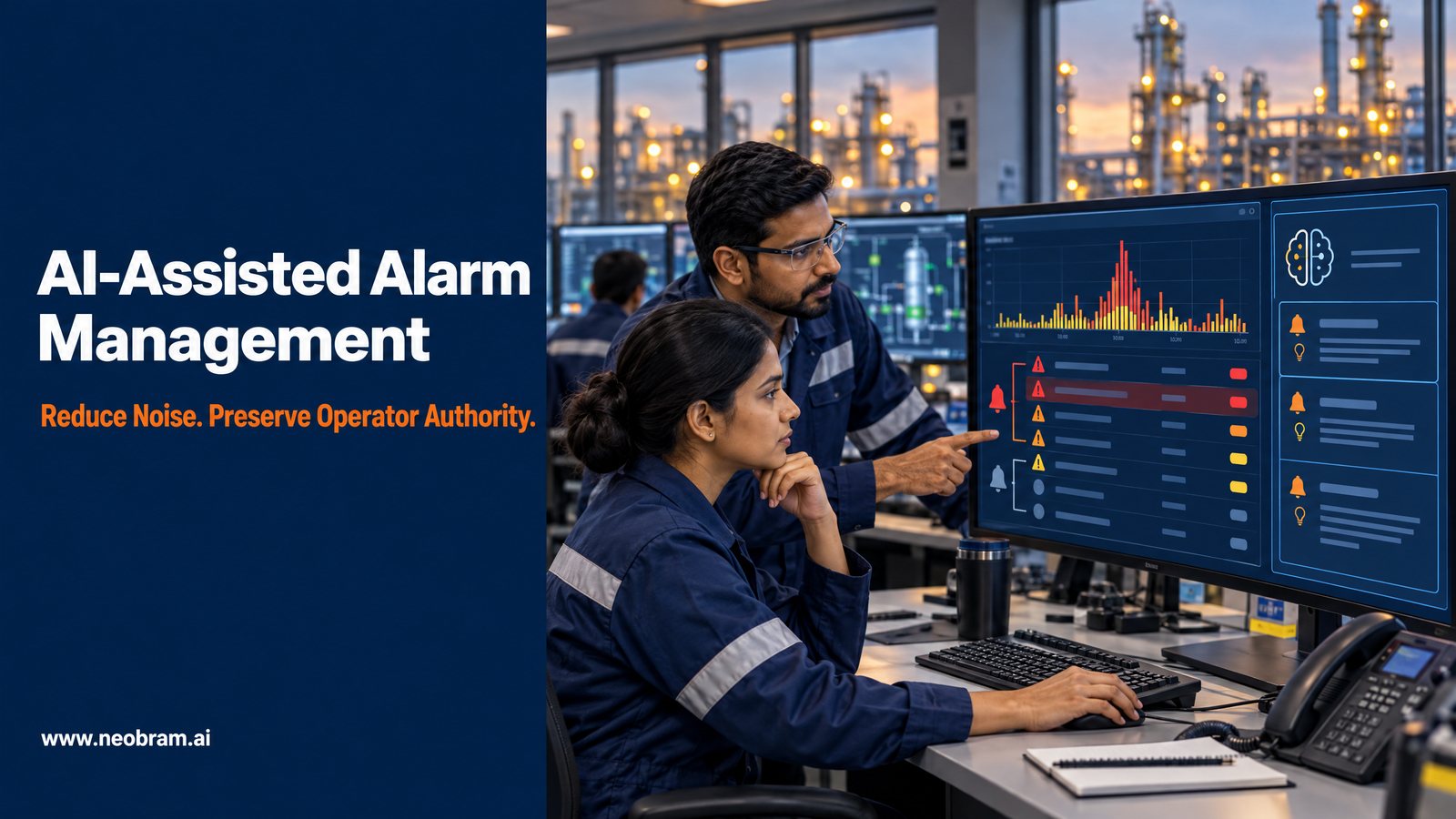
AI can help when the alarm stream is noisy, fragmented or difficult to investigate. It can group related events, retrieve the relevant operating context, summarize what changed and prepare evidence for review. But it can also create a new problem if a generated explanation hides the underlying alarm, changes its apparent priority or encourages an operator to trust a confident narrative over the approved response.
The useful role for AI is to make alarm evidence easier to inspect. It is not to become an invisible alarm philosophy.
What AI-assisted alarm management means
AI-assisted alarm management is a bounded, reviewable workflow that helps people analyze or respond to alarm-system evidence without silently changing the alarm system's approved configuration or authority.
The distinction between an alarm and an AI advisory should remain explicit:
| Signal | Purpose | Authority | Required evidence |
|---|---|---|---|
| Process alarm | Notify the operator of an abnormal condition or equipment malfunction that needs a defined response. | Comes from the approved control or safety-system design. | Tag, timestamp, state, priority, setpoint, process context and response procedure. |
| Alarm-system metric | Measure workload, configuration quality or lifecycle performance. | Calculated from historian or event-log data using defined rules. | Query window, console scope, alarm states, exclusions and calculation version. |
| AI advisory | Organize evidence, suggest relationships or prepare a review queue. | Advisory unless a separate authorized workflow grants a specific action. | Source events, context retrieved, model version, uncertainty and reviewer decision. |
| Engineering change | Alter priority, setpoint, suppression, shelving rules, logic or response documentation. | Follows the site's engineering authorization and management-of-change process. | Rationale, hazard and operability context, approval, test record, release and rollback plan. |
This separation prevents a summary from becoming an unapproved control. A model may say that six alarms appear to belong to the same episode. The operator must still be able to see the original events, and any decision to change the alarm design belongs in the existing lifecycle process.
Start with the alarm philosophy, not the model
Alarm-management guidance treats the alarm philosophy as the foundation for consistent definitions, responsibilities, priorities, response expectations, monitoring and change control. The IChemE Safety Centre notes that systems without a clear philosophy tend to develop inconsistent names, priorities and cause-and-effect alarm patterns. It also describes alarm improvement as a continuing lifecycle, not a one-time clean-up. [4]
Before adding AI, answer five questions:
- What qualifies as an alarm? - Separate alarms that require operator action from status messages, events, alerts and AI observations.
- Who is the operator? - Define the console, span of control, operating modes, workload and required response time.
- Which source is authoritative? - Identify the control-system event log, alarm historian, procedure library and approved master alarm database.
- What may the AI do? - List the exact read, summarize, rank, draft or route permissions. State prohibited actions.
- How is a change approved? - Route changes to priorities, setpoints, logic, shelving, suppression and response procedures through the existing management-of-change process.
If these answers are unclear, AI will organize ambiguity rather than solve it.
Six useful AI roles that preserve operator authority
1. Reconstruct alarm episodes
A plant upset may produce hundreds of related events across equipment and systems. AI can help organize them into a candidate episode using time, topology, process unit, equipment hierarchy and state transitions. It can present the first-out event, subsequent alarms, operator actions and recovery in one reviewable timeline.
The model should not invent causality. Use language such as preceded, followed, coincided with and may be related until a qualified review establishes cause. Keep every summarized item linked to the source event.
2. Triage bad actors for engineering review
Deterministic queries should identify frequent, chattering, fleeting, stale or standing alarms. AI can then enrich the list with operating mode, maintenance history, prior rationalization notes and similar occurrences. The output is a review queue, not an automatic deletion or priority change.
The IChemE guidance distinguishes metrics for stable operation, plant upsets and alarm configuration. It recommends using those measures to decide whether a focused bad-actor review is enough or a broader rationalization is needed. [4] That decision requires engineering and operator judgment.
3. Prepare rationalization evidence
For each candidate alarm, AI can assemble the tag description, initiating condition, consequence, available response time, operator action, priority basis, associated procedure, related safeguards and occurrence history. It can flag missing or conflicting fields before a multidisciplinary workshop.
The review team should include the operators and the relevant process, control, safety, maintenance and human-factors expertise. The system can reduce preparation effort, but it should not decide whether an alarm is necessary or how much risk reduction it provides.
4. Generate shift and event-review summaries
An AI assistant can prepare a handover section that lists unresolved standing alarms, alarms placed out of service, active shelving, repeated alarm episodes and changes since the previous shift. Every statement should link back to the official record, and the summary should show its query period and generation time.
This is useful only if it reduces search effort without hiding detail. The operator must be able to move from the summary to the original alarm and approved response.
5. Retrieve response context
When an alarm occurs, the assistant can retrieve the current operating procedure, equipment context, recent maintenance, related permits and relevant process trend. It should check revision and applicability before displaying a document.
Retrieval is not permission to improvise instructions. If the approved response is missing, obsolete or contradictory, the assistant should escalate the documentation gap rather than produce a plausible substitute.
6. Replay proposed changes against history
Before release, engineers can apply a proposed configuration change to historical event data and estimate how the alarm load, standing-alarm list or episode sequence would have differed. AI can explain the comparison and identify cases for review. Deterministic code should calculate the metrics.
A historical replay is evidence, not proof of future safety. It does not capture every plant mode, equipment failure, operator interaction or unseen condition. The final change still needs the site's hazard, authorization, testing and commissioning process.
What the AI should not be allowed to do
A safe default is read, organize, explain and draft. The following actions should remain outside a general AI assistant unless a separate engineered and authorized control establishes otherwise:
- change an alarm setpoint, priority, deadband, delay or class;
- suppress, shelve, inhibit, bypass or remove an alarm;
- alter basic process control or safety-instrumented logic;
- treat an AI score as an approved alarm without rationalization;
- hide original alarms behind a generated incident label;
- rewrite an operator response procedure without document control;
- claim a cause when the evidence only shows sequence or correlation;
- close a standing alarm or maintenance item without the authorized workflow;
- learn directly from every operator action as if it were a verified label.
This boundary is especially important for alarms associated with safety, environmental protection, personnel protection or risk-reduction claims. A model confidence score is not a process-safety justification.
Build a traceable data contract
An AI assistant needs more than an exported alarm list. It needs a stable contract that preserves event meaning and lets reviewers reconstruct the output.
| Data element | Minimum context | Failure to detect |
|---|---|---|
| Alarm event | Tag, event type, active/clear/acknowledged state, timestamp, source clock and quality. | Duplicated events, clock drift, missing clears, state-transition errors. |
| Configuration | Setpoint, priority, deadband, delay, class, suppression rule and approved revision. | Mismatch between live and master configuration; unapproved change. |
| Process context | Unit, equipment, operating mode, recipe or grade, control state and relevant trends. | Wrong mode, missing asset mapping, inconsistent units. |
| Operator action | Acknowledgement, action, note, shelving or escalation with actor and time. | Shared accounts, missing reason, action recorded in another system. |
| Procedure | Document ID, revision, owner, applicability and approval status. | Obsolete, draft or inaccessible instruction. |
| AI record | Input references, retrieved evidence, model and prompt or policy version, output and uncertainty. | Unsupported summary, lost provenance, inconsistent regeneration. |
| Review outcome | Accept, correct, reject, escalate or defer, plus reason and later finding. | Silent edits, feedback without authority, missing operational outcome. |
Keep timestamp handling explicit. Event order can be wrong when control systems, historians and enterprise applications use different clocks, time zones or collection delays. The assistant should report uncertain ordering rather than force a clean story.
Keep deterministic analytics separate from generated explanation
Alarm counts and states should be reproducible. Use deterministic code for calculations such as alarm rate, time in alarm, time shelved, standing duration, contribution by frequent alarms, priority distribution and time spent in a flood condition. Store the query and calculation version.
Use AI after that layer to:
- explain what a metric may indicate;
- group records for review;
- compare episodes;
- retrieve related documents;
- draft a concise narrative;
- identify missing context;
- propose questions for the review team.
Do not ask a language model to count events from a long pasted log and treat the result as the official metric. The correct architecture makes the number reproducible and the explanation challengeable.
Evaluate the operator workflow, not just the model
NIST's AI Risk Management Framework Playbook recommends measuring systems in conditions similar to deployment, documenting differences between test and deployment, evaluating in non-optimized conditions and involving multidisciplinary and human-factors expertise. [5] For an alarm assistant, that means testing normal, upset and degraded operation with the people who use the control room.
Build scenarios around:
- stable operation with a small number of actionable alarms;
- startup, shutdown, grade change and planned maintenance;
- a genuine alarm flood with closely spaced events;
- chattering inputs and intermittent communications;
- an obsolete procedure or missing document permission;
- conflicting timestamps or an unavailable historian;
- a novel process state outside the evaluated envelope;
- an intentionally misleading operator note or retrieved document;
- loss of the AI service while the alarm system remains available.
Measure the complete decision path:
| Measure | Question |
|---|---|
| Evidence completeness | Can the reviewer reach every source event, trend and document used in the advisory? |
| Episode grouping quality | Are related events grouped without hiding unrelated or first-out alarms? |
| Review time | Does the operator or engineer reach a supported conclusion faster without losing comprehension? |
| Correction and rejection | How often do users change or reject the grouping, narrative or retrieved context, and why? |
| Alarm visibility | Can the user always distinguish the official alarm, the deterministic metric and the AI advisory? |
| Abstention | Does the assistant stop and escalate when identity, ordering, procedure or context is uncertain? |
| Failure recovery | Can the team continue with the approved alarm system and manual analysis when the assistant fails? |
| Change integrity | Does every configuration recommendation enter the authorized engineering and management-of-change process? |
Fewer alarms is not automatically a success measure. An unsafe system can look quiet because important alarms were hidden. The outcome should be a more timely and accurate operator response, a healthier alarm lifecycle and preserved visibility of the approved system.
Use benchmarks as triggers for investigation, not universal promises
The IChemE Safety Centre publishes example metrics for centralized process-industry control rooms, including approximate stable-state and upset-rate bands, standing alarms, flood duration, frequent contributors and priority distribution. It explicitly notes that different industries and smaller plants may need to calibrate the values to their situation. [4]
Treat such values as reference points for a site-specific philosophy, not as AI optimization targets. If a model is rewarded only for reducing the alarm count, it may learn to recommend suppression rather than improve the design. A better scorecard combines workload, configuration quality, operator comprehension, response time, unresolved hazards and the integrity of the change process.
Protect the OT boundary
An alarm-analysis assistant may read from systems close to a distributed control system, SCADA environment, alarm historian or safety system. That proximity does not justify direct control access. NIST SP 800-82 emphasizes that OT security must account for distinctive performance, reliability and safety requirements. [6]
A practical architecture should:
- export or replicate only the data required for the approved use;
- place the AI service outside the control and safety execution path;
- use read-only, least-privilege identities for the first release;
- separate alarm evidence from credentials and configuration-write capability;
- validate schemas, asset identifiers, timestamps and document revisions;
- record access, retrieval, output, review and attempted tool use;
- rate-limit and monitor queries that could affect historian or HMI performance;
- preserve the alarm system and manual investigation path when AI is unavailable;
- test incident restriction and recovery before production use.
Treat operator notes, maintenance text and retrieved procedures as untrusted inputs to the AI layer. Content in a document must not be able to change permissions, suppress logging or instruct the system to bypass policy.
A 90-day pilot for AI-assisted alarm review
Days 1–15: define the operating and authority boundary
Choose one console, process area or equipment class. Document the alarm philosophy, current metrics, systems of record, operating modes, responsible roles and prohibited AI actions. Select a retrospective use case, such as bad-actor triage or alarm-episode reconstruction.
Days 16–30: establish the data contract
Connect read-only event, historian and configuration data. Reconcile tag identity, timestamps, state transitions, priorities, units and revisions. Build deterministic calculations and verify them against an existing report or a manually reviewed sample.
Days 31–50: run retrospective evaluation
Use historical stable periods, upsets, floods, maintenance windows and known bad actors. Have operators and engineers review candidate groupings and summaries. Capture missing events, false relationships, ordering errors, unsupported causes and document-retrieval failures.
Days 51–70: operate in shadow mode
Run the assistant alongside the live alarm workflow without influencing the operator's official display or response. Compare what it surfaces with the events and decisions recorded through the existing process. Test service loss and delayed data.
Days 71–90: introduce a reviewable advisory queue
If the evidence is strong, release a narrow interface for episode review, shift preparation or rationalization support. Keep original alarms visible, make sources one click away, record corrections and route all proposed configuration changes to the approved process.
At the end of the pilot, decide to expand, restrict, redesign or stop. Expansion should depend on demonstrated operator usefulness and lifecycle integrity, not the volume of generated summaries.
Frequently asked questions
The practical takeaway
AI can make alarm management more efficient by organizing episodes, finding bad actors, retrieving context and preparing rationalization evidence. Its value comes from reducing investigation friction while preserving the meaning and authority of the operator alarm system.
Begin with the alarm philosophy. Keep event metrics deterministic. Keep the AI read-only and retrospective first. Test with operators in realistic plant modes. Make every explanation traceable to original evidence. Route configuration changes through the same engineering, hazard-review and management-of-change controls used without AI.
The strongest implementation will not make the control room quieter by hiding information. It will help the right people see what matters, understand why it matters and improve the alarm lifecycle without weakening operator judgment.
References
[1] Alarm management, UK Health and Safety Executive, updated 29 October 2024.
[2] IEC 62682:2022 — Management of alarm systems for the process industries, International Electrotechnical Commission, published 8 December 2022.
[3] EEMUA Publication 191 — Alarm systems: a guide to design, management and procurement, Engineering Equipment and Materials Users Association, Fourth Edition, 2024.
[4] Lead Process Safety Metrics: Alarm Rationalisation, IChemE Safety Centre, November 2021.
[5] Measure — AI Risk Management Framework Playbook, U.S. National Institute of Standards and Technology, accessed 25 September 2026.
[6] Guide to Operational Technology Security, SP 800-82 Rev. 3, U.S. National Institute of Standards and Technology, September 2023.
*This guide is an independent technical overview, not process-safety, control-engineering, cybersecurity or regulatory advice. Apply the site's approved alarm philosophy, hazard studies, operating procedures, management-of-change process and competent professional review before changing an alarm or production workflow.*