
Key takeaways
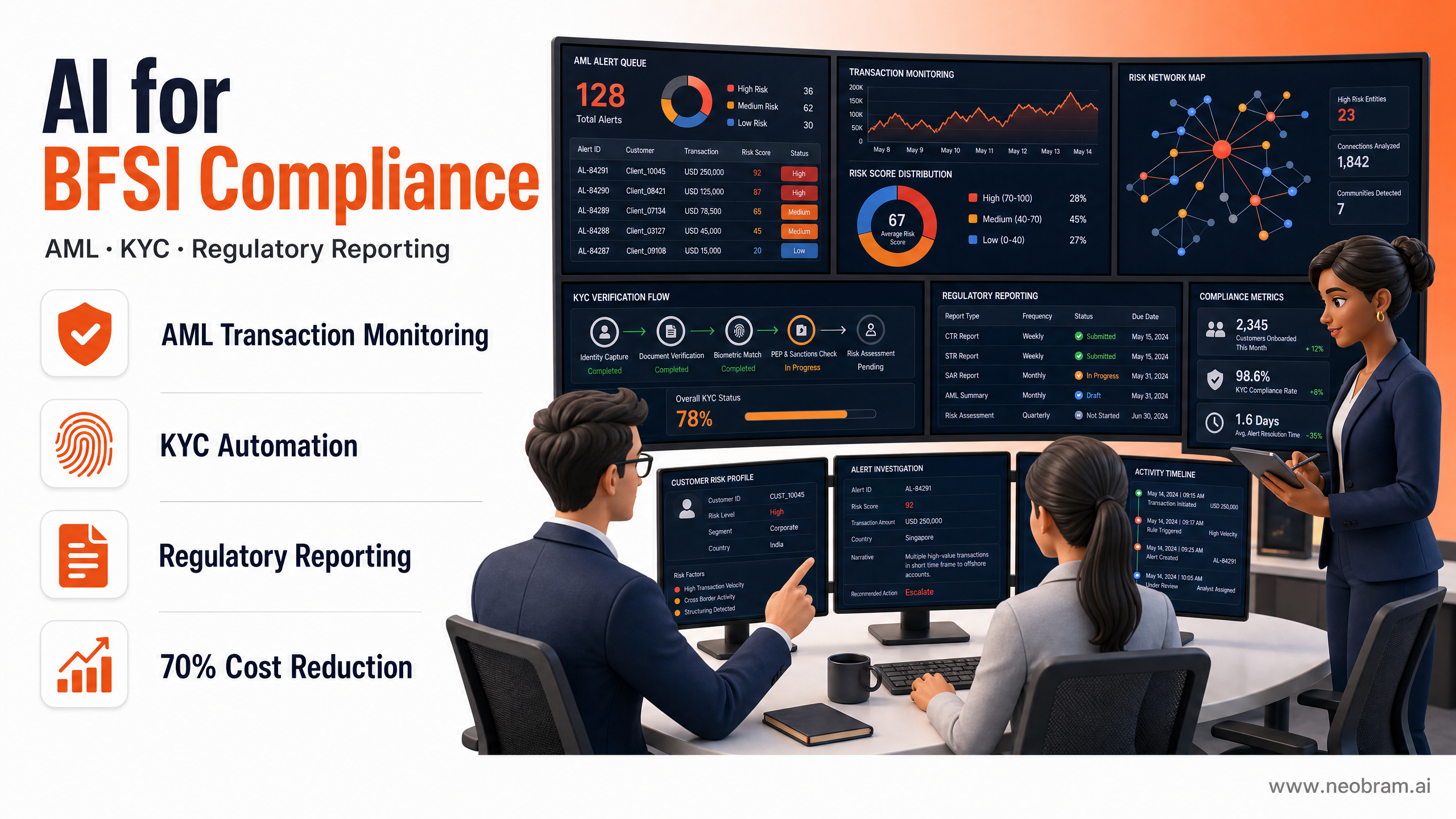
- AML false positives exceed 90% in rules-based systems; ML models reduce them by 40-55% while improving genuine detection.
- Manual KYC costs $1,500-3,000 per client review; AI automation cuts processing costs by up to 70% and time from 18 minutes to under 30 seconds.
- Agentic AI in AML can deliver 200-2,000% productivity uplifts, with one analyst supervising 20+ AI agents simultaneously (McKinsey).
- The global AML software market is growing at 14.8% CAGR, reaching $10.3 billion by 2033, driven by AI-native compliance platforms.
Why BFSI Compliance Is Broken, and Why AI Is the Fix
Compliance in banking, financial services, and insurance (BFSI) has always been expensive. But the cost has become genuinely unsustainable. The average financial institution now spends $72.9 million annually on AML and KYC operations alone, according to Fenergo's 2025 KYC Trends Report. Regulatory fines for compliance failures topped $10 billion globally in 2024. And the volume of suspicious activity reports (SARs) filed each year continues to climb, while the rate of actual criminal convictions from those reports stays stubbornly low.
The core problem is structural. Traditional compliance programs were built on rules: fixed thresholds, static watchlists, and manual review queues. Those rules made sense when transaction volumes were manageable and financial crime was relatively straightforward. Today, neither of those conditions holds. Criminals exploit gaps between siloed systems. Transactions move at near-instant speeds across dozens of jurisdictions. And compliance teams are buried under alert queues where more than 90% of flagged items turn out to be false positives.
AI doesn't just speed up the old process. It replaces the logic underneath it.
The global AML software market is growing at a CAGR of 14.8%, from $2.6 billion in 2023 to a projected $10.3 billion by 2033. AI-driven platforms are the primary driver of that growth, as institutions move away from static rules-based systems toward adaptive, machine-learning-powered compliance engines.
This guide covers the three biggest areas where AI is transforming BFSI compliance: anti-money laundering (AML), Know Your Customer (KYC), and regulatory reporting. For each, we explain what the technology actually does, what results institutions are seeing, and what the realistic implementation picture looks like in 2026.
AI in AML: From Rules to Risk Intelligence
The Problem with Rules-Based Transaction Monitoring
Legacy AML systems work by applying fixed rules to transaction data. If a customer sends more than $10,000 in a single transfer, flag it. If a series of transactions stays just below a reporting threshold, flag it. If a counterparty appears on a watchlist, flag it.
The problem is that criminals learned these rules a long time ago. Structuring, layering, and smurfing are all techniques designed specifically to stay below the thresholds that trigger rule-based alerts. Meanwhile, the rules generate enormous numbers of false positives: legitimate transactions that look suspicious on paper but are entirely benign in context.
Industry estimates suggest that between 90% and 95% of AML alerts generated by rules-based systems are false positives. Compliance teams spend the majority of their time clearing these alerts rather than investigating genuine financial crime. The result is a system that is simultaneously expensive and ineffective.
How Machine Learning Changes the Equation
AI-powered AML systems approach the problem differently. Instead of applying fixed rules, they build statistical models of normal behaviour for each customer, account type, and transaction corridor. Deviations from that baseline, not from an arbitrary threshold, trigger alerts.
The practical impact is significant. ML-enhanced name matching alone reduces false positives by 40-55% compared to basic string matching, according to Refinitiv's 2025 Screening Benchmark Report. Automated screening processes 1,000 to 5,000 names per second, versus 20 to 30 per hour for manual checks.
More importantly, the models improve over time. As analysts review and resolve alerts, their decisions feed back into the model, continuously refining what counts as suspicious. Rules-based systems don't learn. AI systems do.
Network Analysis and Typology Detection
One of the most powerful applications of AI in AML is network analysis: the ability to map relationships between accounts, entities, and transactions to identify coordinated criminal activity that no single transaction would reveal.
A classic money laundering scheme might involve dozens of accounts, each conducting individually unremarkable transactions, all coordinated to move funds through the system. Rules-based monitoring looks at each transaction in isolation and misses the pattern entirely. Graph-based AI models look at the network and can identify the structure of the scheme even when individual transactions appear normal.
McKinsey research indicates that agentic AI applied to AML processes can deliver productivity uplifts of 200% to 2,000%, with one human compliance analyst able to supervise 20 or more AI agents simultaneously. This isn't a projection; it's being achieved in production environments at major financial institutions today.
Real-Time AML: The Shift from Batch to Streaming
Traditional AML monitoring runs on batch processing: transactions are collected, analysed overnight, and alerts generated the next morning. By the time an analyst reviews a suspicious transaction, the funds have already moved.
Real-time AML changes this. AI systems analyse transactions as they occur, flagging suspicious activity before settlement. This is particularly important in the context of instant payment rails, where transactions complete in seconds and batch-based monitoring is effectively useless.
The European Banking Authority has already begun nudging institutions toward real-time monitoring capabilities. In 2026, real-time AML is transitioning from a competitive differentiator to a baseline regulatory expectation in many jurisdictions.
AI in KYC: Faster, Cheaper, and More Accurate
The Cost of Manual KYC
Know Your Customer checks are the single most expensive compliance activity for most financial institutions. Manual KYC reviews cost between $1,500 and $3,000 per client, according to Fenergo research, with 21% of banks spending over $3,000 per review. A human KYC specialist performs roughly three checks per hour. Automated systems verify up to 50 users in the same timeframe.
The cost isn't just financial. Slow KYC is a customer retention problem. In 2025, 70% of financial firms lost clients due to slow onboarding, up from 48% in 2023. When a customer can open a digital bank account in minutes but has to wait days for a traditional bank's KYC process to complete, the choice is obvious.
What AI-Powered KYC Actually Does
AI-powered KYC systems automate the document-heavy, data-intensive parts of the verification process. The core components are:
Document extraction and validation. AI systems scan passports, driver's licences, and corporate documents using optical character recognition, extract structured data, and validate authenticity by checking security features and detecting tampering. Modern OCR engines achieve 95-99% data extraction accuracy for standard documents, according to Gartner's 2025 benchmarks.
Biometric and liveness checks. Facial recognition compares the applicant's selfie against their identity document. Liveness detection confirms the person is physically present, not a printed photo or deepfake. Digital verification enhances fraud detection accuracy by 61% compared to manual review, per AU10TIX research.
Sanctions and PEP screening. Automated screening against OFAC, UN, and EU sanctions lists, politically exposed persons (PEP) databases, and adverse media sources. ML-enhanced fuzzy matching reduces false positives while maintaining near-perfect recall on known sanctions entries.
Risk scoring and routing. AI assigns a risk score to each customer based on the full picture of their identity, behaviour, and transaction profile. Low-risk customers move through straight-through processing automatically. High-risk cases are routed to analysts with all relevant data pre-assembled.
Institutions deploying AI-powered KYC automation reduce average onboarding time by 45-60% for individual customers and 30-40% for corporate accounts, according to Deloitte's 2025 Digital Identity Report. Processing time drops from 18+ minutes per manual review to under 30 seconds for automated verification.
Perpetual KYC: Continuous Monitoring Instead of Periodic Reviews
Traditional KYC operates on a periodic review cycle: customers are checked at onboarding and then reviewed every one to three years depending on their risk classification. The problem is that a customer's risk profile can change dramatically between reviews. A low-risk retail customer who becomes a politically exposed person, or whose business activities shift toward high-risk jurisdictions, may not be caught until their next scheduled review.
Perpetual KYC (pKYC) replaces the periodic review model with continuous monitoring. AI systems track changes in customer data, transaction behaviour, and external risk signals in real time, triggering reviews when risk profiles change rather than on a fixed schedule.
Only 12% of financial institutions have implemented any form of pKYC as of 2025, according to KPMG's Future of KYC Report. But adoption is accelerating as the technology matures and regulators signal their preference for risk-based, continuous monitoring over static periodic reviews.
The Corporate KYC Challenge
Individual customer KYC is relatively straightforward to automate. Corporate KYC is harder. Verifying beneficial ownership, mapping complex corporate structures, and conducting enhanced due diligence on high-risk entities still requires significant human judgment.
AI helps by automating the data assembly phase: pulling corporate registry information, mapping ownership chains, screening all identified beneficial owners against sanctions lists, and surfacing adverse media. This reduces the time analysts spend on data collection, freeing them to focus on the judgment-intensive parts of the review.
The realistic picture in 2026 is that straight-through processing rates for individual onboarding run at 35-55%, while corporate onboarding achieves 15-25% automation, according to Gartner's survey of institutions with KYC automation deployments. Full automation for complex corporate structures remains a future state, not a current reality.
AI in Regulatory Reporting: Accuracy, Speed, and Auditability
The Regulatory Reporting Burden
Financial institutions file millions of regulatory reports each year: SARs, currency transaction reports (CTRs), FATCA filings, MiFID transaction reports, Basel capital reports, and dozens of jurisdiction-specific requirements. Each report must be accurate, timely, and auditable. Errors trigger regulatory scrutiny. Delays attract fines. Inconsistencies between reports filed to different regulators create legal exposure.
Manual regulatory reporting is slow, error-prone, and expensive. Data must be extracted from multiple source systems, validated, transformed into the required format, reviewed by compliance staff, and submitted through regulatory portals. The process is repeated for each report type, each jurisdiction, and each reporting period.
How AI Streamlines Regulatory Reporting
AI automates the mechanical parts of regulatory reporting: data extraction, validation, transformation, and submission. Natural language processing can read unstructured data from internal systems and extract the structured information required for regulatory filings. Machine learning models validate data quality, flagging inconsistencies before reports are submitted rather than after regulators identify them.
More significantly, AI enables proactive compliance monitoring. Instead of discovering a reporting error when a regulator queries it, AI systems continuously monitor data quality and flag potential issues in real time. This shifts the compliance posture from reactive to preventive.
For SAR filing specifically, AI can assist analysts by pre-populating report fields from transaction data, summarising the suspicious activity narrative, and checking the draft report against regulatory requirements before submission. This doesn't replace the analyst's judgment on whether to file, but it significantly reduces the time required to prepare each report.
The Regulatory Technology (RegTech) Market
The RegTech market, which includes AI-powered regulatory reporting tools, is growing rapidly. The AI and automation in banking market was valued at $42.6 billion in 2025 and is projected to reach $239.6 billion by 2033, at a CAGR of 24.9%, according to Grand View Research.
Regulatory divergence between jurisdictions is actually driving AI adoption in reporting. As US and EU regulatory requirements increasingly diverge, institutions need technology that can adapt to different reporting formats and requirements without rebuilding their compliance infrastructure from scratch. AI-powered reporting platforms with configurable rules and templates are better positioned to handle this complexity than rigid legacy systems.
Key Challenges in AI-Powered BFSI Compliance
Explainability and Regulatory Accountability
Regulators don't just want compliance programs that work. They want compliance programs that can be explained. If an AI system flags a transaction as suspicious, or clears a customer through KYC, the institution must be able to explain why. This is the explainability challenge.
Black-box AI models that produce accurate results but cannot explain their reasoning create regulatory risk. The EU AI Act, which entered into force in August 2024, raises expectations around governance, logging, oversight, and documentation for AI systems operating in regulated environments. Institutions deploying AI in compliance must maintain detailed records of model inputs, outputs, confidence thresholds, manual overrides, and approval steps.
This isn't a reason to avoid AI in compliance. It's a reason to choose AI systems designed with explainability as a core feature, not an afterthought.
Data Quality
AI models are only as good as the data they're trained on. In BFSI compliance, data quality problems are endemic. Customer records are incomplete or inconsistent across systems. Transaction data is stored in formats that vary by product line, geography, and acquisition history. Historical SAR data is often labelled inconsistently, making it difficult to train models on what "suspicious" actually means.
Institutions that invest in data quality before deploying AI compliance tools see significantly better results than those that deploy AI on top of poor-quality data. This is not a technology problem. It's a data governance problem that technology can't solve on its own.
The False Positive Paradox
Reducing false positives is one of the main selling points of AI in AML. But reducing false positives too aggressively creates a different problem: false negatives, genuine suspicious activity that the system misses. Regulators are increasingly focused on whether AI-powered monitoring systems are catching financial crime, not just whether they're generating fewer alerts.
The right calibration depends on the institution's risk appetite, the regulatory environment, and the specific transaction types being monitored. There's no universal setting. Institutions need to monitor model performance continuously and adjust thresholds as criminal typologies evolve.
Third-Party Risk
Most institutions deploy AI compliance tools from third-party vendors rather than building them in-house. This creates outsourcing risk. The institution remains responsible for the compliance outcomes even when the underlying technology is provided by a vendor. Regulators expect institutions to understand what their AI systems are doing, how they're making decisions, and how they perform across different customer segments.
Vendor due diligence for AI compliance tools needs to go beyond standard procurement checklists. Institutions should understand the model architecture, training data, validation methodology, performance benchmarks, and update cadence of any AI system they deploy in a compliance context.
Building a Roadmap for AI Compliance Adoption
Start with the Highest-ROI Use Cases
Not all compliance processes are equally ready for AI. The highest-ROI starting points are typically:
Sanctions and PEP screening. This is the most mature AI compliance application. Automated screening is faster, more accurate, and generates fewer false positives than manual processes. The regulatory expectation of automation is already established for institutions processing significant transaction volumes.
Document verification in KYC. AI-powered document extraction and validation delivers measurable cost and time savings with well-understood technology. The ROI is clear and the implementation risk is relatively low.
Alert triage in transaction monitoring. AI can prioritise the existing alert queue, routing the highest-risk cases to experienced analysts and handling routine false-positive clearance automatically. This doesn't require replacing the existing monitoring system; it adds an intelligence layer on top of it.
Build the Data Foundation First
Before deploying AI, institutions need to assess and improve their data quality. This means consolidating customer data across systems, standardising transaction data formats, and establishing clear data governance policies. AI compliance tools amplify the quality of the underlying data. Poor data quality produces poor AI outcomes.
Plan for Human-AI Collaboration, Not Replacement
The most effective compliance programmes in 2026 are not fully automated. They're hybrid: AI handles the high-volume, routine tasks while human analysts focus on complex judgments, escalations, and the cases where regulatory accountability sits at the decision point.
This requires rethinking how compliance teams are structured and trained. Analysts need to understand how the AI models work, what their limitations are, and when to override them. The goal is not to eliminate human judgment but to direct it where it adds the most value.
How NeoBram Can Help
NeoBram works with BFSI institutions to design and deploy AI-powered compliance solutions that are practical, auditable, and built for the regulatory environment you actually operate in.
Our approach starts with an honest assessment of where your compliance programme stands today: the data quality, the existing technology stack, the regulatory obligations, and the specific pain points your team is dealing with. We don't sell a generic AI platform. We build solutions that fit your specific context.
For AML, we help institutions move from static rules-based monitoring to adaptive ML models that reduce false positives without increasing false negatives. We implement network analysis capabilities that surface coordinated financial crime patterns that transaction-level monitoring misses. And we build the explainability and audit trail infrastructure that regulators require.
For KYC, we automate the document-intensive, data-heavy parts of the verification process while preserving human judgment for the cases that genuinely require it. We help institutions implement perpetual KYC monitoring for high-risk customer segments and build the data integration infrastructure that continuous monitoring requires.
For regulatory reporting, we streamline data extraction, validation, and submission workflows, reducing the manual effort involved in routine filings and improving data quality before reports reach regulators.
Our team includes compliance specialists, data engineers, and AI practitioners who understand both the technology and the regulatory context. We've worked with banks, insurers, and financial services firms across multiple jurisdictions, and we understand that compliance requirements vary significantly by geography and institution type.
Book a free strategy call at https://neobram.ai/contact to discuss where AI can make the biggest difference for your institution.