Key takeaways
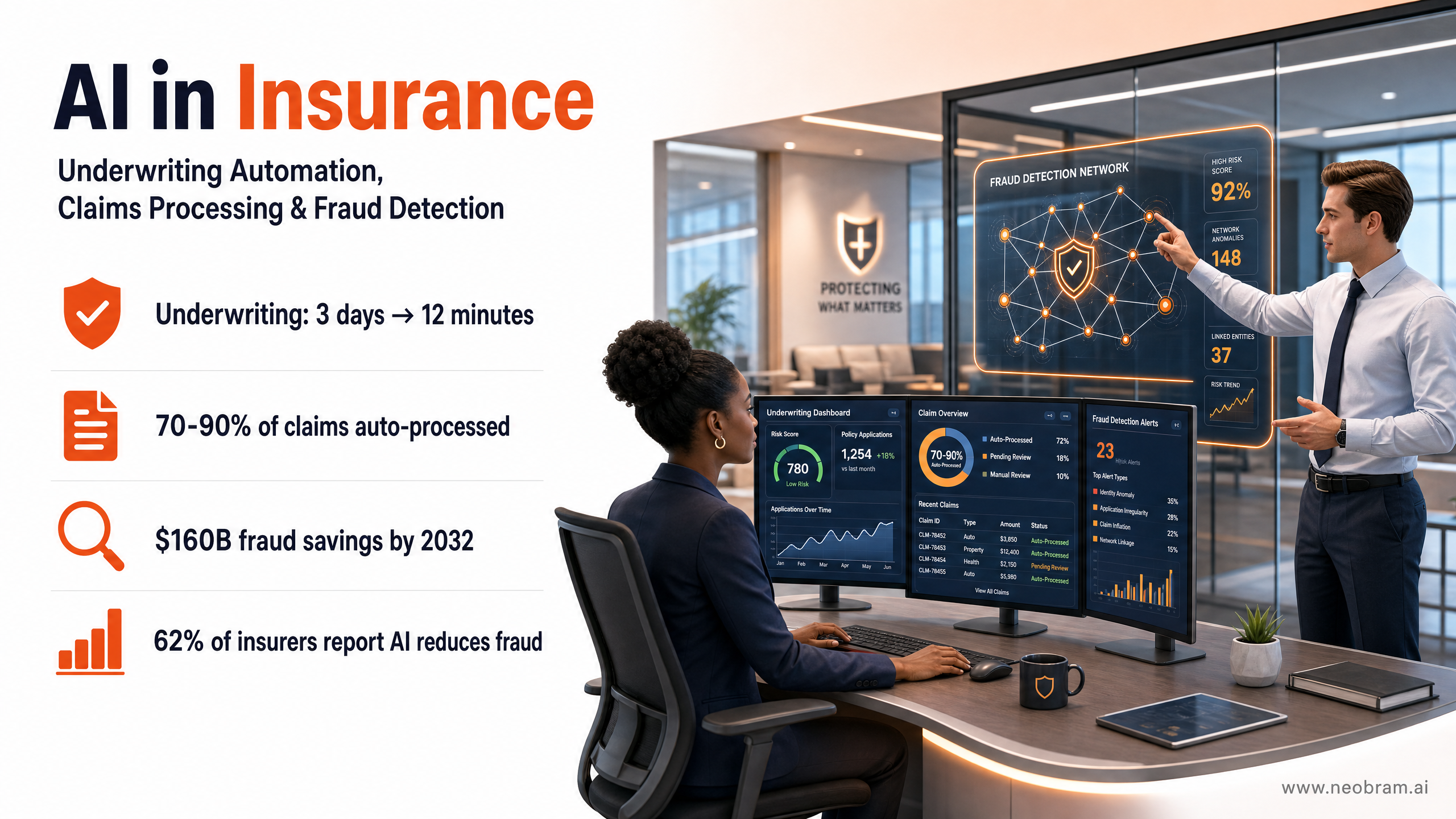
- AI reduces underwriting decision time from days to just 12.4 minutes for standard policies.
- Automated claims systems can process 70 to 90% of simple claims straight-through.
- Generative AI could unlock a $100 billion benefit in P&C claims handling.
- AI fraud detection could save insurers up to $160 billion by 2032.
Why Insurance Is AI's Next Big Frontier
Insurance has always been a data business. Underwriters assess risk from documents, histories, and signals. Claims teams sift through evidence to decide what to pay. Fraud investigators look for patterns that don't add up. Every one of those tasks is exactly what AI does well.
The numbers reflect this. The global AI in insurance market was valued at $13.45 billion in 2026 and is projected to reach $154.39 billion by 2034, growing at a CAGR of roughly 35%. Claims processing is already one of the largest use case segments, and underwriting automation is accelerating fast.
This guide covers three areas where AI is delivering measurable results for insurers today: underwriting automation, claims processing, and fraud detection. If you're a BFSI leader evaluating where to start, this is where the ROI is clearest.
AI in Insurance Underwriting: From Days to Minutes
The Traditional Underwriting Problem
Standard underwriting is slow by design. An underwriter reviews an application, pulls data from multiple sources, cross-references policy rules, assesses risk, and makes a decision. For complex commercial policies, this can take three to five days per case. For high-volume personal lines, the backlog builds fast.
The bottleneck isn't judgment. It's data gathering and document processing. According to Capgemini, 41% of underwriters' working hours go toward operational and administrative tasks rather than actual risk assessment. That's nearly half the team's capacity consumed by work that AI can handle.
How AI Transforms the Underwriting Workflow
AI changes underwriting in three concrete ways.
Risk digitisation is the first. AI systems ingest documents in any format, including PDFs, emails, scanned forms, and handwritten notes, and convert them into structured, machine-readable risk profiles. What used to take an underwriter hours of manual extraction now happens in seconds.
Automated risk scoring is the second. Once data is structured, ML models assess risk against thousands of historical cases. They surface anomalies, flag missing information, and generate preliminary risk scores with explanations. The underwriter reviews the output rather than building it from scratch.
Decision-ready workflows are the third. Instead of assembling a risk picture, underwriters receive one. They spend their time on judgment calls, not data entry.
AI has reduced average underwriting decision time from three to five days to just 12.4 minutes for standard policies, while maintaining a 99.3% accuracy rate in risk assessment. For complex policies, AI reduces processing times by 31% and improves risk assessment accuracy by 43%. (Source: 2025 ResearchGate technical analysis)
Real-World Underwriting Automation in Practice
Allianz deployed BRIAN, a generative AI underwriter guidance tool that reads hundred-page documents and surfaces relevant risk signals for underwriters. The system doesn't replace the underwriter's judgment. It removes the reading and extraction work so underwriters can focus on the decision.
AIG's leadership has spoken publicly about building AI agents for end-to-end underwriting, from data ingestion at the start of the process all the way to calculating propensity to bind at the end. That's a fully automated underwriting pipeline with human oversight at key decision points.
BCG research found that AI can improve underwriting efficiency by up to 36% in complex lines of business and reduce loss ratios meaningfully. Over 380 companies, including technology vendors and established insurers, now rely on AI-based underwriting tools.
What AI Can Underwrite Today
Personal lines like auto, home, and life insurance are the most automated. Simple applications can be processed end-to-end with minimal human involvement. Commercial lines are more complex, but AI is making inroads there too, particularly in data extraction and preliminary scoring.
Healthcare insurers are moving quickly. 44% already use AI or ML for calculating rates, and adoption is accelerating as claims data becomes richer and more structured.
AI in Claims Processing: Faster, Cheaper, More Accurate
The Claims Processing Challenge
Claims are where insurers spend money. The faster and more accurately they're processed, the better the outcome for both the insurer and the policyholder. But traditional claims processing is slow, manual, and inconsistent.
A standard auto claim might take two to three weeks to settle. A complex liability claim can take months. Every day of delay costs money in administrative overhead, and inconsistent decisions create leakage, where claims are paid at more or less than the correct amount.
AI-powered claims management systems can process 70 to 90% of simple insurance claims in a straight-through manner, with decisions delivered in minutes rather than weeks. This drives a 20 to 50% reduction in claim resolution costs and up to a 50% increase in claims specialists' productivity. (Sources: BCG, Bain, ScienceSoft)
The AI-Powered Claims Lifecycle
AI touches every stage of the claims process.
Intake and triage. When a claim arrives, AI reads the submission, extracts key data, classifies the claim type, and assigns a priority level. Complex claims get routed to specialists. Simple, clean claims go straight to automated processing. This alone eliminates days of manual sorting.
Validation. AI cross-references the claim against policy terms, checks for coverage gaps, and flags inconsistencies. It pulls data from third-party sources, including repair databases, medical billing codes, and weather records, to verify that what's claimed matches what happened.
Damage assessment. Computer vision models analyse photos and videos submitted with claims. For auto insurance, they can estimate repair costs from images with accuracy comparable to human adjusters. For property claims, satellite and drone imagery is used to verify damage extent without sending an adjuster to the site.
Decisioning. For straightforward claims, AI generates an approval recommendation with supporting evidence. For borderline cases, it flags the specific issues for human review. The adjuster sees a structured summary rather than a pile of documents.
Customer communication. AI-powered virtual assistants handle routine updates, document requests, and status queries. Policyholders get faster responses. Claims teams spend less time on phone calls.
The Numbers Behind Claims AI
Generative AI is estimated to unlock a $100 billion benefit opportunity for insurers in P&C claims alone, through reducing loss-adjusting expenses by 20 to 25% and claims leakage by 30 to 50%.
McKinsey predicts that by 2030, claims processing will become the most important insurance function, with AI as the primary driver of its transformation. The global AI in insurance market is projected to grow from $14.99 billion in 2025 to $246.3 billion by 2035, a CAGR of 32.3%.
One practical example: Great American Insurance implemented an AI document processing tool and dramatically reduced the time their teams spent on manual document handling, freeing underwriters and claims staff for higher-value work.
Straight-Through Processing: The Goal
The ultimate measure of claims AI maturity is straight-through processing (STP) rate: the percentage of claims resolved without human intervention. Leading insurers are achieving STP rates of 70 to 90% for simple claims. That means the majority of routine claims never touch a human adjuster's desk.
For insurers processing millions of claims per year, even a 10-percentage-point improvement in STP rate translates to tens of millions in operational savings.
AI in Insurance Fraud Detection: Protecting the Bottom Line
The Scale of Insurance Fraud
Insurance fraud is the second-most costly white-collar crime in the United States, after tax evasion. The FBI estimates it costs the average American family between $400 and $700 per year in higher premiums. In the property and casualty sector alone, an estimated 10% of claims are fraudulent, resulting in approximately $122 billion in annual losses.
Fraud falls into two categories. Soft fraud, which accounts for 60% of incidents, involves inflating legitimate claims, such as overstating repair costs or exaggerating injuries. Hard fraud involves premeditated actions to create false claims: staged accidents, arson, faked theft. Soft fraud is more common and harder to prove.
The problem has intensified since the pandemic, which accelerated digital claims submission and created new opportunities for organised fraud rings.
AI could save insurers between $80 billion and $160 billion in fraud prevention by 2032, according to Deloitte. The fraud detection technology market is projected to grow from $4 billion in 2023 to $32 billion by 2032. Insurers that integrate multimodal AI capabilities could generate potential savings of 20 to 40%. (Source: Deloitte, 2025)
How AI Detects Fraud
Traditional fraud detection relied on rules: if a claim exceeds a certain threshold, flag it. Rules-based systems catch obvious fraud but miss sophisticated schemes. They also generate high false-positive rates, wasting investigators' time on legitimate claims.
AI takes a different approach. It learns patterns from thousands of confirmed fraud cases and identifies anomalies that don't match normal behaviour, even when no single rule is violated.
Text analytics uses natural language processing to analyse claims forms, emails, and social media posts. It identifies suspicious language, inconsistencies between documents, and patterns that correlate with fraud.
Image and video analysis examines photos submitted with claims for signs of manipulation, checks metadata for inconsistencies, and uses computer vision to assess whether damage is consistent with the claimed incident.
Geospatial analysis uses satellite images and drone footage to verify damage extent and location. For weather-related claims, it cross-references the claim with actual weather data at the specific location and time.
IoT and telematics data provides objective evidence. Vehicle telematics can reconstruct an accident and verify whether the claimed sequence of events is physically plausible. Smart home sensors can provide evidence for or against property claims.
Behavioural analytics tracks patterns across multiple claims and interactions. A claimant who files multiple claims with similar characteristics, or whose behaviour changes significantly after a policy is issued, gets flagged for review.
The Compounding Effect
What makes AI fraud detection particularly powerful is that it improves over time. Every confirmed fraud case trains the model. Every false positive that gets cleared teaches the system to be more precise. Over months and years, the detection rate rises and the false-positive rate falls.
ScienceSoft built ML algorithms for a health insurance startup that achieved 95% accuracy in dental insurance fraud detection, using computer vision to analyse X-ray images and identify mismatched oral health data. That level of precision is impossible with manual review.
62% of insurers now report that AI has improved underwriting quality and reduced fraud. That's not a pilot programme result. That's the majority of the industry seeing measurable benefit.
Key Challenges in Insurance AI Adoption
AI delivers real results in insurance, but implementation isn't without friction. Understanding the challenges upfront helps you plan for them.
Data Quality and Availability
AI models are only as good as the data they're trained on. Many insurers have decades of claims and underwriting data locked in legacy systems, in inconsistent formats, with incomplete records. Before AI can deliver value, that data needs to be cleaned, structured, and made accessible.
This is often the most time-consuming part of an AI implementation. It's also the most important. Skipping it leads to models that perform well in testing and poorly in production.
Regulatory Compliance
Insurance is heavily regulated. AI systems that make or influence underwriting and claims decisions need to be explainable, auditable, and free from discriminatory bias. Regulators in the US, EU, and India are increasingly scrutinising AI decision-making in financial services.
This means insurers can't just deploy a black-box model. They need AI systems that can explain their decisions in plain language, log every recommendation, and demonstrate that protected characteristics aren't being used as proxies for risk.
Bias in Training Data
If historical underwriting decisions were biased, training an AI on that data will replicate and potentially amplify the bias. This is particularly relevant for life insurance, where historical underwriting criteria have sometimes disadvantaged certain demographic groups.
Responsible AI implementation requires auditing training data for bias, testing model outputs across demographic groups, and building in ongoing monitoring to catch drift over time.
Change Management
Underwriters and claims adjusters who have spent years building expertise don't always welcome AI tools that seem to second-guess their judgment. Successful AI adoption in insurance requires genuine engagement with frontline staff, clear communication about what AI does and doesn't do, and workflows that position AI as a tool that makes their job better, not a replacement.
Building an AI Roadmap for Insurance
If you're an insurance leader evaluating AI adoption, here's how to think about sequencing.
Start with Claims Automation
Claims processing offers the clearest ROI and the most structured data. Start with a specific claims type, such as auto or property, and build a pilot that targets intake, validation, and straight-through processing for simple claims. Measure STP rate, cycle time, and cost per claim before and after.
Add Fraud Detection in Parallel
Fraud detection can run alongside claims automation. Start with rules-based flagging enhanced by ML anomaly detection. As the model learns from your confirmed fraud cases, it gets more precise. Track false-positive rate and fraud detection rate as your key metrics.
Expand to Underwriting
Underwriting automation is more complex because it involves more judgment and more regulatory scrutiny. Start with data extraction and risk digitisation, where the ROI is immediate and the risk is low. Then layer in automated scoring for standard policies before moving to complex commercial lines.
Build the Data Foundation
Regardless of where you start, invest in data infrastructure. A clean, accessible data layer is what separates insurers that get real value from AI from those that run endless pilots without scaling.
How NeoBram Can Help
NeoBram works with BFSI organisations to design and implement AI solutions that deliver measurable results, not just proof-of-concept demos.
For insurance clients, our work typically spans three areas. First, we assess your current data infrastructure and identify the gaps that would limit AI performance. Second, we design and build the specific AI capabilities that match your highest-priority use cases, whether that's claims automation, fraud detection, or underwriting support. Third, we build the monitoring and governance layer that keeps your AI systems compliant, explainable, and continuously improving.
We don't sell platforms. We build solutions that fit your existing systems, your regulatory environment, and your team's way of working. Our implementations are designed to scale, so what starts as a pilot for one claims type can expand across your entire portfolio.
If you're evaluating AI for your insurance operations and want a clear-eyed view of what's achievable in your specific context, we'd welcome the conversation.
Book a free strategy call with the NeoBram team at https://neobram.ai/contact to discuss your AI roadmap.