Key takeaways
- An engineering copilot is a permission-aware retrieval and reasoning layer over PLM, PDM, document, maintenance, and operational knowledge, not an ungrounded chat interface.
- The quality of the answer depends more on source authority, metadata, version control, and evaluation than on model size alone.
- OPC Foundation work to make more than 430 Companion Specifications easier for RAG and AI-assisted engineering shows why machine-readable industrial semantics matter.
- Production acceptance should measure retrieval recall, citation completeness, permission isolation, answer usefulness, and safe fallback behavior before any write-back action is allowed.
The engineering search problem is not a model problem
An engineer who asks, "Which previous design decision explains this vibration limit?" is rarely asking for a generic paragraph. They are asking for the approved drawing revision, the calculation note behind it, the test record that challenged it, and the change order that made the current answer valid.
That information usually exists. It is distributed across a product lifecycle management system, a document repository, a shared drive, email exports, maintenance records, supplier packages, scanned PDFs, drawings, spreadsheets, and the memory of experienced people. The cost is not only the time spent searching. It is the risk of using an obsolete revision, missing a constraint, repeating a failed experiment, or making a decision without the evidence that should accompany it.
The title of this guide uses "20 years" as a representative knowledge-continuity scenario, not as a claim that every engineering organization has the same archive age. The practical question is more useful: Can an engineer find the authoritative evidence behind a decision quickly, with permissions and revision history intact?
Deloitte’s 2026 manufacturing survey illustrates the current operating tension. It reports that 84 percent of manufacturers surveyed see measurable value from AI, while only 20 percent of use cases are scaled. [1] For engineering teams, scaling does not mean placing a chat box beside CAD. It means turning fragmented technical knowledge into a reviewable workflow that engineers can use without weakening configuration control.
What an engineering copilot actually is
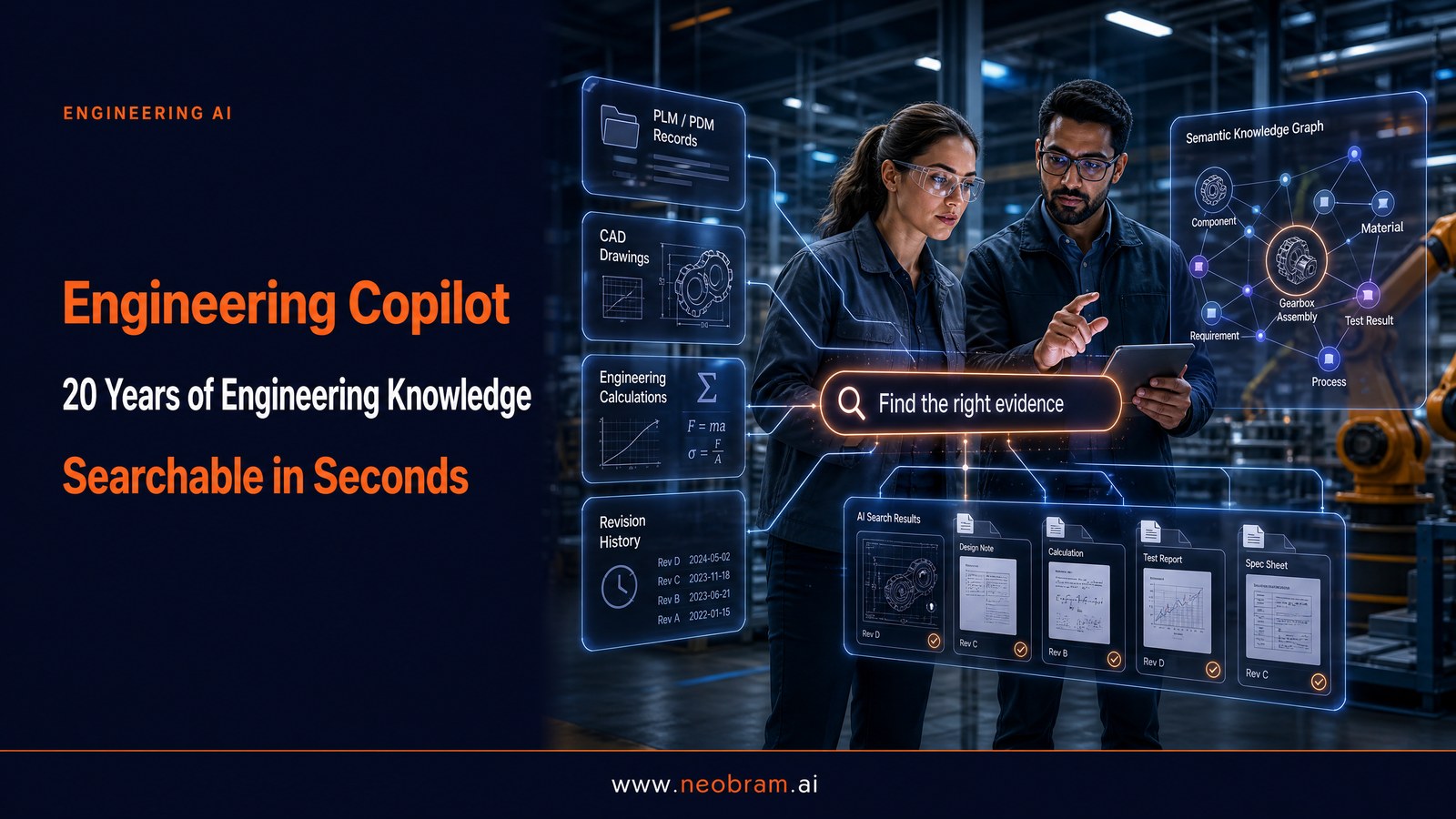
An engineering copilot is a controlled retrieval, reasoning, and interaction layer over engineering knowledge. It accepts a question in the language engineers use, finds relevant evidence from approved sources, explains the answer with citations and document context, and makes uncertainty visible. The engineer remains the decision owner.
A useful copilot therefore has five properties:
- Grounded: - The answer is generated from retrieved evidence rather than from the model’s general memory alone.
- Version-aware: - The system distinguishes released, superseded, draft, and archived revisions.
- Permission-aware: - A user cannot retrieve information they could not access in the source system.
- Traceable: - Each material statement can be inspected back to a page, section, drawing, record, or data object.
- Operationally bounded: - The copilot can suggest, summarize, compare, and route work, but it does not silently approve a design or change a control system.
This is why a general-purpose chatbot often disappoints in engineering. A fluent answer without document identity, revision, source location, and access enforcement is not an engineering answer. It is an unreviewable suggestion.
The knowledge estate an engineering copilot must search
Before selecting a model, map the sources that contain decisions and constraints. A source inventory is more valuable than a long list of documents because it records authority, ownership, update behavior, and the consequence of using a stale copy.
| Knowledge domain | Typical source | What the copilot should return | Control that matters |
|---|---|---|---|
| Product definition | PLM, PDM, CAD vault | Part, assembly, drawing, revision, release state | Configuration and revision authority |
| Requirements and verification | Requirements tool, test system | Requirement, verification method, result, exception | Traceability from requirement to evidence |
| Engineering calculations | Calculation notes, spreadsheets, simulation files | Assumption, input, result, boundary, approval | Formula context and unit integrity |
| Manufacturing engineering | Work instructions, routings, tooling records | Operation, parameter, fixture, approved instruction | Plant and product applicability |
| Quality and change | NCR, CAPA, deviation, ECO or ECN records | Failure, disposition, change reason, affected objects | Status, closure, and impact links |
| Field and service knowledge | Maintenance logs, service reports, manuals | Symptom, diagnosis, remedy, observed condition | Asset identity and time context |
| Standards and suppliers | Standards library, supplier packages | Requirement, interpretation, certificate, scope | Licence, source authority, and expiry |
The system should not flatten all of these sources into one anonymous text bucket. A released drawing and an engineer’s informal note may contain the same words but have very different authority. Metadata is part of the meaning.
How the copilot turns archives into searchable evidence
1. Define the decision before the index
Start with a recurring engineering decision, not with a document-count target. Examples include finding the approved torque range for a service task, identifying the design changes that affect a component interface, locating prior root-cause evidence for a recurring failure, or answering which verification record supports a requirement.
For each decision, name the user, the permitted evidence, the expected output, the reviewer, and the safe fallback. This prevents the project from becoming a vague promise to "make all engineering knowledge searchable."
2. Build an authority and version model
Every source connector should preserve identifiers that engineers already trust: document number, revision, lifecycle state, product or asset applicability, author, approver, effective date, supersession link, and access group. If those fields do not exist, the ingestion process should record the limitation instead of inventing certainty.
A practical retrieval record is not just a paragraph. It is a paragraph plus its source identity, page or section, revision, status, timestamp, and relationships to neighbouring objects. That structure is what lets an answer say, "This is from released drawing 1234, revision C," rather than, "I found a similar sentence."
3. Extract structure from technical files
Engineering knowledge is multimodal. A PDF may contain text, tables, symbols, scanned annotations, and drawing callouts. A calculation workbook contains formulas, units, named ranges, and hidden assumptions. A CAD or PLM record contains structured relationships that should not be reduced to a screenshot.
Use format-specific extraction where possible, then preserve the original file as the review record. OCR can make a scanned document discoverable, but OCR output should retain page coordinates and confidence information. Tables should remain tables. Units should remain explicit. Drawings should carry title-block metadata, revision, and sheet number.
4. Use hybrid retrieval, not semantic similarity alone
A robust engineering search normally combines lexical, semantic, metadata, and relationship retrieval. Exact part numbers and standard clauses need lexical matching. Natural-language questions benefit from semantic retrieval. Revision, asset, product, plant, and lifecycle filters protect applicability. Graph or link traversal connects a requirement to a test, a component to an ECO, or a failure mode to a corrective action.
The retrieval sequence should be inspectable. Log the query, filters, candidate sources, reranking decision, selected passages, and final citations. When the answer is weak, the team needs to know whether the problem was missing content, bad extraction, insufficient metadata, poor ranking, or an unsupported generation step.
5. Generate an answer that shows its work
The answer format should match the decision. A quick lookup may need a value, source, revision, and caveat. A design-change question may need a list of affected objects, the evidence for each relationship, and unresolved conflicts. A troubleshooting question may need observed symptoms, similar cases, recommended checks, and an explicit statement that the result is not a safety approval.
Use a stable answer contract:
- State the direct answer in one or two sentences.
- Show the evidence used, including source title, identifier, revision, and location.
- Separate retrieved fact, inference, and recommendation.
- Surface conflicts, missing records, and stale or draft evidence.
- State the next human review or verification step.
A citation is not decoration. It is the mechanism that allows another engineer to reproduce the reasoning and reject it when the evidence is not applicable.
A reference architecture for engineering knowledge search
A production design usually has distinct zones rather than one large prompt. The following pattern is intentionally vendor-neutral.
| Zone | Responsibility | Design question |
|---|---|---|
| Source systems | PLM, PDM, ERP, MES, QMS, EAM, file stores, standards | Which system is authoritative for each object? |
| Ingestion and change detection | Connectors, incremental updates, OCR, parsing | How is a new revision detected and an old one marked? |
| Knowledge model | Metadata, identifiers, relationships, lifecycle states | Can the system distinguish a released part from a draft? |
| Retrieval | Hybrid search, filters, reranking, graph traversal | Can the team inspect why each passage was selected? |
| Model and tools | Answer generation, comparison, extraction, workflow actions | Which tools are read-only, and which require approval? |
| Experience | Search, chat, document side panel, API, Teams or portal | Does the engineer see evidence without leaving the workflow? |
| Evaluation and governance | Test sets, logs, access checks, feedback, monitoring | Who owns acceptance when the answer is wrong? |
Microsoft describes an AI-powered digital thread as a way to combine knowledge across manufacturing data domains, including CRM, PLM, ERP, and MES, so AI systems are not confined to a single domain. [5] That is a useful architecture direction, but it does not remove the need for source ownership, data contracts, access control, and evaluation.
The OPC Foundation’s April 2026 announcement is also instructive. It says the Foundation intends to extend prototype work to make all over 430 OPC UA Companion Specifications more accessible to RAG, MCP, semantic search, and AI-assisted engineering workflows. [2] The significance is not the number alone. It is the principle that industrial semantics should remain machine-readable and governed while becoming easier for AI systems to retrieve.
High-value engineering copilot use cases
Design and change impact search
An engineer can ask which assemblies, drawings, requirements, tests, work instructions, and supplier documents reference a component or interface. The copilot should return linked evidence and identify where the relationship is explicit versus inferred. It should not declare an ECO safe to release.
Troubleshooting by symptom and context
A service or maintenance engineer can search for a symptom together with asset model, operating condition, alarm code, and recent work. The result should distinguish a verified procedure from a similar historical case. Siemens describes Industrial Copilot examples that include conversational troubleshooting, automation-code support, Teamcenter and Azure AI use cases, and digital-twin workflows. [3] These examples show the direction of the market; they are not proof that a generic implementation will deliver the same result.
Requirement and verification retrieval
Instead of searching for a sentence, the engineer can ask which verification evidence supports a requirement, what result was recorded, and whether an exception remains open. This is where link integrity matters more than prose generation.
Lessons from nonconformance and service history
Quality and service records contain valuable failure knowledge, but they also contain inconsistent terminology and incomplete closure notes. A copilot can cluster similar cases, identify recurring terms, and retrieve the original records. It should preserve uncertainty and never turn an unverified hypothesis into a corrective-action fact.
Onboarding and knowledge continuity
New engineers can ask how a subsystem works and receive a guided path through approved documents, prior decisions, and key terminology. The goal is not to replace the senior engineer. It is to make the senior engineer’s reasoning easier to reuse and easier to review.
How to evaluate an engineering copilot before production
A demo is not an evaluation. Build a representative test set from real questions, including ambiguous queries, near-duplicate part numbers, superseded revisions, missing documents, restricted content, multilingual records where relevant, and questions whose correct answer is "insufficient evidence."
| Evaluation dimension | What to measure | Failure that it catches |
|---|---|---|
| Retrieval recall | Whether the required source appears in the candidate set | The answer fails because the right evidence was never retrieved |
| Citation completeness | Whether material claims have inspectable sources | A fluent answer hides unsupported reasoning |
| Groundedness | Whether the answer stays within retrieved evidence | The model fills gaps with plausible invention |
| Version correctness | Whether the current approved revision wins | A superseded drawing is presented as current |
| Permission isolation | Whether restricted sources stay restricted | Cross-project or export-control leakage |
| Usefulness | Whether engineers can act or review without redoing the search | Technically correct but operationally irrelevant output |
| Resilience | Whether the system declines or escalates when evidence is weak | False certainty during missing-data conditions |
| Latency and cost | Response time and resource use for the target workflow | A good answer that cannot fit the operating process |
Label every test result. A helpful taxonomy is retrieved fact, supported inference, unsupported answer, permission failure, version failure, and needs human review. Measure changes against a documented baseline and keep the test set stable enough to compare model or index changes.
NIST says the AI RMF is intended to help organizations incorporate trustworthiness considerations into the design, development, use, and evaluation of AI systems. Its Generative AI Profile proposes actions for identifying and managing generative-AI risks. [4] For an engineering copilot, that means evaluation is not a launch ceremony. It is a lifecycle control with an owner, evidence, and a response when performance drifts.
Security and governance boundaries
Engineering knowledge often includes intellectual property, export-controlled information, supplier restrictions, safety information, and product vulnerabilities. A search layer should inherit or deliberately reproduce the source system’s access decisions. Do not assume that because a model is hosted privately, a user is entitled to see every retrieved chunk.
Separate read-only assistance from write-back actions. Reading a released procedure, comparing two revisions, or summarizing a test record can be governed differently from creating an ECO, changing a setpoint, or approving a design. Any write-back flow should use the target system’s identity, workflow, approval, and audit controls. The model should not become a shadow change-management system.
Retain the original evidence and the answer log according to the organization’s policy. Record model version, retrieval index version, prompt or instruction version, source revisions, user identity, and tool actions where appropriate. Define what happens when a document is deleted, access is revoked, a source connector fails, or a new revision invalidates an earlier answer.
A practical implementation sequence
Stage 1: Choose one decision and one evidence boundary
Select a workflow with a clear owner and a recurring search burden. Write down the users, systems, acceptable evidence, restricted evidence, expected answer format, and fallback. Do not begin by indexing every drive.
Stage 2: Build the source and evaluation baseline
Inventory representative files and records. Measure current search effort, answer quality, and the failure modes that matter. Create a test set before tuning the index so the project can distinguish real improvement from a better demo.
Stage 3: Pilot read-only retrieval
Connect the minimum set of authoritative sources. Preserve identifiers and revisions. Launch a read-only experience with visible citations, permission checks, logs, and an easy route to report a wrong or stale answer.
Stage 4: Expand by evidence and workflow
Add another source only when the previous one has a clear ownership model and an evaluation result. Expand from search to comparison, summarization, and structured extraction before considering controlled workflow actions.
Stage 5: Operate the copilot as an engineered system
Monitor source freshness, connector health, retrieval quality, access failures, user feedback, and changes in the model or prompt. Review the test set after major source, model, or process changes. Assign a product owner, a technical owner, and domain reviewers.
What an engineering copilot should not promise
It should not promise that every historical document becomes reliable simply because it is indexed. It should not promise that retrieval eliminates engineering judgment, that a private deployment is automatically secure, or that a generated explanation is a substitute for a released calculation, drawing, test, or approval.
It should not claim a universal reduction in search time without a defined baseline, representative tasks, and an acceptance method. A planning estimate can help scope a pilot, but it is not a customer outcome. The honest promise is narrower and more valuable: make the right evidence easier to find, make the answer easier to inspect, and make uncertainty harder to hide.
How NeoBram can help
NeoBram helps industrial and engineering teams turn one high-value knowledge decision into a scoped, reviewable AI system. The work starts with source authority, data boundaries, access rules, evaluation design, and the human owner of the decision. Model and platform selection follows those constraints.
The resulting system may combine document intelligence, hybrid retrieval, knowledge graphs, structured metadata, private deployment, and workflow integration. The architecture is selected for the customer’s evidence and operating context rather than for a generic chatbot demonstration. Engineering, quality, safety, and regulatory professionals retain their authority; NeoBram provides the AI engineering, integration, evaluation, documentation, and capability transfer.
Conclusion
The next engineering productivity gain will not come from asking a larger model to guess what a company meant twenty years ago. It will come from making the company’s technical evidence identifiable, searchable, permission-aware, version-correct, and reviewable.
An engineering copilot is therefore a knowledge system with a conversational interface, not a conversational system with a few documents attached. Start with one decision, preserve the source context, evaluate the retrieval and the answer separately, and keep human approval where the consequence demands it. That is how AI can make long-lived engineering knowledge usable in seconds without pretending that expertise, configuration control, or accountability have disappeared.
Frequently Asked Questions
References
[1] Deloitte, “AI in Manufacturing 2026: From pilot value to scaled industrial impact,” https://www.deloitte.com/ch/en/Industries/industrial-construction/perspectives/ai-in-manufacturing.html
[2] OPC Foundation, “OPC Foundation Advances OPC UA for the AI Era with Companion Specifications Optimized for Agentic AI,” https://opcfoundation.org/news/press-releases/opc-foundation-advances-opc-ua-for-the-ai-era-with-companion-specifications-optimized-for-agentic-ai/
[3] Siemens, “Siemens Industrial Copilot,” https://www.siemens.com/en-us/company/insights/generative-ai-industrial-copilot/
[4] U.S. National Institute of Standards and Technology, “AI Risk Management Framework,” https://www.nist.gov/itl/ai-risk-management-framework
[5] Microsoft, “Unlocking the future of manufacturing with AI-powered digital thread,” https://www.microsoft.com/en-us/microsoft-cloud/blog/manufacturing/2025/03/13/unlocking-the-future-of-manufacturing-with-ai-powered-digital-thread/