NeoBramBook a Meeting

    Industrial AI for food and beverage manufacturing

    AI for food and beverage plants that need consistent product, fewer stoppages and traceable evidence.

    Engineer visual inspection, process deviation detection, predictive maintenance and production knowledge systems around your lines, recipes, changeovers and quality criteria.

    • 01Quality and food-safety teams retain authority
    • 02Edge, on-premises and private deployment
    • 03Selected engagements supported by a Food Industry SME
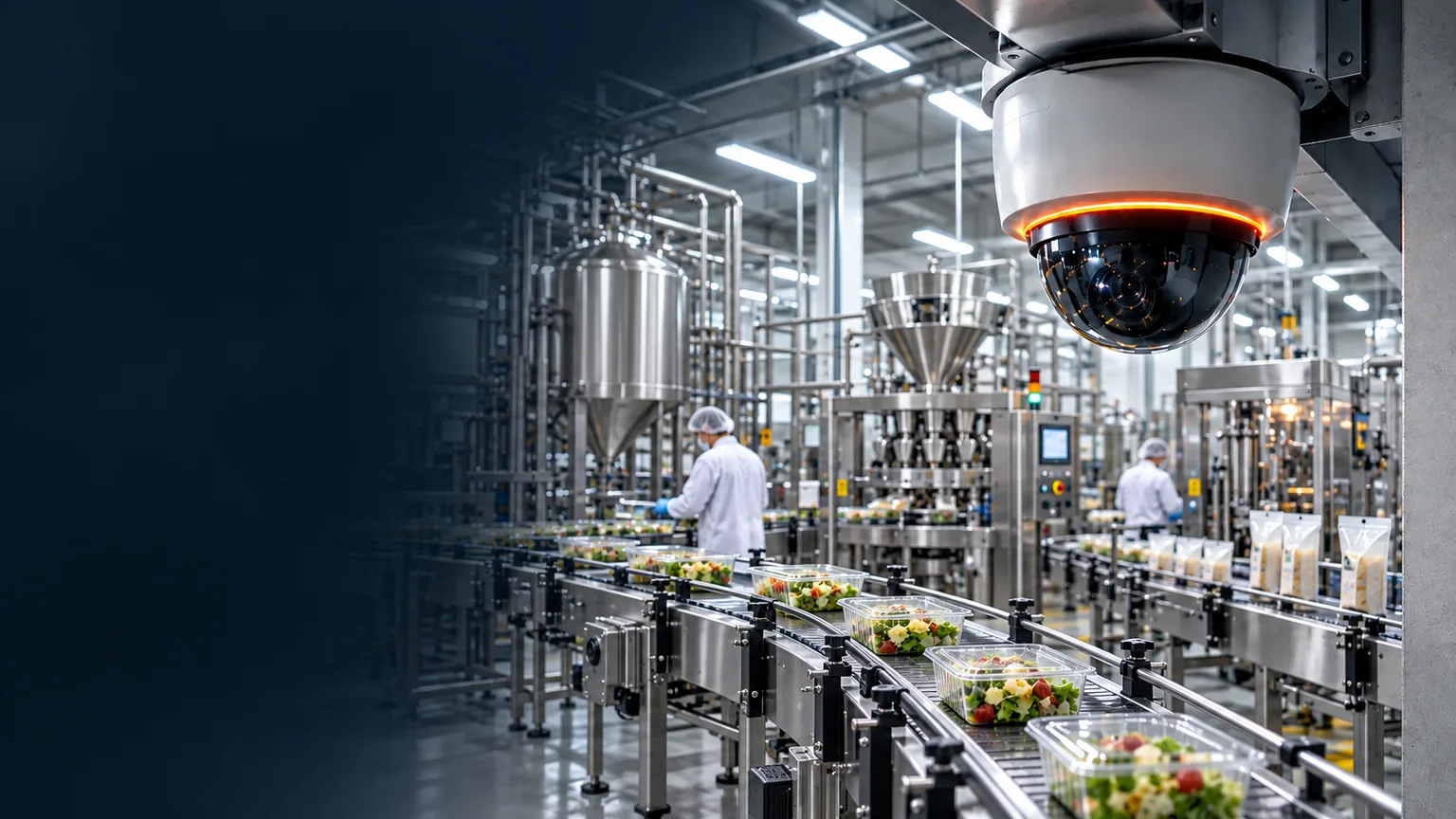
    Food processing and packaging line under camera monitoring inside a production facility
    AI engineering partner

    Your experts define process truth. NeoBram engineers the AI. The production team validates the outcome.

    01 / Domain02 / Evidence03 / AI
    AI

    Quick Answer

    NeoBram engineers production AI for food and beverage manufacturers: visual quality and packaging inspection, label verification, process deviation detection, predictive maintenance on filling, packing and utility equipment, OEE and yield intelligence, energy and water usage analytics, clean-in-place and process monitoring, and SOP or work-instruction assistants. Systems can run on the plant network, at the edge or in a private cloud. Your quality, food-safety and operations experts retain authority over product, process and release decisions.

    Choosing a first use case

    Start where evidence can change a real decision.

    The best first project is not automatically the most advanced one. It has a named user, available data, a measurable baseline, a manageable failure mode and an owner who can accept or reject the result.

    Direct answer

    What is the best first AI use case?

    Start at a point where a recurring decision already has a measurable cost and observable evidence: one packaging or labelling inspection station, one line with unexplained stoppages, or one high-friction procedure search during changeovers. Confirm camera or sensor coverage, who owns the acceptance criteria and what happens when the system is uncertain before selecting a model.

    Decision library

    Use cases with data needs and failure conditions.

    These are implementation patterns, not promised outcomes. A discovery step must confirm value, feasibility and responsibility in the client's environment.

    Use case 01

    Visual quality and packaging inspection

    Question it should answer
    Which product, pack or seal needs review, rework or rejection at this inspection point?
    Value to measure
    Defect escape rate, false reject rate, review time and traceability by SKU and shift.
    Minimum useful data
    Representative images across products, formats, lighting and acceptable variation, with quality-team labels.
    When it can fail
    Format changes, lighting drift or rare defects are not represented, or a confidence score is treated as a release decision.
    Explore the implementation pattern

    Use case 02

    Label and date-code verification

    Question it should answer
    Does the label, allergen statement, batch and date code match the production order for this run?
    Value to measure
    Mislabel incidents, verification time and evidence available for investigation.
    Minimum useful data
    Production orders, label artwork, OCR-readable codes, line and changeover context.
    When it can fail
    Artwork versions are uncontrolled, OCR fails on curved or reflective packs, or overrides are not logged.
    Explore the implementation pattern

    Use case 03

    Process deviation detection

    Question it should answer
    Which cook, fill, mix or clean-in-place cycle is drifting from its approved profile?
    Value to measure
    Early warnings accepted, deviations investigated, rework and waste avoided.
    Minimum useful data
    Time-series from PLC, SCADA or historian, recipe and batch context, quality results and expert-labelled events.
    When it can fail
    Recipe or format context is missing, sensors drift uncalibrated, or alerts have no owner.
    Explore the implementation pattern

    Use case 04

    Predictive maintenance

    Question it should answer
    Which filler, sealer, conveyor, compressor or refrigeration asset needs attention before it stops the line?
    Value to measure
    Avoided stoppages, planned interventions, false alerts and spare-part readiness.
    Minimum useful data
    Asset hierarchy, work orders, failure history, operating context and relevant sensor signals.
    When it can fail
    Failure history is sparse, run-mode changes are not represented, or alerts do not connect to maintenance action.
    Explore the implementation pattern

    Use case 05

    OEE, yield and downtime intelligence

    Question it should answer
    Which verified loss category is constraining this line this week?
    Value to measure
    Loss attribution quality, time to action, recurring losses and operator adoption.
    Minimum useful data
    Machine states, counts, rejects, changeovers, downtime codes and shift context.
    When it can fail
    Reason codes are unreliable, definitions differ by line, or OEE is optimised without the quality constraint.
    Explore the implementation pattern

    Use case 06

    Energy and water usage analytics

    Question it should answer
    Which operating pattern is consuming more energy or water than the approved baseline?
    Value to measure
    Normalised intensity, exceptions explained and accepted recommendations.
    Minimum useful data
    Interval utility data, production and cleaning schedules, ambient conditions and process constraints.
    When it can fail
    Savings are not normalised for output, or recommendations conflict with hygiene or safety limits.
    Explore the implementation pattern

    Use case 07

    Production knowledge and SOP assistant

    Question it should answer
    Which approved procedure, work instruction or past event helps the operator handle this changeover or fault?
    Value to measure
    Time to approved answer, escalation quality and training support.
    Minimum useful data
    Controlled SOPs, work instructions, HACCP plans, cleaning procedures, issue history and named content owners.
    When it can fail
    Documents conflict or are superseded, retrieval is not evaluated, or answers hide their source.
    Explore the implementation pattern

    Use case 08

    Traceability and investigation support

    Question it should answer
    Which batches, materials, lines and records are connected to this quality event?
    Value to measure
    Investigation cycle time, evidence coverage and repeat causes found.
    Minimum useful data
    Batch genealogy, supplier lots, line events, quality results and hold or release records.
    When it can fail
    Identifiers do not align across systems or the assistant presents correlation as root cause.
    Explore the implementation pattern

    Integration map

    Work with the systems already trusted by the operation.

    A product name is an integration context, not a partnership or a guarantee that a ready-made connector exists. Access, APIs, licences, validation and security boundaries determine the final design.

    Line control and utilities

    PLC and SCADA context, fillers, sealers, checkweighers, refrigeration, compressed air and clean-in-place systems through approved interfaces.

    MES, OEE and quality

    Production orders, counts, rejects, downtime codes, quality checks, hold and release records.

    Cameras and edge compute

    Existing CCTV or inspection cameras, local inference hardware and reviewed events written back to plant systems.

    ERP and maintenance

    SAP or other ERP, CMMS work orders, spare parts and material masters.

    Documents and procedures

    SOPs, work instructions, HACCP and food-safety plans, cleaning schedules and controlled document repositories.

    Private model runtime

    On-premises, edge or private-cloud model serving with versioning, monitoring and controlled updates.

    Delivery time

    Proven products move fast. Custom systems are scoped honestly.

    Delivery time depends on the use case, available data, integrations and validation requirements. Where NeoBram already has a reusable product or accelerator, the first deployment can often move significantly faster than a custom build.

    01

    Reusable product or accelerator

    NeoVision industrial vision, tender and procurement intelligence, knowledge systems, lifecycle intelligence.

    Often the fastest route to a first deployment because the capability already exists; the work is configuration around your cameras, data, documents and rules, acceptance checks with your team and rollout. Because NeoVision is built on a reusable industrial vision platform, deployments can often move significantly faster than a fully custom computer-vision project. Final timing depends on camera readiness, use cases, integrations, hardware and site conditions.

    • Site access, hardware and network approvals
    • Number of cameras, lines, documents or sites
    • Alert rules and acceptance criteria your team defines

    02

    Custom engineering

    A new predictive model for a unique process, a bespoke integration or a multi-site industrial AI system.

    Discovery, data readiness, model development, validation and integration set the schedule. Each stage is scoped with you before the build starts and ends with a decision to continue, adjust or stop.

    • Data coverage and quality
    • Integration and OT security review
    • Validation and regulatory requirements

    03

    Company-specific model training

    A private language model adapted to your terminology, products, procedures and technical knowledge.

    Data preparation and approval, training, evaluation against your own test cases and private deployment are planned per corpus. No fixed schedule is promised in advance.

    • Approved training material and its owners
    • Target hardware and deployment boundary
    • Evaluation cases your experts define

    No single timeline applies to every project. Regulated validation, hardware procurement, sensor work, interface approvals and multi-site change management are scoped with you before work starts.

    Governance boundary

    AI engineering does not replace domain authority.

    Quality, food-safety, operations and maintenance owners define acceptable behaviour and retain decision authority over product, process and release. NeoBram provides AI architecture, engineering, evaluation and operating handover. No certification, regulatory approval or customer outcome is implied by the patterns described on this page.

    Review private deployment and ownership

    Limitations to test

    What can make a technically good model operationally weak.

    • Vision performance changes when packaging, lighting, product mix or defect definitions change and must be revalidated.
    • Process deviation detection cannot flag conditions that are absent from the historical evidence or unlabelled by experts.
    • A knowledge assistant can retrieve a superseded procedure if document control and ownership are weak.
    • AI output does not establish food-safety compliance; the plant's quality and food-safety system does.
    • Edge or offline deployment reduces data movement but does not remove patching, monitoring or governance work.

    Sector support

    AI engineering, with food industry experience available where useful.

    For Food & Beverage Manufacturing, NeoBram's AI engineering team can work alongside an experienced industry SME with approximately 30 years of sector experience on selected engagements. This helps translate line, hygiene and quality realities into acceptance criteria and evaluation cases. The customer still retains final process, safety, quality and regulatory authority.

    Questions buyers ask

    Direct answers with the trade-offs included.

    The full answer remains in the page HTML while the visual panel is closed.

    Can vision inspection work with our existing cameras?+

    Sometimes, for monitoring and event detection. Fine defect inspection usually needs controlled lighting and positioning. A short assessment compares what existing cameras can support against what a dedicated inspection station would require before any model is built.

    Does NeoBram bring food industry expertise?+

    NeoBram brings the AI engineering: architecture, models, integration, evaluation, private deployment and handover. Your quality, food-safety and operations teams remain the authority on product, process and release decisions. Selected Food & Beverage engagements can also be supported by an industry SME with approximately 30 years of sector experience.

    Can the system run without sending plant data to the cloud?+

    Yes, when the selected models, hardware and licences support it. Edge inference near the line, on-premises serving or a private cloud can be designed for the real requirement. Offline operation still needs identity, logging, backup, patching and a controlled update path.

    How do you handle frequent product and format changes?+

    Models and inspection recipes are organised per product or format family, selected from the production order or line signal. New formats go through a short data-collection and validation cycle. The change process is agreed with the quality team so a new format cannot go live unvalidated.

    Will AI replace our quality inspectors or operators?+

    No. The systems are designed to recommend review, flag deviations and retrieve approved knowledge. People approve disposition, investigate causes and decide on release. Human capacity for review is part of the design, not an afterthought.

    How long does a food and beverage AI pilot take?+

    It depends on the use case, available data, integrations and validation requirements. Because NeoVision is built on a reusable industrial vision platform, deployments can often move significantly faster than a fully custom computer-vision project. Final timing depends on camera readiness, use cases, integrations, hardware and site conditions. The work is camera positioning, format coverage and acceptance checks with your quality team. Process deviation models and predictive maintenance on your specific lines take longer because data readiness, model development and validation set the schedule. The plan is agreed for your plant.

    Bring one workflow, one baseline and one person who owns the decision.

    We will help separate a useful first project from an expensive demonstration.

    Discuss the use case