
Key takeaways
- McKinsey estimates generative AI could add $200B to $340B annually to global banking, equivalent to 9 to 15% of operating profits.
- Mastercard's generative AI fraud system doubled detection speed and cut false positives by up to 200%, demonstrating clear ROI in production.
- Banks deploying AI compliance automation achieve 25 to 40% operational cost reductions over 2 to 3 years, with regulatory reporting ROI reaching 200 to 300% in year one.
- Well-implemented AI KYC programs cut onboarding time from 3 to 5 days to under 8 hours, reducing drop-off and improving customer experience.
Why Generative AI Is Reshaping Banking Right Now
Banking has always been a data-intensive industry. But for most of its modern history, that data sat in siloed systems, processed by rules-based software that could only do what it was explicitly programmed to do. Generative AI changes that equation fundamentally.
Unlike traditional machine learning models that classify or predict based on historical patterns, generative AI can produce new content: written explanations, synthetic training data, structured reports, code, and conversational responses. In a banking context, this means the technology can draft a loan denial letter, generate a compliance report, simulate thousands of fraud scenarios for model training, and answer a customer's complex mortgage question, all without a human writing a single line of that output.
The financial stakes are significant. McKinsey estimates that generative AI could add $200 billion to $340 billion in annual value to the global banking sector, equivalent to 9 to 15 percent of operating profits. IBM's 2025 Global Banking and Financial Markets Outlook found that 78 percent of banks are now adopting generative AI tactically, up from just 8 percent in 2024. The shift from experimentation to production deployment is well underway.
McKinsey estimates generative AI could add $200 billion to $340 billion in annual value to the global banking sector. IBM reports that 78% of banks are now adopting generative AI tactically, up from only 8% in 2024.
This guide covers 15 real generative AI applications in banking that are delivering measurable results today, not theoretical future-state scenarios. Each one is grounded in what actual financial institutions are doing in 2026.
The 15 Real Generative AI Use Cases in Banking
1. Intelligent Customer Service and Conversational Banking
The most visible generative AI application in banking is the intelligent virtual assistant. These go well beyond the scripted chatbots of five years ago. Modern generative AI-powered assistants understand context, handle multi-turn conversations, detect sentiment, and respond in the customer's preferred language.
Wells Fargo's AI assistant Fargo handled over 245 million customer interactions in 2024, demonstrating that generative AI can operate at massive volume in a regulated environment. These systems handle balance inquiries, transaction explanations, account setup, password resets, and product questions without human intervention. When a query requires specialist attention, the system routes it with full context, so the customer doesn't have to repeat themselves.
The operational impact is substantial. Banks deploying conversational AI report 30 to 40 percent reductions in call center volume for routine inquiries. Customer satisfaction scores improve because response times drop from minutes to seconds, and support is available around the clock.
2. Real-Time Fraud Detection and Prevention
Fraud detection is where generative AI is delivering some of its clearest, most measurable returns. Traditional rule-based fraud systems flag transactions based on static thresholds. Sophisticated fraudsters learn those thresholds and stay just below them. AI models trained on behavioral patterns detect fraud that breaks none of the static rules, because the pattern itself is anomalous.
Mastercard's generative AI fraud detection system doubled the speed of compromised card detection, cut false positives by up to 200 percent, and accelerated identification of at-risk merchants by 300 percent. Banks using AI-powered fraud detection typically see false positive rates drop by 30 to 50 percent. Every false positive is a blocked legitimate transaction, a customer service call, and a churn risk, so this reduction has direct revenue impact beyond just the fraud prevention line.
Generative AI also creates synthetic fraud scenarios for training purposes. By generating thousands of novel fraud patterns that haven't occurred yet, it prepares detection models for attacks before they happen.
Mastercard's generative AI fraud system doubled compromised card detection speed, cut false positives by up to 200%, and accelerated identification of at-risk merchants by 300%. Banks using AI fraud detection typically see false positive rates fall by 30 to 50%.
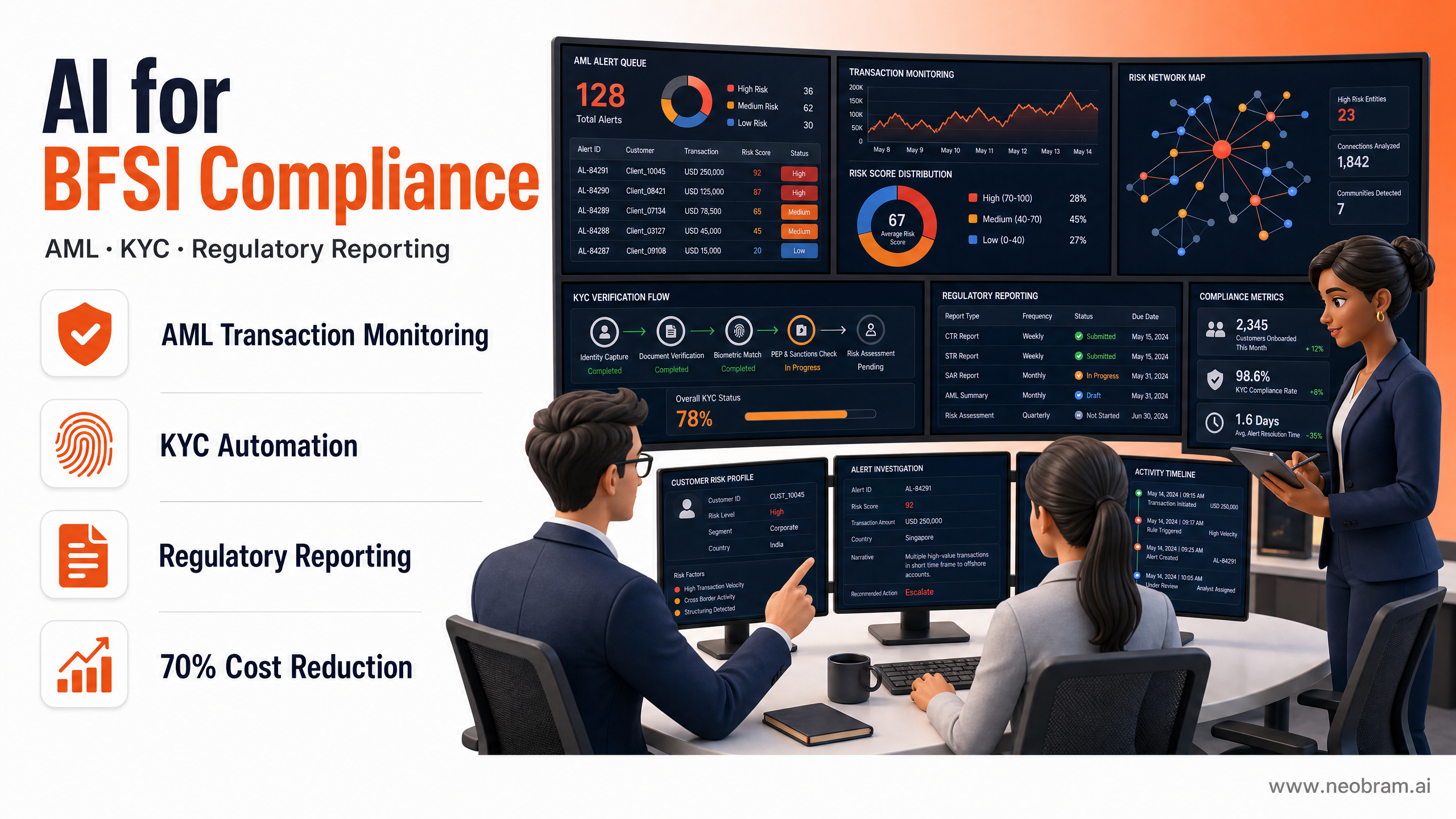
3. AML Transaction Monitoring and Alert Triage
Anti-money laundering compliance is one of the most expensive operational burdens in banking. The cost of compliance for financial services has grown at roughly 5 to 8 percent annually for a decade. Manual compliance at a mid-size bank now runs $30 to $50 million annually when you account for staff, technology, and the opportunity cost of slow processes.
The compliance stakes are rising too. In 2024, US regulators issued approximately $4.6 billion in financial penalties across financial institutions, with banks absorbing $3.65 billion of that total, a 522 percent increase year-over-year. TD Bank alone agreed to pay a $3 billion penalty for anti-money laundering failures.
Generative AI addresses this by automating alert triage. Instead of human analysts reviewing thousands of low-quality alerts, AI systems pre-screen alerts, identify the genuinely suspicious ones, and draft structured case summaries for human review. This reduces analyst workload by 40 to 60 percent while improving the quality of investigations that do reach human reviewers.
4. KYC Onboarding Automation
Know Your Customer onboarding is notoriously slow. Traditional KYC processes take 3 to 5 business days for standard cases, frustrating customers and creating drop-off risk. Generative AI automates document extraction, liveness detection, sanctions screening, and adverse media checks to a level that satisfies most regulatory standards.
Well-implemented AI-powered KYC programs cut average onboarding time from 3 to 5 days to under 8 hours. For corporate clients with complex ownership structures, AI can extract and structure entity information from unstructured documents, cross-reference against global watchlists, and flag discrepancies for human review.
The key requirement is a clean audit trail. Regulators need to see why each decision was made. Generative AI systems that produce explainable outputs, documenting which data points drove each screening outcome, satisfy this requirement while dramatically reducing the labor involved.
5. Credit Risk Assessment and Loan Decisioning
Credit risk assessment has traditionally relied on structured data: credit scores, income verification, debt-to-income ratios. Generative AI expands the data universe significantly. By analyzing transaction history, behavioral patterns, social data, and economic indicators, AI models evaluate creditworthiness with greater precision than traditional statistical models.
The practical impact is twofold. Banks can make lending decisions faster, often in minutes rather than days. They can also extend credit to a broader population, including customers who lack traditional credit histories but demonstrate financial responsibility through their transaction behavior. This expands the addressable market while maintaining or improving portfolio quality.
Generative AI also improves the quality of loan denial explanations. Conditional generative models can produce applicant-friendly explanations of why a loan was declined, organized from simple to complex, improving transparency and customer trust.
6. Personalized Financial Advice and Wealth Management
Morgan Stanley deployed an OpenAI-powered chatbot that searches through its wealth management content to support financial advisors. The system gives advisors instant access to relevant research, product information, and client history, reducing the time spent on information retrieval and allowing more time for actual client relationships.
For retail banking, generative AI enables hyper-personalized financial guidance at scale. By analyzing spending patterns, life events, and financial goals, AI systems can proactively suggest relevant products, flag potential financial risks, and offer savings recommendations before customers even think to ask. This level of personalization was previously only available to high-net-worth clients with dedicated advisors.
7. Algorithmic Trading and Market Analysis
In capital markets, generative AI models analyze vast amounts of market data, historical trading patterns, news sentiment, and social media trends. These models generate sophisticated trading algorithms that can make split-second decisions based on insights derived from multiple data streams simultaneously.
The key advantage is adaptability. Traditional algorithmic trading systems execute fixed strategies. Generative AI models continuously update themselves, reacting to changing market conditions and emerging trends with precision. This results in more efficient trading strategies that can maximize returns while managing risk in real time.
For research analysts, generative AI dramatically accelerates the production of market analysis reports. What previously required 2 to 3 days of analyst time can be reduced to reviewing and refining an AI-prepared draft in 4 to 6 hours.
8. Regulatory Reporting Automation
Regulatory reporting is a high-volume, rule-consistent task that is well-suited to automation. Banks must produce hundreds of regulatory reports annually, each requiring data extraction from multiple systems, formatting to specific regulatory schemas, and validation against compliance requirements.
Generative AI automates this process end to end. The system pulls the right data, applies the correct regulatory schema, and flags edge cases for human review. Compliance automation ROI on regulatory reporting often reaches 200 to 300 percent in the first year when measured against full labor cost.
The EU's AI Act classifies certain banking uses, including creditworthiness and credit scoring, as high-risk, raising the bar on controls and documentation. Generative AI systems that produce structured audit trails and explainable outputs are better positioned to meet these requirements than black-box models.
9. Document Generation and Contract Analysis
Banks produce thousands of documents daily: investment summaries, loan agreements, client reports, regulatory submissions, and correspondence. Generative AI handles document generation from simple prompts, pulling relevant data from multiple systems and applying appropriate formatting based on document type and recipient.
On the analysis side, generative AI can review complex contracts, flag non-standard clauses, identify compliance risks, and summarize key terms in plain language. A contract review that previously took a paralegal several hours can be completed in minutes, with the AI highlighting the sections that require human attention.
This application is particularly valuable for trade finance, where complex multi-party agreements must be reviewed quickly against regulatory requirements and bank policies.
10. Legacy Code Modernization
Banks still run critical software written in COBOL from the 1970s and 1980s. Finding developers who know COBOL is nearly impossible, but this software handles critical transactions and can't simply be turned off. Goldman Sachs confirmed that generative AI is now central to its application development and enhancement efforts.
Generative AI models can read legacy code in COBOL, Fortran, or other older languages, convert it to modern languages like Python or Java, maintain the same business logic while improving performance, and generate documentation explaining what the code actually does. Technology costs make up approximately 10 percent of a typical bank's expenses. Speeding up development and reducing maintenance costs directly improves profitability.
11. Personalized Marketing and Product Recommendations
Generative AI enables banks to move beyond generic email campaigns to truly personalized marketing at scale. By analyzing transaction history, browsing behavior, and demographic information, AI generates highly personalized campaigns and product recommendations tailored to individual customers.
Examples include custom credit card offers based on spending patterns, mortgage promotions for customers browsing real estate content, loan pre-approvals based on salary and account activity, and tailored savings advice using transaction data. This level of personalization drives higher conversion rates, increased cross-selling opportunities, and stronger customer loyalty.
12. Insurance Underwriting and Claims Processing
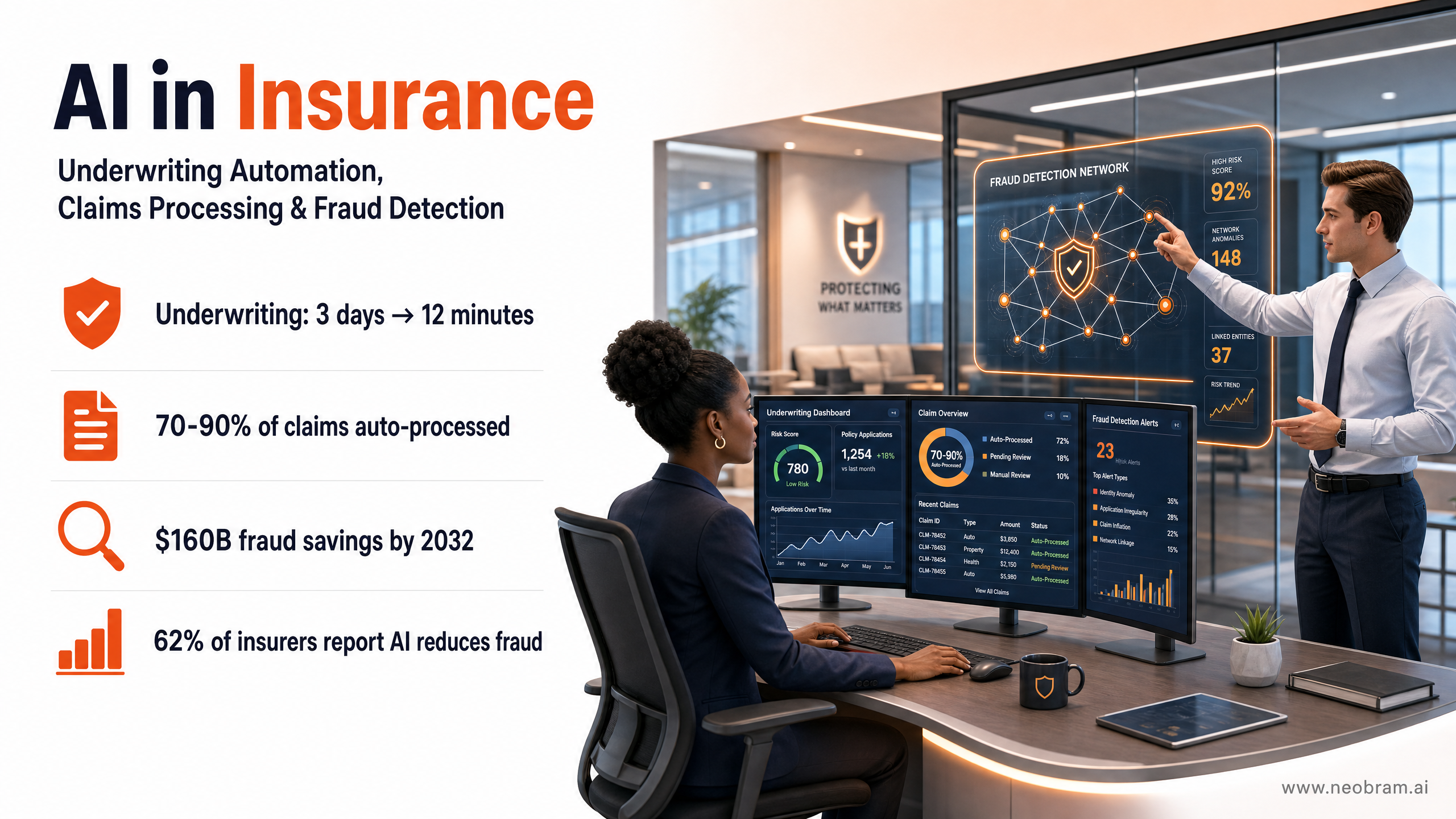
For banks with insurance subsidiaries, generative AI is transforming underwriting and claims processing. AI models analyze unstructured data from multiple sources, including medical records, property assessments, and historical claims, to generate more accurate risk assessments faster than traditional actuarial methods.
Claims processing benefits from AI's ability to extract information from unstructured documents, cross-reference against policy terms, and generate structured claims assessments. Routine claims can be processed automatically, with AI flagging complex or potentially fraudulent claims for human review. This reduces processing time from weeks to days while improving accuracy.
13. Financial Forecasting and Scenario Analysis
Generative AI improves financial forecasting by learning from historical data to capture complex patterns and relationships. When fine-tuned for specific banks and economic contexts, these models make predictions about asset price movements, interest rate trajectories, credit default probabilities, and market volatility.
Scenario analysis benefits particularly from generative AI's ability to simulate thousands of economic scenarios simultaneously. Instead of running a handful of stress test scenarios manually, risk teams can generate comprehensive scenario libraries that cover a much wider range of potential economic conditions. This improves the quality of capital planning and risk management decisions.
Banks that deployed AI compliance automation achieved 25 to 40% operational cost reductions over 2 to 3 years. Compliance automation ROI on regulatory reporting often reaches 200 to 300% in the first year when measured against full labor cost.
14. Employee Productivity and Internal Knowledge Management
Generative AI is transforming how bank employees access and use institutional knowledge. Large banks have vast repositories of research, policy documents, product information, and procedural guides. Finding the right information used to require knowing where to look or asking a colleague.
AI-powered internal knowledge systems let employees ask natural language questions and receive accurate, sourced answers drawn from the institution's own documents. This reduces the time employees spend searching for information, improves the consistency of customer-facing advice, and accelerates onboarding for new staff.
15. Agentic AI for End-to-End Process Automation
The most advanced generative AI deployments in banking involve agentic systems that can execute multi-step processes autonomously. Instead of a model flagging an alert for human review, an agentic system investigates the alert, pulls supporting data from multiple systems, and drafts a case disposition recommendation without human intervention at each step.
In 2026, most financial institutions have one or two agentic workflows in production, typically in fraud investigation or regulatory report drafting. Fully autonomous compliance operations without human oversight remain a future-state goal, but the trajectory is clear. Banks that are building the data infrastructure and governance frameworks for agentic AI today will have a significant competitive advantage as the technology matures.
What Separates Successful Deployments from Failed Ones
Gartner's 2025 research placed the average AI project failure rate in financial services above 60 percent when measured against original ROI targets. That doesn't mean the technology fails. It means most deployments underestimated what production-ready actually requires in a regulated environment.
The gap between vendor claims and live deployments is rarely about the AI model itself. It's about the data pipelines feeding it, the change management required to get operations teams to trust outputs they can't fully interpret, and the compliance review process that must sign off before anything touches a live customer workflow.
Banks that succeed with generative AI share several characteristics. They start with high-volume, rule-consistent workflows where the underlying task is data-rich and well-defined. They invest in data infrastructure before deploying AI models. They involve compliance and risk teams from day one, not as a final approval step. They measure outcomes against specific, auditable metrics rather than broad efficiency claims.
The realistic improvement range for well-scoped generative AI deployments in banking is 30 to 40 percent improvement in specific workflows, achieved after 9 to 18 months of integration work. That's still material. A 35 percent reduction in AML alert review time at a bank spending $40 million annually on compliance operations represents $14 million in annual savings.
Key Considerations for BFSI Leaders
Before committing to a generative AI program, banking executives should address several critical questions.
Data quality and governance come first. Generative AI models are only as good as the data they're trained on. Banks with fragmented, inconsistent data across legacy systems will spend more time on data remediation than on AI deployment. A data quality audit should precede any significant AI investment.
Regulatory compliance is non-negotiable. The EU AI Act classifies credit scoring and certain risk assessment applications as high-risk, requiring extensive documentation, human oversight mechanisms, and bias testing. US regulators are developing similar frameworks. Any generative AI deployment in a regulated banking function must be designed with explainability and audit trails from the start.
Vendor evaluation requires scrutiny. The marketing for AI banking solutions promises straight-line improvements: 80 percent reduction in false positives, 90 percent faster KYC. The reality is closer to 30 to 40 percent improvement in specific, well-scoped workflows, achieved after significant integration work. Evaluate vendors on their production track record in regulated environments, not pilot results.
Change management is often the limiting factor. Operations teams that have built expertise around existing processes will resist AI systems they don't understand. Successful deployments invest heavily in training, transparent communication about what the AI does and doesn't do, and gradual rollouts that build trust through demonstrated accuracy.
How NeoBram Can Help
Deploying generative AI in a banking or financial services environment is not a software purchase. It's a transformation program that requires deep expertise in financial services operations, regulatory compliance, data architecture, and AI engineering.
NeoBram's BFSI practice works with banks, NBFCs, and insurance companies to design and implement generative AI programs that deliver measurable results. Our approach starts with a structured assessment of your current operations, data infrastructure, and regulatory environment. We identify the specific workflows where generative AI will deliver the highest ROI with the lowest implementation risk.
From there, we design solutions that are built for production in regulated environments: explainable outputs, clean audit trails, human-in-the-loop escalation paths, and compliance documentation that satisfies regulatory examination. We don't hand over a proof of concept and walk away. We stay through deployment, monitor outcomes against agreed metrics, and iterate until the results are real.
Our work spans fraud detection, AML automation, KYC onboarding, regulatory reporting, and customer-facing conversational AI. We've helped financial institutions reduce compliance operational costs by 25 to 40 percent, cut KYC onboarding time from days to hours, and improve fraud detection accuracy while reducing false positives.
If you're evaluating a generative AI program for your institution, the first step is an honest assessment of where you stand today: your data quality, your regulatory constraints, and the specific workflows where automation will deliver the most value. That's exactly what our free strategy call is designed to provide.
Ready to move from pilot to production? [Book a free strategy call with the NeoBram team](https://neobram.ai/contact) to assess your generative AI readiness, identify your highest-value use cases, and build a realistic deployment roadmap for your institution.