Key takeaways
- Sepsis mortality increases by approximately 8% for every hour treatment is delayed, making early AI detection critical to patient survival.
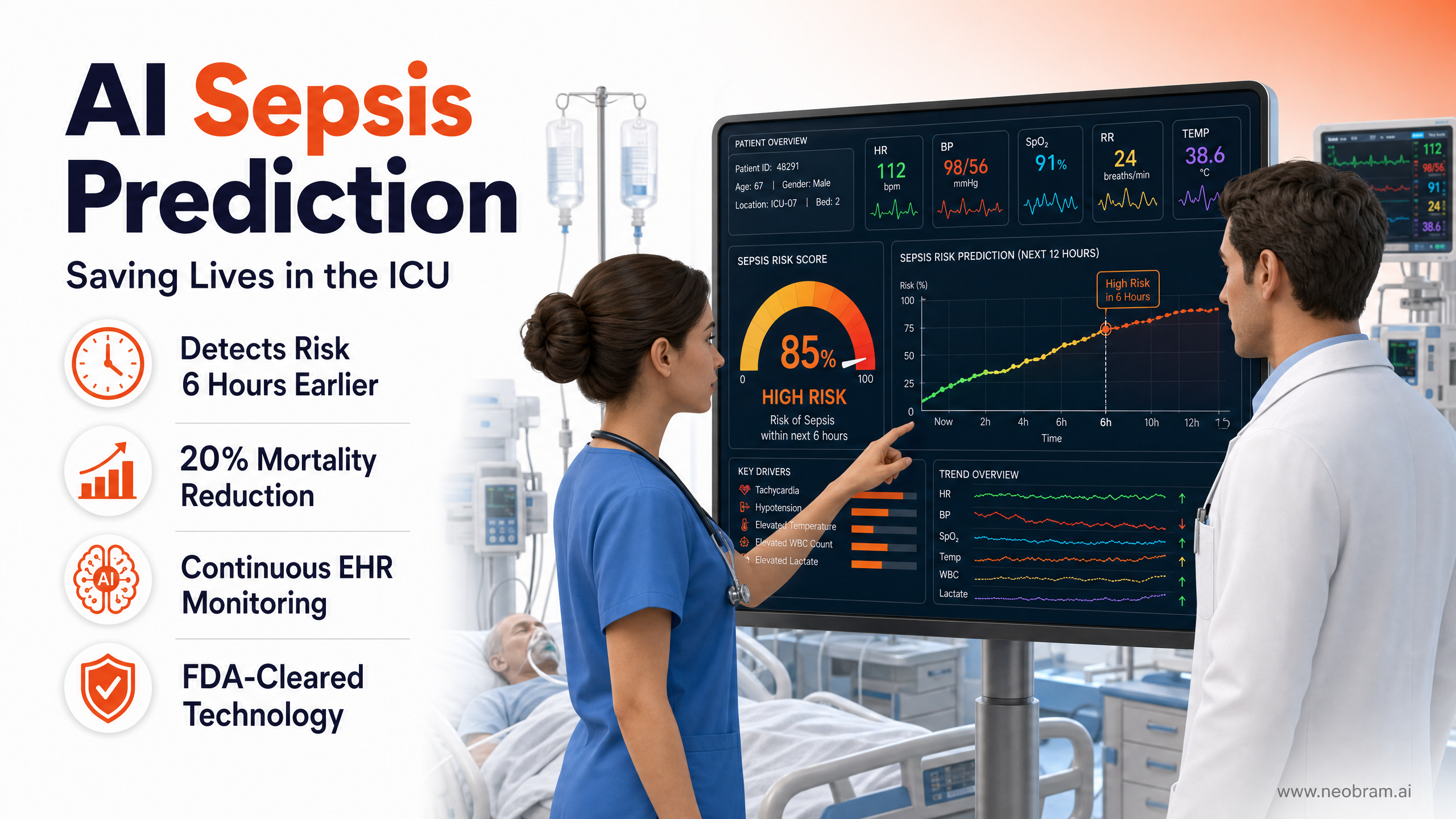
- The Johns Hopkins TREWS system, FDA-cleared in May 2026, reduced sepsis mortality by 20% across 590,000 patients at five hospitals.
- ML-based early warning systems achieve AUROC values exceeding 0.80, significantly outperforming qSOFA (0.66 to 0.74) in external validation studies.
- The global AI in sepsis warning systems market was valued at USD 575.3 million in 2025 and is projected to grow at a CAGR exceeding 25% through 2034.
The Silent Killer in the ICU: Why Sepsis Is So Hard to Catch
Sepsis kills more people in hospitals than most clinicians or patients realise. In the United States alone, roughly 1.7 million adults develop sepsis every year, and more than 250,000 of them die. Globally, the numbers are staggering: a 2021 analysis estimated 166 million sepsis cases and 21.4 million deaths annually, accounting for nearly one in three in-hospital deaths worldwide.
What makes sepsis so deadly is not just its severity. It's the speed at which it escalates, combined with how easy it is to miss in the early stages. Fever, confusion, elevated heart rate: these are symptoms that fit dozens of other conditions. By the time a clinician suspects sepsis and orders the right tests, the window for effective intervention may already be closing.
The data on timing is unambiguous. Mortality from sepsis increases by approximately 8% for every hour that treatment is delayed. Patients who receive antibiotics within one hour of triage have a 30-day mortality rate of around 13.6%; that figure climbs sharply with each hour of delay. In the ICU, where up to 50% of mortality is attributed to sepsis, getting ahead of the condition is not just a clinical goal. It's a survival imperative.
This is the problem that AI sepsis prediction is designed to solve.
What AI Sepsis Prediction Actually Does
AI-based sepsis prediction systems are not diagnostic tools in the traditional sense. They don't replace a physician's clinical judgment. What they do is continuously monitor patient data across dozens of variables simultaneously, flagging risk before a human clinician would typically notice a pattern.
Most systems draw on data already flowing through the electronic health record (EHR): vital signs, lab results, medication records, nursing notes, and patient history. They apply machine learning models trained on hundreds of thousands of historical patient cases to identify the subtle combinations of signals that precede sepsis onset, often hours before the condition becomes clinically apparent.
The key variables these models track include:
- Heart rate, respiratory rate, blood pressure, and temperature trends
- White blood cell count, lactate levels, creatinine, and bilirubin
- Fluid balance and urine output
- Oxygen saturation and ventilator settings
- Clinical notes and nursing assessments (via natural language processing)
Traditional scoring tools like qSOFA (quick Sequential Organ Failure Assessment) and SIRS (Systemic Inflammatory Response Syndrome) use a small number of these variables and apply fixed thresholds. They're easy to use at the bedside, but they're not designed for continuous, real-time monitoring, and their sensitivity for early detection is limited. A 2023 study published in JAMA Network Open found that while machine learning-based sepsis prediction models outperformed qSOFA and SOFA on balanced accuracy at higher risk thresholds, the real advantage was in earlier detection, not just better detection.
AI models, by contrast, can process hundreds of data points simultaneously and update their risk scores every few minutes as new data arrives. They can also identify non-linear patterns and interactions between variables that no scoring rubric would capture.
The scale of the problem: Sepsis accounts for approximately 48.9 million cases and 11 million deaths globally each year, representing nearly 20% of all global deaths. In the ICU, sepsis is responsible for 30 to 50% of all mortality. The economic burden in the US alone exceeds $16.7 billion annually in direct hospital costs.
The Johns Hopkins TREWS System: A Landmark in Clinical AI
The most extensively studied AI sepsis prediction system is the Targeted Real-Time Early Warning System (TREWS), developed by researchers at Johns Hopkins University. TREWS combines a patient's medical history with current clinical data, continuously scanning EHR records to flag patients at risk and suggest treatment protocols.
A landmark study published in *Nature Medicine* in 2022 evaluated TREWS across five hospitals, covering more than 590,000 patients and involving more than 4,000 clinicians over two years. The results were striking. In 82% of sepsis cases, the AI was accurate in identifying risk nearly 40% of the time. Previous electronic detection tools caught fewer than half that proportion of cases, with accuracy rates of just 2% to 5%. In the most severe sepsis cases, where an hour's delay can mean the difference between survival and organ failure, TREWS detected the condition an average of nearly six hours earlier than traditional methods.
Patients treated at hospitals using TREWS were 20% less likely to die from sepsis. That's not a marginal improvement. In a condition that kills 250,000 Americans annually, a 20% mortality reduction translates to tens of thousands of lives saved each year.
In May 2026, the system received FDA clearance, making it one of the first AI-based medical tools to gain regulatory approval for clinical use. The FDA's Breakthrough Designation, granted in 2023, had already enabled deployment at Cleveland Clinic, MemorialCare in California, and the University of Rochester School of Medicine, where it significantly reduced in-hospital mortality, morbidity, and length of stay for sepsis patients.
"Pre-suspicion screening is what creates lead time, and lead time is what changes outcomes in sepsis," said Suchi Saria, the Johns Hopkins professor who led the research. "Once a clinician already suspects sepsis, the clock has been running, often for hours or even days."
TREWS in numbers: Across five hospitals and 590,000 patients, the Johns Hopkins TREWS system detected sepsis an average of six hours earlier than traditional methods, reduced sepsis mortality by 20%, and achieved an accuracy rate of nearly 40% in 82% of sepsis cases. Previous electronic tools achieved accuracy rates of just 2% to 5%.
How AI Compares to Traditional Scoring Systems
The limitations of conventional sepsis scoring tools are well-documented. qSOFA uses three criteria: altered mental status, respiratory rate above 22 breaths per minute, and systolic blood pressure below 100 mmHg. It's quick and requires no lab results, but its sensitivity for early sepsis is poor. SOFA is more comprehensive, covering six organ systems, but it requires laboratory data and is designed for assessment rather than continuous monitoring.
A systematic review published in 2025 covering studies from 2015 to 2025 found that ML-based early warning systems demonstrated AUROC values (a measure of diagnostic accuracy) consistently exceeding 0.80, with some models reaching 0.93 or higher. This compares favourably to qSOFA, which typically achieves an AUROC of around 0.66 to 0.74 in external validation studies.
One particularly notable finding: an ML model developed at Johns Hopkins could forecast sepsis a median of five hours in advance, significantly outperforming SIRS and qSOFA. A separate model using natural language processing on nursing triage notes, combined with basic vital signs, achieved an AUROC of approximately 0.94.
The same review found that in implementation studies, ML-based alerts reduced time to antibiotic administration by approximately 1.8 hours when alerts were promptly addressed. A randomised controlled trial found that real-time ML sepsis alerts increased the proportion of patients receiving antibiotics within one hour of triage from 60% to 68%.
That improvement matters. Every hour of delay in antibiotic administration is associated with a measurable increase in mortality. Closing that gap by nearly two hours is clinically significant.
It's worth noting that not all AI sepsis tools perform equally. The Epic Sepsis Model, widely deployed across US hospitals, has faced criticism following external validation studies that found its AUROC to be around 0.63, substantially below the 0.76 to 0.83 range claimed by its developers. This highlights a critical point: the quality of AI sepsis prediction varies considerably, and independent validation in real-world settings is essential before any system is trusted at scale.
Key Features of Effective AI Sepsis Prediction Systems
Not all machine learning models for sepsis are built the same way. The most effective systems share several characteristics that distinguish them from simpler rule-based tools.
Continuous, Real-Time Monitoring
Effective systems don't just calculate a risk score at admission. They update continuously as new data arrives, whether that's a new lab result, a change in vital signs, or a nursing note flagging a change in mental status. This continuous monitoring is what enables early detection, catching the subtle deterioration that precedes clinical recognition.
Multi-Variable Feature Integration
The best models integrate dozens of variables simultaneously, including structured data (vitals, labs, medications) and unstructured data (clinical notes, nursing assessments). Natural language processing allows the system to extract clinically relevant signals from free-text entries that would otherwise be invisible to rule-based tools.
Explainability for Clinicians
One of the most common barriers to AI adoption in clinical settings is the "black box" problem: clinicians are reluctant to act on alerts they don't understand. The most effective systems provide explanations alongside their risk scores, showing which specific data points drove the alert. TREWS, for example, displays the contributing factors for each alert, allowing clinicians to quickly assess whether the recommendation makes sense in context.
Calibration to Local Patient Populations
A model trained on data from one hospital system may perform poorly at another, due to differences in patient demographics, documentation practices, and clinical workflows. External validation studies have shown that some models experience significant drops in performance when deployed outside their development environment. Effective AI sepsis systems are calibrated and validated locally before deployment.
Integration with Clinical Workflows
An alert that requires a clinician to log into a separate system, or that fires so frequently it gets ignored, will not save lives. The most effective implementations integrate directly into the EHR workflow, presenting alerts in the context where clinicians are already working and minimising alert fatigue through high specificity.
The Market Behind the Technology
The commercial landscape for AI sepsis prediction is growing rapidly. The global AI in sepsis warning systems market was valued at USD 575.3 million in 2025 and is projected to grow at a compound annual growth rate of over 25% through 2034. A separate analysis projects the AI sepsis detection market to reach USD 2.47 billion by 2034.
This growth is being driven by several converging factors: the increasing availability of EHR data, the maturation of machine learning techniques, growing regulatory clarity (including the FDA's approval of TREWS), and rising awareness among hospital administrators of the cost burden that sepsis represents.
The economic case for AI sepsis prediction is compelling. Severe sepsis generates costs of approximately $16.7 billion annually in US hospitals. A 2022 cost-effectiveness analysis found that an ML-based sepsis prediction algorithm could reduce cost per ICU patient and deliver substantial cost savings at scale. When you factor in reduced ICU length of stay, fewer organ failure complications, and lower mortality, the return on investment for effective AI sepsis tools is significant.
Market growth: The global AI in sepsis warning systems market was valued at USD 575.3 million in 2025 and is projected to grow at a CAGR exceeding 25% through 2034. The economic burden of sepsis in US hospitals alone exceeds $16.7 billion annually, making the ROI case for effective AI prediction tools compelling for hospital administrators.
Implementation Challenges: What Hospitals Need to Get Right
Despite the clinical evidence, AI sepsis prediction is not yet standard of care in most hospitals. Several practical challenges slow adoption.
Alert Fatigue
High-sensitivity models generate more alerts, but not all of them will be actionable. If clinicians receive too many false positives, they begin to ignore alerts, undermining the system's value. Designing models with appropriate specificity, and building workflows that help clinicians quickly triage alerts, is essential.
Clinician Trust and Education
UCHealth, which developed its own AI sepsis detection model, has reported significant challenges in educating thousands of nurses across 15 hospitals to use and trust the system's outputs. Clinicians who don't understand how a model works, or who have experienced false alarms, are less likely to act on its recommendations. Training, transparency, and ongoing feedback loops are critical to sustained adoption.
Data Quality and EHR Integration
AI models are only as good as the data they're trained on and the data they receive in real time. Hospitals with inconsistent documentation practices, fragmented EHR systems, or gaps in data completeness will see degraded model performance. Before deploying any AI sepsis tool, a thorough assessment of data quality and EHR integration capability is essential.
Generalisability and Local Validation
As noted earlier, models that perform well in development environments don't always transfer cleanly to new settings. One study found that an ML model's AUROC dropped from 0.86 in its development hospital to 0.76 in an external validation cohort. Hospitals should insist on local validation data before committing to any AI sepsis prediction system.
Regulatory and Liability Considerations
The FDA's clearance of TREWS in 2026 is a significant milestone, but most AI sepsis tools are not yet FDA-cleared. Hospitals deploying non-cleared tools need to consider their regulatory obligations and liability exposure carefully. The regulatory landscape for clinical AI is evolving, and staying current with FDA guidance is important for any hospital considering deployment.
The Road Ahead: What's Coming in AI Sepsis Prediction
The field is moving quickly. Several developments are likely to shape AI sepsis prediction over the next few years.
Wearable and continuous monitoring devices are beginning to feed real-time physiological data into sepsis prediction models, enabling earlier detection in step-down units and general wards, not just the ICU. Multimodal models that combine imaging data, genomic markers, and microbiome profiles with traditional clinical data are in development, promising even earlier and more precise risk stratification.
Federated learning approaches, which allow models to be trained across multiple hospital systems without sharing raw patient data, are addressing the generalisability problem while preserving privacy. And as more AI sepsis tools gain regulatory clearance, the pathway to reimbursement under programmes like Medicare's New Technology Add-on Payment will make the financial case for adoption clearer.
The combination of better models, better data infrastructure, and clearer regulatory pathways means that AI sepsis prediction is moving from an experimental technology to a clinical standard. Hospitals that invest in the right systems now will be better positioned to deliver better outcomes and lower costs as the technology matures.
How NeoBram Can Help
Deploying AI in a clinical environment is not just a technology project. It requires careful integration with existing workflows, rigorous validation against local patient populations, and a structured approach to change management that brings clinical staff along with the technology.
NeoBram works with healthcare organisations to design and implement AI-powered clinical decision support systems, including sepsis prediction and early warning tools. Our approach starts with a thorough assessment of your existing data infrastructure, EHR integration capability, and clinical workflow requirements. We help you evaluate available tools against your specific patient population, design the alert logic and escalation protocols that will actually be used by your clinical teams, and build the training and feedback mechanisms that sustain adoption over time.
We understand that clinical AI is only valuable when it changes outcomes. That means getting the implementation right, not just the model.
If your organisation is exploring AI-powered sepsis prediction or broader clinical decision support, we'd welcome the conversation.
Book a free strategy call with the NeoBram team to discuss how AI can improve patient outcomes at your hospital.