Key takeaways
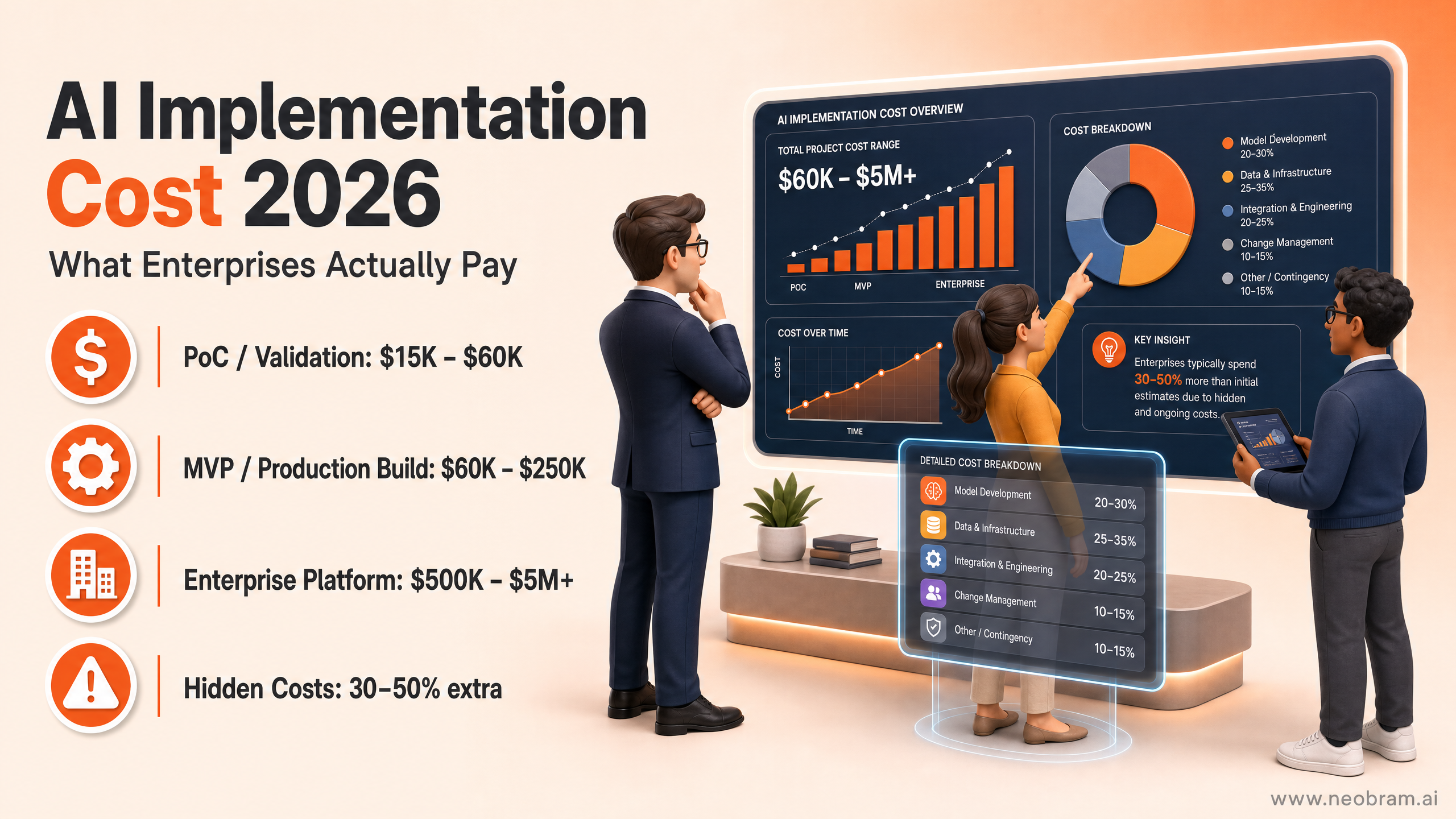
- AI implementation costs range from $5K for internal tools to $5M+ for enterprise platforms, but 80-85% of enterprises miss their cost forecasts by more than 25%.
- The hidden third layer of AI costs (data prep, evaluation infrastructure, drift monitoring) typically equals or exceeds the build cost itself.
- Only 5% of companies are true AI leaders achieving significant ROI; 60% see minimal or no material value from their AI investments (BCG, 2025).
- A well-scoped mid-market AI implementation (predictive maintenance, 3 lines) costs ~$317K in year one and can deliver $1.2M in annual savings.
What Does AI Implementation Actually Cost in 2026?
Most enterprises approach AI budgeting the same way they approach software projects: get a quote, add a contingency buffer, and sign the statement of work. That approach works for CRM rollouts and cloud migrations. It fails badly for AI.
The reason is structural. AI implementation is not one cost. It's three. There's the build cost (the engineering work), the run cost (what it takes to keep the system alive at production scale), and a hidden third layer that most vendors never quote: data preparation, evaluation infrastructure, drift monitoring, and change management. That third layer typically equals or exceeds the build itself.
This guide gives you the real numbers, broken down by project type, company size, and industry. It also explains why 80-85% of enterprises miss their AI cost forecasts by more than 25%, and what you can do to avoid that trap.
Global AI spending will reach $2.59 trillion in 2026, a 47% year-over-year increase, according to Gartner. Enterprises will more than double their spending on generative AI models and AI agents this year alone.
The Three Layers of AI Cost
Before looking at any numbers, you need to understand the structure of AI costs. Most budget conversations collapse because they only price the first layer.
Layer 1: Build Cost
This is the engineering work: model selection, prompt engineering, integration, UI, testing, and deployment. It's the layer that shows up in vendor proposals. It's also the layer that gets the most attention and the most distortion.
Layer 2: Run Cost
Once the system ships, you pay to keep it running. This includes cloud compute, API calls, inference infrastructure, and the engineering time to handle outages and updates. Token economics surprise almost everyone. A demo that costs $40 in API calls during a pilot can cost $40,000 per month at production volume.
Layer 3: The Hidden Layer
Data preparation, evaluation infrastructure, drift monitoring, retraining, compliance work, and change management. This is the layer that most proposals omit entirely. It's also the layer that determines whether your AI system actually gets used and trusted, or quietly becomes shelfware.
A vendor who quotes a $250,000 project with $20,000 of "data work" in it has either inherited a miraculous dataset or, far more likely, under-scoped the messiest part of the engagement.
AI Implementation Cost by Project Type
The most useful way to think about AI costs is by engagement type. Here's what the 2026 market actually looks like.
| Project Type | Build Cost Range | Typical Timeline |
|---|---|---|
| Internal AI tools (Slack bots, doc Q&A, summarisation) | $5,000 to $60,000 | 2 to 8 weeks |
| LLM-powered product feature (chatbot, copilot, search) | $25,000 to $150,000 | 6 to 16 weeks |
| Custom model / fine-tuning / RAG with proprietary data | $150,000 to $750,000 | 3 to 6 months |
| Enterprise AI platform (multi-model, pipelines, governance) | $500,000 to $5 million+ | 6 to 18 months |
These are 2026 market rates for US and UK vendors. Offshore development (India, Eastern Europe) typically runs 30 to 60% lower, with corresponding tradeoffs in oversight, timezone alignment, and domain knowledge.
Internal AI Tools: $5,000 to $60,000
A Slack bot that answers questions about your employee handbook. A summariser for support tickets. A document Q&A layer built on top of Confluence or SharePoint. These are the cheapest engagements because the off-the-shelf tooling is excellent and the integration surface is small.
If a vendor quotes $90,000 for a Slack bot, you're paying for their overhead and their roadmap, not your project. Most internal tools should be built by a small team in three to six weeks.
LLM-Powered Product Features: $25,000 to $150,000
A customer-facing chatbot, an in-app copilot, or an AI-powered search experience. The cost spread is wide because requirements vary enormously. A bot that uses an off-the-shelf API and handles a single domain lands at the low end. A copilot that reasons across multiple data sources, routes to different models, handles multi-turn conversations with memory, and meets enterprise SSO and audit requirements lands at the high end.
The cost driver here is rarely the model itself. It's the integration, the evaluation harness, and the UI.
Custom Model / Fine-Tuning / RAG: $150,000 to $750,000
This is where serious data work begins. You're either fine-tuning a base model on your proprietary data, building a retrieval-augmented generation pipeline against a proprietary corpus, or both. Data preparation alone typically accounts for 40 to 60% of the total engagement cost.
Most companies should not start here. Start with off-the-shelf, prove demand, then graduate to custom work once you know exactly what you need.
Enterprise AI Platform: $500,000 to $5 Million+
Multi-team, multi-model deployments with shared data infrastructure, governance, model registry, evaluation pipelines, and centralised observability. This work spans 6 to 18 months and typically involves a platform team, an ML team, a data engineering team, and a security and compliance review.
The reason to understand this range is so you don't get talked into it when an internal tool would do the job.
The Hidden Costs That Blow Up Budgets
80 to 85% of enterprises miss their AI infrastructure forecasts by more than 25%, according to research from Mavvrik and BenchmarkIT. The primary cause is not vendor dishonesty. It's the systematic under-pricing of data preparation, evaluation infrastructure, and ongoing maintenance.
Data Preparation: 30 to 50% of Total Project Cost
AI runs on data, and your data is almost certainly not ready. It lives in five systems. It has inconsistent formatting, missing fields, duplicate records, and three different ways to spell the same product name. You need to extract it, clean it, normalise it, deduplicate it, label some of it, and build a pipeline that keeps it fresh.
In regulated industries like healthcare and financial services, data preparation costs closer to 50 to 70% of the total engagement. This is the single most common reason AI projects run over budget and over schedule.
Evaluation Infrastructure: $20,000 to $150,000
You cannot ship an AI feature without an evaluation set. An eval set is a labelled corpus of inputs paired with the outputs you want, typically a few hundred to a few thousand examples that let you measure whether the model is improving or degrading.
Building one takes domain experts, not engineers. It's slow, expensive, and almost never quoted in vendor proposals. Without it, you don't know if the model works. You're shipping on hope.
Inference at Scale
A model that costs $0.005 per query in the pilot costs $5,000 per day at one million queries. Most internal demos run hundreds of queries. Production runs millions. Token economics are non-negotiable, and most buyers don't price this until the first invoice arrives.
Monitoring and Drift Detection: $15,000 to $80,000 Setup, $20,000 to $60,000 Per Year
Models drift. The world changes, your data changes, user behaviour changes, and the underlying model gets updated by the provider. You need monitoring that catches drift before your users do. That means logging inputs and outputs, sampling for human review, alerting on accuracy regressions, and having a clear process for what to do when an alert fires.
Annual Maintenance: 20 to 40% of Build Cost Per Year
This is the ongoing cost to keep the system current. It includes retraining, model updates, infrastructure scaling, security patches, and the engineering time to handle the things that break in production that never broke in the demo.
AI Implementation Costs by Company Size
Cost isn't just a function of what you're building. It's also a function of who you are.
Small and Mid-Market Companies ($10M to $500M Revenue)
For most mid-market companies, the right starting point is a scoped proof of concept: $15,000 to $60,000 to validate that AI can solve your specific problem with your actual data. If the PoC succeeds, a production build typically runs $60,000 to $250,000.
Total first-year budget for a meaningful AI capability: $150,000 to $350,000. That's a fraction of the cost of hiring a full-time AI team, and you'll have a production system in months rather than a hiring pipeline.
Ongoing operational costs typically run $3,000 to $15,000 per month once the system is live.
Large Enterprises ($500M+ Revenue)
Large enterprises face a different set of challenges. They're not just building one AI system; they're building the infrastructure to support dozens of them. That means investing in shared data platforms, model governance, security and compliance frameworks, and the internal talent to manage it all.
A realistic first-year AI budget for a large enterprise ranges from $500,000 to $5 million, depending on scope and ambition. Companies in this segment should plan for 20 to 40% of build cost annually in maintenance and operations.
Industry-Specific Cost Drivers
Some industries face structural cost premiums that others don't.
Healthcare and Pharma: HIPAA compliance, GxP validation, and clinical data governance add 15 to 30% to most AI projects. Data labelling is particularly expensive because it requires clinically qualified reviewers.
Financial Services: AML, KYC, and regulatory reporting requirements add audit trails, explainability requirements, and compliance documentation that can add 20 to 40% to a standard build.
Manufacturing and Oil and Gas: Real-time inference requirements for predictive maintenance and process control add infrastructure costs. Sub-100ms inference at scale requires specialised hardware and optimisation work.
Why Most AI Projects Fail to Deliver ROI
The numbers here are sobering, and every enterprise leader should know them before signing a statement of work.
Only 5% of companies are "AI leaders" achieving significant returns from their investments. A full 60% see minimal or no material value, according to BCG's 2025 AI ROI research. The leaders achieve 5x the revenue increases of peers and 3x the cost reductions.
According to IBM's research, only around 25% of AI initiatives deliver expected ROI. Just 16% have scaled enterprise-wide. The most common failure modes are:
Unclear problem definition. "We want to use AI to improve customer support" is not a requirement. "We need to classify customer support tickets into 12 categories with 90%+ accuracy, with sub-two-second response time, integrated into Salesforce" is. Vague requirements produce expensive scope creep.
Under-investment in data. Roughly 60% of AI project time is spent on data, not models. Companies that treat data preparation as a minor line item consistently overspend and underdeliver.
No evaluation infrastructure. Without a proper eval set and eval harness, you don't know if your model is working. You find out when customers complain.
Skipping the proof of concept. A well-executed PoC at $15,000 to $60,000 can prevent you from spending $500,000 on a project that was never going to work. Many companies skip it to save time and end up spending far more on a failed production build.
Measuring the wrong things. 64% of companies use operational efficiency as their primary ROI metric. Operational efficiency is important, but it's not a business outcome. The companies achieving real returns measure AI's impact on revenue, margin, and customer value, not just time saved.
How to Build a Defensible AI Budget
Given everything above, here's a practical framework for budgeting your AI implementation.
Step 1: Define the Problem Precisely
Before talking to any vendor, write down exactly what you need the AI system to do. Include accuracy requirements, latency requirements, integration points, compliance constraints, and the business metric you're trying to move. Vague requirements produce expensive proposals.
Step 2: Start with a Proof of Concept
Budget $15,000 to $60,000 for a time-boxed PoC with a clear success criterion. The PoC should use your actual data, not a demo dataset. If it doesn't work with your data in the PoC, it won't work in production.
Step 3: Price All Three Layers
When you receive a vendor proposal, check that it includes:
- Build cost (engineering, integration, UI)
- Data preparation (extraction, cleaning, labelling, pipeline)
- Evaluation infrastructure (eval set, eval harness, accuracy benchmarks)
- Run cost (cloud compute, API costs at production volume)
- Monitoring and drift detection
- Annual maintenance estimate
If any of these are missing, ask for them explicitly. A vendor who can't price the hidden layer hasn't operated a system like yours at scale.
Step 4: Add a 20% Contingency
Even with a well-scoped proposal, AI projects encounter surprises. Data quality issues, integration complexity, and accuracy requirements that prove harder to meet than expected are the three most common. A 20% contingency is not pessimism; it's experience.
Step 5: Plan for Year Two
The build cost is not the total cost. Plan for 20 to 40% of build cost annually in maintenance, monitoring, and retraining. If you're using cloud-based inference, model your token costs at 3x your pilot volume to account for production usage patterns.
Comparing Build vs. Buy vs. Partner
Every enterprise faces this decision at some point. Here's how to think about it.
Build in-house makes sense when you have a strong internal ML team, proprietary data that gives you a genuine competitive advantage, and the long-term commitment to maintain the system. The cost is high (senior ML engineers command $150,000 to $300,000+ annually in the US), but the control and IP ownership are unmatched.
Buy off-the-shelf makes sense for commodity use cases: document summarisation, basic chatbots, email triage, meeting transcription. The market is mature, the tools are good, and the cost is low. Don't build what you can buy.
Partner with a specialist makes sense for most enterprises. You get production-grade expertise without the hiring cost, you retain IP ownership of your data and models, and you can scale the engagement up or down as needs change. The key is choosing a partner who has operated systems like yours in production, not just built demos.
What Good Looks Like: A Worked Example
A mid-market manufacturer with $200M in revenue wants to implement predictive maintenance AI for three production lines.
Proof of concept: $40,000 over six weeks. Uses six months of historical sensor data. Validates that the model can predict failures 48 hours in advance with 85%+ accuracy.
Production build: $180,000 over four months. Includes data pipeline, model training, integration with the existing SCADA system, a monitoring dashboard, and an alert system for maintenance teams.
Data preparation: $60,000 (included in the production build estimate, but worth calling out separately).
Evaluation infrastructure: $25,000 for eval set construction and automated testing pipeline.
Year one run cost: $36,000 ($3,000 per month for cloud compute and API costs).
Year one maintenance: $36,000 (20% of build cost).
Total year one cost: approximately $317,000.
Expected ROI: A 20% reduction in unplanned downtime across three lines, saving approximately $1.2 million annually in production losses and emergency maintenance costs. Payback period: under four months.
This is what a well-scoped, well-executed AI implementation looks like. The numbers are real, the ROI is measurable, and the path from investment to return is clear.
How NeoBram Can Help
NeoBram works with manufacturers, pharma companies, oil and gas operators, and enterprise IT teams to design and deploy AI systems that deliver measurable business outcomes, not just impressive demos.
Our approach starts with a structured AI readiness assessment that evaluates your data quality, infrastructure, and organisational readiness before any build begins. We price all three layers upfront: build, run, and the hidden layer that most vendors leave out. And we stay engaged through production, because that's where the real work happens.
We've helped clients achieve predictive maintenance ROI in under six months, reduce quality control defect rates by 30%, and cut document processing time by 80%. Every engagement starts with a clear problem definition, a time-boxed proof of concept, and a success metric that ties directly to your P&L.