Key takeaways
- Over 80% of enterprise AI projects fail, twice the failure rate of traditional IT projects.
- 61% of AI consulting engagements result in unplanned vendor lock-in within 18 months.
- The AI consulting market is valued at $14.1 billion in 2026, growing to $116 billion by 2035.
- Asking about IP ownership, named delivery team, and post-engagement handoff separates good firms from risky ones.
Why Choosing the Wrong AI Consulting Firm Is an Expensive Mistake
The AI consulting market is growing fast. It was valued at $14.1 billion in 2026 and is projected to surpass $116 billion by 2035. That growth has attracted a flood of new entrants: boutique shops, solo consultants, and large system integrators all claiming they can transform your business with AI.
The problem is that more than 80% of enterprise AI projects fail, according to RAND Corporation research. That's twice the failure rate of traditional IT projects. And a significant portion of those failures trace back to one decision made early: choosing the wrong consulting partner.
A bad engagement doesn't just waste budget. It burns internal goodwill, delays your competitive position, and often leaves your team more skeptical of AI than when you started. Getting this decision right is worth the time it takes.
This guide gives you 10 specific questions to ask any AI consulting firm before you sign. For each question, you'll see what a good answer looks like and what red flags to watch for.
The stakes are real: 80% of AI projects fail to deliver intended business value. Failures cluster around poor vendor selection, inadequate change management, and insufficient internal capability-building. Choosing the right partner is the single most important decision in your AI journey.
Before You Start: Know What You're Actually Buying
There's a meaningful difference between AI strategy consulting, AI implementation, and AI managed services. Some firms do all three. Many specialise in one. Before you start interviewing firms, be clear on what you need.
If you don't have a clear AI strategy yet, you need a firm that can assess your business, identify high-value use cases, and build a roadmap. If you already have a roadmap and need someone to build and deploy, you need an implementation partner. If you want ongoing AI operations support, you need a managed services provider.
Mismatching your need to the firm's core competency is one of the most common causes of disappointing engagements. A firm that excels at strategy decks may not have the engineering depth to build production-grade systems. A firm that's great at building models may struggle to help you think through change management.
Get clear on your need first. Then ask these questions.
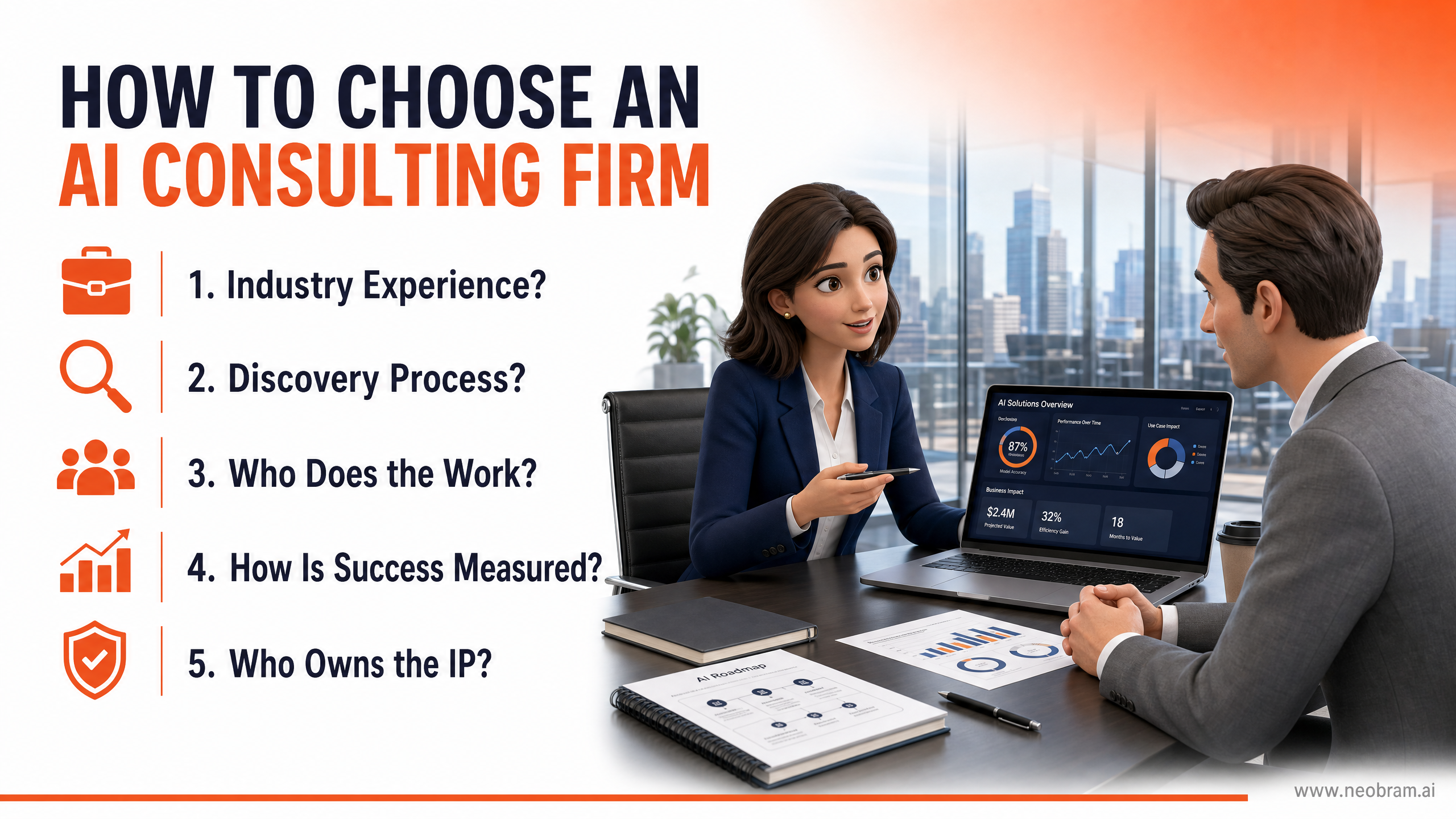
Question 1: Can You Show Me Completed Projects in My Industry?
This is the most important question on the list. Generic AI expertise is not enough. A firm that has built AI systems for consumer retail may not understand the compliance requirements, data structures, or operational constraints of your industry.
Ask for specific case studies, not just logos. You want to hear about the actual problem they solved, the approach they took, the data they worked with, and the measurable outcome they delivered. If they can't describe a project in your sector with that level of detail, they're probably not the right fit.
What a good answer looks like: Two or three specific examples with named industries, clear problem statements, and quantified outcomes. The consultant should be able to explain what made those projects hard and what they learned.
Red flags: Vague references to "working with companies in your space." Pivoting to enterprise case studies when you're a mid-market business. Inability to name the specific AI techniques or tools used.
Question 2: What Does Your Discovery Process Look Like?
The best AI consultants spend significant time understanding your business before they recommend anything. A firm that jumps straight to solutions is selling technology, not solving problems.
A proper discovery process should include stakeholder interviews with the people who will actually use the system, workflow mapping to understand current processes, constraint assessment covering budget, timeline, and team capacity, and iterative validation before any implementation begins.
Ask them to walk you through exactly how they run discovery. How long does it take? Who is involved? What deliverables come out of it? If the answer is "we can start building next week," that's a problem.
What a good answer looks like: A structured, documented discovery process that runs at least two to four weeks. Clear deliverables: a current-state assessment, a use case prioritisation framework, and a proposed roadmap with business case.
Red flags: Rushing past discovery. Proposing a solution before asking about your current processes. No mention of speaking to end users.
Discovery matters more than you think: The technology is rarely the hard part of AI implementation. The hard part is understanding which processes to automate, how to handle edge cases, and how to get your team to actually use the system. That understanding only comes from rigorous discovery.
Question 3: Who Will Actually Do the Work?
This is where many firms fall short. Senior partners sell the engagement, then hand it off to junior consultants or offshore teams who have never met you. The expertise you paid for disappears after the kickoff meeting.
Ask directly: Who will be your primary point of contact throughout the engagement? What is the senior person's ongoing role after kickoff? What experience do the people doing the day-to-day work actually have?
Get names. Ask for LinkedIn profiles if you want to verify backgrounds. A good firm will be transparent about this. A firm that gets defensive about the question is telling you something important.
What a good answer looks like: Clear names and roles for the delivery team. A senior person who commits to ongoing involvement, not just the sales process. Honest explanation of when and why junior team members are involved.
Red flags: "Our team of experts" without specifics. Inability to name who will be working on your account. Senior person who is clearly only present for the sales conversation.
Question 4: How Do You Define and Measure Success?
If a consulting firm can't tell you how they'll measure success before the engagement starts, you have no way to hold them accountable. The best firms establish specific, measurable outcomes upfront and track progress against them throughout the project.
Ask them to describe what success looks like for a project like yours. Push for specific metrics: hours saved per week, error reduction rate, processing time improvement, cost per transaction. Ask how they'll track those metrics and how often they'll report on progress.
Be cautious of firms that promise dramatic results without specifics. "10x productivity" and "transform your business" are marketing language, not commitments. Real AI projects deliver real value, but that value needs to be defined in terms your business actually cares about.
What a good answer looks like: Specific metrics tied to your business objectives. A measurement framework established before implementation begins. Regular reporting cadence with clear accountability.
Red flags: Vague promises about efficiency gains. Reluctance to commit to specific outcomes. No methodology for tracking progress.
Question 5: What Happens After the Engagement Ends?
This question reveals whether a firm is building your capabilities or creating a dependency. The best AI consultants work themselves out of a job. They document everything, train your team, and set you up to own and evolve the system without them.
If there's no handoff plan, you're not buying an implementation. You're buying an ongoing dependency that will cost you every year.
Ask specifically: What documentation will you produce? How will you train our team? What does the transition from consultant-led to internally-owned look like? What support is available after go-live, and at what cost?
What a good answer looks like: A structured knowledge transfer plan. Documentation your team can actually use. Training sessions for the people who will maintain the system. A clear support boundary after the engagement ends.
Red flags: No mention of handoff in the proposal. Answers that imply you'll always need them. Lack of documentation or training deliverables. Vague promises about "ongoing support" that turn out to mean expensive retainers.
Vendor lock-in is a real risk: 61% of AI consulting engagements result in unplanned vendor lock-in within 18 months, according to research from Helium42. Get clarity on what you own, what you can operate independently, and what ongoing costs you're committing to before you sign.
Question 6: Who Owns the IP?
This question is non-negotiable for any engagement above a certain size, and it's one that many buyers forget to ask until it's too late. When a consulting firm builds an AI system for you, who owns the models, the code, the methodology, and the data pipelines?
Some firms retain rights to the underlying methodology or models, even if they were built specifically for your use case. Others include language that gives them the right to reuse components of your solution for other clients. Neither of these arrangements is necessarily wrong, but you need to know about them before you sign.
Have your legal team review the IP clause in any contract. Ask the firm directly: What do we own at the end of this engagement? Can we modify it without you? Can we take it to a different vendor for support?
What a good answer looks like: Clear, explicit language in the contract about what you own. A firm that is comfortable discussing this openly and doesn't get defensive. IP ownership that gives you full flexibility after the engagement.
Red flags: Vague contract language about "proprietary methodology." Reluctance to discuss IP ownership. Any clause that requires you to continue working with the firm to use or modify the system.
Question 7: How Do You Handle Data Security and Compliance?
AI implementations touch your most sensitive business data. Customer records, financial data, operational data, and in some industries, regulated data like health records or financial transactions. A consulting firm that doesn't take data security seriously can expose you to regulatory penalties, client trust violations, and IP leakage.
Ask them to walk you through their data handling practices. How is your data stored during the engagement? Who has access to it? What tools are used, and are those tools enterprise-grade or consumer-grade? How do they ensure compliance with GDPR, CCPA, or industry-specific regulations like HIPAA or SOC 2?
Be particularly careful about firms that use consumer AI tools like the free tier of ChatGPT with your proprietary data. Consumer versions of these tools may use your inputs for model training. Enterprise API versions have different data handling terms.
What a good answer looks like: Clear policies on data handling and retention. Use of enterprise-grade tools with appropriate security controls. Familiarity with the compliance requirements relevant to your industry. Willingness to sign a data processing agreement.
Red flags: "We use ChatGPT" with no mention of API versus consumer version. Dismissive responses to security questions. No mention of compliance frameworks.
Question 8: Can You Provide References from Similar Engagements?
References are your opportunity to verify everything the firm has told you. A firm that can't produce willing references from similar engagements is telling you something important.
When you speak to references, don't just ask whether the project was successful. Ask what went wrong and how the firm handled it. Ask whether the team that was promised was the team that showed up. Ask whether the firm was transparent when things got difficult. Ask whether they would hire them again, and why or why not.
The most revealing question you can ask a reference is: "What would you do differently if you were starting this engagement again?" Their answer will tell you more than any sales pitch.
What a good answer looks like: Three to five references from clients in similar industries or with similar use cases. References who can speak honestly about challenges, not just successes. A firm that proactively offers references rather than waiting to be asked.
Red flags: Inability to provide references. References who only speak in vague positives. References who are clearly cherry-picked and coached.
Question 9: What Is Your Approach to Change Management?
This is the question that separates firms that understand how AI actually gets adopted from those that think the work ends at deployment. The technology is the easy part. Getting your team to trust it, use it, and integrate it into their daily workflows is where most implementations succeed or fail.
Ask the firm how they approach change management. Do they have a dedicated change management practice, or is it an afterthought? How do they handle resistance from employees who are worried about job security? How do they ensure that the people who will use the system are involved in designing it?
What a good answer looks like: A structured change management methodology. Experience handling employee concerns about AI. A track record of high adoption rates, not just successful deployments. Involvement of end users in the design process from the beginning.
Red flags: "Change management isn't really our thing." Treating adoption as someone else's problem. No experience with the human side of AI implementation.
Question 10: What Does a Typical Engagement Timeline Look Like?
Unrealistic timelines are one of the most common sources of disappointment in AI consulting engagements. A firm that promises to transform your operations in four weeks either doesn't understand the complexity of your business or is setting you up for a scope creep conversation later.
Ask for a realistic timeline for a project like yours, broken down by phase. What does discovery take? What does build and test take? What does deployment and handoff take? What are the most common causes of delays, and how do they handle them?
A firm that has done this before will give you a thoughtful, honest answer. A firm that is primarily focused on closing the deal will tell you what you want to hear.
What a good answer looks like: A phased timeline with realistic estimates for each stage. Honest acknowledgment of common delays and how they're managed. Milestones and checkpoints where you can assess progress before committing to the next phase.
Red flags: Unrealistically short timelines. No mention of what could cause delays. Reluctance to break the project into phases with clear go/no-go decision points.
The Evaluation Framework: Scoring Your Candidates
Once you've asked these questions across two or three firms, you need a way to compare them objectively. Here's a simple framework.
| Criterion | Weight | What to Score |
|---|---|---|
| Industry experience and case studies | High | Depth and relevance of examples |
| Discovery process | High | Structure, thoroughness, deliverables |
| Named delivery team | High | Seniority, continuity, transparency |
| Success metrics and accountability | High | Specificity, measurement framework |
| Post-engagement handoff plan | High | Documentation, training, independence |
| IP ownership clarity | Critical | Contract language, flexibility |
| Data security and compliance | Critical | Policies, tools, compliance knowledge |
| References | High | Quality, honesty, similarity |
| Change management approach | Medium | Methodology, track record |
| Realistic timeline | Medium | Phasing, honesty, milestone structure |
Score each criterion on a simple scale: strong, adequate, or weak. A firm with multiple "weak" scores in the high or critical categories is not the right partner, regardless of how compelling their pitch was.
Big Firm vs. Boutique vs. Specialist: Which Is Right for You?
The type of firm you choose matters as much as the specific firm. Each category has different strengths and appropriate use cases.
Large system integrators and Big 4 firms (Deloitte, Accenture, PwC, Infosys) are best suited for enterprise-scale transformations with complex governance requirements, large budgets, and long timelines. They bring deep resources and credibility, but they're expensive, often slow, and the bait-and-switch problem is most common here.
Boutique AI consultancies specialising in specific industries or use cases often deliver the best combination of expertise and responsiveness for mid-market companies. They're faster, more flexible, and you're more likely to get senior attention throughout the engagement. Budget ranges typically run from $50,000 to $500,000 depending on scope.
Specialist AI firms focused on specific verticals (manufacturing, healthcare, financial services) bring deep domain knowledge that generalist firms can't match. If your use case is highly industry-specific, a specialist is often the better choice even if their brand is less recognisable.
For most mid-market companies implementing AI for the first time, a boutique or specialist firm with a strong track record in your industry will outperform a large generalist firm at a fraction of the cost.
How NeoBram Can Help
NeoBram is a specialist AI consulting firm focused on industrial and enterprise AI implementation. We work with manufacturing, pharma, oil and gas, EPC, and enterprise IT clients to design, build, and deploy AI systems that deliver measurable operational value.
Here's how we approach the questions above:
We bring documented case studies from your industry, not generic AI success stories. Our discovery process runs three to four weeks and produces a prioritised use case roadmap with a clear business case for each initiative. The team that scopes your project is the team that builds it. We define success metrics before we start and report against them every two weeks.
Every engagement includes a knowledge transfer plan, full documentation, and training for your internal team. We believe our job is to build your capability, not your dependency on us. Contracts can transfer client-specific source code, configuration, prompts, evaluation assets and documentation to you. Third-party models, libraries, data and connectors remain under their own licences, so ownership terms are stated precisely per engagement. We use enterprise-grade tools and can work within your existing security and compliance framework.
We're not the right fit for every company. If you need a strategy deck with no implementation follow-through, there are firms better suited to that. If you want to move fast, build something real, and own it when we're done, we'd like to talk.
Book a Free Strategy Call
Ready to evaluate whether NeoBram is the right fit for your AI initiative? Book a free 45-minute strategy call at https://neobram.ai/contact. We'll ask you the same hard questions this guide recommends you ask us, and you'll leave with a clearer picture of what your AI initiative should look like, whether you work with us or not.