Key takeaways
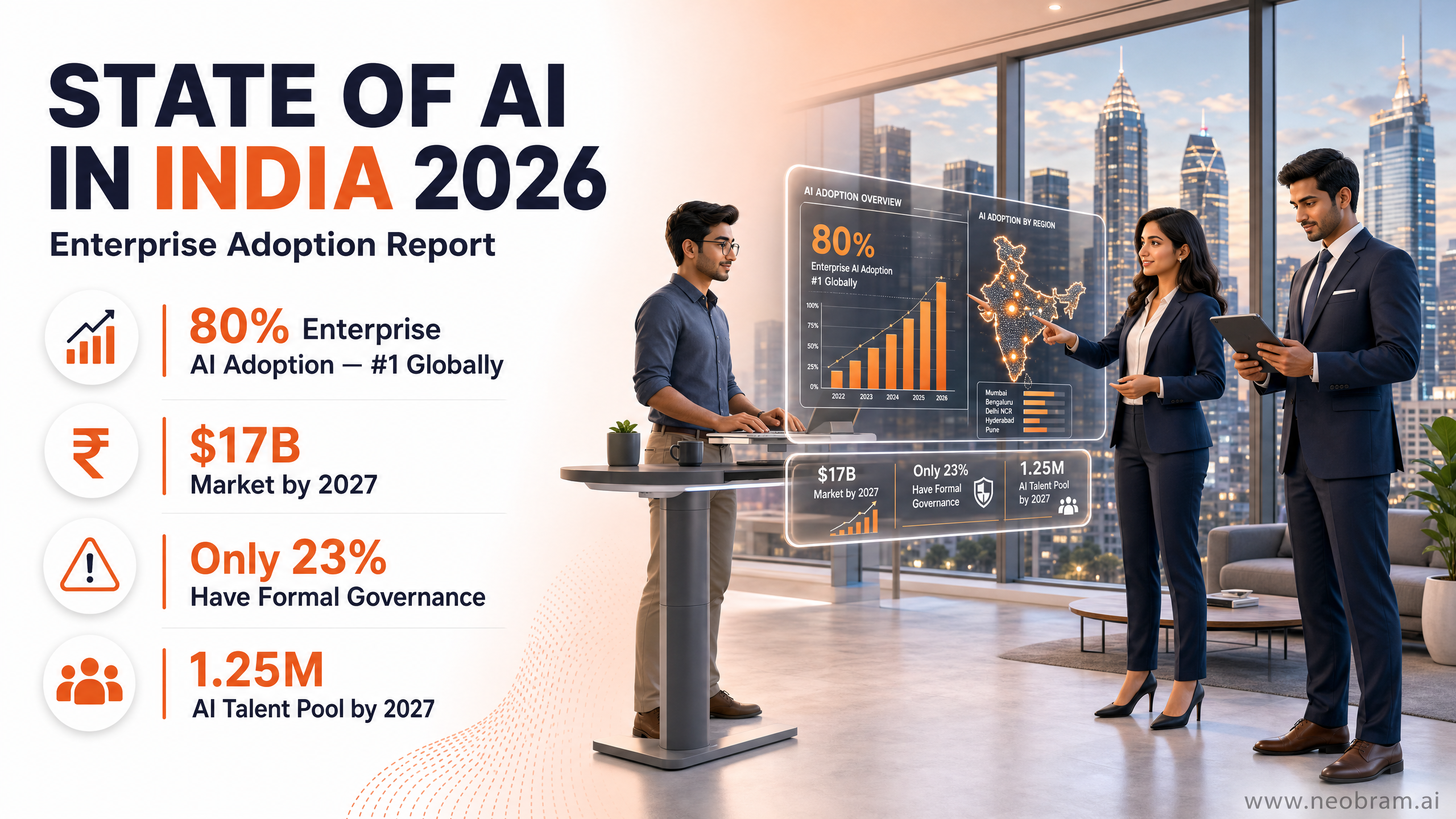
- India leads global enterprise AI adoption at 80%, outpacing the US at 59%, with 94% of organisations expecting AI budgets to increase in the next year.
- At-scale AI deployment is strongest in product development (62%) and strategy and operations (56%), with 40% of Indian respondents reporting significant or full AI usage versus a 28% global average.
- Only 23% of Indian enterprises have formal AI governance frameworks, creating a 57-point gap between adoption velocity and accountability maturity.
- The AI talent gap could reach 1.4 million professionals by 2027, with AI skills now topping India's hardest-to-fill roles at an 82% shortage rate.
India's AI Inflection Point: What the Numbers Actually Say
India has crossed a threshold in 2026. Enterprise AI adoption is no longer a pilot-stage conversation. It's a board-level mandate, a procurement priority, and increasingly, a competitive differentiator that separates the companies pulling ahead from those still debating whether to start.
The headline figure is striking: 80% of Indian enterprises now prioritise AI adoption, outpacing the United States at 59% and the global average by a significant margin. But the more important story is what's happening beneath that number. Adoption rates tell you how many companies have started. They don't tell you how many are actually getting results.
This report synthesises data from Deloitte's 2026 State of AI in the Enterprise survey, the Rotavision State of Enterprise AI: India 2026 analysis, NASSCOM research, and sector-specific studies to give you a clear picture of where Indian enterprise AI actually stands, what's working, what's stalling, and what the next 18 months will demand.
The Scale of India's AI Commitment
The investment signals are unambiguous. Microsoft, Amazon, and Google collectively committed over $67 billion to India's AI infrastructure in a 24-hour window in early 2026. Microsoft alone pledged $17.5 billion for cloud and AI infrastructure through 2029, including a new Hyderabad data centre region. Amazon committed $35 billion. Google committed $15 billion, alongside free AI tools for millions of Indian users.
The Indian government matched this with the IndiaAI Mission, a five-year programme with ₹10,371 crore approved for AI infrastructure, talent development, and startup support. By early 2026, the programme had already provisioned 38,000 GPUs for domestic compute access, exceeding its initial 10,000-unit target by nearly four times. GPU compute costs in India now run 40-50% cheaper than global averages, at ₹115-150 per hour versus ₹213-256 globally.
India's AI market is projected to reach $17 billion by 2027, growing at a 25-35% CAGR. The country hosts 50%+ of global Global Capability Centres (GCCs), with 1,800+ centres employing over 2 million professionals, including 126,000 AI specialists embedded in Fortune 500 companies.
The talent pool is substantial and growing. India currently holds 16% of global AI talent, second only to the United States. NASSCOM and Deloitte project this pool will reach 1.25 million AI professionals by 2027. The challenge, as we'll explore, is that demand is growing faster than supply.
At-Scale Deployment: Where Indian Enterprises Are Leading
Deloitte's 2026 survey of over 200 Indian business and technology leaders found that Indian enterprises are not just experimenting with AI. They're deploying it at scale across core functions.
At-scale deployment is strongest in:
- Product development: 62% of Indian enterprises report at-scale AI deployment
- Strategy and operations: 56%
- Marketing and sales: 55%
- Supply chain: 48%
These are not peripheral functions. Product development, operations, and supply chain are where enterprise value is created and where AI integration has the most direct impact on margins and speed.
The usage intensity data reinforces this. 40% of Indian respondents report significant or full AI usage, compared to a global average of approximately 28%. Indian organisations aren't just buying AI tools. They're using them.
The forward-looking signal is equally clear: 94% of Indian organisations expect their AI budgets to increase over the next year. That's not a marginal majority. It's near-universal commitment to continued investment.
97% of Indian enterprise leaders expect AI to increase productivity within the next 12 months. 44% are redesigning select processes while keeping their core business model intact: a pragmatic, incremental approach that is generating measurable returns faster than wholesale reinvention.
The Governance Gap: India's Most Urgent Problem
Here's where the story gets complicated. India leads the world in AI adoption velocity. It trails significantly in AI governance maturity.
Only 23% of Indian enterprises have formal AI ethics or governance frameworks. That's a 57-point gap between adoption and accountability. The Rotavision analysis describes this as "the defining challenge of 2026: velocity without accountability is velocity without value."
The governance deficit shows up in Deloitte's data too. Regulatory and compliance requirements are the top AI integration challenge for 39% of Indian enterprises. Resistance to change follows at 34%. Notably, cost (12%) and infrastructure (5%) are relatively minor concerns, which tells you something important: the barriers to AI scale in India are not technical or financial. They're organisational and regulatory.
The government has responded. At the India AI Summit in February 2026, MeitY unveiled India's AI Governance Guidelines, built around seven foundational principles: trust, transparency, fairness, accountability, privacy, safety, and inclusion. The guidelines are structured around four components: foundational principles, governance challenges and recommendations, a phased implementation plan, and practical guidance for industry participants.
The framework is a start. But guidelines without enforcement mechanisms and internal governance structures are aspirational documents. The enterprises that will build durable AI advantages are those treating governance as a competitive asset, not a compliance checkbox.
Sector Analysis: Who's Leading, Who's Catching Up
BFSI: The Governance Benchmark
Banking, financial services, and insurance holds 19.6% of India's AI market share, with 41% year-on-year job growth in AI-related roles. India processed over 20.39 billion real-time payment transactions through UPI in February 2026 alone, and AI is embedded throughout that infrastructure in fraud detection, risk scoring, and customer service.
The BFSI sector's AI maturity is partly a product of regulatory pressure. RBI oversight has forced governance discipline that other sectors lack. Fraud detection leads use cases at 78% adoption. Generative AI could boost efficiency by 46% according to sector analysis, and the India Generative AI in BFSI market is projected to grow from $61 million in 2024 to $662 million by 2035.
The lesson from BFSI is that regulation, when well-designed, accelerates rather than impedes AI maturity. The sectors with the least regulatory pressure are also the ones with the lowest governance readiness.
Manufacturing: Industry 4.0 in Practice
Manufacturing contributes 17% of India's GDP, and the sector is moving faster than most observers expected. 88% of Indian manufacturers now use AI or machine learning somewhere in operations, and 41% of operations are AI-augmented. 97% of manufacturers describe digital transformation as essential.
The most common entry points are predictive maintenance and vision-based quality control. Digital twins are cutting unplanned downtime by 20-40% with payback periods of 12-24 months. Edge AI now runs on approximately $500 devices instead of $50,000 server infrastructure, which has collapsed the entry cost for mid-sized manufacturers.
Pune is emerging as India's Industry 4.0 hub. The government's SAMARTH Udyog Bharat 4.0 programme provides manufacturers with demo centres to trial smart manufacturing technology before committing capital. Industrial AI funding in India is projected to reach $1.5 billion by 2030.
The main barrier isn't cost or technology. It's skills. Running an IoT-enabled factory requires people who understand both manufacturing processes and data systems, and that combination is genuinely scarce.
IT Services and GCCs: The Agentic AI Vanguard
India's IT services sector is undergoing a structural transformation. AI deals now form 74% of all IT services contracts signed in the last six quarters. The major players are not selling traditional services with AI add-ons. They're selling AI with services support.
The numbers from individual companies illustrate the scale:
| Company | AI Revenue/Deals | Key Initiatives |
|---|---|---|
| TCS | $1.8B (6% of total revenue) | 81 AI deals, multi-agent platforms |
| Infosys | 4,600 AI projects | 90% of top 200 clients on AI |
| HCLTech | 139 AI deals | 72% of deal wins in AI |
| Wipro | $1B three-year plan | 50,000+ Copilot licences |
India's 1,800+ GCCs are evolving from cost-efficient support hubs to strategic AI intelligence centres. 58% are now investing in Agentic AI capabilities. 126,000+ AI professionals are embedded in Fortune 500 GCCs, not as support staff but as innovation drivers. The GCC revenue projection for 2030 is $105 billion.
Healthcare: Highest Potential, Lowest Readiness
Healthcare shows the strongest AI hiring growth at 38% year-on-year, but it significantly lags in actual deployment. The majority of healthcare organisations lack AI risk management frameworks. The potential is substantial: 30-40% productivity gains are achievable by 2030 if the governance gap closes.
The sector's challenge is that healthcare AI failures carry consequences that failed manufacturing algorithms don't. A misclassified invoice is a recoverable error. A misclassified diagnostic image is not. This reality demands governance frameworks that the sector hasn't yet built.
The most regulated Indian sectors (BFSI, Telecom) show the highest AI maturity. The least regulated sectors (Healthcare, Retail) show the highest potential but the lowest governance readiness. Regulation, it turns out, is an AI maturity accelerant, not a brake.
The Agentic AI Shift
Agentic AI is the defining technology conversation of 2026. These are AI systems that don't just respond to prompts. They plan, execute multi-step tasks, use tools, and operate with meaningful autonomy. The shift from generative AI to agentic AI is a shift from AI that assists to AI that acts.
India is moving into this space faster than most markets. 74% of Indian enterprises are exploring agentic AI use cases. 24% have already deployed. 92% expect AI agents to handle customer interactions within the next 12 months.
The adoption maturity curve looks like this:
- Awareness: 26%
- Exploring: 50%
- Piloting: 18%
- Production: 4%
- Scale: 2%
The 50% in the "exploring" stage represents the next wave of deployment. When those organisations move from exploration to production, India's enterprise AI landscape will look fundamentally different.
GCCs are leading this shift. 58% are investing in Agentic AI, with 29% more planning investment within a year. Multi-agent orchestration is becoming a standard GCC offering. The organisations that build agentic AI capabilities in 2026 will have a significant head start when the technology matures.
The Talent Crisis: India's Hidden Constraint
India's AI talent story is a paradox. The country has the world's second-largest AI talent pool and the highest AI skill penetration rate globally. It also has an AI talent gap that could reach 1.4 million professionals by 2027 if upskilling doesn't accelerate dramatically.
In 2024, India had approximately 420,000 AI professionals against an immediate industry requirement of 600,000, a shortfall of close to 50%. By 2026, demand has grown faster than supply. Only 16% of Indian IT professionals are AI-skilled, according to MeitY data.
The gap is not uniform. Demand is concentrated in specific high-skill roles: machine learning engineers, data scientists, AI product managers, MLOps specialists, and prompt engineers who can wire large language models into actual enterprise workflows. Supply is constrained by university curricula that haven't kept pace with a field where the tooling changes every few months.
AI skills now top India's hardest-to-fill roles, with an 82% talent shortage in AI-specific positions. A 2026 NASSCOM-Deloitte analysis estimates that 37% of entry-level IT jobs will be impacted by AI, not through elimination but through role redefinition. Testing, basic coding, customer service scripting, and data entry are being transformed, with the human role shifting from execution to oversight and exception management.
The companies responding effectively to this constraint aren't primarily hiring from an empty talent pool. They're building AI fluency across their existing workforce. TCS trained 350,000 employees on AI technologies in 2023-24. Wipro trained 220,000. Infosys launched customised in-house AI training through its Springboard initiative. Microsoft committed to skilling 2 million Indians in AI by 2025.
These are significant programmes. But 43% of the Indian workforce has used AI in their organisations over the past year, and 60% of workers recognise that AI skills will enhance their career prospects. The demand for capability building is coming from employees as much as from employers.
The Regional Language Opportunity
One dimension of India's AI story that receives insufficient attention outside the country is the vernacular AI opportunity. India has 500 million internet users who primarily access content in regional languages. English-language AI tools reach a fraction of this market.
The IndiaAI Mission's BharatGen AI initiative is addressing this directly. The programme will cover all 22 scheduled Indian languages by June 2026, unlocking what analysts estimate is a $20 billion vernacular AI market. Nine languages are already live. The remaining 13 are in active development.
This matters for enterprise AI in ways that go beyond consumer applications. Manufacturing workers in Tamil Nadu, healthcare workers in Maharashtra, and agricultural operators in Punjab all need AI tools that work in their language. The enterprises that deploy AI in regional languages will reach deeper into their workforces and supply chains than those relying on English-only tools.
What the Big Tech Bets Signal
When Microsoft, Amazon, and Google collectively commit $67 billion to a single market in 24 hours, they're not making a charitable investment. They're making a calculated bet on where the next decade of enterprise AI deployment will happen.
The logic is straightforward. India offers three things simultaneously: scale (1.4 billion people, 800 million internet users), talent (the world's second-largest AI workforce), and cost arbitrage (40-50% cheaper compute than global averages, with Tier 2 and Tier 3 city expansion reducing talent costs further).
The government's IndiaAI Mission adds a fourth factor: infrastructure commitment. 38,000 GPUs provisioned, ₹2,000 crore allocated for FY 2025-26, and a FutureSkills Prime programme targeting 2 million reskilled professionals. India is building the infrastructure layer that enterprise AI deployment requires, at a scale and cost that no other market currently matches.
For enterprise leaders, this investment landscape has a practical implication: the tools, infrastructure, and talent required for AI deployment are becoming more accessible and more affordable in India than anywhere else. The question is no longer whether to invest in AI. It's how to invest effectively.
The Four Barriers Holding Indian Enterprises Back
Despite the momentum, most Indian enterprises are not yet extracting full value from their AI investments. The Deloitte data identifies the primary constraints:
1. Governance and compliance readiness (39%): Regulatory requirements are the top integration challenge. Organisations that haven't built internal AI governance frameworks are finding that deployment stalls at the point where legal and compliance teams need to sign off.
2. Organisational resistance to change (34%): Technology is rarely the limiting factor. The harder problem is getting people to change how they work. Organisations that treat AI adoption as a technology project rather than a change management programme consistently underperform.
3. Data infrastructure quality: A 2026 survey found that poor real-time data infrastructure, not AI budgets, is the primary barrier to enterprise AI in India. You can't build reliable AI on unreliable data. Many organisations discover this after they've already invested in the AI layer.
4. Specialist expertise gaps: Only 0-4% of Indian companies possess high-level AI expertise, compared to a global average of 2-8%. The expertise gap is most acute in the roles that matter most: the people who can design AI systems, evaluate their outputs, and govern their behaviour at scale.
The organisations closing these gaps fastest share a common characteristic. They treat AI adoption as a strategic capability to be built, not a technology to be purchased. They invest in governance frameworks before they need them. They build data infrastructure before they build AI models. They develop internal expertise rather than depending entirely on external vendors.
How NeoBram Can Help
India's AI opportunity is real. So are the barriers. Most enterprises have the ambition and the budget. What they often lack is the implementation expertise to move from pilot to production at scale.
NeoBram works with enterprise teams across manufacturing, BFSI, pharma, oil and gas, and EPC to design and deploy AI solutions that deliver measurable outcomes. Our approach addresses the specific barriers that Indian enterprises face:
Governance-first deployment: We build AI governance frameworks before we build AI systems. Every deployment includes risk assessment, data governance protocols, and monitoring frameworks that satisfy regulatory requirements and build internal confidence.
Data infrastructure readiness: Before recommending any AI solution, we audit your data infrastructure. If the data isn't ready, the AI won't be either. We help organisations build the data foundations that make AI deployment reliable.
Workforce capability building: We don't just deploy AI tools. We build the internal capability to use, maintain, and evolve them. That means training programmes, documentation, and ongoing support that transfers knowledge to your team.
Sector-specific expertise: India's AI challenges vary significantly by sector. The governance requirements in BFSI are different from those in manufacturing. The data challenges in pharma are different from those in construction. We bring sector-specific knowledge to every engagement.
Whether you're exploring your first AI use case or scaling from pilot to enterprise-wide deployment, we can help you move faster with fewer false starts.
The 2027 Outlook
The next 18 months will determine which Indian enterprises build durable AI advantages and which ones remain in the exploration phase.
The organisations that will pull ahead are those that:
- Close the governance gap before regulators force them to
- Build data infrastructure that makes AI deployment reliable
- Develop internal AI expertise rather than depending entirely on vendors
- Move from generative AI to agentic AI in at least one core workflow
- Deploy in regional languages to reach their full workforce and customer base
The organisations that will fall behind are those that treat AI as a technology procurement decision rather than a capability-building programme, that pilot without a path to production, and that adopt without governing.
India's AI market is projected to reach $17 billion by 2027. The enterprises that capture their share of that value will be those that treat 2026 as the year to build foundations, not just deploy tools.
The window for building a durable AI advantage is open. It won't stay open indefinitely.
Key Takeaways
- India leads global enterprise AI adoption at 80%, outpacing the US (59%) and global averages, with 94% of organisations expecting AI budgets to increase in the next year.
- At-scale deployment is strongest in product development (62%), strategy and operations (56%), and marketing and sales (55%), with 40% of Indian respondents reporting significant or full AI usage versus a 28% global average.
- Only 23% of Indian enterprises have formal AI governance frameworks, creating a 57-point gap between adoption velocity and accountability maturity.
- The AI talent gap could reach 1.4 million professionals by 2027 if upskilling doesn't accelerate, with AI skills now topping India's hardest-to-fill roles at an 82% shortage rate.
- 74% of Indian enterprises are exploring agentic AI, with 24% already deploying, signalling a structural shift from AI that assists to AI that acts.