Key takeaways
- 79% of organizations face challenges adopting AI, largely due to strategy gaps.
- Data maturity is the most critical factor; fragmented data blocks AI scaling.
- Governance must be built into architecture from day one, not bolted on later.
- Adoption requires workflow redesign and change management, not just deployment.
Why Most Enterprise AI Strategies Fail Before They Start
Every boardroom has an AI slide deck. Most of them are performance art.
According to Writer's 2026 Enterprise AI Adoption Survey, 75% of executives admit their company's AI strategy is "more for show" than actual internal guidance. Meanwhile, MIT research published in Fortune found that 95% of generative AI pilots fail to reach production. McKinsey confirms that while 88% of companies now use AI in at least one business function, only one-third have scaled it across the enterprise.
The gap between AI ambition and AI outcomes is not a technology problem. It's a strategy problem.
Building an enterprise AI strategy that actually delivers requires more than picking tools or running pilots. It means aligning business priorities, data infrastructure, governance, and organizational change into a single coherent plan. This guide walks through a practical 6-step framework for doing exactly that.
The scale of the problem: 79% of organizations face challenges in adopting AI in 2026, a double-digit increase from 2025. Only 29% report significant ROI from generative AI, despite the majority investing over $1 million annually in AI technology. (Writer, 2026 Enterprise AI Adoption Survey)
What Is an Enterprise AI Strategy?
An enterprise AI strategy is a structured blueprint that defines how an organisation will use artificial intelligence to achieve measurable business outcomes. It is not a list of tools to evaluate, a set of pilots to run, or a vision statement for the annual report.
A real enterprise AI strategy connects business objectives to data readiness, governance, technical architecture, and workforce enablement. It answers one central question: how do we turn scattered AI experiments into a scalable, enterprise-wide capability that moves the P&L?
The distinction matters because most organisations confuse AI activity with AI strategy. Gartner notes that companies routinely launch pilots, buy tools, and experiment with large language models without a unifying direction. The result is what practitioners call "pilot purgatory": a graveyard of successful proofs-of-concept that never reach production.
A genuine enterprise AI strategy is built on five pillars:
- Business alignment: - Every AI initiative is tied to a revenue goal, cost reduction target, or operational KPI, not to a model or algorithm.
- Data foundation: - The strategy defines data quality, accessibility, and governance requirements before model development begins.
- Governance and risk controls: - Frameworks for transparency, compliance, bias mitigation, and auditability are built in from the start, not bolted on later.
- Architecture and MLOps readiness: - Cloud infrastructure, pipelines, monitoring, and model lifecycle management are planned for production, not just for demos.
- Workforce enablement: - Change management, skills development, and adoption pathways are treated as core deliverables, not afterthoughts.
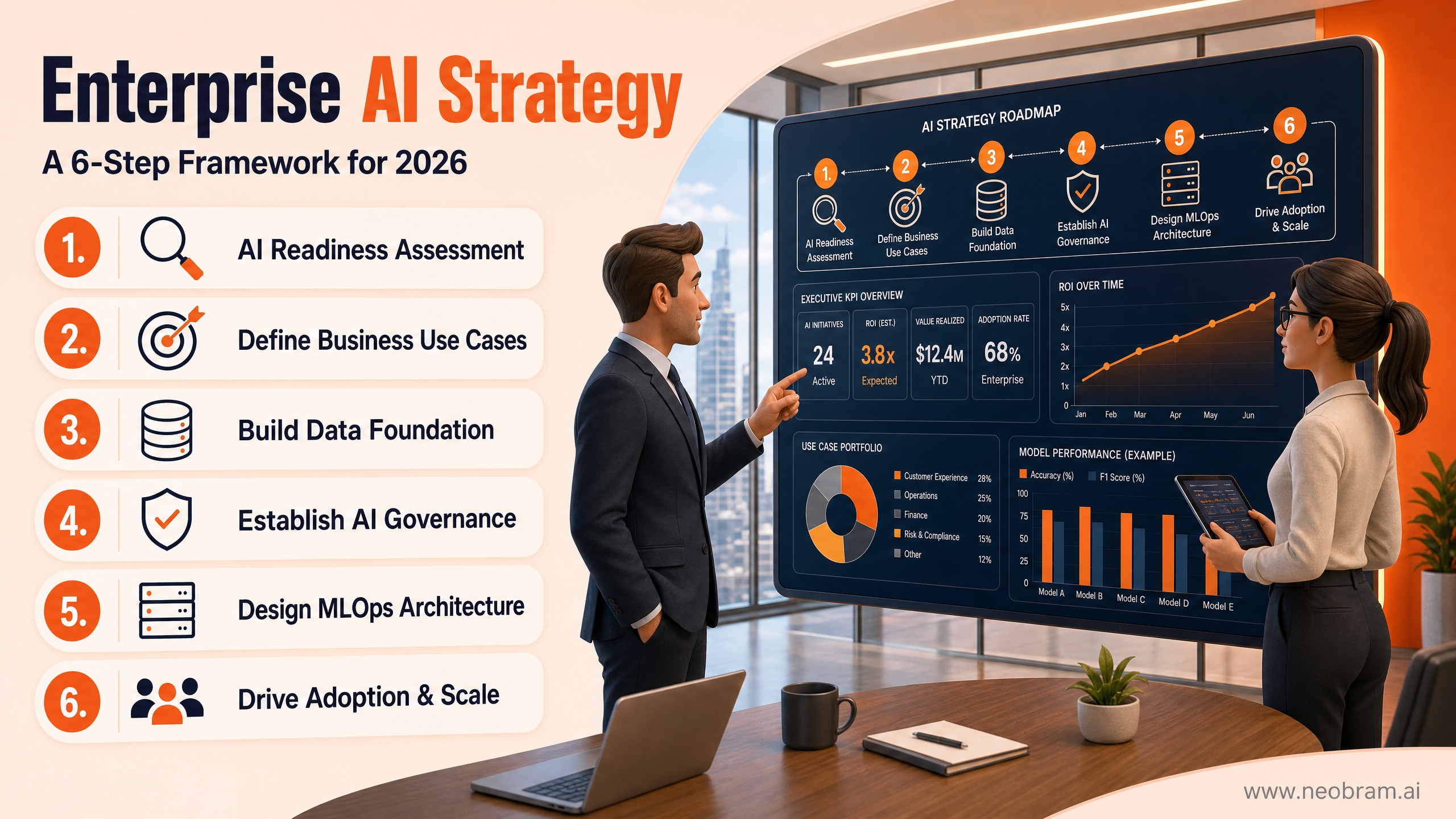
The 6-Step Framework for Building an Enterprise AI Strategy
Step 1: Conduct an Honest AI Readiness Assessment
Before choosing a single tool or use case, you need to know where you actually stand. An AI readiness assessment examines four dimensions: data maturity, infrastructure capability, talent availability, and organisational culture.
Data maturity is the most critical and most underestimated factor. Gartner identifies data fragmentation as the number one barrier to enterprise AI maturity. If your data lives in siloed legacy systems with inconsistent schemas and unclear ownership, no AI model will fix that. The assessment should map every major data source, its quality, its accessibility, and who owns it.
Infrastructure capability covers whether your cloud and compute environment can support AI workloads. A 2026 AI Maturity Index found that 64% of enterprises lack the architecture required for reliable AI operations. Running AI on infrastructure designed for traditional software is like installing a jet engine in a propeller plane: the power is there, but the frame cannot handle it.
Talent availability is about more than hiring data scientists. It includes whether your business teams can define AI use cases, whether your engineers can build and maintain ML pipelines, and whether your leaders understand enough to make good decisions.
Organisational culture is where many assessments stop short. McKinsey reports that 70% of digital transformations fail not because of technical issues, but because of cultural resistance. If people do not understand why AI matters to their work, they will route around it.
The output of a readiness assessment is not a score. It is a clear picture of your gaps and a prioritised list of what needs to be fixed before AI can scale.
Readiness reality check: Only 40% of organisations confirm they have a formal AI strategy in place, according to Deloitte's State of AI in the Enterprise report. Yet 91% plan to increase their AI investment. Spending more on AI without a strategy does not close the gap; it widens it.
Step 2: Define Business-Aligned Use Cases
The most common mistake in enterprise AI is starting with the technology. Teams evaluate LLMs, buy AI platforms, and then search for problems to solve. This approach produces demos, not outcomes.
The right sequence is the reverse: start with your highest-priority business problems, then identify where AI can address them.
Work with business unit leaders to map their top three to five pain points by P&L impact. Look for patterns across functions. Common high-value categories include:
- Operational efficiency: - Predictive maintenance, quality inspection, demand forecasting, supply chain optimisation.
- Revenue growth: - Personalisation, lead scoring, pricing optimisation, customer churn prediction.
- Risk reduction: - Fraud detection, compliance monitoring, safety incident prediction, credit risk assessment.
- Cost reduction: - Process automation, document processing, contract review, IT operations.
For each candidate use case, score it on three dimensions: business value (revenue or cost impact), technical feasibility (data availability, model complexity), and organisational readiness (stakeholder buy-in, change management requirements). This creates a prioritised backlog of AI initiatives, not a wish list.
Deloitte's research finds that 91% of organisations plan to increase AI investment, but only 6% reported payback within a year. The difference between the 6% and the rest is almost always use case selection and business alignment, not the quality of the models.
Step 3: Build Your Data Foundation
AI is only as good as the data it runs on. This step is where most enterprise AI strategies stall, because it requires unglamorous, time-consuming work that does not produce visible results quickly.
A production-ready data foundation has four components:
Data governance: Clear ownership, access controls, lineage tracking, and quality standards for every data asset used in AI. Without governance, you cannot trust model outputs, and you cannot comply with regulations like GDPR or the EU AI Act.
Data integration: A unified data layer that connects sources across business units, applications, and systems. This does not necessarily mean a single data warehouse. It means consistent schemas, reliable pipelines, and accessible APIs so that AI systems can reach the data they need.
Data quality management: Automated pipelines that detect and flag data quality issues before they reach models. Garbage in, garbage out is not a cliché; it is the single most common cause of AI project failure in production.
Real-time data access: Many high-value AI applications, including predictive maintenance, fraud detection, and dynamic pricing, require streaming data, not batch updates. Your data architecture needs to support both.
This step often takes longer than organisations expect. Budget for it accordingly. The companies that rush past data foundation work to get to the "exciting" model development phase are the same companies that end up in pilot purgatory.
Step 4: Establish AI Governance and Risk Controls
AI governance is not a compliance checkbox. It is the infrastructure that makes AI trustworthy enough to deploy at scale.
Harvard Business Review notes that enterprises without AI governance face significantly higher regulatory and reputational risk. As the EU AI Act comes into force and other jurisdictions follow, the cost of ungovernered AI is rising fast. Writer's 2026 survey found that 67% of executives believe their company has already suffered a data leak or breach due to unapproved AI tools, and 55% describe AI use at their company as a "chaotic free-for-all."
A practical AI governance framework covers:
Model risk management: Processes for evaluating model accuracy, bias, and drift before deployment and on an ongoing basis. Every model in production should have an owner, a performance baseline, and a defined threshold for human review or retraining.
Explainability standards: For decisions that affect customers, employees, or financial outcomes, you need to be able to explain why the model produced a given output. This is both a regulatory requirement in many jurisdictions and a basic requirement for building internal trust.
Data privacy and security: Controls that prevent sensitive data from being exposed to external AI systems, and that ensure AI-generated outputs do not leak proprietary information. This is particularly critical for organisations using third-party LLM APIs.
AI use policy: Clear guidelines for employees on which AI tools are approved, how to use them, and what data can and cannot be shared with external systems. The 35% of employees who have entered proprietary information into public AI tools are not reckless; they are filling a governance vacuum.
Incident response: A plan for what happens when an AI system produces harmful, biased, or incorrect outputs at scale. The 35% of executives who admit they could not immediately "pull the plug" on a rogue AI agent need to fix this before they scale agentic systems.
Governance is not optional: Gartner predicts that over 40% of agentic AI projects will be cancelled by end of 2027 due to lack of governance frameworks. Organisations that build governance into their AI strategy from day one will have a significant competitive advantage as regulation tightens.
Step 5: Design Your AI Architecture and MLOps Stack
An AI strategy without an architecture plan is a strategy that will not survive contact with production.
The architecture decisions you make in this step determine whether your AI systems can scale, adapt, and operate reliably over time. Key decisions include:
Cloud and compute strategy: Most enterprise AI workloads run on cloud infrastructure, but the choice of provider, the mix of cloud and on-premise, and the compute tier (CPU, GPU, TPU) have significant cost and performance implications. Define your cloud strategy before you start building.
Model deployment patterns: Will you use pre-built foundation models via API, fine-tune open-source models on your own data, or build custom models from scratch? Each approach has different cost, control, and capability tradeoffs. Most enterprises use a combination, with pre-built APIs for general tasks and custom models for domain-specific applications.
MLOps infrastructure: The tooling and processes for training, testing, deploying, monitoring, and retraining models. This includes experiment tracking, model registries, CI/CD pipelines for ML, and monitoring dashboards. Without MLOps, models degrade silently in production and teams cannot iterate quickly.
Integration architecture: How AI systems connect to existing enterprise applications, databases, and workflows. AI that sits in isolation does not create business value. Define the integration points, APIs, and data flows before you build.
Agentic AI infrastructure: As organisations move toward AI agents that can plan and execute multi-step workflows, the architecture requirements change significantly. Agent orchestration, tool access controls, memory management, and human-in-the-loop checkpoints all need to be designed explicitly. McKinsey found that 62% of organisations are experimenting with AI agents, but most lack the infrastructure to run them safely at scale.
Step 6: Build for Adoption, Not Just Deployment
The final step is the one most organisations skip, and it is the reason most AI projects fail to deliver value even when the technology works.
Deploying an AI system and getting people to use it effectively are two different problems. McKinsey's research on AI high performers shows that they are nearly three times as likely as their peers to have fundamentally redesigned individual workflows around AI, not just added AI tools to existing workflows.
Adoption requires:
Change management: A structured programme for communicating why AI is being introduced, what it means for specific roles, and how employees will be supported through the transition. The 29% of employees who admit to sabotaging their company's AI strategy are not the enemy; they are a signal that change management has failed.
Training and upskilling: Role-specific training that goes beyond "here is how to use the tool" to "here is how your job changes when this tool is part of your workflow." AI super-users save nearly 9 hours per week according to Writer's research. That productivity gain does not happen by accident.
Incentive alignment: If employees are evaluated on metrics that do not account for AI adoption, they will not prioritise it. High performers are three times more likely to have received a promotion or pay raise in the past year according to Writer's data. Make AI proficiency a visible part of performance evaluation.
Feedback loops: Mechanisms for users to report when AI systems produce incorrect, unhelpful, or harmful outputs. This is both a quality improvement tool and a trust-building mechanism. People adopt tools they trust; they abandon tools that make them look bad.
Executive sponsorship: McKinsey finds that AI high performers are three times more likely to strongly agree that senior leaders demonstrate ownership of and commitment to AI initiatives. AI transformation does not happen bottom-up. It requires visible, sustained leadership commitment.
Common Pitfalls to Avoid
Even with a solid framework, enterprise AI strategies run into predictable problems. The most common ones are worth naming explicitly.
Starting with technology instead of business problems. Buying an AI platform and then searching for use cases is backwards. The technology should follow the business case, not lead it.
Underestimating data readiness. Teams consistently underestimate how much work is required to get data into a state where AI can use it reliably. Build more time and budget into this phase than you think you need.
Treating governance as a compliance exercise. Governance that is designed to satisfy auditors rather than to make AI trustworthy will fail in both respects. Build governance that your engineers and business users actually follow.
Scaling before validating. The pressure to show results quickly leads organisations to scale AI systems before they have validated that those systems produce reliable, unbiased, and accurate outputs in real-world conditions. Scaling a broken system makes it more broken, faster.
Ignoring the human side. AI transformation is a change management challenge that happens to involve technology. Organisations that treat it as a technology challenge that happens to involve people will struggle with adoption, resistance, and cultural fragmentation.
Measuring the Success of Your Enterprise AI Strategy
A strategy without measurement is a wish. Define your success metrics before you start executing, and review them regularly.
At the portfolio level, track the number of AI use cases in production, the aggregate business value delivered (cost savings, revenue impact, risk reduction), and the speed at which new use cases move from concept to production.
At the use case level, track the specific KPIs tied to each initiative: reduction in unplanned downtime, improvement in forecast accuracy, decrease in fraud losses, increase in customer satisfaction scores.
At the organisational level, track AI adoption rates by function, employee confidence scores, and the ratio of AI super-users to laggards. These leading indicators predict future business impact before it shows up in financial results.
Review your strategy annually and update it based on what you have learned. The AI landscape changes fast. A strategy that was right in 2024 may need significant revision in 2026. Build in the flexibility to adapt.
How NeoBram Can Help
Building an enterprise AI strategy is not a one-time project. It is an ongoing capability that requires deep expertise across business strategy, data engineering, AI development, and change management.
NeoBram works with enterprise organisations across manufacturing, pharma, oil and gas, banking, and EPC sectors to design and execute AI strategies that deliver measurable outcomes. Our approach is built on the same 6-step framework described in this guide, adapted to the specific context, constraints, and priorities of each organisation.
We start with an honest assessment of where you are, not where you want to be. We help you identify the use cases with the highest business value and the clearest path to production. We build the data foundations, governance frameworks, and technical architecture that make AI reliable at scale. And we work alongside your teams to drive adoption and build internal capability, so that AI becomes a durable competitive advantage, not a dependency.
Results reported across the industry for comparable deployments include reductions in unplanned downtime, improvements in inspection accuracy and lower energy costs; the achievable range depends on baseline, data quality and adoption. Treat any specific percentage as an estimate to validate in your own environment, not a guarantee. These outcomes do not come from better models. They come from better strategy.
If you're ready to move from AI experimentation to AI at scale, [book a free strategy call with the NeoBram team](https://neobram.ai/contact). We'll help you build a roadmap that connects your AI ambitions to your business results.
Enterprise AI Strategy by Industry: What Changes and What Stays the Same
The 6-step framework above applies across industries, but the specific priorities and constraints vary significantly by sector. Understanding these differences helps you calibrate your strategy to your context.
Manufacturing
Manufacturing organisations typically have rich operational data from sensors, PLCs, and MES systems, but that data is often siloed in legacy OT systems that were never designed to connect to modern analytics platforms. The IT/OT integration challenge is real and significant.
The highest-value AI use cases in manufacturing cluster around predictive maintenance, quality inspection, demand forecasting, and energy optimisation. These are all data-intensive applications that require reliable, real-time data feeds from the shop floor.
Governance in manufacturing AI has a physical safety dimension that other industries do not face. A model that produces a bad recommendation in a financial services context might cost money. A model that produces a bad recommendation in a manufacturing context might injure someone. Safety validation and human-in-the-loop controls are not optional.
Pharma and Life Sciences
Pharma organisations face the most stringent regulatory environment of any sector. Every AI system that touches GxP processes, clinical data, or manufacturing quality must be validated under FDA 21 CFR Part 11, EU GMP Annex 11, or equivalent frameworks. This is not a barrier to AI adoption; it is a design constraint that shapes how AI systems are built and deployed.
The highest-value use cases in pharma include clinical trial optimisation, drug discovery acceleration, manufacturing quality control, and pharmacovigilance. All of these require exceptionally high data quality and robust audit trails.
The data governance work in pharma is more intensive than in most industries, but the payoff is proportionally higher. AI systems that can reliably accelerate drug development timelines or reduce manufacturing deviations deliver enormous value.
Oil and Gas
Oil and gas organisations operate in physically remote, safety-critical environments where the cost of equipment failure is measured in millions of dollars per day. Predictive maintenance and asset integrity management are the clearest AI value drivers.
The data challenge in oil and gas is often connectivity: getting reliable data from offshore platforms, remote pipelines, and distributed field assets into a centralised analytics environment. Edge AI and hybrid cloud architectures are often necessary.
ESG reporting is creating new AI use cases in oil and gas around emissions monitoring, energy efficiency optimisation, and sustainability reporting. These are increasingly board-level priorities that create budget and executive sponsorship for AI investment.
Banking and Financial Services
Banking organisations typically have the most mature data infrastructure of any sector, but they face the most complex regulatory environment for AI. Model risk management (MRM) frameworks, fair lending requirements, and explainability mandates shape every AI deployment decision.
The highest-value use cases in banking include fraud detection, credit risk assessment, customer service automation, and regulatory compliance monitoring. All of these require models that are not just accurate, but explainable and auditable.
The talent challenge in banking AI is different from other sectors. Banks have strong quantitative talent but often lack the engineering capability to build and operate production ML systems at scale. Bridging the gap between model development and production deployment is a common challenge.
The Role of AI Consulting Partners in Enterprise AI Strategy
Most enterprises do not have all the capabilities they need to execute an enterprise AI strategy in-house. The question is not whether to use external expertise, but how to use it effectively.
The most common mistake organisations make with AI consulting is treating it as a staff augmentation exercise: bringing in consultants to build AI systems that the internal team cannot build, then watching those systems degrade when the consultants leave.
Effective use of AI consulting partners focuses on three things:
Capability transfer: The consulting engagement should build internal capability, not create dependency. Every project should include knowledge transfer, documentation, and training that leaves the organisation more capable than it was before.
Strategic alignment: Consultants who understand your business, your industry, and your competitive context will deliver better outcomes than those who apply generic frameworks. Look for partners with deep domain expertise in your sector, not just AI expertise in general.
Production focus: The value of an AI system is realised in production, not in a demo. Choose partners who have a track record of taking AI from concept to production in enterprise environments, not just building impressive prototypes.
The right consulting partner accelerates your AI strategy by bringing expertise, tools, and proven methodologies that would take years to build internally. The wrong partner creates expensive pilots that never scale.
Building Internal AI Capability Over Time
A dependency on external consultants is not a sustainable AI strategy. The goal is to build internal capability that can design, build, and operate AI systems without constant external support.
This requires a deliberate talent strategy. The roles you need include:
AI product managers: Business-oriented professionals who can translate business problems into AI use cases, define success metrics, and manage the relationship between business stakeholders and technical teams.
ML engineers: Technical professionals who can build and maintain production ML systems, including data pipelines, model training infrastructure, deployment tooling, and monitoring systems.
Data engineers: Professionals who build and maintain the data infrastructure that AI systems depend on: pipelines, warehouses, streaming systems, and data quality frameworks.
AI governance specialists: Professionals who can design and implement governance frameworks, conduct model audits, manage regulatory compliance, and build the trust infrastructure that makes AI deployable at scale.
AI trainers and adoption specialists: Professionals who can design training programmes, manage change, and drive adoption across business functions.
Building this team takes time. Most organisations start by hiring one or two senior AI leaders who can define the strategy and build the team around them. The alternative, hiring a large team before you have a clear strategy, typically produces expensive confusion.
The talent reality: McKinsey's research shows that AI high performers are more likely to have redesigned workflows around AI and to have senior leaders actively driving adoption. The technology is rarely the bottleneck. Leadership commitment and talent strategy are what separate the 6% of organisations achieving significant AI impact from the rest.
Your Next Steps
Building an enterprise AI strategy is not a single project with a start and end date. It is an ongoing capability that evolves as your organisation learns, as the technology changes, and as your competitive environment shifts.
The 6-step framework in this guide gives you a starting point. But the most important step is the first one: being honest about where you are today, not where you want to be.
Start with the readiness assessment. Map your data. Identify your highest-value use cases. Build governance into your architecture from day one. Invest in adoption as seriously as you invest in technology. And measure everything.
The organisations that will win with AI over the next five years are not the ones with the biggest AI budgets or the most advanced models. They are the ones with the clearest strategy, the strongest data foundations, and the most disciplined execution.
Ready to build an AI strategy that delivers real business outcomes? [Book a free strategy call with NeoBram](https://neobram.ai/contact) and let's map out your path from AI experimentation to AI at scale.