
Key takeaways
- 79% of organizations face challenges adopting AI in 2026, despite 59% investing over $1 million annually in AI technology.
- A 2025 MIT study found 95% of enterprise generative AI initiatives showed no measurable impact on profit and loss, primarily due to lack of organizational readiness.
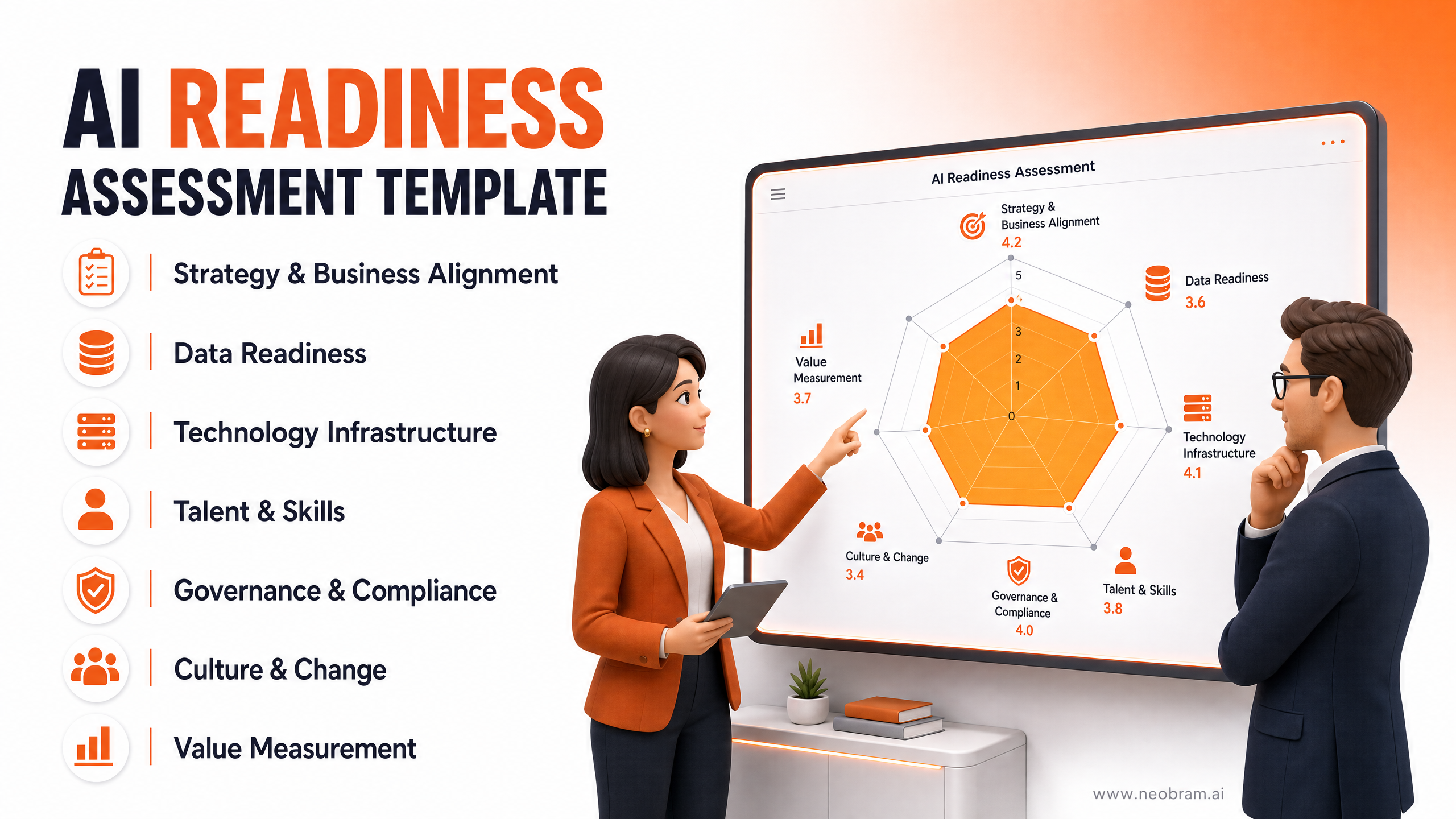
- The 7-domain assessment template covers strategy, data, infrastructure, talent, governance, culture, and value measurement, each scored out of 10.
- 65% of business leaders don't know when or where to apply AI, making a structured readiness assessment the essential first step before any AI investment.
Why Most AI Projects Fail Before They Start
Seventy-nine percent of organizations face challenges adopting AI in 2026, according to Writer's enterprise AI adoption survey. That's a double-digit increase from 2025. Yet 59% of those same companies are investing over $1 million annually in AI technology.
The money is there. The intent is there. What's missing is the foundation.
A 2025 MIT study found that 95% of enterprise generative AI initiatives showed no measurable impact on profit and loss. The primary reason wasn't bad technology. It was weak integration with existing workflows and a lack of organizational readiness.
This is the AI readiness problem. Companies rush to deploy tools before they've assessed whether their data, infrastructure, governance, and culture can actually support them. The result is wasted investment, stalled pilots, and frustrated teams.
This guide gives you a practical AI readiness assessment template you can use right now. It covers the seven critical dimensions every organization needs to evaluate, a scoring framework to identify your maturity stage, and a clear path forward based on where you land.
The numbers are stark: 65% of business leaders don't know when or where to apply AI, 52% lack foundational understanding of how AI works, and 42% are unsure about ethics, policy, and emerging tools. Source: Data Society 2025 AI Readiness Report.
What Is an AI Readiness Assessment?
An AI readiness assessment is a structured evaluation of your organization's ability to successfully adopt, deploy, and scale artificial intelligence. It's not a technology audit. It's a full organizational diagnostic.
True readiness spans six interconnected areas: strategy, data, infrastructure, talent, governance, and culture. A weakness in any one of these areas can derail an AI initiative, regardless of how strong the others are.
Think of it like building a house. You can have the best architect, the finest materials, and a generous budget. But if the foundation is cracked, the whole structure is at risk.
The assessment template in this guide is designed for business leaders, operations managers, and IT decision-makers who want an honest picture of where their organization stands before committing resources to AI.
The 5-Stage AI Maturity Model
Before running through the detailed assessment, it helps to understand the five stages of AI maturity. This gives you a rough starting point and helps you interpret your scores in context.
Stage 1: Awareness
Your organization recognizes that AI matters and is gathering information. There's no dedicated AI budget, no department responsible for AI, and no formal roadmap. The focus is on building understanding and generating organizational will.
Stage 2: Exploratory
You're running pilots and experiments. Teams are testing AI tools to build confidence and understand what's possible. This is a necessary step, but it shouldn't become a permanent state. Pilots demonstrate potential; they don't create systematic capability.
Stage 3: Operational
AI is running in at least one area of your business with proper governance in place. Policies exist around how AI should and shouldn't be used. This marks the shift from "playing with AI" to "running our business with AI."
Stage 4: Systematized
AI operates across multiple departments. You have an AI leader or dedicated team, a formal roadmap, and budget allocated specifically for AI. Different teams use AI for different purposes, with coordination connecting those implementations.
Stage 5: Transformational
AI is woven throughout your operations. The distinction between AI-powered and non-AI-powered parts of the business largely disappears. Not every organization needs to reach this stage. Solid Stage 4 performance puts you well ahead of most competitors.
Where most companies sit today: According to McKinsey's 2026 State of Organizations report, 88% of companies use AI in at least one business function. But fewer than one in five have the foundational practices needed to scale AI for real bottom-line impact. Most are stuck between Stage 2 and Stage 3.
The AI Readiness Assessment Template
This template evaluates your organization across seven domains. For each question, score yourself honestly:
- 2 - = Yes, formally and consistently in place
- 1 - = Partially or informally in place
- 0 - = Not in place
Work through this with your leadership team. The conversation it generates is often as valuable as the score.
Domain 1: Strategy and Business Alignment
AI without strategic alignment becomes an expensive experiment. With alignment, it drives measurable ROI.
| Question | Score (0-2) |
|---|---|
| Do you have a written AI strategy connected to specific business objectives? | |
| Are AI use cases mapped to measurable KPIs (cost reduction, revenue, efficiency)? | |
| Does your leadership team agree on which AI initiatives to prioritize? | |
| Is there a named executive sponsor for AI transformation? | |
| Do you have a roadmap with milestones for the next 12-24 months? |
Domain 1 Total: ___ / 10
What to look for: A score below 6 here means your AI initiatives risk becoming disconnected experiments. The most common failure pattern is running pilots that never connect to a business outcome. Before investing further, get your leadership team aligned on two or three specific problems AI should solve, and define what success looks like in measurable terms.
Domain 2: Data Readiness and Quality
AI runs on data. Poor-quality or siloed data is the leading cause of AI project failures. According to one industry estimate, 84% of companies have data stacks that won't support production-grade AI.
| Question | Score (0-2) |
|---|---|
| Is the data your AI initiatives need accessible and centralized? | |
| Is your data documented, labeled, and of consistent quality? | |
| Do you have data pipelines that can feed AI systems in real time or near-real time? | |
| Are data ownership and access rights clearly defined across departments? | |
| Do you have processes to monitor and improve data quality over time? |
Domain 2 Total: ___ / 10
What to look for: Data issues rarely announce themselves upfront. Teams often discover them six months into a project. If you scored below 6, prioritize a data audit before any new AI investment. Map where your critical data lives, who owns it, and what it would take to make it AI-ready.
Domain 3: Technology Infrastructure
AI workloads need flexible, scalable infrastructure. Legacy systems create bottlenecks that prevent AI from reaching production.
| Question | Score (0-2) |
|---|---|
| Do you have cloud infrastructure (or a clear migration plan) capable of supporting AI workloads? | |
| Can your systems handle the compute and storage requirements of AI at scale? | |
| Are your security and access controls sufficient for AI systems handling sensitive data? | |
| Do you have APIs or integration layers that allow AI to connect with existing business systems? | |
| Is your infrastructure monitored for performance and reliability? |
Domain 3 Total: ___ / 10
What to look for: Infrastructure gaps often only surface when you try to move from pilot to production. A pilot running on a data scientist's laptop doesn't tell you whether your infrastructure can support a production system serving thousands of users. Score this dimension honestly, and factor infrastructure investment into your AI budget from day one.
Domain 4: Talent and Skills
AI success depends on human expertise to build, manage, and apply models effectively. This doesn't mean you need a large in-house data science team. It does mean you need the right capabilities, whether internal or through partners.
| Question | Score (0-2) |
|---|---|
| Do you have team members with hands-on experience deploying AI in production? | |
| Is there a named person or team responsible for AI initiatives with an allocated budget? | |
| Have you invested in AI literacy training for non-technical staff? | |
| Do you have a plan for upskilling employees whose roles will change due to AI? | |
| Can your team evaluate AI vendors and solutions critically, not just accept vendor claims? |
Domain 4 Total: ___ / 10
What to look for: The talent gap is real. According to Writer's 2026 survey, 92% of C-suite executives are actively cultivating "AI elite" employees, while 60% plan layoffs for non-adopters. This creates a two-tiered workforce that breeds resentment and resistance. A better approach is investing in broad AI literacy alongside deep technical capability.
Domain 5: Governance and Compliance
Governance covers policies, oversight, and compliance around AI usage. Without it, you're exposed to legal, ethical, and reputational risk. According to Writer's 2026 survey, 67% of executives believe their company has already suffered a data breach due to unapproved AI tools.
| Question | Score (0-2) |
|---|---|
| Do you have formal policies governing how AI tools can and cannot be used? | |
| Are there controls preventing employees from sharing proprietary data with public AI systems? | |
| Do you have a process for auditing AI decisions for bias, accuracy, and fairness? | |
| Is there clear accountability for AI outcomes (who is responsible when something goes wrong)? | |
| Are your AI practices compliant with relevant regulations (GDPR, EU AI Act, sector-specific rules)? |
Domain 5 Total: ___ / 10
What to look for: Governance is often the last thing companies think about and the first thing that causes problems. A score below 6 here is a red flag, especially if you're in a regulated industry. You don't need a 50-page policy document to start. A clear one-page AI use policy, reviewed by legal, is a meaningful first step.
Domain 6: Change Management and Culture
Even the best technology fails if employees resist or don't understand it. Culture is the hardest dimension to change and the most important to get right.
| Question | Score (0-2) |
|---|---|
| Is leadership visibly championing AI adoption, not just approving budget? | |
| Do employees understand why AI is being introduced and what it means for their roles? | |
| Are there change champions at the department level who can support adoption? | |
| Is there a feedback mechanism for employees to raise concerns about AI? | |
| Is AI adoption framed as augmenting human work, not replacing it? |
Domain 6 Total: ___ / 10
What to look for: Writer's 2026 survey found that 29% of employees admit to sabotaging their company's AI strategy, with that figure jumping to 44% among Gen Z workers. This isn't obstinacy. It's a predictable response to poor change management. If employees don't understand the "why" behind AI, they'll find ways to work around it.
Domain 7: Value Measurement and ROI
Are you tracking whether AI is actually working? This sounds obvious, but 75% of executives in Writer's 2026 survey admitted their company's AI strategy is "more for show" than actual internal guidance.
| Question | Score (0-2) |
|---|---|
| Do you have defined success metrics for each AI initiative before it launches? | |
| Are you measuring the ROI of current AI initiatives (time saved, cost reduced, revenue generated)? | |
| Is there a process for reviewing AI performance and adjusting course? | |
| Can you connect AI investment to specific business outcomes in your reporting? | |
| Do you have a framework for deciding when to scale, pivot, or stop an AI initiative? |
Domain 7 Total: ___ / 10
Scoring and Interpreting Your Results
Add up your domain totals for an overall score out of 70.
| Total Score | Maturity Stage | Recommended Focus |
|---|---|---|
| 0-20 | Stage 1-2: Awareness / Exploratory | Build foundations: strategy, data audit, governance basics, one small pilot |
| 21-35 | Stage 2-3: Exploratory / Operational | Address your lowest-scoring domain first; avoid expanding pilots until gaps are closed |
| 36-50 | Stage 3-4: Operational / Systematized | Scale what works; build cross-department coordination and formal AI roadmap |
| 51-60 | Stage 4: Systematized | Focus on integration, ROI measurement, and competitive differentiation |
| 61-70 | Stage 4-5: Transformational | Optimize for speed and innovation; explore AI-native business models |
Important: The total score matters less than the pattern. A score of 40 with even distribution across domains is very different from a score of 40 where Governance is 2 and Strategy is 10. Look at where your zeros and ones cluster. That's where you start.
The most common gap pattern: Organizations tend to score well on Strategy and Infrastructure, and poorly on Governance and Change Management. This creates a dangerous imbalance: the technical capability to deploy AI, but not the organizational structures to deploy it safely or sustainably.
How to Use Your Assessment Results
Step 1: Identify Your Critical Gaps
Look at any domain where you scored below 6 out of 10. These are your blockers. An AI initiative launched with a critical gap in any domain is likely to stall, fail, or create problems you'll spend months cleaning up.
Rank your gaps by severity and by how long they'll take to address. Some gaps (like writing a basic AI use policy) can be closed in weeks. Others (like rebuilding a fragmented data architecture) take months or years.
Step 2: Match Your Gaps to Actions
Here's a quick reference for common gaps and what to do about them:
Low Strategy score: Run a focused AI strategy workshop with your leadership team. Define three specific business problems AI should solve. Set measurable targets. Assign an executive sponsor.
Low Data score: Commission a data audit. Map where your critical data lives, assess its quality, and identify what it would take to make it AI-ready. This is often the most valuable investment you can make before any AI project.
Low Infrastructure score: Work with your IT team to assess cloud readiness. Identify which legacy systems are blocking AI integration. Build infrastructure investment into your AI budget from the start.
Low Talent score: Decide whether to build, buy, or partner. Most mid-market companies get the best results from a hybrid approach: a small internal AI team that can evaluate and manage external partners, combined with broad AI literacy training for the wider workforce.
Low Governance score: Start with a one-page AI use policy. Define what employees can and can't do with AI tools. Assign accountability for AI decisions. Then build from there.
Low Culture score: Invest in communication before you invest in technology. Explain the "why" behind AI initiatives. Create forums for employees to ask questions and raise concerns. Celebrate early wins publicly.
Low Value Measurement score: Define success metrics before launching any AI initiative. Make ROI measurement a non-negotiable part of your AI project process.
Step 3: Build a 90-Day Readiness Plan
Don't try to fix everything at once. Pick the two or three highest-priority gaps and build a 90-day plan to address them. A focused 90-day sprint on your biggest blockers will do more for your AI readiness than a sprawling 12-month transformation program.
Common Mistakes to Avoid
Starting with the technology, not the problem. The most common mistake in AI adoption is choosing a tool and then looking for a use case. Start with a specific business problem, then find the right AI approach to solve it.
Treating AI readiness as a one-time exercise. Your organization changes. Your data changes. Your regulatory environment changes. AI readiness is an ongoing practice, not a box to check.
Underestimating the data challenge. Most organizations overestimate the quality and accessibility of their data. A realistic data audit, done before any AI project, saves enormous time and money.
Ignoring governance until something goes wrong. Governance frameworks feel like overhead until you have a data breach, a biased model, or a regulatory inquiry. Build governance in from the start.
Measuring activity instead of outcomes. The number of AI pilots launched is not a success metric. The business value generated by AI in production is.
How NeoBram Can Help
NeoBram works with industrial and enterprise organizations to build AI readiness from the ground up. We've run readiness assessments for manufacturers, pharma plants and EPC contractors.
Our approach is practical, not theoretical. We don't deliver a 200-page report and leave. We work alongside your team to close the gaps that matter most, in the sequence that makes sense for your specific context.
Here's what that looks like in practice:
AI Readiness Audit: A structured two-week engagement that covers all seven domains in this template, plus a detailed gap analysis and prioritized action plan. You leave with a clear picture of where you stand and exactly what to do next.
Data Readiness Sprint: A focused four-week engagement to assess your data landscape, identify quality and accessibility issues, and build a roadmap for making your data AI-ready.
AI Governance Framework: A six-week engagement to build the policies, oversight structures, and compliance frameworks your organization needs to deploy AI safely and sustainably.
AI Strategy Workshop: A one-day leadership workshop to align your executive team on AI priorities, define measurable success metrics, and build a 12-month AI roadmap.
Every engagement starts with an honest conversation about where you are and what you're trying to achieve. We don't sell solutions in search of problems.
Frequently Asked Questions
The Bottom Line
AI readiness isn't about having the latest tools or the biggest budget. It's about having the right foundations in place to turn AI investment into real business outcomes.
The organizations that will win with AI in the next three years aren't necessarily the ones spending the most. They're the ones that took the time to assess honestly, close their critical gaps, and build AI on a solid foundation.
Use this template as a starting point. Run it with your leadership team. Be honest about what you find. Then build a focused plan to address your most critical gaps before your next AI investment.
The assessment itself takes a few hours. The clarity it creates is worth far more than that.