Key takeaways
- The global AI in oil and gas market grows from $2.89 billion in 2026 to $7.91 billion by 2031, a 13% CAGR, with predictive maintenance driving 37.6% of AI spending.
- AI-powered reservoir forecasting reduces cycle times by over 80% and improves predictive accuracy by 30% versus traditional decline curve methods.
- ADNOC's AI suite prevented 1 million tonnes of CO2 equivalent emissions and generated $500 million in additional value in a single year.
- AI predictive maintenance lowers maintenance costs by 25-40% and delivers ROI ratios of 10:1 to 30:1 versus conventional approaches.
Why AI Is Now Central to Oil and Gas Operations
The oil and gas industry has always been a data-intensive business. Seismic surveys, well logs, production histories, equipment sensor feeds, weather data, commodity prices: the information flowing through a single upstream operation can run into petabytes. For decades, that data sat largely underused, processed in weekly reports and quarterly reviews while decisions were made on intuition and experience.
That's changing fast. The global AI in oil and gas market was valued at $2.89 billion in 2026 and is on track to reach $7.91 billion by 2031, growing at a compound annual rate of over 13%. More importantly, the technology is no longer confined to pilot projects. Major operators are embedding AI into core workflows, from drilling optimization and reservoir management to emissions monitoring and regulatory compliance.
This guide covers the full picture: where AI is delivering measurable results across the oil and gas value chain, what the technology actually does in each application area, and how companies can build a credible AI roadmap that balances operational performance with ESG obligations.
The global AI in oil and gas market is projected to grow from $2.89 billion in 2026 to $7.91 billion by 2031, a CAGR of 13.03%. Predictive maintenance alone accounted for 37.6% of AI spending in the sector in 2025, reflecting where operators see the clearest and fastest returns.
The Value Chain: Where AI Makes the Biggest Difference
AI applications in oil and gas span the entire value chain, from exploration and drilling through production, midstream logistics, refining, and distribution. The use cases are not uniform in maturity or ROI. Some are well-established and delivering consistent returns. Others are earlier-stage but moving quickly. Understanding where you are in that spectrum is the starting point for any serious AI strategy.
Upstream: Exploration and Reservoir Management
Exploration is where AI's ability to process vast, heterogeneous datasets pays off most dramatically. Traditional seismic interpretation required teams of geophysicists working for months to identify prospective drilling locations. Machine learning models can now analyze 3D seismic data, well logs, and geological surveys simultaneously, flagging hydrocarbon-bearing formations with a speed and consistency that manual workflows can't match.
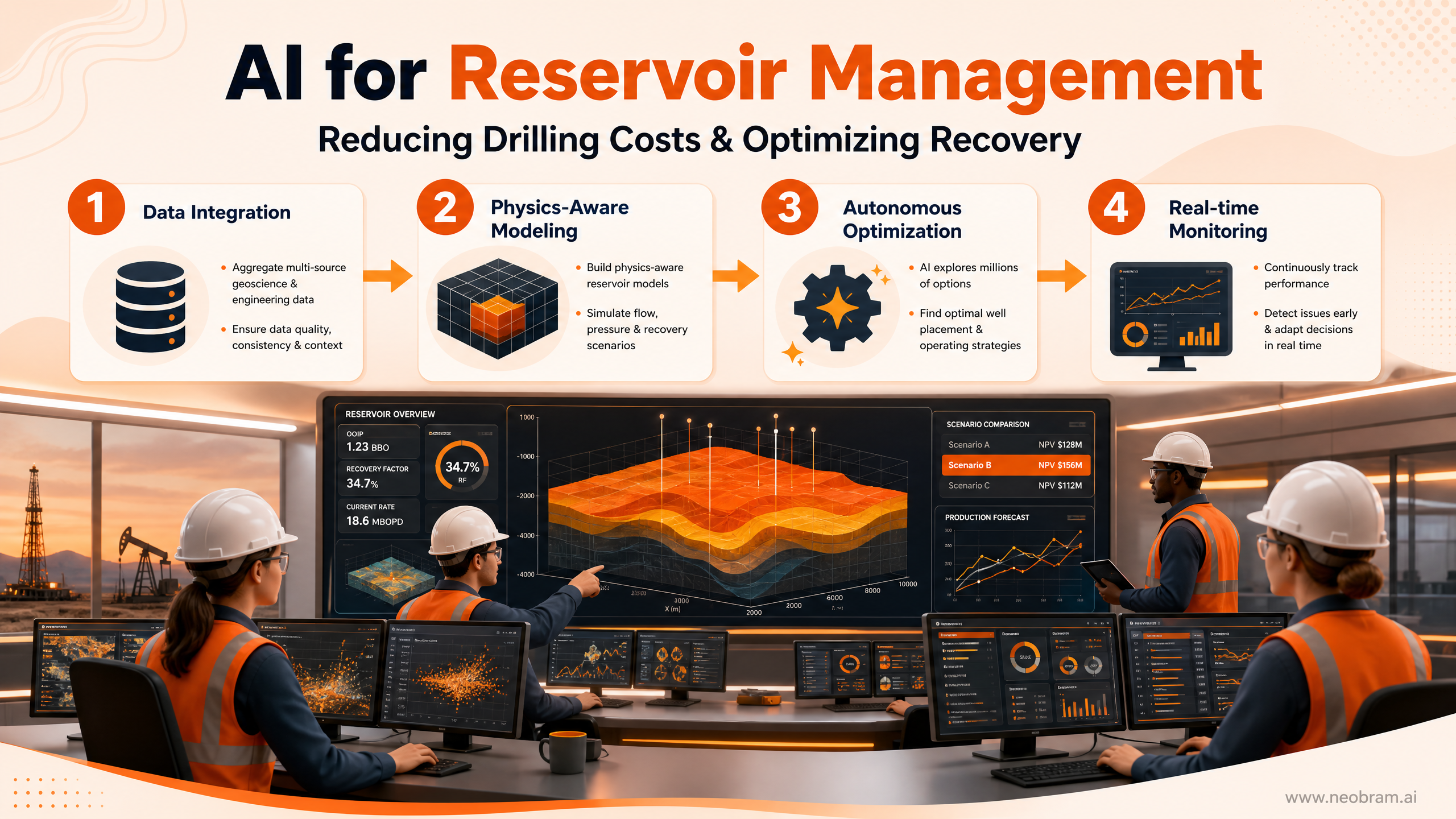
Reservoir management is equally transformed. AI-powered reservoir models continuously ingest production data, pressure readings, and fluid analysis to update recovery strategies in near real time. Where traditional type curve analysis averaged well performance across a basin and applied static assumptions, machine learning models treat each well individually, accounting for geological variability, completion design, parent-child interference, and operational history.
The results are significant. Studies from Novi Labs, working with Equinor, demonstrated that machine learning models can generate well performance forecasts for hundreds of wells in minutes, improving predictive accuracy by over 30% compared to conventional Arps-based decline models. Forecasting cycle times have been reduced by more than 80% in some workflows.
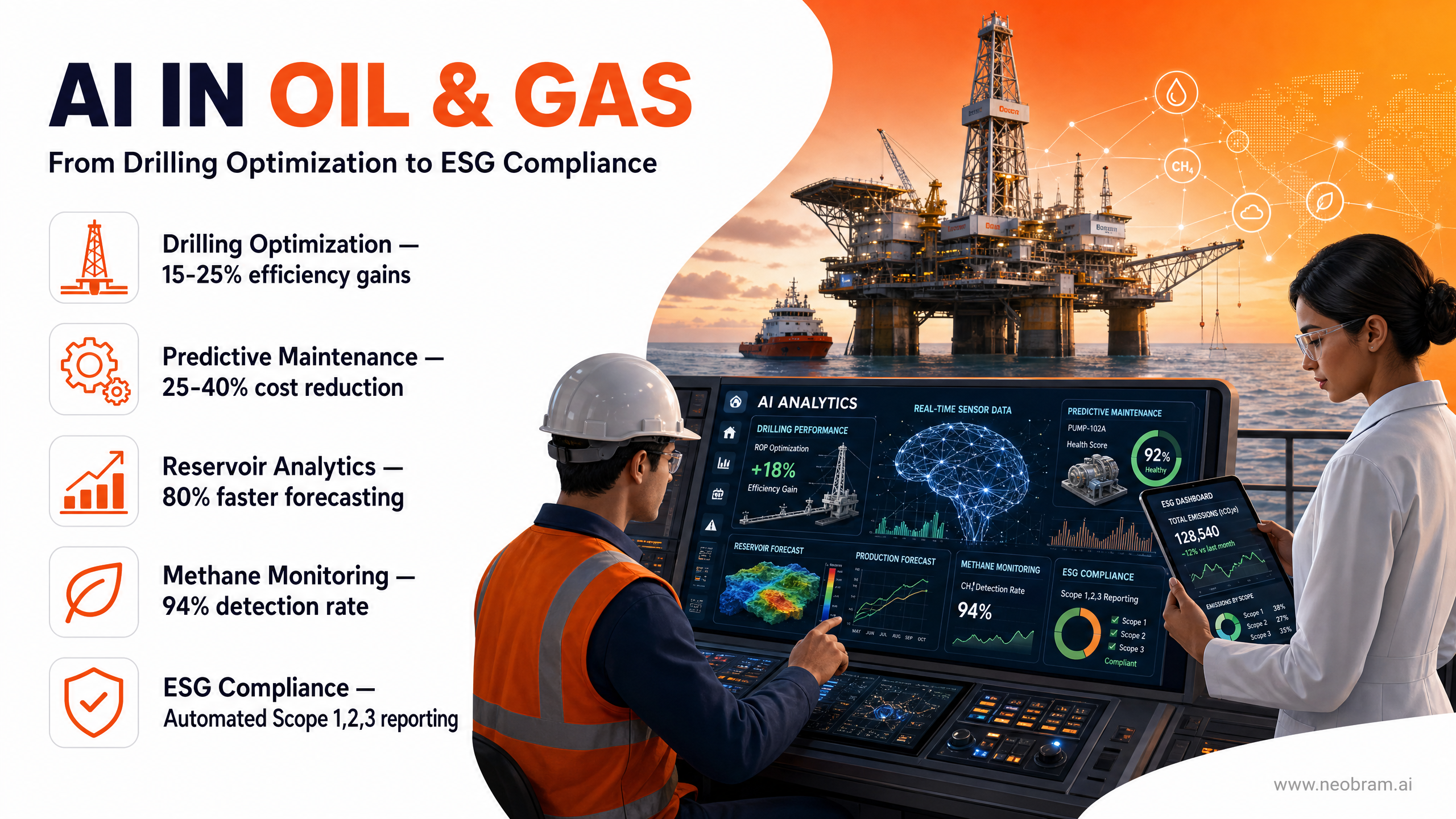
AI-powered reservoir forecasting has reduced cycle times by over 80% in some workflows, while improving predictive accuracy by 30% or more compared to traditional decline curve analysis. For operators managing large, complex asset portfolios, that speed advantage translates directly into faster, better capital allocation decisions.
Drilling Optimization
Drilling is one of the most expensive and technically demanding phases of oil and gas operations. A single deepwater well can cost $100 million or more. Reducing non-productive time (NPT), avoiding stuck pipe incidents, and optimizing drilling parameters in real time are all areas where AI is delivering measurable savings.
AI systems for drilling optimization work by ingesting real-time data from downhole measurement-while-drilling (MWD) tools, surface sensors, and historical well records. Machine learning models identify patterns that precede common drilling problems, such as vibration signatures that indicate bit wear, pressure anomalies that signal formation changes, and torque trends that predict stuck pipe events. Operators can adjust weight on bit, rotary speed, and mud flow rates before problems develop rather than after.
Beyond risk mitigation, AI enables continuous optimization of the drilling trajectory. Models evaluate multiple well path options against geological uncertainty, completion design goals, and cost constraints, recommending the trajectory most likely to maximize hydrocarbon recovery at minimum cost. Some operators have reported drilling efficiency improvements of 15 to 25% on AI-optimized wells compared to offset wells drilled with conventional methods.
Halliburton's AI-driven drilling systems, for instance, analyze real-time sensor data from downhole tools to dynamically adjust drilling parameters, reducing the frequency of costly incidents while improving rate of penetration. The technology is now deployed across multiple basins globally.
Predictive Maintenance and Asset Integrity
Equipment failure in oil and gas is expensive in ways that go beyond the repair cost. An unplanned shutdown on a production platform can cost hundreds of thousands of dollars per day in lost output. A compressor failure on a gas pipeline can trigger regulatory scrutiny and safety investigations. A pump failure in a refinery can cascade into broader process disruptions.
Predictive maintenance using AI addresses this by shifting from time-based or run-to-failure maintenance strategies to condition-based interventions. Sensors on rotating equipment, pressure vessels, heat exchangers, and pipelines feed continuous data streams into machine learning models that detect early-stage degradation signatures. When the model identifies a pattern consistent with impending failure, it triggers a maintenance alert, giving operators time to plan the intervention during a scheduled window rather than scrambling in response to an emergency.
The ROI case is well-documented. AI-driven predictive maintenance systems lower maintenance costs by 25 to 40% compared to traditional approaches, which typically achieve 10 to 18% savings. Return on investment ratios of 10:1 to 30:1 have been reported across industrial applications. In one documented oil and gas case, Nanoprecise's AI predictive maintenance system saved $130,000 in production losses and four hours of unplanned downtime at a single facility.
Deloitte's research confirms that predictive maintenance can reduce unplanned downtime by up to 50% and cut maintenance costs by 25% across industrial operations. For an offshore platform running at $500,000 per day in production value, a 50% reduction in unplanned downtime events is transformative.
Midstream and Downstream Applications
AI's impact is not limited to the upstream. Midstream and downstream operations face their own set of challenges where intelligent systems are proving their value.
Pipeline Integrity and Leak Detection
Pipeline networks in oil and gas span hundreds of thousands of miles globally. Traditional inspection regimes rely on periodic pigging runs, aerial surveys, and manual pressure monitoring. These methods catch many problems, but they're slow, expensive, and inherently retrospective.
AI-powered pipeline monitoring systems use a combination of sensor data, satellite imagery, acoustic signals, and flow analysis to detect anomalies in near real time. Machine learning models distinguish between normal operational variations and genuine integrity concerns, reducing false alarm rates while improving detection sensitivity. Some systems can identify slow leaks that would be invisible to conventional monitoring for weeks or months.
The environmental and financial stakes are high. A single major pipeline leak can result in millions of dollars in cleanup costs, regulatory fines, and reputational damage. Early detection through AI monitoring can contain incidents before they escalate.
Refinery Optimization
Refineries are extraordinarily complex systems where hundreds of process variables interact continuously. Optimizing yields, energy consumption, and product quality simultaneously is a problem that exceeds the capacity of human operators working with conventional control systems.
AI-based advanced process control (APC) systems address this by continuously modeling the refinery's process state and adjusting control parameters to maximize target outcomes. Energy consumption reductions of 5 to 10% are commonly reported. Yield improvements of 1 to 3% on high-value products can translate into millions of dollars in annual revenue at a large refinery.
Generative AI is also beginning to play a role in refinery operations, supporting maintenance engineers with natural-language interfaces to equipment manuals, inspection records, and troubleshooting guides. Instead of searching through thousands of pages of documentation, a technician can ask a question and receive a synthesized answer in seconds.
Supply Chain and Trading
Commodity price forecasting, logistics optimization, and inventory management are all areas where AI is adding value in the midstream and downstream segments. Machine learning models that incorporate historical price data, macroeconomic indicators, weather patterns, and geopolitical signals can generate more accurate demand forecasts than traditional statistical methods.
For trading operations, AI-powered analytics platforms enable faster identification of arbitrage opportunities, better hedging strategies, and more responsive position management. The ability to process and synthesize information from thousands of sources simultaneously gives AI-equipped trading teams a genuine edge.
ESG Compliance: AI's Growing Role in Sustainability
ESG obligations have moved from voluntary reporting to legal requirements for many oil and gas operators. In 2026, ESG reporting has evolved into a strict legal obligation for operators in multiple jurisdictions, with mandatory frameworks covering Scope 1, 2, and 3 emissions, water usage, biodiversity impact, and social performance.
For oil and gas companies, the ESG challenge is particularly acute. The sector is under intense scrutiny from investors, regulators, and the public. Demonstrating credible progress on emissions reduction, methane management, and climate risk disclosure is no longer optional. It's a condition of maintaining access to capital markets and operating licenses.
AI is becoming a critical tool for meeting these obligations, not just for reporting but for actually reducing environmental impact.
Methane Emissions Monitoring and Reduction
Methane is a potent greenhouse gas, with a global warming potential 80 times that of CO2 over a 20-year horizon. The oil and gas sector is responsible for a significant share of global methane emissions, primarily from equipment leaks, venting, and flaring. Regulatory pressure to detect and reduce these emissions is intensifying globally.
AI-powered methane monitoring systems combine satellite data, aerial surveys, ground-based sensors, and IoT devices to create continuous, high-resolution emissions maps across operating areas. Machine learning models identify emission sources, quantify leak rates, and prioritize repair interventions based on impact and cost.
The iFactory AI monitoring platform, for example, operates continuously and detects 94% of actual methane sources within hours of occurrence, triggering immediate repair workflows. This level of detection speed and coverage is impossible with conventional inspection regimes.
ADNOC's Emission X tool gathers historic and real-time data from hundreds of operational sources to predict emission origins up to five years in advance. Across its operations, ADNOC's AI suite helped prevent up to 1 million tonnes of CO2 equivalent emissions between 2022 and 2023, equivalent to removing 200,000 gasoline-powered cars from the road.
ADNOC's AI-powered Emission X tool helped prevent up to 1 million tonnes of CO2 equivalent emissions between 2022 and 2023. The same AI suite generated $500 million in additional operational value in a single year, demonstrating that environmental performance and financial performance are not in conflict when AI is deployed intelligently.
Automated ESG Reporting
The data requirements for comprehensive ESG reporting are substantial. Scope 1 emissions from direct operations, Scope 2 emissions from purchased energy, and Scope 3 emissions from the value chain all need to be measured, verified, and reported against recognized frameworks such as GHG Protocol, TCFD, and increasingly mandatory regulatory standards.
AI-powered ESG data management platforms automate the collection, validation, and aggregation of emissions data from across the operational footprint. They flag anomalies, ensure data quality, and generate reports in the formats required by different regulatory regimes. This reduces the manual burden on sustainability teams while improving the accuracy and auditability of reported data.
For companies operating across multiple jurisdictions with different reporting requirements, AI-driven automation is the only practical way to manage compliance at scale.
Safety and HSE Compliance
Health, Safety, and Environment (HSE) compliance is the fastest-growing AI application in the oil and gas sector, with a projected CAGR of 14.34%. Computer vision systems now monitor PPE compliance on offshore platforms and construction sites, detect safety hazards in real time, and track the position of personnel in hazardous zones.
AI-powered safety systems can analyze video feeds from hundreds of cameras simultaneously, identifying non-compliance events and triggering alerts in seconds. This capability would require an impractical number of human monitors to replicate manually. The result is more consistent enforcement of safety standards and faster response to emerging hazards.
Digital Twins: The Convergence Point
Digital twins represent the most comprehensive application of AI in oil and gas: a continuously updated virtual model of a physical asset, from a single pump to an entire production platform or refinery.
A digital twin integrates data from sensors, process historians, maintenance records, and operational logs to maintain a real-time representation of the asset's state. AI models running on the twin can simulate the impact of operational changes, predict equipment behavior under different conditions, and optimize performance parameters continuously.
Research published in the Journal of Intelligent Systems in Engineering and Management found that digital twin investments in refinery operations deliver maintenance cost reductions of 25 to 55%, unplanned downtime decreases of 25 to 42%, and significant improvements in Overall Equipment Effectiveness (OEE). These are not marginal gains. They represent a fundamental shift in how assets are managed over their operational lives.
For oil and gas companies managing aging infrastructure, digital twins offer a way to extend asset life, defer capital expenditure on replacements, and maintain production performance without the cost and risk of major physical interventions.
Generative AI: The Next Wave
Generative AI is beginning to move from experimentation to production deployment in oil and gas. The generative AI in oil and gas market is projected to grow from $601 million in 2025 to over $2 billion by 2034, a compound annual growth rate above 14%.
The applications are diverse. In upstream operations, generative AI assists geoscientists in interpreting seismic data, generating synthetic well logs to fill data gaps, and summarizing complex geological reports. In drilling, it supports engineers with real-time troubleshooting guidance, drawing on vast libraries of historical incident reports and technical documentation.
In commercial and trading functions, generative AI processes news feeds, regulatory filings, and market reports to surface relevant intelligence faster than human analysts can. In HSE, it helps safety teams draft incident reports, analyze near-miss data, and identify systemic risk patterns across large datasets.
The Deloitte 2026 Oil and Gas Industry Outlook notes that AI and generative AI currently make up less than 20% of total IT spending by US oil and gas companies but are projected to reach more than 50% by 2029. The direction of travel is clear.
Challenges and How to Address Them
AI adoption in oil and gas is accelerating, but it's not without friction. Understanding the real barriers and how to address them is essential for building a credible implementation roadmap.
Data Quality and Integration
Oil and gas operations generate enormous volumes of data, but much of it is inconsistent, incomplete, or siloed across legacy systems. Sensor data from aging equipment may have gaps or calibration drift. Well records may be stored in incompatible formats across different operating regions. Production histories may have been maintained in spreadsheets rather than structured databases.
Addressing data quality is not glamorous work, but it's the foundation on which AI models depend. Companies that invest in data governance, standardization, and integration infrastructure before deploying AI models get significantly better results than those that try to build on poor data foundations.
Legacy System Integration
Many oil and gas facilities run on operational technology (OT) systems that were designed decades ago, before modern connectivity and data standards existed. Integrating AI capabilities with these systems requires careful planning to avoid disrupting critical operations and introducing cybersecurity vulnerabilities.
A phased approach, starting with non-critical applications and building integration capability incrementally, reduces risk while building organizational confidence and technical expertise.
Workforce and Culture
Only 45% of oil and gas professionals currently use AI in their work, according to the Global Energy Talent Index. Cultural resistance, particularly among experienced field personnel who are skeptical of technology-driven recommendations, is a genuine barrier.
Successful AI deployments in oil and gas consistently involve field workers in the design and testing process. When the people who will use the system have a voice in how it works, adoption rates improve significantly. Structured proof-of-concept programs that demonstrate value in specific, measurable workflows before scaling also help build organizational confidence.
Cybersecurity
Increased connectivity between IT and OT systems, which is a prerequisite for many AI applications, also increases the attack surface for cyber threats. The oil and gas sector is a high-value target for state-sponsored and criminal actors. Any AI implementation program must include a rigorous cybersecurity assessment and ongoing monitoring capability.
Building Your AI Roadmap for Oil and Gas
A credible AI strategy for oil and gas doesn't start with technology. It starts with business outcomes. The most effective implementations begin by identifying the specific operational or compliance challenges that are costing the most money, creating the most risk, or consuming the most management attention.
From there, the roadmap typically follows a phased approach:
Phase 1: Foundation. Assess data availability and quality. Identify the two or three use cases with the clearest ROI and the most accessible data. Run structured pilots with defined success metrics.
Phase 2: Scale. Expand successful pilots to additional assets or geographies. Build the integration infrastructure needed to connect AI systems with operational workflows. Invest in workforce capability.
Phase 3: Optimize. Deploy advanced applications such as digital twins and generative AI. Integrate AI insights into strategic planning and capital allocation processes. Establish continuous improvement cycles.
The companies that are getting the most value from AI in oil and gas are not the ones that deployed the most technology fastest. They're the ones that were most disciplined about connecting AI investments to specific, measurable business outcomes.
How NeoBram Can Help
NeoBram works with oil and gas operators, service companies, and energy majors to design and deploy AI solutions that deliver measurable results across the value chain.
Our work in the oil and gas sector spans predictive maintenance for upstream and midstream assets, AI-powered reservoir analytics, emissions monitoring and ESG reporting automation, and generative AI applications for engineering and operations teams.
We don't sell generic AI platforms. We build solutions that are trained on your operational data, integrated with your existing systems, and designed to solve the specific problems that matter most to your business. Our team includes engineers and data scientists with direct experience in oil and gas operations, which means we understand the technical constraints, the regulatory environment, and the cultural dynamics that determine whether an AI deployment succeeds or stalls.
Whether you're running a proof-of-concept on a single asset or planning an enterprise-wide AI transformation, NeoBram brings the technical depth and industry knowledge to make it work.
Book a free strategy call with our oil and gas AI team at https://neobram.ai/contact to discuss your specific challenges and explore what's possible.
Key Takeaways
The oil and gas industry is in the middle of a genuine AI transformation, not a future one. The technology is mature enough to deliver real results across the value chain today, from drilling optimization and predictive maintenance to reservoir management and ESG compliance.
The market data is clear: the global AI in oil and gas market is growing at over 13% annually, with predictive maintenance, HSE compliance, and reservoir analytics leading adoption. Companies like ADNOC are generating hundreds of millions of dollars in value from AI deployments at scale.
The barriers to adoption are real but manageable. Data quality, legacy system integration, workforce capability, and cybersecurity are all solvable problems with the right approach. The companies that treat these as engineering challenges to be addressed systematically, rather than reasons to delay, are the ones building durable competitive advantage.
ESG is no longer separate from operational strategy. AI is the tool that makes it possible to improve environmental performance and operational performance simultaneously, turning what was once a compliance burden into a source of operational intelligence.
The question for oil and gas leaders in 2026 is not whether to invest in AI. It's how to invest intelligently, with the right use cases, the right data foundations, and the right partners.
The Competitive Landscape: Who Is Leading AI Adoption in Oil and Gas?
The gap between AI leaders and laggards in oil and gas is widening. The companies that invested early in data infrastructure and AI capability are now operating with structural cost and efficiency advantages that are difficult for competitors to close quickly.
The Major Operators
Shell, BP, ExxonMobil, TotalEnergies, and Saudi Aramco have all made significant AI investments over the past five years. Their programs share common characteristics: strong data governance foundations, dedicated AI teams embedded within business units rather than sitting in separate innovation labs, and a focus on scaling proven use cases rather than chasing novelty.
ADNOC's AI program is perhaps the most documented. With over 30 AI tools deployed across its value chain, the company generated $500 million in additional value in a single year. That figure encompasses faster drilling decisions, reduced maintenance costs, improved reservoir recovery, and emissions reductions. It's a compelling proof point for what's achievable when AI is treated as a core operational capability rather than an IT project.
Saudi Aramco has invested heavily in AI for seismic interpretation and reservoir management, reducing exploration cycle times and improving drilling success rates. The company's AI-powered drilling optimization systems have been deployed across multiple basins, with documented improvements in rate of penetration and reductions in non-productive time.
Independent Operators and Service Companies
Smaller independent operators face a different set of challenges. They typically have less data, smaller technology teams, and tighter capital budgets. But they also have less organizational complexity, which means they can move faster when they decide to act.
The emergence of AI-as-a-service platforms and specialized oil and gas AI vendors has made it possible for independents to access capabilities that previously required the scale of a major. Cloud-based predictive maintenance platforms, AI-powered well performance analytics, and automated ESG reporting tools are all available at price points that work for companies with a few hundred wells rather than a few thousand.
Oilfield service companies, including Halliburton, SLB (formerly Schlumberger), and Baker Hughes, have also become significant AI players. Their position at the interface between operators and the wellbore gives them access to vast datasets and the ability to deploy AI solutions across multiple operators simultaneously. SLB's Delfi platform and Halliburton's iEnergy platform are examples of AI-enabled digital environments that operators can use without building their own infrastructure from scratch.
Regulatory Environment and AI Governance
As AI becomes more deeply embedded in oil and gas operations, the regulatory environment around its use is evolving. This is particularly relevant for safety-critical applications, where AI recommendations may influence decisions that affect worker safety, environmental protection, and asset integrity.
AI in Safety-Critical Decisions
Regulators in multiple jurisdictions are beginning to develop guidance on the use of AI in safety-critical industrial applications. The key questions center on accountability: when an AI system recommends an action that leads to an incident, who is responsible? How should AI recommendations be validated before being acted upon? What level of human oversight is required?
The emerging consensus is that AI systems in safety-critical applications should be treated as decision support tools rather than autonomous decision-makers. Human operators retain accountability for decisions, and AI recommendations should be validated against operational context before being implemented. This is consistent with how most oil and gas operators are actually deploying AI today, but it's important to document and formalize these governance arrangements as regulatory scrutiny increases.
Data Privacy and Cybersecurity Regulations
The integration of AI with operational technology systems raises data privacy and cybersecurity concerns that are attracting regulatory attention. The EU's NIS2 Directive, which came into force in 2024, imposes cybersecurity obligations on operators of critical infrastructure including energy companies. Similar frameworks are developing in other jurisdictions.
Oil and gas companies deploying AI need to ensure that their data governance frameworks, cybersecurity controls, and incident response capabilities are aligned with these evolving requirements. This is not just a compliance issue. A successful cyberattack on an AI-integrated operational system could have consequences that go far beyond data loss.
Measuring AI ROI in Oil and Gas: A Practical Framework
One of the most common questions from oil and gas executives considering AI investments is: how do we measure the return? The answer depends on the use case, but a consistent framework helps.
For operational AI applications such as predictive maintenance and drilling optimization, the primary metrics are:
- Reduction in unplanned downtime - (measured in hours per year per asset, converted to production value at prevailing commodity prices)
- Reduction in maintenance costs - (direct cost comparison between AI-managed and conventionally managed assets)
- Improvement in drilling efficiency - (rate of penetration improvement, reduction in non-productive time, reduction in well cost per meter)
- Production uplift - (incremental production from optimized reservoir management, measured against a baseline forecast)
For ESG and compliance applications, the metrics are:
- Reduction in methane emissions - (tonnes CO2 equivalent per year, with a monetary value attached based on carbon pricing or regulatory penalty avoidance)
- Reduction in compliance reporting costs - (staff time and external consultant costs for ESG data collection and reporting)
- Reduction in HSE incidents - (frequency and severity of safety events, with associated cost savings)
For strategic and commercial applications such as reservoir analytics and trading support, the metrics are:
- Improvement in forecast accuracy - (reduction in variance between predicted and actual production)
- Improvement in capital allocation decisions - (measured by the performance of AI-informed investment decisions versus historical baseline)
- Reduction in exploration costs - (cost per successful well, improvement in drilling success rate)
The most important principle is to establish baseline metrics before deploying AI, so that the impact of the technology can be measured objectively. Companies that skip this step often find it difficult to demonstrate ROI, even when the AI is clearly delivering value, because they have no reference point for comparison.
Looking Ahead: AI in Oil and Gas Through 2030
The trajectory of AI adoption in oil and gas through 2030 is shaped by several converging forces.
Increasing data availability. The continued rollout of IoT sensors, satellite monitoring, and digital field systems is generating more operational data than ever before. As data volumes grow and data quality improves, AI models become more capable and more reliable.
Falling technology costs. Cloud computing costs continue to decline, making it more economical to run sophisticated AI models at scale. The cost of deploying AI in oil and gas operations is falling even as the capability is rising.
Regulatory pressure. Emissions regulations, ESG reporting requirements, and safety standards are all tightening. AI is increasingly the most practical way to meet these obligations at scale without proportional increases in headcount.
Energy transition dynamics. Oil and gas companies are under pressure to demonstrate that they can operate responsibly while continuing to supply the energy the world needs. AI-enabled efficiency improvements and emissions reductions are central to that narrative.
Talent competition. The oil and gas industry competes for data science and AI talent with technology companies, financial services, and other industries. Companies that build strong AI capabilities and interesting technical challenges attract better talent, creating a virtuous cycle.
By 2030, AI is likely to be as fundamental to oil and gas operations as seismic interpretation or reservoir simulation are today: not a differentiator in itself, but a baseline capability without which companies cannot compete effectively. The differentiator will be how well companies use AI, how deeply it's integrated into decision-making processes, and how effectively they've built the organizational capability to keep improving.
The companies that start building that capability now, with disciplined focus on specific business outcomes and strong data foundations, will be the ones best positioned to lead the industry through the decade ahead.