Key takeaways
- 70% of critical operational knowledge in manufacturing is undocumented, costing organizations an estimated $47 million annually in lost productivity and errors (Helpjuice Research / Manual.to, 2026).
- Up to 80% of manufacturing defects originate from human mistakes, largely due to outdated, unclear, or inaccessible standard operating procedures (International Journal of Engineering Research and Applications / NIST).
- AI-powered platforms can now generate structured, step-by-step visual guides from raw video footage in under 60 seconds, eliminating manual documentation bottlenecks.
- Organizations implementing AI-driven knowledge management report up to a 40% reduction in training time and a 90% reduction in translation costs for global operations (eGain / APQC, 2025).
The Manufacturing Knowledge Crisis
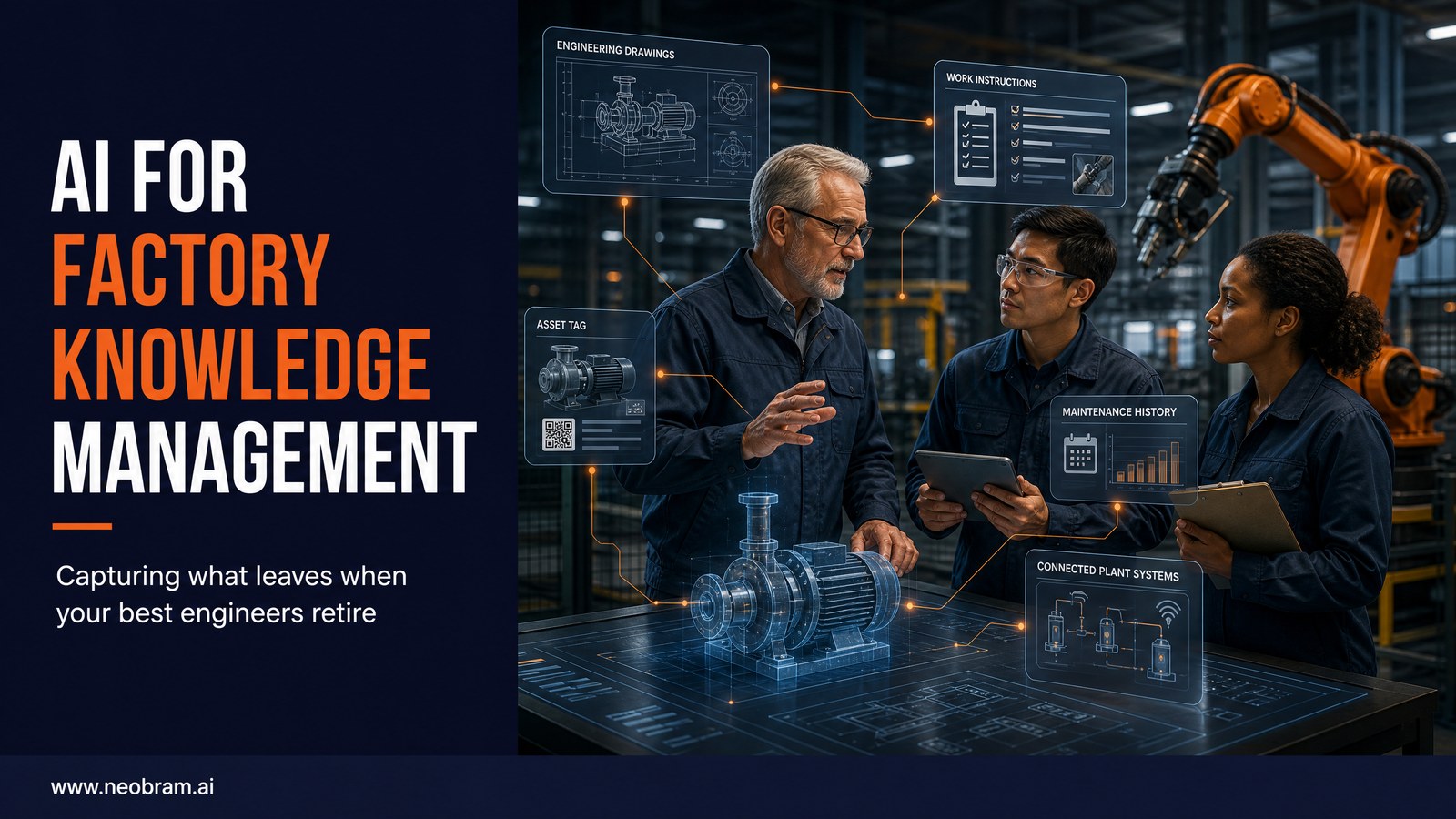
In 2026, the manufacturing sector is facing an unprecedented knowledge crisis. According to research by APQC in partnership with eGain, an estimated 51% of the manufacturing workforce will retire or leave within the next five years. As these experienced operators exit, they take decades of irreplaceable, undocumented expertise with them—creating what experts call the "Great Retirement."
This "tribal knowledge" includes the shortcuts, sensory diagnoses, and contextual decision-making skills that operators develop over years on the job. Research estimates that 70% of critical operational knowledge is undocumented, never written down, and at risk of permanent loss when the person holding it leaves the organization. The financial impact is staggering: knowledge loss costs organizations an estimated $47 million per year in increased errors, extended training periods, and duplicated problem-solving.
The scale of the problem is structural. According to the Manufacturing Institute and Deloitte, 3.8 million manufacturing jobs will need to be filled by 2033, with 2.8 million of those being direct replacements for retiring workers. Right now, 25% of the manufacturing workforce is over 55. These are not junior employees—they are the people who hold 15 to 40 years of accumulated, plant-specific knowledge that was never formally documented.
Key Statistic: Only 30% of organizations consistently capture knowledge from departing employees, and 41% rarely or never attempt it at all, according to an APQC survey of 1,000 global organizations (August 2025).
The Real Cost of Bad SOPs
Standard Operating Procedures (SOPs) are meant to capture this knowledge and standardize operations. However, traditional paper-based or static digital SOPs frequently fail in practice. They become outdated, are difficult to search, and are hard to follow on the production floor. The consequences are measurable and severe across five distinct cost categories.
Quality Defects and Scrap: Up to 80% of manufacturing defects originate from human mistakes—largely due to unclear, outdated, or inaccessible instructions. Scrap and rework alone cost the average manufacturer between 5% and 30% of total manufacturing expenses, per NIST estimates. The American Productivity and Quality Center (APQC) reports that scrap and rework cost the average manufacturer up to 2.2% of annual revenue, while top performers keep this below 0.6%.
Information Search Waste: McKinsey Global Institute research shows that employees spend 1.8 hours every day—9.3 hours per week, on average—searching and gathering information. On a manufacturing floor where every minute of downtime has a cost, this represents a significant and often invisible drain on productivity. For a facility with 50 frontline workers, this translates to an estimated €195,000 per year in wasted time alone.
Slow Onboarding: It takes 6 to 9 months for a new hire to reach full productivity without effective knowledge transfer systems. With 43% of frontline workers leaving within their first 90 days, the cost of inadequate onboarding compounds rapidly. Replacing a single frontline worker costs approximately 40% of their annual salary, according to Gallup research.
Compliance Risk: Deloitte research indicates that effective SOPs can reduce compliance-related risks by up to 60%. A single ISO 9001 non-conformity can trigger corrective action costs ranging from €5,000 to €50,000 or more, depending on severity and industry. In pharmaceutical and food manufacturing environments, a compliance failure can mean product recalls costing millions.
| Cost Category | Annual Cost (50-person operation) |
|---|---|
| Errors, rework, and scrap | €36,000 |
| SOP-related employee turnover | €96,000 |
| Time wasted searching for information | €195,000 |
| Compliance failures | €50,000 |
| Lost productivity from slow onboarding | €20,000 |
| Total estimated annual cost of bad SOPs | €397,000 |
*Source: Manual.to SOP Cost Impact Framework (2026)*
The Three Layers of Operational Knowledge
A critical insight for manufacturers attempting knowledge capture is that operational knowledge exists in three distinct layers, each requiring a different approach. Most organizations only capture the most visible layer and miss the rest.
Explicit Knowledge (10%): Written procedures, checklists, specifications, and process parameters. This is the information already documented—even if poorly. Standard documentation methods apply here.
Implicit Knowledge (30%): The optimized sequences, personal adjustments, and workarounds that experienced operators develop over years. The difference between how the SOP says to do it and how the expert actually does it. This layer requires video observation to capture effectively, as experts often cannot articulate what they do differently because it has become automatic.
Tacit Knowledge (60%): Sensory diagnosis ("that bearing sounds wrong"), quality judgment ("this batch feels too thick"), and predictive maintenance intuition. This is the knowledge that takes 15 to 30 years to develop and is the most valuable—and the most at risk. Capturing it requires structured mentoring combined with video documentation of decision points.
Most knowledge management programs focus on the 10% that is already explicit. The companies that survive the Silver Tsunami will be the ones that develop systematic methods to capture the implicit and tacit layers before their experts leave.
How AI Is Transforming SOPs and Work Instructions
To combat knowledge loss and operational inefficiency, manufacturers are turning to Artificial Intelligence to transform how work instructions are created, managed, and consumed. AI is moving SOPs from static documents to dynamic, interactive, and intelligent systems.
Rapid Knowledge Capture from Video
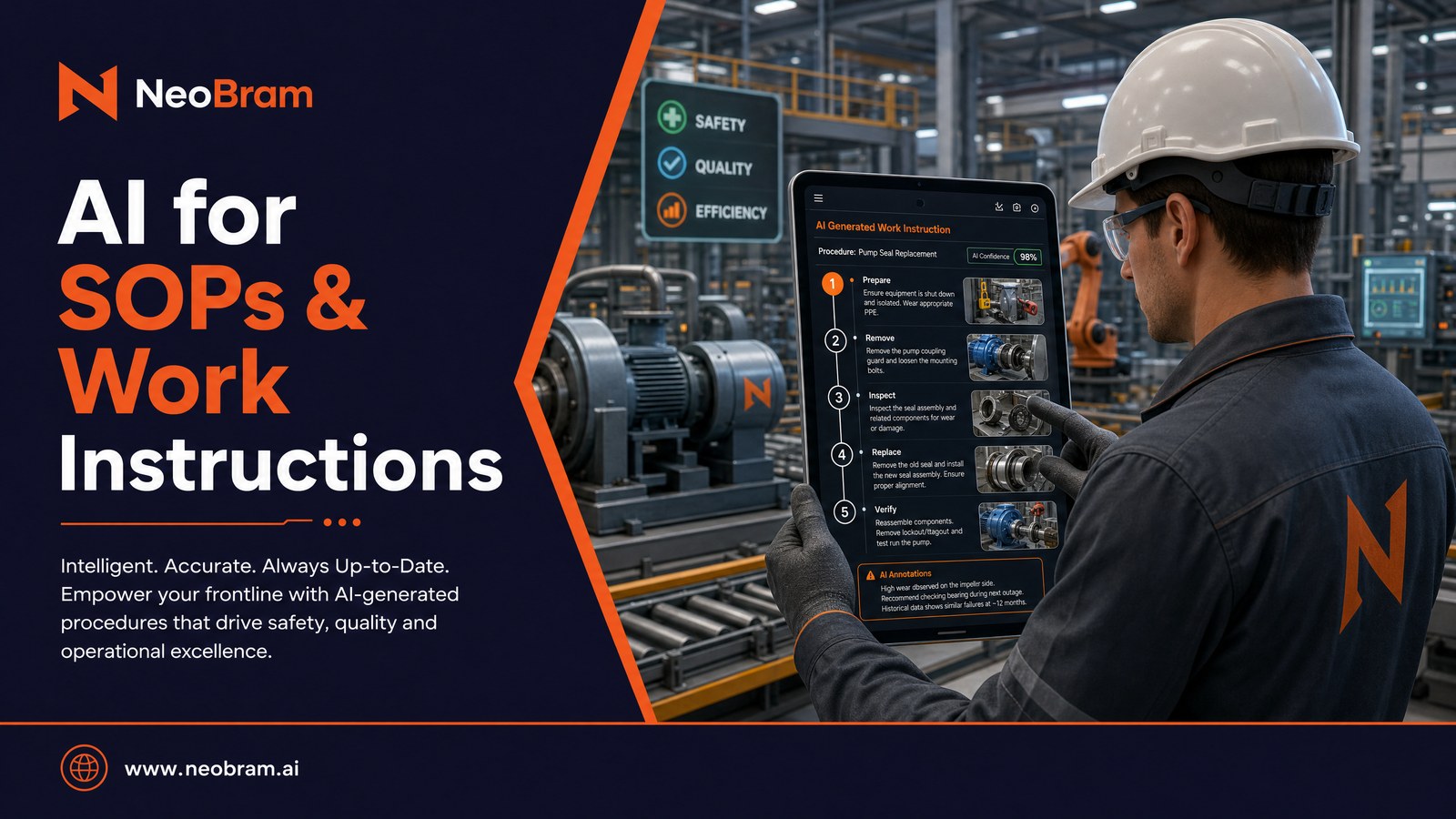
The most effective way to capture tacit knowledge is not by asking an expert to write it down, but by observing them in action. AI-powered platforms now allow team leads to record a video of an expert performing a task. The AI then automatically analyzes the video, segments it into logical steps, and generates a structured, step-by-step visual guide—often in under 60 seconds. This eliminates the bottleneck of manual documentation and technical writing, compressing what previously took weeks into minutes.
Speech-to-Text and Automatic Annotation
AI uses advanced speech-to-text algorithms to transcribe verbal instructions accurately, even in noisy factory environments. The system understands technical terminology, adjusts for accents, and captures precise details in real time. Furthermore, AI can automatically annotate images and videos, identifying tools, components, and specific actions, making the instructions highly visual and easy to follow.
Real-Time Multilingual Support
In global manufacturing operations, language barriers can lead to critical errors. AI provides instant, context-aware translations of work instructions into hundreds of languages. This ensures that every worker, regardless of their native language, has access to standardized, accurate procedures. BekaertDeslee, a global textiles manufacturer operating across 20+ sites, achieved a 90% reduction in translation costs and a 150% boost in training efficiency after implementing AI-powered digital work instructions.
Smart Search and Contextual Delivery
AI-driven search uses natural language processing to understand the context of a worker's query, delivering the exact instruction needed instantly. Instead of searching through binders or complex file systems, workers can scan a QR code on a machine or ask a digital assistant to retrieve the relevant procedure immediately. This addresses the McKinsey finding on information search time directly: when the right instruction is one scan away, the 1.8 hours per day of search time is eliminated.
Legacy Document Conversion
Many manufacturers have decades of procedures stored in paper binders, PDFs, and Word documents. AI-powered conversion tools can automatically analyze these legacy files, recognize key elements such as text, images, and tables, and transform them into structured, interactive digital work instructions. This provides a practical path to modernization without requiring a complete documentation rewrite.
Best Practice: When digitizing legacy SOPs, prioritize the 20% of procedures that drive 80% of operational impact. Focus first on safety-critical procedures, highest-frequency tasks, and processes with the highest error cost. This approach delivers the fastest ROI and builds organizational momentum for broader adoption.
Implementing AI-Powered Work Instructions: A Practical Framework
Successfully deploying AI for SOPs and work instructions requires a structured approach. The following framework provides a practical path for manufacturing organizations.
Phase 1 — Knowledge Risk Assessment: Map your experts at risk using a Knowledge Risk Matrix. List every person over 55 or within three years of expected departure. For each, identify the specific processes, machines, or decisions that depend on their personal knowledge. Prioritize based on operational criticality and departure risk.
Phase 2 — Pilot Capture: Select three to five high-priority procedures and use video-based AI capture to create the first digital work instructions. Validate with a novice user and have the original expert review for accuracy. This pilot phase builds internal confidence and demonstrates ROI before broader rollout.
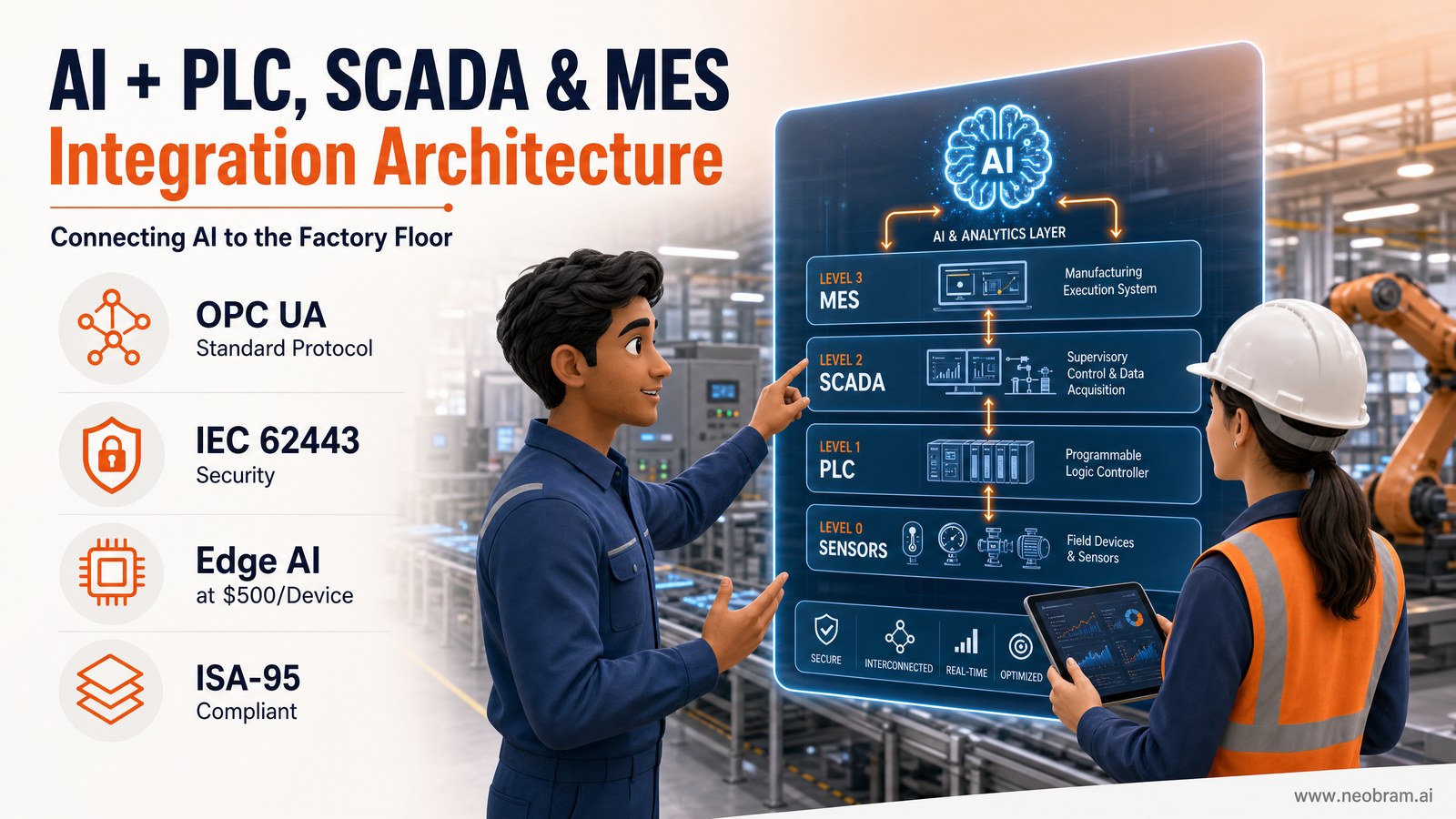
Phase 3 — Platform Integration: Connect the digital work instruction platform with existing systems including MES, CMMS, and ERP. Ensure instructions are accessible at the point of work—via QR codes on machines, links in work orders, or integration with operator tablets.
Phase 4 — Continuous Improvement Loop: Establish review cycles for every guide (quarterly for safety-critical, annually for standard). Use analytics to track which guides are accessed and which are not. Enable feedback from the shop floor so operators can flag steps that are outdated or unclear.
Measuring the ROI of AI-Powered SOPs
Organizations implementing AI-driven knowledge management systems report consistent and measurable returns. The following outcomes have been documented across manufacturing implementations.
Aperam, a global stainless steel producer, reduced non-conformities by 41% after standardizing work instructions digitally. The company also achieved a 75% increase in the speed of manual creation, meaning new instructions reach workers faster and onboarding timelines shrink. Training time decreased by 80%.
BekaertDeslee, operating across 4,000+ employees in 20+ global sites, achieved a 150% boost in training efficiency and a 90% reduction in translation costs by making the right instruction instantly available to any worker, in any language, at any location.
Across organizations using AI-powered knowledge management platforms, APQC research documents up to 90% deflection of service requests to digital self-service, 36% improvement in First Contact Resolution, 40% reduction in training time, and 50% reduction in agent time-to-competency.
These results demonstrate a consistent pattern: when the right instruction is available to the right person at the right time, in the right language, on the device in their hand, the costs of knowledge loss and SOP failure are dramatically reduced.
The Competitive Imperative
The window for action is narrowing. With 79% of manufacturing organizations expressing interest in AI-powered knowledge capture but only 21% actually implementing it, the competitive advantage belongs to those who act now. The Great Retirement is accelerating, and every day that an experienced worker's knowledge remains uncaptured is a day closer to losing it permanently.
The technology is mature, the ROI is proven, and the organizational barriers—time (52%), resources (45%), and prioritization (38%)—are choices rather than constraints. Manufacturers who build systematic AI-powered knowledge capture and work instruction systems today will preserve institutional expertise, accelerate workforce development, and build sustainable competitive advantages while their competitors watch decades of operational intelligence walk out the door.
References
[1] APQC / eGain. (2025). *The Great Retirement: Knowledge Loss, AI and The Workforce Shift.* Survey of 1,000 global organizations. https://www.egain.com/blog/knowledge-management-in-manufacturing-navigating-risks-and-unlocking-transformational-value/
[2] Manual.to. (2026). *The Tribal Knowledge Crisis in Manufacturing.* Sources: Manufacturing Institute & Deloitte (2024); Helpjuice Research (2023). https://manual.to/the-tribal-knowledge-crisis-in-manufacturing/
[3] Manual.to. (2026). *The Real Cost of Bad SOPs.* Sources: NIST; International Journal of Engineering Research and Applications; APQC; Gallup. https://manual.to/the-real-cost-of-bad-sops/
[4] McKinsey Global Institute. (2012). *The social economy: Unlocking value and productivity through social technologies.* https://www.mckinsey.com/industries/technology-media-and-telecommunications/our-insights/the-social-economy
[5] Azumuta. (2025). *How AI Is Used for Digital Work Instructions.* https://www.azumuta.com/blog/how-ai-is-used-for-digital-work-instructions/
[6] Dewstack. (2026). *Mastering Efficiency: A Comprehensive Guide to Effective SOPs in Manufacturing.* https://www.dewstack.com/blog/comprehensive-guide-to-effective-sops-in-manufacturing