Key takeaways
- The global Edge AI market is projected to grow from $46.96 billion in 2026 to $445.75 billion by 2034, at a CAGR of 32.5% (Fortune Business Insights, July 2026).
- Over 45 million automation products installed globally employ OPC client technology, providing a standardized path for AI integration (ARC Advisory Group / OPC Foundation).
- The OPC Foundation launched the "OPC UA for AI" working group in April 2024 to establish standards for semantic data modeling and natural language interfaces in manufacturing.
- Edge AI deployments typically run on devices in the $500 to $2,000 range (estimate), significantly lowering the entry cost compared to traditional on-premises server infrastructure.
The Industrial AI Integration Gap
Manufacturing leaders understand the value of predictive maintenance, computer vision, and process optimization. The primary barrier is not the artificial intelligence itself, but the integration gap between modern AI platforms and legacy operational technology.
Factories operate on Programmable Logic Controllers (PLCs), Supervisory Control and Data Acquisition (SCADA) systems, and Manufacturing Execution Systems (MES) that were often installed decades ago. These systems were designed for deterministic control and safety, not for exposing high-frequency data to external machine learning models. Connecting an AI platform directly to a PLC without a proper architecture risks network saturation, latency issues, and security vulnerabilities.
A common practice is to implement a structured integration architecture that respects the ANSI/ISA-95.00.01-2025 automation hierarchy. By using standardized protocols like OPC UA and deploying edge computing, manufacturers can extract the data required for AI without disrupting the deterministic control of the factory floor.
Best Practice: AI typically does not replace PLCs or SCADA systems. It adds an analytical layer on top of existing infrastructure, consuming the data these systems already collect to generate predictions, recommendations, and alerts.
Reference Architecture: ISA-95 Compliant Integration
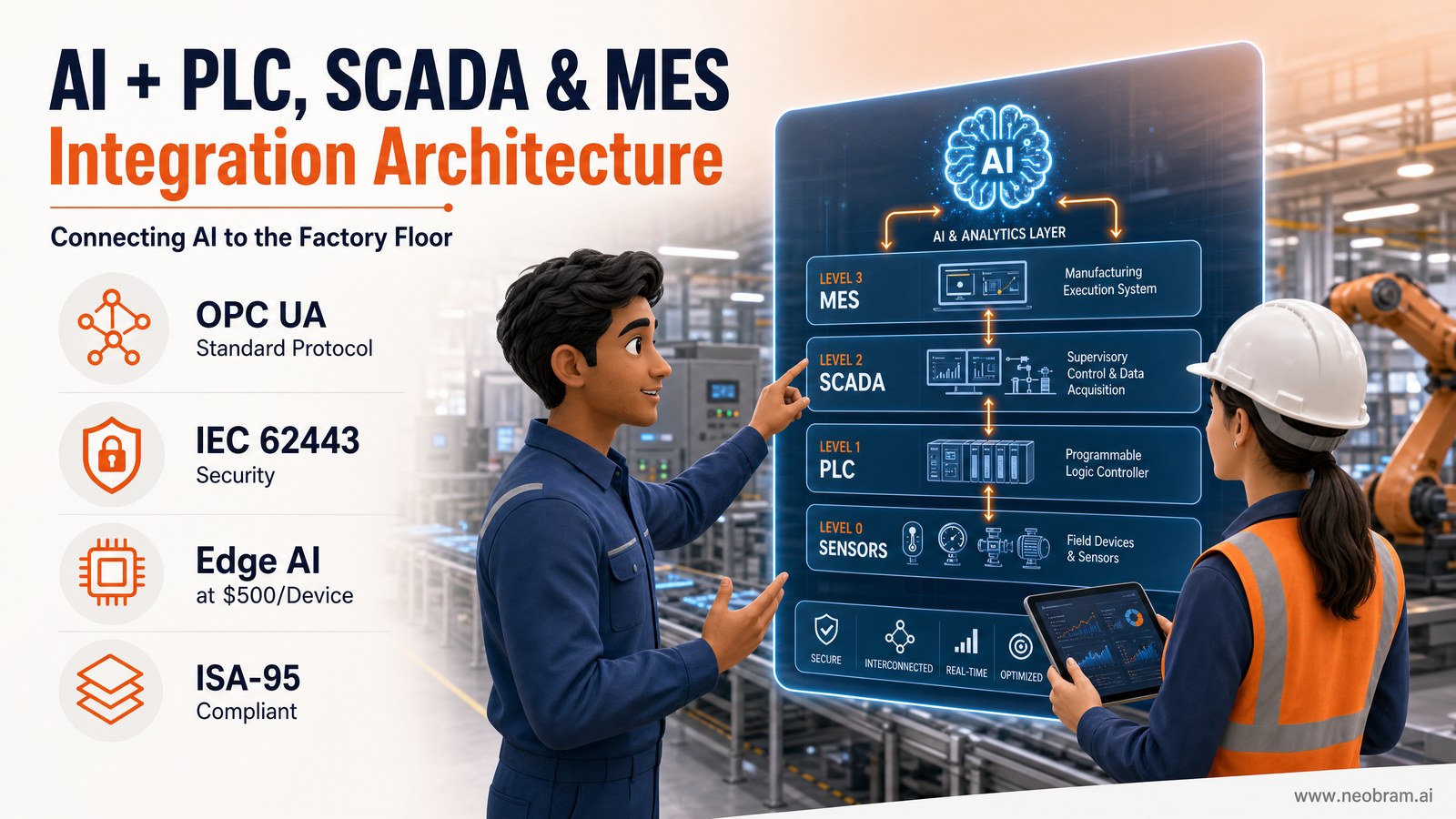
Integrating AI requires mapping the data flow across the established layers of industrial automation. The ISA-95 standard (ANSI/ISA-95.00.01-2025) defines this hierarchy, and AI systems typically operate at the supervisory and management levels (Levels 2 and 3).
Layer Definitions (per ISA-95)
Level 0: Physical Process. The actual physical processes, machines, sensors, and actuators that perform production work.
Level 1: Basic Control. PLCs and Distributed Control Systems (DCS) that directly control machines. These receive signals from sensors and send commands to actuators.
Level 2: Supervisory Control. SCADA systems and HMI interfaces that aggregate data from multiple controllers. This is a critical integration point where an OPC UA server acts as a centralized data broker.
Level 3: Manufacturing Operations Management. MES, CMMS, and scheduling systems that manage production, work orders, and maintenance. Edge AI typically resides here.
Level 4: Business Planning and Logistics. ERP systems and cloud AI for heavy compute, model training, and cross-plant analytics.
The Standard Data Flow
A common data path for a secure industrial AI deployment follows this sequence:
- Sensors transmit physical state data to the PLC.
- The PLC or an industrial IoT gateway aggregates the data.
- An OPC UA server standardizes the data with semantic context.
- The AI platform (typically running on an edge device) ingests the OPC UA stream.
- The AI model processes the data, detects anomalies, and sends alerts or work orders to the MES or SCADA dashboard.
- Human operators review AI recommendations and authorize actions.
Best Practice: In most deployments, AI systems should not write directly to PLC registers or actuator commands unless specifically designed for closed-loop control with rigorous safety validation (e.g., per IEC 61511 for safety instrumented systems). The control loop should remain deterministic. AI typically provides recommendations; human operators or validated safety systems execute the actions.
Core Communication Protocols
Selecting the right communication protocol is the foundation of a stable architecture. Three standards are frequently used in modern AI integration.
OPC UA: The Unifying Standard
OPC Unified Architecture (OPC UA) is widely considered the primary standard for industrial integration. Its advantages include platform independence (Linux, Windows, embedded), semantic data modeling through Information Models, and built-in security (X.509 certificate authentication, encryption).
The OPC Foundation, with over 1,019 member companies, launched the "OPC UA for AI" working group in April 2024 to standardize how AI systems consume and interact with industrial data. According to ARC Advisory Group research commissioned by the OPC Foundation, over 45 million automation products installed globally employ OPC client technology.
MQTT: Lightweight IoT Messaging
Message Queuing Telemetry Transport (MQTT) is a lightweight publish-subscribe protocol ideal for distributed sensor networks. With a header size of just two bytes, MQTT minimizes bandwidth consumption. Sensors publish data to specific topics on an MQTT broker, and the AI system subscribes only to the topics required for its models. This is effective for retrofitting legacy machines with wireless IIoT sensors.
Modbus: The Legacy Workhorse
Introduced in the 1970s, Modbus remains ubiquitous. While it lacks the security and semantic modeling of OPC UA, virtually every PLC supports it. For older installations, converting Modbus RTU or TCP traffic into OPC UA via an edge gateway is often the most practical first step toward AI readiness.
| Protocol | Best For | Security | Data Context | Bandwidth |
|---|---|---|---|---|
| OPC UA | Unified AI integration layer | X.509 certificates, encryption | Full semantic modeling | Medium-High |
| MQTT | Distributed IoT sensors, retrofits | TLS, client certificates | Topic-based only | Very Low |
| Modbus | Legacy PLC communication | None built-in | Raw registers only | Low |
Edge vs Cloud: Where Should AI Run?
Manufacturers must decide where the AI will physically execute its calculations. This decision impacts latency, bandwidth, cost, and security. In most deployments, a hybrid approach works best.
Edge AI for Low-Latency Response
Edge computing places the AI model directly on the factory floor, often on an industrial PC or a specialized edge device. This architecture is recommended for use cases requiring low latency, such as computer vision for high-speed defect detection.
Edge AI helps prevent network saturation. High-frequency vibration sensors can generate hundreds of thousands of data points per second. Transmitting this raw volume to the cloud is often impractical. Instead, the edge device processes the raw data locally and transmits only the resulting insights or anomaly alerts to the central system.
Private Cloud for Heavy Compute
For tasks that require analyzing massive historical datasets across multiple facilities, such as training complex demand forecasting models, a private cloud or on-premises server cluster provides the necessary compute power.
The Hybrid Architecture (Recommended)
Many successful architectures employ a hybrid approach: training the heavy models in the private cloud and deploying the optimized, lightweight inference models to the edge. This provides the compute power needed for model training and the low-latency execution needed for real-time factory operations.
Estimate: Edge AI devices from vendors like Siemens (Industrial Edge), NVIDIA (Jetson), and similar platforms typically cost in the range of $500 to $2,000 per device, depending on compute requirements. This is significantly lower than the traditional on-premises server infrastructure that was previously required for industrial analytics.
Security and Governance Considerations
Connecting OT networks to AI platforms introduces cybersecurity risks if not architected correctly. The following recommendations align with IEC 62443 principles for Industrial Automation and Control Systems (IACS) security.
Network Segmentation and the DMZ
A fundamental security principle is strict network segmentation. The OT network should be separated from the enterprise IT network by a Demilitarized Zone (DMZ) utilizing industrial firewalls with deep packet inspection. Data should generally flow outward from the OT network to the AI systems in the IT or cloud environment.
Unidirectional Gateways for Critical Systems
For critical infrastructure where external intrusion carries severe safety or environmental risks, manufacturers often deploy data diodes. These physical hardware devices permit data to flow in only one direction, from the SCADA system to the AI analytics platform, protecting the control systems from inbound network traffic.
Access Control and Compliance
Integrations should enforce Role-Based Access Control (RBAC). The AI agent should only have read access to the specific data tags required for its model. Logging all connections and data requests helps comply with IEC 62443 and enables rapid threat detection.
Real Implementation Example: CNC Vibration Monitoring
To illustrate this architecture in practice, consider a tier-two automotive parts manufacturer implementing predictive maintenance on a line of legacy CNC milling machines.
Problem: Unplanned spindle bearing failures were causing approximately 15 hours of downtime per month. The legacy PLCs controlling the CNC machines did not have the processing power to run anomaly detection models.
Architecture:
- Data Source (Level 0): - The manufacturer retrofitted the CNC spindles with high-frequency IO-Link vibration sensors sampling at 25.6 kHz.
- Gateway (Level 1/2): - The sensors were wired to an industrial IoT gateway. The gateway converted the raw IO-Link data into an OPC UA data stream, exposing each sensor as a semantically modeled node.
- Edge AI (Level 3): - An industrial edge PC was installed in the control cabinet. It ran a pre-trained machine learning model that ingested the OPC UA vibration data at the edge, performing FFT analysis and anomaly detection locally.
- The Output: - The edge model did not send the raw vibration data to the cloud. It only sent a health score (0-100) via MQTT to the plant's existing SCADA dashboard.
- Human Decision: - When the health score dropped below 40, the system generated a work order in the MES, scheduling a bearing replacement during the next planned shift change. An operator reviewed and approved the work order before execution.
Challenges Encountered:
- The legacy PLCs used Modbus RTU, requiring an additional protocol conversion gateway.
- Initial network bandwidth was insufficient for raw vibration data, confirming the need for edge processing.
- Operators initially distrusted the AI alerts until they witnessed two accurate predictions in the first month.
Outcome (Example): The manufacturer prevented three catastrophic spindle failures in the first six months, shifting from 15 hours of unplanned downtime to approximately 2 hours of planned maintenance per incident. The control loop of the CNC machine was not modified, ensuring safety and deterministic operation remained intact.
Deployment Readiness Checklist
Before connecting an AI platform to your industrial control systems, verify the following:
- [ ] Infrastructure Audit: Inventoried all PLCs, SCADA software, and MES platforms in scope, including firmware versions and supported protocols.
- [ ] Protocol Standardization: Identified a clear path to convert proprietary PLC protocols into a standard format like OPC UA.
- [ ] Network Segmentation: AI platform is separated from the core control network by an industrial firewall or DMZ.
- [ ] Read-Only Enforcement: AI system is restricted to read-only access for control registers (unless safety-validated for closed-loop control).
- [ ] Bandwidth Assessment: Local network can handle the data volume required by the sensors without impacting control traffic.
- [ ] Edge Strategy: Identified which models run at the edge for latency reasons versus which can run in the cloud.
- [ ] Security Compliance: Integration aligns with IEC 62443 principles, including encrypted communication, RBAC, and audit logging.
- [ ] Human-in-the-Loop: Defined the approval workflow for AI-generated recommendations before they trigger physical actions.
- [ ] Pilot Scope: Selected a single, non-critical machine or simulated environment for initial testing before scaling.
Limitations and Assumptions
This guide presents one common reference architecture. Multiple valid architectures exist depending on the specific industry, safety requirements, regulatory environment, and existing infrastructure. Air-gapped environments, safety-instrumented systems (per IEC 61511), and regulated industries (pharma GxP, nuclear) may require additional constraints not covered here. Consult with your automation vendor and cybersecurity team before implementation.
References and Further Reading
[1] Fortune Business Insights. "Edge AI Market Size, Share, Trends | Growth Forecast [2034]". Published July 13, 2026. https://www.fortunebusinessinsights.com/edge-ai-market-107023
[2] ARC Advisory Group / OPC Foundation. "ARC Report: OPC Installed Base Insights". https://opcfoundation.org/wp-content/uploads/2018/02/ARC-Report-OPC-Installed-Base-Insights.pdf
[3] OPC Foundation. "OPC Foundation Launches New Working Group 'OPC UA for AI', Revolutionizing Manufacturing Solutions". Published April 21, 2024. https://opcfoundation.org/news/press-releases/opc-foundation-launches-new-working-group-opc-ua-for-ai-revolutionizing-manufacturing-solutions/
[4] International Society of Automation (ISA). "ANSI/ISA-95.00.01-2025: Enterprise-Control System Integration". https://www.isa.org/standards-and-publications/isa-standards/isa-95-standard
[5] International Electrotechnical Commission (IEC). "IEC 62443: Industrial communication networks - Network and system security".
[6] OPC Foundation. "OPC UA Specification". https://opcfoundation.org/developer-tools/specifications-opc-ua/
[7] Siemens. "ISA-95 Framework and Layers". https://www.siemens.com/en-us/technology/isa-95-framework-layers/