
Key takeaways
- Gartner projects that by 2028, 33% of enterprise software applications will include agentic AI, up from less than 1% in 2024.
- PwC's May 2025 survey found that 79% of companies are already adopting AI agents, with 66% reporting measurable productivity gains.
- Trust remains a barrier for high-stakes tasks, with only 20% of executives trusting AI agents to handle financial transactions autonomously.
- McKinsey's 2025 State of AI report found that fewer than 10% of organizations have successfully scaled AI agents in any individual function.
What Is an AI Agent? The Short Answer
An AI agent is a software system that can perceive its environment, reason about what needs to happen, and then take actions to complete a goal, without someone holding its hand through every step.
That's the plain-English version. The longer version matters for anyone deciding where to invest in AI right now.
Traditional AI tools respond to a single prompt. You ask a question, you get an answer, and the interaction ends there. An AI agent is different. It can break a complex goal into steps, use tools like web search or databases, check its own output, adjust course when something goes wrong, and keep going until the job is done.
Think of it like the difference between a calculator and a junior analyst. The calculator does exactly what you type. The analyst understands the goal, figures out the steps, pulls the right data, and comes back with a finished result.
How AI Agents Actually Work
To understand AI agents, it helps to know the four things they do that ordinary AI tools don't.
They Perceive Their Environment
An agent takes in information from multiple sources: databases, APIs, emails, documents, web pages, or sensor feeds. It doesn't just read what you paste into a chat window. It can go and find what it needs.
They Reason and Plan
Using a large language model (LLM) as its reasoning engine, an agent breaks a goal into sub-tasks and figures out the right sequence. If step three fails, it doesn't stop. It tries another path.
They Use Tools
This is the part that makes agents genuinely useful in business. An agent can call APIs, run code, query databases, send emails, update CRM records, or trigger workflows in other software. It's not just generating text; it's doing things.
They Remember
Agents maintain context across a session, and increasingly across multiple sessions. They know what they've already done, what worked, and what didn't. This memory is what allows them to handle multi-step tasks that unfold over hours or days.
Gartner projects that by 2028, 33% of enterprise software applications will include agentic AI, up from less than 1% in 2024. That's a 33-fold increase in four years, driven by the shift from AI as a tool to AI as a worker.
AI Agents vs. Chatbots vs. Automation: What's the Difference?
Business leaders often ask how AI agents fit alongside the tools they already use. The distinctions are worth getting clear.
| Chatbot | RPA / Automation | AI Agent | |
|---|---|---|---|
| Handles unstructured input | Yes | No | Yes |
| Adapts to new situations | Limited | No | Yes |
| Uses multiple tools | No | Sometimes | Yes |
| Plans multi-step tasks | No | No | Yes |
| Learns from context | Limited | No | Yes |
A chatbot handles conversation. Robotic Process Automation (RPA) follows rigid, pre-programmed rules. An AI agent combines the flexibility of language understanding with the ability to take real actions in real systems. It's the combination that makes it powerful.
Why Business Leaders Are Paying Attention Now
The interest in AI agents isn't hype for its own sake. Several things have converged in the past two years to make agents genuinely deployable at enterprise scale.
LLMs got good enough. Models like GPT-4 and its successors can now reason reliably across complex tasks. Earlier models were too inconsistent for production use.
The tooling matured. Frameworks for building agents, including LangChain, AutoGen, and CrewAI, have made it far easier to connect agents to enterprise systems. What took months to build in 2022 takes weeks today.
The cost dropped. Inference costs for frontier models have fallen by more than 90% since 2023. Running agents at scale is no longer prohibitively expensive.
The results are measurable. Companies aren't just experimenting. They're reporting real numbers. PwC's 2025 AI Agent Survey found that among companies adopting AI agents, 66% report increased productivity, 57% report cost savings, and 55% report faster decision-making.
According to PwC's May 2025 survey of 308 senior executives, 79% say AI agents are already being adopted in their companies. Of those adopting, two-thirds report measurable productivity gains. Yet fewer than half are fundamentally rethinking their operating models to capture the full value.
Real-World Use Cases Across Business Functions
AI agents aren't limited to one department or industry. Here's where they're delivering results right now.
Customer Service and Support
Agents handle inbound queries end-to-end: reading the customer's history, checking order status, processing refunds, and escalating only when genuinely needed. Unlike scripted chatbots, they handle edge cases and unusual requests without breaking. One major retail company cited by PwC cut software development cycle times and reduced production errors by more than half after deploying agents, then scaled the approach across HR, finance, supply chain, and marketing.
Finance and Accounting
Agents process invoices, reconcile accounts, flag anomalies, and generate variance reports. They can pull data from multiple ERP systems, apply business rules, and produce a first-draft analysis that a human reviews and approves. Tasks that took a finance team two days can be completed overnight.
Sales and Marketing
Agents research prospects, draft personalised outreach, update CRM records after calls, and score leads based on real-time signals. PwC found that 54% of companies are already using or planning to use agents in sales and marketing within six months.
IT Operations
Agents monitor systems, diagnose alerts, run standard remediation scripts, and create incident tickets with full context already filled in. They reduce mean time to resolution and free up engineers for work that actually requires human judgment.
Legal and Compliance
Agents review contracts, flag non-standard clauses, cross-reference regulatory requirements, and produce summary reports. Legal AI adoption nearly doubled in one year, rising from 14% in 2024 to 26% in 2025, according to industry surveys.
Human Resources
Agents screen CVs against job requirements, schedule interviews, answer candidate questions, and onboard new hires by walking them through documentation and system setup. They handle the administrative load so HR teams focus on the decisions that require human judgment.
The Different Types of AI Agents
Not all agents are the same. Understanding the spectrum helps you match the right approach to the right problem.
Simple reflex agents respond to the current input based on fixed rules. They're fast and predictable but can't handle anything outside their programmed conditions.
Model-based agents maintain an internal model of the world and use it to make decisions. They handle more complexity but require more careful design.
Goal-based agents work backward from a defined objective, choosing actions that move them toward that goal. Most enterprise AI agents today fall into this category.
Learning agents improve over time based on feedback and outcomes. They're the most powerful and the most complex to deploy responsibly.
Multi-agent systems involve multiple agents working together, each handling a different part of a workflow. One agent might research, another might draft, a third might review and approve. This is where the biggest enterprise value lies, and also where governance becomes most important.
What AI Agents Can't Do (Yet)
Honest assessment matters here. AI agents are powerful, but they have real limitations that business leaders need to understand before deploying them.
They make mistakes. Agents can misinterpret instructions, use the wrong tool, or produce plausible-sounding but incorrect outputs. Human oversight remains essential for high-stakes decisions.
They can't handle truly novel situations. An agent trained on your business processes will struggle when those processes change significantly. They need updating.
Trust is still limited for high-stakes tasks. PwC found that only 20% of executives trust AI agents to handle financial transactions autonomously. For customer-facing and compliance-sensitive work, human review checkpoints are still the norm.
They require good data. An agent is only as useful as the systems it connects to. If your CRM data is messy, your agent's outputs will be too.
McKinsey's 2025 State of AI report found that fewer than 10% of organisations have scaled AI agents in any individual function. The technology is proven; the bottleneck is implementation, change management, and governance, not the AI itself.
How to Evaluate Whether Your Business Is Ready for AI Agents
Before you commission a build or sign a vendor contract, work through these questions.
What problem are you actually trying to solve? Agents work best on high-volume, multi-step tasks where the rules are clear but the inputs vary. If you can't articulate the workflow clearly, the agent won't be able to execute it.
Do you have the data infrastructure? Agents need clean, accessible data. If your systems are siloed or your data quality is poor, fix that first.
Who owns the output? Every agent action should have a human accountable for the result. Define that before you build.
How will you handle errors? Agents will make mistakes. You need a process for catching them, correcting them, and feeding that learning back into the system.
What's your governance framework? For regulated industries, you need to document what the agent does, why it does it, and how decisions can be audited. This isn't optional.
The Business Case: What Returns Are Companies Seeing?
The numbers are becoming clearer as more deployments move from pilot to production.
Companies using AI agents in customer service report handling 40-60% of inbound queries without human involvement, while maintaining or improving satisfaction scores. Finance teams using agents for invoice processing report 70-80% reductions in processing time. IT operations teams using agents for first-line support report 30-50% reductions in ticket resolution time.
The broader picture: Gartner projects that by 2028, at least 15% of day-to-day business decisions will be made autonomously through agentic AI, up from essentially zero in 2024. The organisations that build the capability now will have a structural advantage over those that wait.
How NeoBram Can Help
Understanding AI agents conceptually is one thing. Deploying them in a way that actually works inside your organisation is another challenge entirely.
NeoBram specialises in enterprise AI implementation: from identifying the right use cases for your specific business context, to designing the agent architecture, to integrating with your existing systems, to building the governance frameworks that keep everything auditable and safe.
We've worked across manufacturing, BFSI, healthcare, oil and gas, and enterprise IT. We know what works in production, not just in demos. We know where the failure modes are, and we know how to design around them.
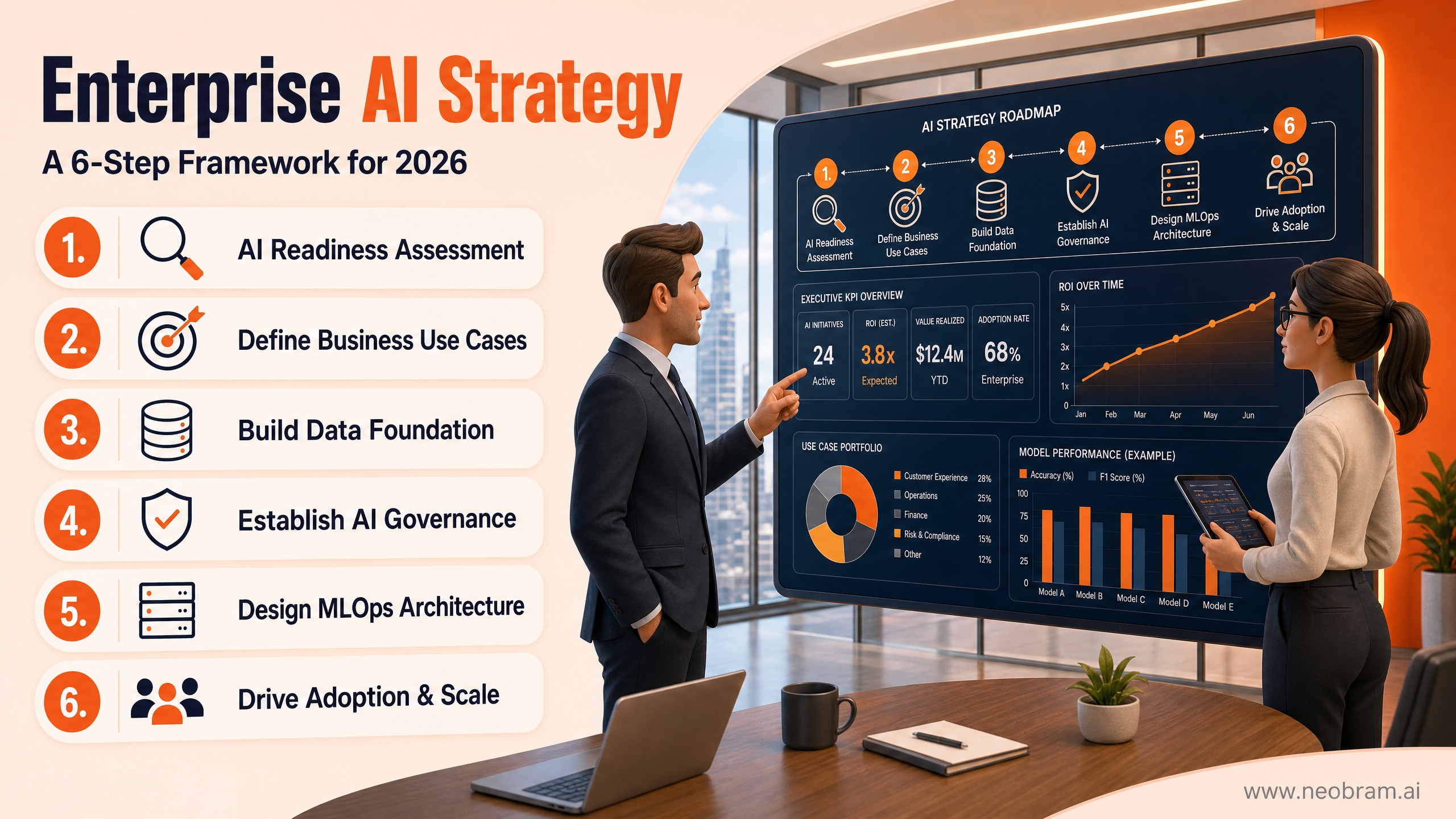
Our approach starts with a structured AI readiness assessment. We look at your data infrastructure, your existing workflows, your team's capabilities, and your risk tolerance. From that, we build a prioritised roadmap: which agent use cases to tackle first, what the realistic ROI looks like, and what needs to be in place before you go live.
We don't sell you a platform and leave. We stay involved through deployment, iteration, and scale. Because the difference between an agent that works in a demo and one that delivers value in production is almost always in the implementation details.
Frequently Asked Questions
Ready to See What AI Agents Can Do for Your Business?
AI agents are not a future technology. They're being deployed in production right now, across every major industry, by companies that decided to move from experimentation to implementation.
The question isn't whether AI agents will change how your business operates. The question is whether you'll be the one driving that change or responding to it.
Book a free strategy call with the NeoBram team at [contact us](https://neobram.ai/contact). We'll help you identify the highest-value agent use cases for your specific context, assess your readiness, and build a clear path from where you are today to where you need to be.