Key takeaways
- RPA handles structured, rule-based tasks but breaks when UI or data formats change.
- AI process automation adapts to unstructured data and exceptions, delivering up to 40% productivity gains.
- 60% of RPA projects fail to meet ROI targets, often due to underestimating maintenance costs.
- Hyperautomation combines both technologies, using RPA for execution and AI for intelligence.
AI Process Automation vs RPA: What's the Difference and Which Wins?
If you've spent any time researching automation for your business, you've probably run into both terms: RPA (Robotic Process Automation) and AI process automation. Vendors use them interchangeably. Analysts treat them as separate categories. And most buyers end up confused about what they actually need.
This guide cuts through that confusion. We'll explain what each technology does, where each one excels, where each one fails, and how to decide which approach fits your situation. We'll also look at why the "vs" framing is increasingly outdated, and what the real choice looks like in 2026.
What Is RPA?
Robotic Process Automation is software that mimics human actions on a computer. An RPA bot can log into an application, copy data from one system, paste it into another, click buttons, fill forms, and extract information from structured documents. It does exactly what a human would do, but faster and without breaks.
The key word is "rule-based." RPA works by following a script. You define the steps, the bot executes them. If the screen layout changes, the bot breaks. If an exception occurs that wasn't anticipated, the bot stops and waits for a human to intervene.
RPA is genuinely useful for processes that are:
- Repetitive and high-volume
- Based on structured data (spreadsheets, forms, databases)
- Stable over time (the UI and data format don't change often)
- Well-documented with clear rules for every scenario
Classic RPA use cases include invoice processing, payroll data entry, compliance reporting, order status updates, and IT system provisioning. These are tasks where the logic is simple, the volume is high, and the cost of manual effort is easy to measure.
The global RPA market was valued at approximately $7 billion in 2025 and is projected to reach $35.84 billion by 2033, growing at a CAGR of 29%. Despite this growth, only 20-30% of RPA projects are considered fully successful, with around 65-70% delivering some value but falling short of initial expectations.
What Is AI Process Automation?
AI process automation goes further. It combines machine learning, natural language processing, computer vision, and reasoning capabilities to handle processes that involve unstructured data, judgment calls, and variability.
Where RPA follows a script, AI process automation can interpret context. It can read an unstructured email and understand the intent. It can analyse a scanned document with variable formatting and extract the right fields. It can make decisions based on patterns in data, not just predefined rules.
The umbrella term "AI process automation" covers several overlapping technologies:
- Intelligent Document Processing (IDP): - Extracting and classifying data from unstructured documents like contracts, invoices with non-standard layouts, and medical records
- Conversational AI: - Handling customer queries, routing requests, and resolving issues without human intervention
- Predictive analytics: - Flagging anomalies, forecasting demand, or scoring risk before a human would notice a problem
- AI agents: - Autonomous systems that can plan, reason, and execute multi-step tasks with minimal human input
- Process mining with AI: - Discovering inefficiencies in workflows automatically by analysing event logs
The defining characteristic is adaptability. AI process automation can handle variation. It learns from new data. It can deal with exceptions that weren't explicitly programmed.
Companies using AI-driven process automation report productivity increases of up to 40%, with organisations running AI automation seeing 35% higher output than peers relying on manual processes. Cost reductions of 20-30% in targeted process areas are consistently reported across enterprise deployments.
The Core Difference: Scripts vs. Intelligence
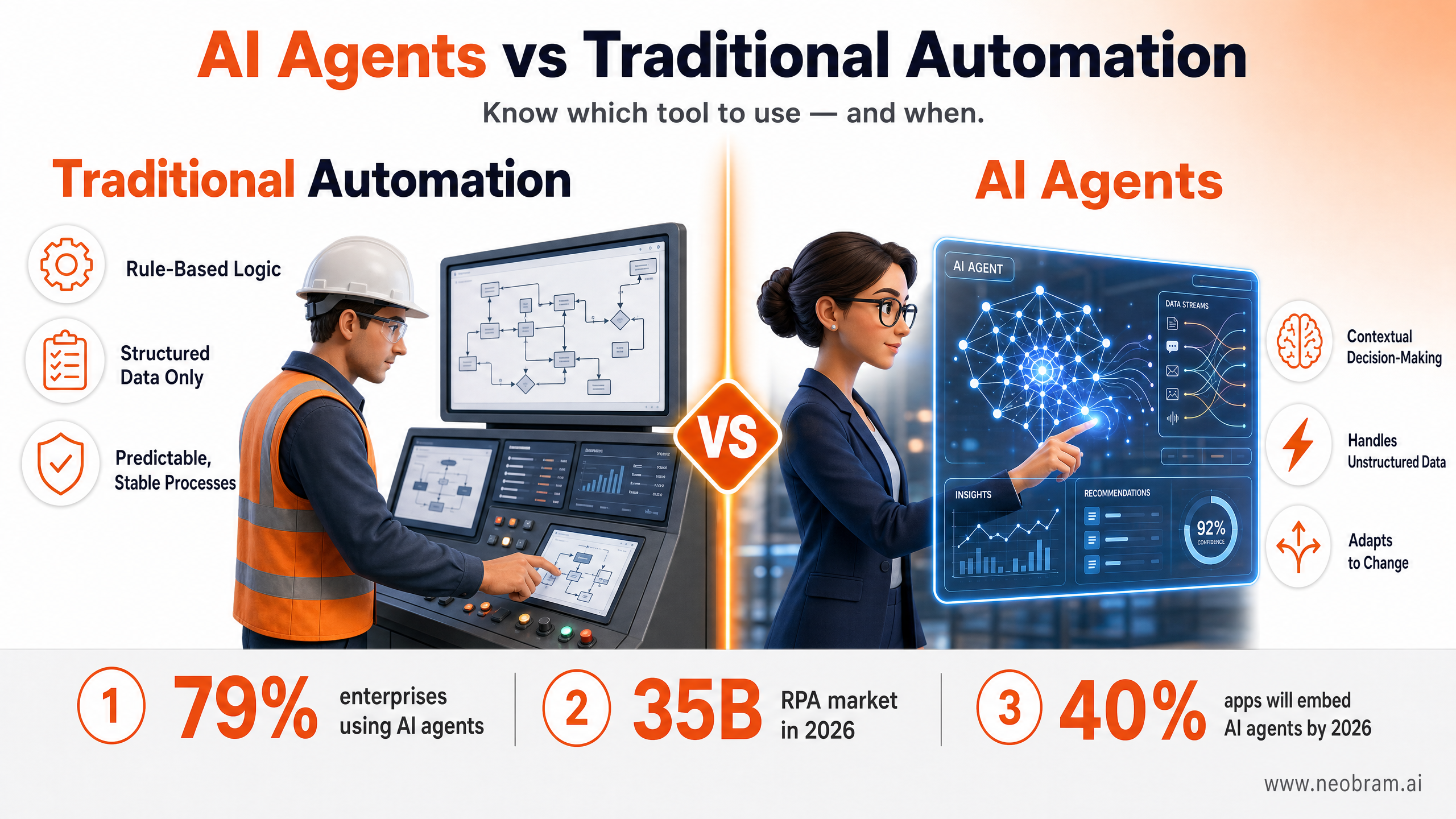
The simplest way to understand the difference is this: RPA does. AI process automation thinks, then does.
An RPA bot executes a defined sequence of steps. It has no understanding of what those steps mean or why they're being done. If you tell it to copy column B from spreadsheet A into column D of spreadsheet B, it will do that forever, even if the business logic changes and that mapping is now wrong.
AI process automation can understand the intent behind a task. It can read a supplier invoice with a completely different layout from anything it's seen before and still extract the correct fields, because it understands what an invoice is and what information matters.
This distinction has real consequences for where each technology belongs in your automation stack.
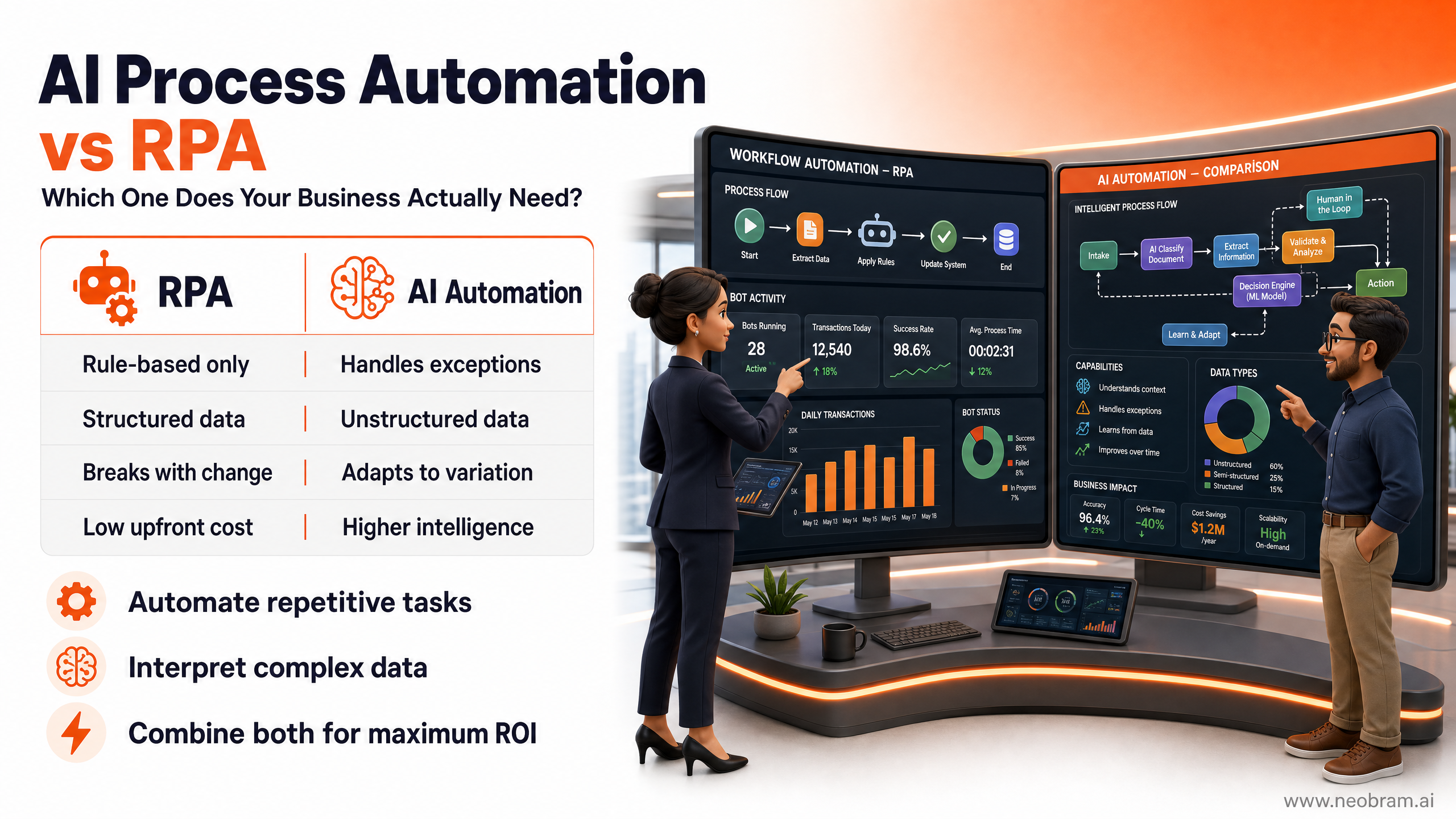
| Dimension | RPA | AI Process Automation |
|---|---|---|
| Data type | Structured only | Structured and unstructured |
| Process variability | Low tolerance | High tolerance |
| Exception handling | Requires human intervention | Can handle many exceptions autonomously |
| Learning | Does not learn | Improves with more data |
| Setup complexity | Moderate (scripting) | Higher (training, model selection) |
| Maintenance burden | High (breaks with UI changes) | Lower (adapts to variation) |
| Cost to implement | Lower upfront | Higher upfront |
| Best for | Stable, rule-based tasks | Variable, judgment-intensive tasks |
Where RPA Wins
RPA is the right choice when your process is genuinely stable, structured, and high-volume. The technology has been around long enough that the tooling is mature, the implementation playbooks are well-established, and the ROI calculation is straightforward.
High-Volume Data Entry
If your team spends hours each day copying data between systems, RPA delivers fast, measurable ROI. The bot runs 24/7, doesn't make transcription errors, and the cost per transaction drops dramatically compared to manual processing.
Compliance and Audit Trails
RPA bots log every action they take. For regulated industries, this creates a complete audit trail without additional effort. Every data extraction, every system update, every report generation is timestamped and recorded.
Legacy System Integration
Many enterprises run critical processes on legacy systems that have no APIs. RPA can interact with these systems at the UI level, effectively acting as an integration layer without requiring expensive system upgrades. This is one of RPA's most practical advantages.
Predictable, Repetitive Workflows
Payroll processing, monthly financial close activities, IT user provisioning, and compliance reporting are all good RPA candidates. The logic is clear, the data is structured, and the process runs the same way every time.
Where RPA Fails
RPA's limitations are well-documented at this point, and they're structural, not just implementation issues.
Brittle to Change
RPA bots are tightly coupled to the UI they were built for. When a vendor updates their software, changes a screen layout, or renames a field, the bot breaks. Organisations running large RPA estates spend significant time and money on bot maintenance. Some estimates put maintenance at 30-40% of the total cost of ownership for mature RPA programmes.
Can't Handle Unstructured Data
If a process involves reading emails, interpreting PDFs with variable layouts, understanding natural language, or making judgment calls, RPA can't do it without significant human pre-processing. You can build workarounds, but they add complexity and fragility.
Exception Handling Bottlenecks
Real-world processes have exceptions. A customer submits a form with a field filled in unexpectedly. A supplier sends an invoice in a format the bot hasn't seen. A system returns an error the script didn't anticipate. Every exception requires human intervention, which creates queues, delays, and the need for dedicated exception-handling teams.
Research consistently shows that 60% of RPA projects fail to meet their initial ROI targets. The most common reasons are underestimating maintenance costs, poor process selection (automating processes that are too variable), and inadequate exception handling design. Only about 50% of RPA implementations are considered successful by the organisations that deployed them.
Doesn't Scale to Complex Decisions
RPA can execute a decision tree if you define every branch. But it can't make a judgment call. It can't weigh competing factors, interpret ambiguous information, or adapt to a situation it hasn't been explicitly programmed for. For anything requiring reasoning, RPA hits a hard ceiling.
Where AI Process Automation Wins
AI process automation is the right choice when your process involves variability, unstructured data, or decisions that require interpretation.
Document Processing at Scale
Contracts, invoices, medical records, insurance claims, and regulatory filings all arrive in variable formats. Intelligent Document Processing (IDP) can extract the right information regardless of layout, classify documents automatically, and flag anomalies for human review. The accuracy rates for modern IDP systems now exceed 95% on most document types.
Customer-Facing Interactions
Conversational AI can handle a significant portion of customer service interactions without human involvement. It can understand intent, access relevant data, resolve common issues, and escalate complex cases with full context. Unlike RPA-powered chatbots that follow decision trees, AI-powered systems can handle open-ended conversations.
Fraud Detection and Risk Scoring
AI can identify patterns across thousands of variables simultaneously, spotting anomalies that no rule-based system would catch. Banks using AI for fraud detection report 20-30% reductions in false positives compared to rule-based systems, which means fewer legitimate transactions blocked and fewer fraud cases missed.
Processes That Change Frequently
If your business operates in a fast-moving environment where processes evolve regularly, AI process automation is more resilient. The system adapts to new patterns rather than breaking when something changes.
Unstructured Data Pipelines
Emails, chat logs, call transcripts, social media mentions, and free-text fields in forms all contain valuable information that RPA can't touch. AI can process this data, extract insights, and feed them into downstream workflows.
The Real Question: Which Processes Do You Have?
The "AI vs RPA" framing is somewhat misleading, because the right answer depends entirely on the nature of your processes. The practical question is: what kind of work are you trying to automate?
A useful way to categorise your processes:
Tier 1: Fully structured, stable, rule-based. These are ideal for RPA. The logic is clear, the data is clean, and the process doesn't change. Think: monthly report generation, system-to-system data transfers, user account provisioning.
Tier 2: Mostly structured, some variability. These benefit from combining RPA with AI components. RPA handles the execution; AI handles the interpretation of variable inputs. Think: invoice processing where some suppliers use non-standard formats, or customer onboarding where documents arrive in different layouts.
Tier 3: Unstructured, judgment-intensive, variable. These require AI process automation. RPA alone won't work. Think: contract review, customer complaint resolution, clinical documentation, or any process where the input format and content vary significantly.
Most enterprise automation programmes have processes in all three tiers. The mistake many organisations make is applying RPA to Tier 2 and Tier 3 processes, then wondering why the bots keep breaking.
Hyperautomation: The Convergence
The industry has largely moved past the "RPA vs AI" debate. The current direction is hyperautomation, a term Gartner popularised to describe the combination of multiple automation technologies working together.
In a hyperautomation architecture:
- Process mining - identifies which processes to automate and in what order
- RPA - handles the execution of structured, rule-based steps
- AI/ML - handles interpretation, decision-making, and exception handling
- AI agents - orchestrate multi-step workflows that span multiple systems
- Analytics - monitors performance and surfaces optimisation opportunities
The practical implication is that RPA and AI process automation aren't competitors. They're complementary layers in an automation stack. RPA provides the execution muscle. AI provides the intelligence. Together, they can automate processes that neither could handle alone.
Cost and Implementation Considerations
The cost difference between RPA and AI process automation is real and worth understanding before you make a decision.
RPA implementations typically cost between £20,000 and £80,000 for an enterprise deployment, depending on the number of bots and the complexity of the processes. The upfront cost is relatively low, but ongoing maintenance can be significant, particularly if the underlying systems change frequently.
AI process automation has higher upfront costs: model training, data preparation, integration work, and ongoing monitoring. However, the maintenance burden is often lower because the system adapts to variation rather than breaking when something changes.
The ROI calculation also differs. RPA ROI is typically measured in cost savings from reduced manual effort, and it's usually straightforward to calculate. AI process automation ROI often includes harder-to-quantify benefits: faster decision-making, improved accuracy, better customer experience, and reduced exception-handling overhead.
For most enterprise automation programmes, the right approach is to start with RPA for the clearest, highest-volume opportunities, then layer in AI capabilities as the programme matures and the more complex processes come into scope.
Common Mistakes to Avoid
Organisations that struggle with automation programmes typically make one of these mistakes:
Automating the wrong processes with RPA. Applying RPA to processes that are too variable or too dependent on judgment leads to fragile bots that require constant maintenance. The process selection step is critical.
Underestimating RPA maintenance. RPA bots are not "set and forget." They require ongoing maintenance as the underlying systems evolve. Many organisations discover this only after their bot estate has grown to a size where maintenance consumes most of the automation team's capacity.
Treating AI as a magic solution. AI process automation requires good data, clear success metrics, and ongoing monitoring. Deploying AI without a clear understanding of what it's optimising for, and how you'll measure success, leads to disappointing results.
Not involving the people who do the work. The best process automation projects involve the people who currently do the work manually. They know where the exceptions are, where the edge cases live, and what the real logic is. Ignoring them leads to automations that work in testing but fail in production.
How NeoBram Can Help
Choosing between RPA and AI process automation, or figuring out how to combine them effectively, requires a clear-eyed assessment of your current processes, your data quality, and your automation maturity.
NeoBram works with enterprise teams to do exactly that. Our process automation consulting starts with a structured audit of your current workflows: identifying which processes are genuinely RPA-ready, which need AI capabilities, and which should be redesigned before any automation is applied.
We've helped manufacturers eliminate invoice processing backlogs using intelligent document processing, helped financial services firms replace brittle RPA bots with AI-powered alternatives that handle exceptions autonomously, and helped EPC companies build automation programmes that scale without accumulating technical debt.
Our approach is practical. We don't recommend technology for its own sake. We start with the business outcome you're trying to achieve, work backwards to the right technology stack, and build implementations that deliver measurable ROI within months, not years.
If you're evaluating process automation options or trying to get more value from an existing RPA programme, we can help you cut through the complexity and build a clear path forward.
**Book a free strategy call at contact us** to discuss your automation challenges with our team.