Key takeaways
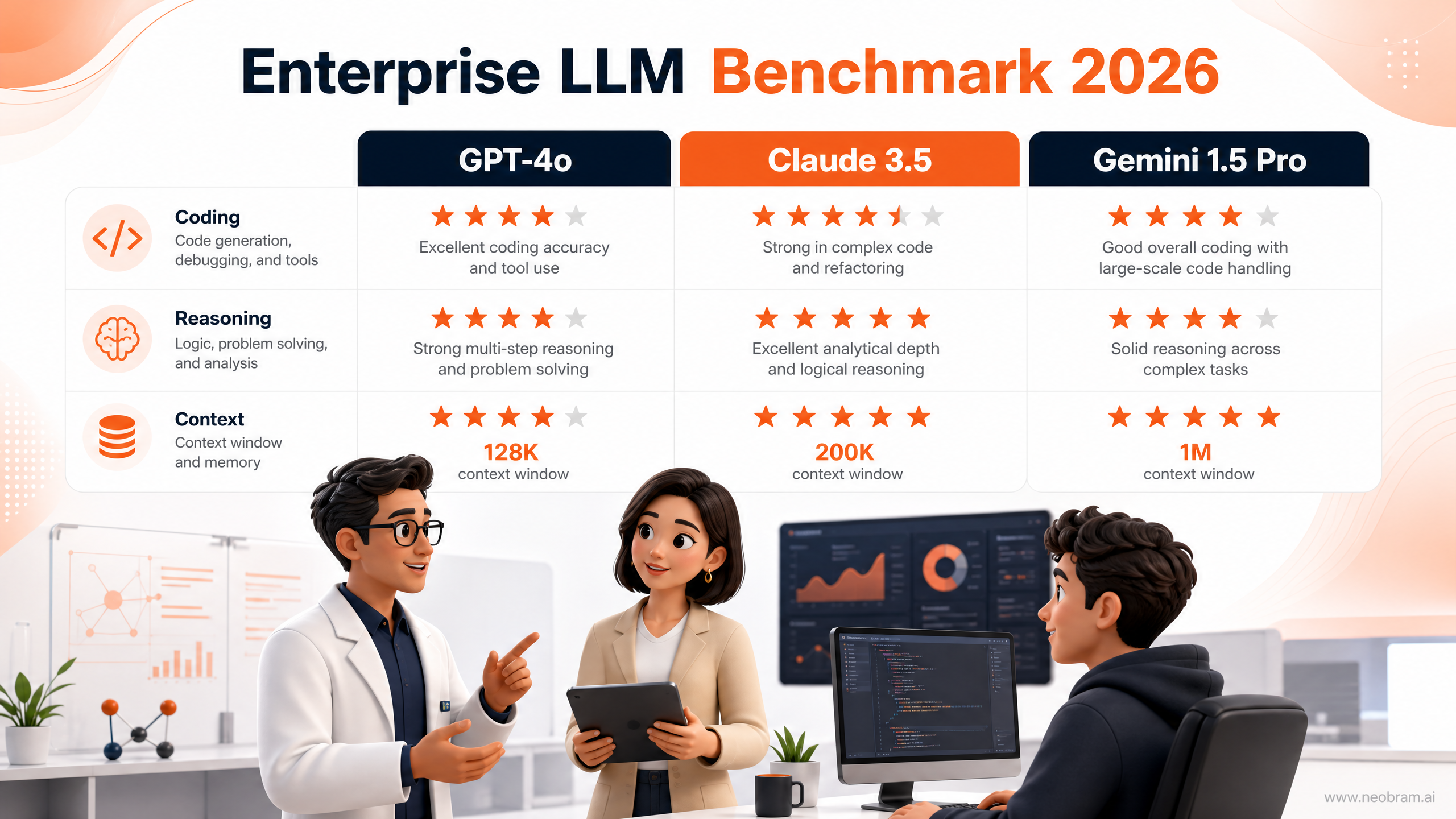
- Claude 3.5 Opus 4.8 leads in software engineering with an 88.6% success rate on SWE-bench Verified.
- Gemini 3.1 Pro excels in scientific reasoning, scoring 94.3% on GPQA Diamond.
- GPT-4o offers the most stable tool use and ecosystem integration, particularly with Azure.
- Leading enterprises use a "Model Router" to leverage the strengths of different LLMs for specific tasks.
The State of LLM Benchmarks in 2026
Choosing the right Large Language Model (LLM) for your enterprise in 2026 is no longer about finding the "smartest" model. The era of a single dominant leader is over. Today, intelligence has fragmented, and the "best" model depends entirely on your specific workload, latency requirements, and data constraints.
In this comprehensive benchmark, we compare the three titans of the enterprise AI space: OpenAI's GPT-4o (and its GPT-5 successors), Google's Gemini 1.5 Pro (and Gemini 3.1), and Anthropic's Claude 3.5 (including the Opus 4.8 powerhouse). We'll look past the marketing hype to see how these models perform in real-world production environments.
By mid-2026, standard benchmarks like MMLU (General Knowledge) and GSM8K (Basic Math) have become saturated. Most top-tier models score in the 90th percentile, making these tests nearly useless for differentiation. To truly separate the leaders, we now look at "frontier" benchmarks:
* GPQA Diamond: PhD-level science reasoning that even human experts struggle with.
* SWE-bench Verified: The gold standard for real-world software engineering, requiring models to fix actual GitHub bugs.
* Humanity's Last Exam (HLE): A set of extremely difficult questions from global experts designed to push AI to its absolute limit.
Key Data Point: In 2026, Claude 3.5 Opus 4.8 leads the pack in software engineering with an 88.6% success rate on SWE-bench Verified, while Gemini 3.1 Pro holds the crown for scientific reasoning with a 94.3% score on GPQA Diamond.
1. Claude 3.5: The Precision Instrument
Anthropic has carved out a unique position by focusing on "Constitutional AI"—a training methodology that embeds safety and reasoning directly into the model's architecture. In 2026, Claude 3.5 (and the newer Opus 4.8) remains the favorite for tasks requiring nuance, safety, and complex code generation.
Why Enterprises Choose Claude:
* Superior Reasoning: Claude consistently follows complex, multi-step instructions without "drifting" off-task.
* Natural Prose: Unlike the often-robotic tone of other models, Claude writes in a way that feels genuinely human, making it ideal for external communications.
* Coding Mastery: For developers, Claude is the top choice. Its ability to refactor large blocks of code and understand architectural patterns is currently unmatched.
2. GPT-4o: The Ecosystem Powerhouse
OpenAI’s GPT-4o (and the GPT-5.2 "Sol" series) remains the most widely deployed model globally. Its strength lies not just in the model itself, but in the massive ecosystem surrounding it. Through Microsoft Azure, it offers the most robust enterprise-grade infrastructure available.
Why Enterprises Choose GPT:
* Unrivaled Ecosystem: Integration with Microsoft 365, Azure AI Studio, and the Assistants API makes it the fastest path from prototype to production.
* Tool Use Stability: GPT-4o is exceptionally stable when calling external APIs and tools, a critical requirement for autonomous agents.
* Multimodal Speed: Its native handling of voice and vision is incredibly fast, powering real-time customer service applications that feel instantaneous.
Pro Tip: If your company is already deep in the Microsoft stack, GPT-4o is almost always the lowest-friction choice for enterprise-wide AI adoption.
3. Gemini 1.5 Pro: The Multimodal Giant
Google’s Gemini 1.5 Pro (and the 3.1 series) has changed the game with its massive context window. While competitors were stuck at 128K or 200K tokens, Google pushed Gemini to 1 million—and now 2 million—tokens.
Why Enterprises Choose Gemini:
* The "Infinite" Context Window: You can feed Gemini an entire codebase, thousands of pages of legal documents, or hours of video footage in a single prompt. It doesn't just "read" them; it understands the relationships across the entire dataset.
* Native Multimodality: Gemini was built from the ground up to understand video and audio natively, not just through transcriptions. This makes it the only viable choice for complex media analysis.
* Google Workspace Integration: For teams living in Google Docs, Sheets, and Drive, Gemini provides a seamless "connective tissue" that other models can't replicate.
Head-to-Head: The 2026 Scorecard
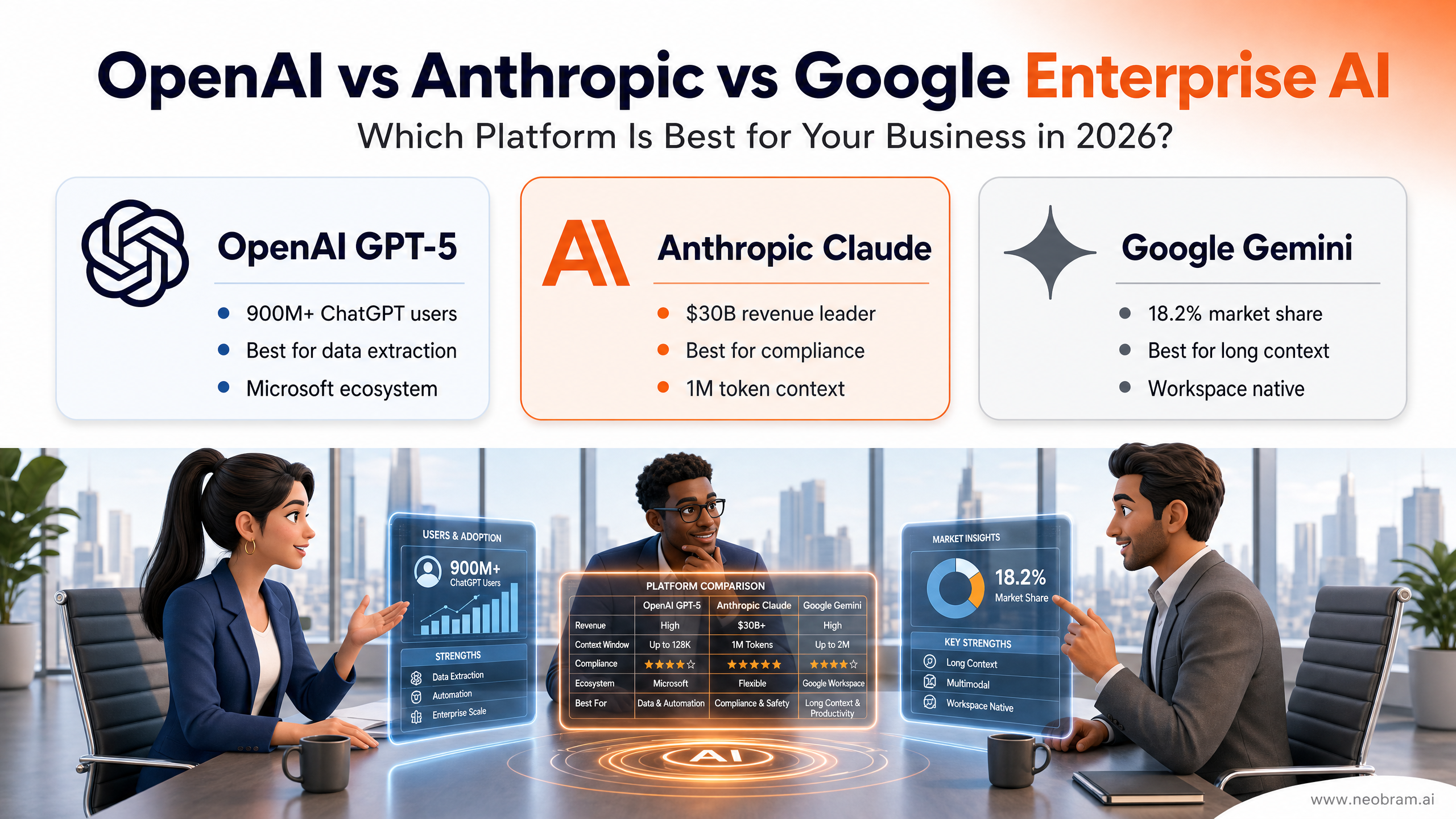
| Feature | Claude 3.5 / Opus 4.8 | GPT-4o / 5.2 | Gemini 1.5 Pro / 3.1 |
|---|---|---|---|
| Primary Strength | Reasoning & Coding | Ecosystem & Stability | Long Context & Video |
| Context Window | 200K Tokens | 128K Tokens | 1M - 2M Tokens |
| Coding (SWE-bench) | 88.6% (Winner) | 80.0% | 80.6% |
| Science (GPQA) | 93.6% | 92.4% | 94.3% (Winner) |
| Human Preference | Highest (Arena Elo) | High | High |
How to Choose the Right Model for Your Workflow
The "right" choice is rarely about which model has the highest score on a chart. Instead, consider these three factors:
- The Complexity of the Task: If you need to analyze a 500-page legal contract for subtle inconsistencies, Claude's reasoning is your best bet.
- The Size of the Data: If you need to query a massive repository of technical manuals or hours of recorded meetings, Gemini's context window is non-negotiable.
- The Speed of Deployment: If you need a stable, high-volume customer service bot that integrates with your existing CRM, GPT-4o through Azure is the safest operational bet.
The Hybrid Reality: Most leading enterprises in 2026 don't pick just one. They use a "Model Router" to send coding tasks to Claude, long-document analysis to Gemini, and general-purpose automation to GPT.
How NeoBram Can Help
Navigating the fragmented LLM landscape is a full-time job. At NeoBram, we specialize in building the infrastructure that allows enterprises to leverage the best of all three worlds. We help you design model-agnostic architectures, implement robust "Model Routers," and ensure that your AI deployments are both cost-effective and high-performing.
Whether you're looking to build autonomous agents, automate complex document workflows, or integrate AI into your core product, our team provides the strategic guidance and technical execution needed to succeed in the 2026 AI economy.
Ready to optimize your AI stack? [Book a free strategy call with our experts](https://neobram.ai/contact) to discuss which model is right for your specific use case.