Key takeaways
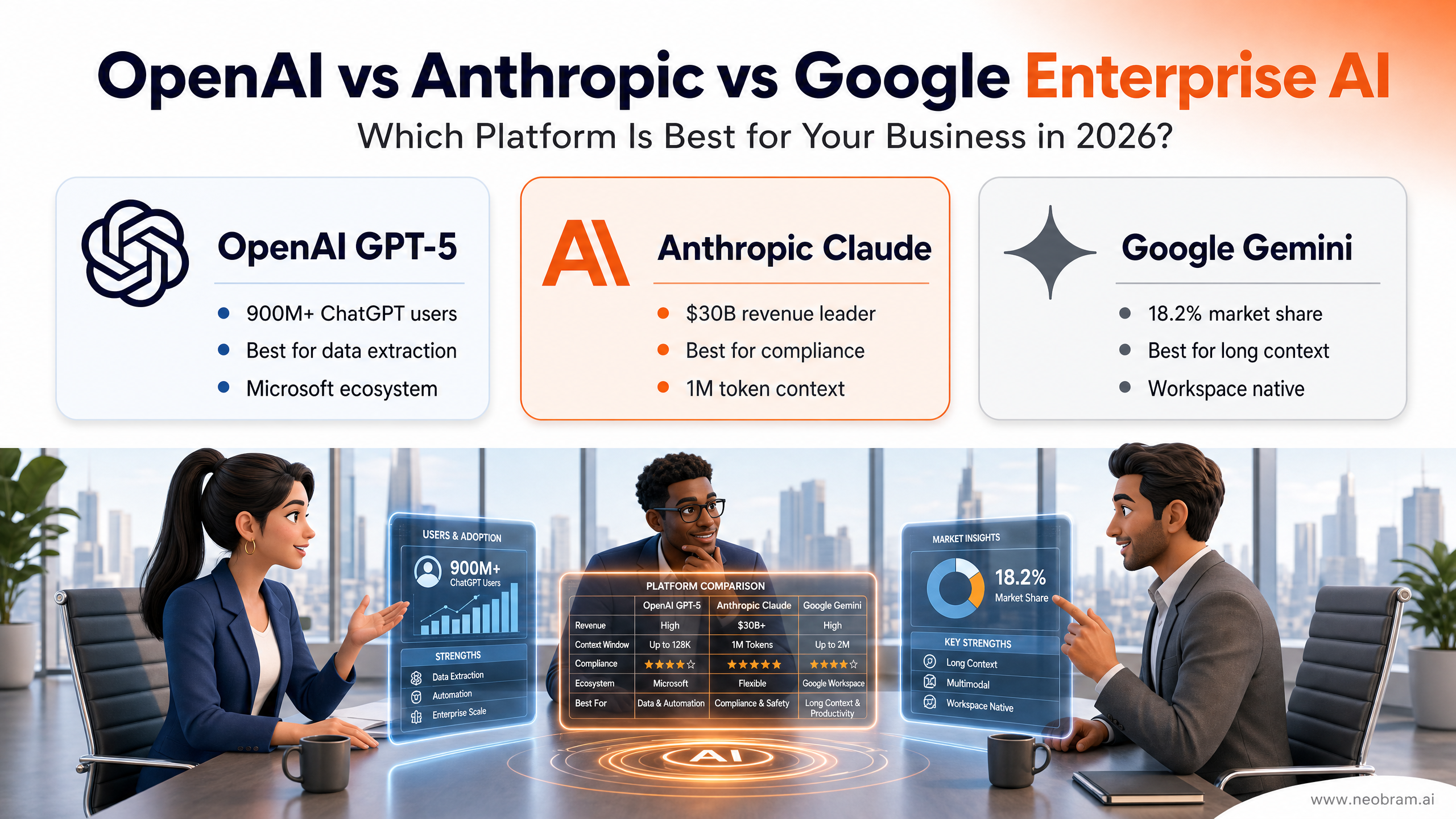
- Anthropic Claude leads in document analysis and compliance, overtaking OpenAI in enterprise revenue.
- OpenAI GPT-4o excels at structured data extraction and broad ecosystem integration.
- Google Gemini dominates in ultra-long context processing and Workspace native integration.
- Enterprise data governance is the primary differentiator, with Anthropic offering the most control.
OpenAI vs Anthropic vs Google: Which AI Platform Is Best for Enterprise?
The three most powerful AI platforms in the world are not competing on benchmarks alone. In 2026, the real battle is commercial: which platform can your enterprise actually trust with sensitive data, mission-critical workflows, and a multi-year deployment roadmap?
OpenAI, Anthropic, and Google each made a different bet. OpenAI built the world's most recognised AI brand and is racing toward infrastructure dominance. Anthropic chose enterprise trust over consumer scale and is now the highest-revenue AI company in the world. Google is replatforming its entire cloud stack around AI agents and betting on distribution through Workspace and Cloud.
This guide cuts through the marketing. You'll get a direct comparison across model performance, pricing, data governance, enterprise support, and the use cases where each platform genuinely wins.
Market snapshot (April 2026): Anthropic's annualised revenue hit $30 billion, overtaking OpenAI's $24-25 billion, despite having a fraction of OpenAI's consumer reach. Anthropic grew revenue 10x year-over-year. Google's Gemini reached 18.2% global AI market share by January 2026, the fastest-growing AI platform of the year.
The Three Platforms at a Glance
Before diving into the details, it helps to understand what each company is actually optimising for. These aren't just different products; they're different philosophies about what enterprise AI should be.
OpenAI is the consumer-first, ecosystem-wide player. ChatGPT has 900 million weekly active users. GPT-5.4 and GPT-5 Pro power Microsoft Copilot, which reaches over 400 million Microsoft 365 users. OpenAI's strategy is to own the AI category across every product surface: text, voice, image, video, code, and agents.
Anthropic is the enterprise-first, safety-led challenger. Founded by former OpenAI researchers Dario and Daniela Amodei, Anthropic structured itself as a Public Benefit Corporation with a legal commitment to societal responsibility. Claude's 1M-token context window, Constitutional AI training method, and flexible data governance have made it the preferred platform for regulated industries: finance, healthcare, legal, and pharma.
Google is the distribution giant. Gemini is embedded in Gmail, Docs, Meet, and every Google Workspace product used by over 3 billion people. At Google Cloud Next 2026, Google rebranded Vertex AI as the Gemini Enterprise Agent Platform, signalling a full pivot to agentic AI. For enterprises already running on Google Cloud, the integration depth is unmatched.
| Dimension | OpenAI | Anthropic | |
|---|---|---|---|
| Flagship model | GPT-5.4 / GPT-5 Pro | Claude Opus 4.6 / Sonnet 4.6 | Gemini 2 Pro / Gemini Enterprise |
| Context window | 272K (GPT-5.4), 400K (GPT-5 Pro) | 1M tokens | 1M tokens |
| Annual run-rate revenue | ~$24-25B | ~$30B | Part of Google Cloud ($43B+ per quarter) |
| Primary cloud partner | Microsoft Azure | AWS + Google Cloud | Google Cloud (native) |
| Corporate structure | For-profit (restructuring) | Public Benefit Corporation | Alphabet subsidiary |
| Best for | Breadth, consumer apps, Microsoft ecosystem | Regulated industries, long-context, safety | Google Cloud users, Workspace integration |
Model Performance: What the Tests Actually Show
Benchmarks are a starting point, not a verdict. The more useful question is: which model performs best on the tasks your enterprise actually runs?
Independent testing across document analysis, code review, data extraction, customer support, and long-context tasks reveals a clear pattern. No single model wins everything.
Document Analysis and Contract Review
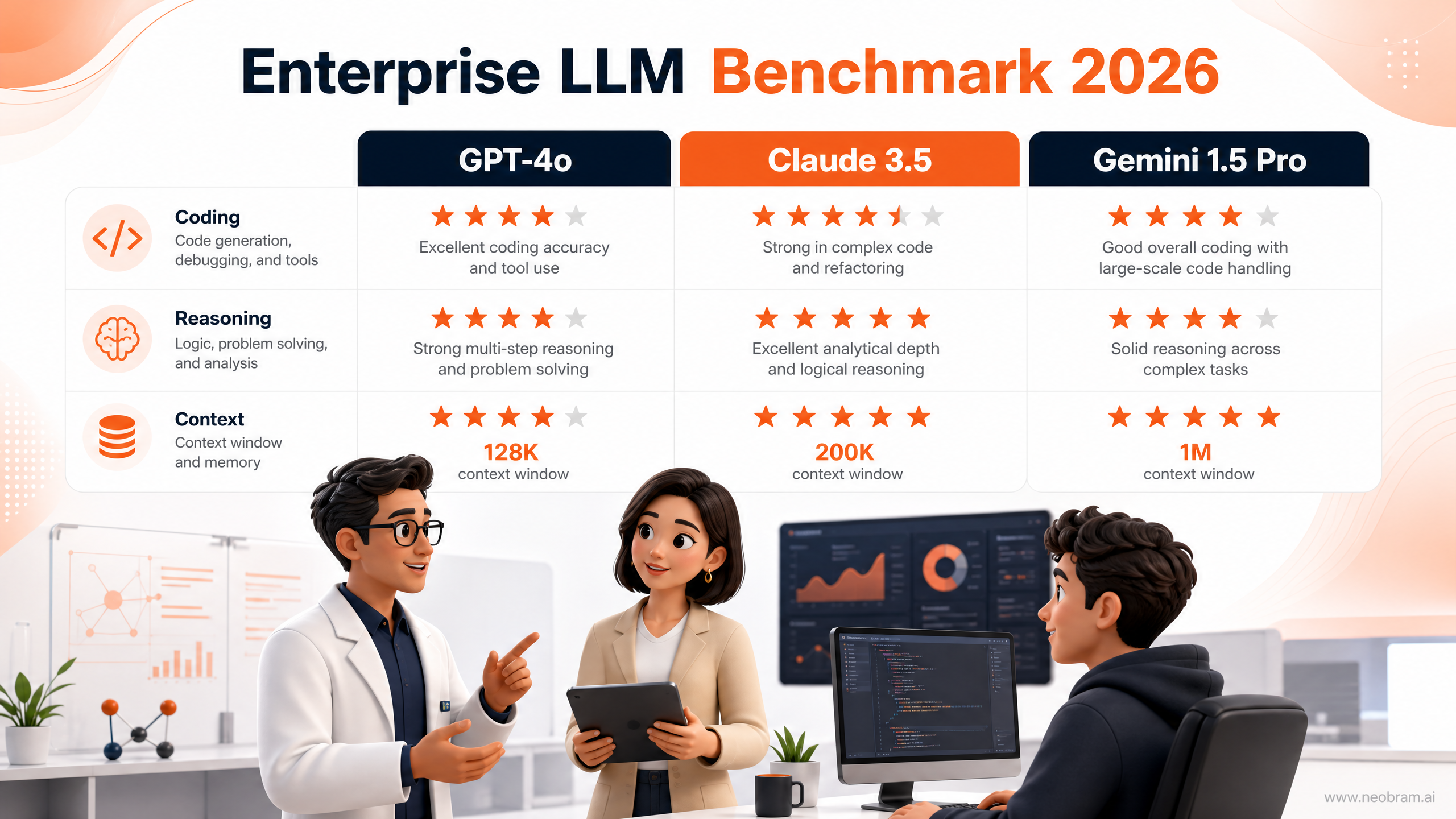
Claude 3.5 Sonnet leads on document analysis, scoring 94.2% accuracy on contract review tasks versus 91.8% for GPT-4o and 89.4% for Gemini 2 Pro. Claude's advantage is instruction-following consistency: it maintains output format across varied inputs and catches implicit obligations that other models miss. For legal, compliance, and procurement teams processing high volumes of contracts, this consistency translates directly into reduced review time.
Structured Data Extraction
GPT-4o wins on structured data extraction, scoring 96.2% accuracy with a 1.2% hallucination rate. Its native JSON mode with strict schema enforcement is the key differentiator. When you need to extract invoice data, parse resumes, or pull structured fields from forms, GPT-4o's schema compliance is near-perfect. Claude scores 94.8% but occasionally adds explanatory text when you want pure JSON, requiring explicit prompting to suppress.
Long-Context Processing
Gemini 2 Pro holds the advantage for very long documents. With a 1M-token context window and quality that remains above 88% even at 500K tokens, Gemini is the only viable option when you need to analyse entire codebases, process legal discovery documents, or synthesise research across hundreds of papers. Claude's 200K window covers most enterprise documents, but Gemini's ceiling is genuinely higher.
Code Review and Security Analysis
Claude leads on code review, detecting 88% of intentional bugs versus 84% for GPT-4o and 80% for Gemini 2 Pro. More importantly, Claude's security analysis scored 92% on OWASP vulnerability detection. It identified race conditions and injection vulnerabilities that other models missed. For software engineering teams using AI for code review, Claude Code has already become the industry standard: it reached a $2.5 billion run-rate revenue by February 2026.
Performance summary: Claude wins on document analysis, code review, and customer support. GPT-4o wins on structured data extraction. Gemini wins on long-context and multimodal tasks. For most enterprise deployments, the right answer is model routing: use the best tool for each task type rather than committing to a single provider.
Pricing: What You'll Actually Pay
Pricing transparency varies significantly across the three vendors, and the sticker price rarely reflects what large enterprises pay.
API Token Pricing
| Model | Input (per 1M tokens) | Output (per 1M tokens) |
|---|---|---|
| GPT-4o | $2.50 | $10.00 |
| Claude 3.5 Sonnet | $3.00 | $15.00 |
| Gemini 2 Pro (Vertex AI) | $1.88 | $7.50 |
| GPT-4o-mini | $0.15 | $0.60 |
| Claude Haiku | $1.00 | $5.00 |
| Gemini 2 Flash | $0.075 | $0.30 |
At face value, Gemini is the cheapest and Claude the most expensive. But the real picture is more nuanced.
Anthropic offers the most flexible enterprise pricing. Direct contracts allow volume discounts, custom data retention windows, and model customisation parameters. Through AWS Bedrock, Claude pricing drops to $0.80-$1.25 per million input tokens, competitive with GPT-4o. For enterprises with existing AWS commitments, this is a significant lever.
Google bundles Gemini discounts with broader Cloud spending. An enterprise spending $5 million per year on Google Cloud might negotiate Gemini pricing down by 40%, making the effective token cost the lowest of the three. Without that Cloud commitment, Vertex AI pricing is mid-range.
OpenAI is the least flexible on pricing. Volume discounts exist but are negotiated case-by-case, and OpenAI rarely adjusts contract terms or data governance beyond its standard ChatGPT Enterprise offering.
For a monthly projection at 10,000 tasks, Claude costs approximately $1,200, GPT-4o $800, and Gemini $400. Claude costs roughly 50% more than GPT-4o but delivers measurably better results for most enterprise tasks. The ROI depends on your quality requirements and the cost of errors in your specific workflow.
Data Governance: The Non-Negotiable for Regulated Industries
If your enterprise operates in finance, healthcare, legal, or any regulated sector, data governance is not a secondary consideration. It's the primary filter.
Anthropic: Customer-Controlled Retention
Anthropic offers the strongest data governance of the three. Enterprise contracts allow customers to dictate data retention windows, including zero-retention (deletion immediately after inference). This flexibility was designed specifically for regulated industries. Anthropic's Constitutional AI training method and Public Benefit Corporation structure reinforce its positioning as the safety-first choice.
For HIPAA-covered healthcare workflows, FINRA-regulated financial services, and GDPR-sensitive European deployments, Anthropic's contractual flexibility is worth the price premium on output tokens.
OpenAI: No Training, But Limited Control
OpenAI does not train GPT models on your API inputs under the Enterprise agreement. However, it retains your data for 30 days post-request for safety monitoring, and you cannot shorten that window. For enterprises handling personally identifiable information or protected health information, this 30-day retention period creates compliance friction.
OpenAI's IP indemnity covers most use cases but excludes high-risk applications. For content-generation workflows, the indemnity gap is worth reviewing with your legal team.
Google: Opt-Out Required, Complex Sub-Processor Chain
Google's Vertex AI terms require you to explicitly opt out of data collection for product improvement. By default, Google retains queries and responses to improve Gemini models. The sub-processor chain is also more opaque than Anthropic's or OpenAI's, which creates challenges for enterprises with strict data residency requirements in the EU, Japan, or other regulated jurisdictions.
Google's strength is in its Workspace integration: if your data already lives in Google Drive, Gmail, and BigQuery, the governance model is consistent. If you're bringing sensitive data from outside the Google ecosystem, the opt-out process requires careful configuration.
Data governance verdict: For regulated industries, Anthropic's zero-retention option and contractual flexibility make it the clear choice. OpenAI is acceptable for most enterprise use cases but lacks retention control. Google requires active configuration to meet strict compliance requirements.
Enterprise Support and SLAs
How a vendor supports your deployment matters as much as the technology itself.
Anthropic provides the most customer-centric support of the three. Dedicated customer success managers are standard for Enterprise contracts with no minimum spend threshold. Anthropic's smaller customer base means more personalised attention: engineers often join customer escalations directly. Response times for critical issues are typically under one hour.
OpenAI assigns dedicated support for ChatGPT Enterprise and high-volume API customers, generally those spending $1 million or more annually. Support is reactive rather than proactive, operating through ticket systems rather than dedicated engineering relationships. Critical issue response is four hours.
Google's support quality depends heavily on your Cloud commitment. Enterprises spending $2 million or more annually on Google Cloud get a Technical Account Manager. Below that threshold, support runs through standard Cloud channels. For enterprises already embedded in the Google ecosystem, this is manageable. For those using Gemini as a standalone AI platform, the support experience can be inconsistent.
On uptime, Google leads with 99.95% availability over the past 90 days, followed by Anthropic at 99.92% and OpenAI at 99.88%. All three offer enterprise SLAs, but Google's infrastructure reliability reflects its decades of hyperscale cloud operations.
Which Platform Wins by Use Case
The honest answer is that no single platform wins everything. The most sophisticated enterprise AI deployments in 2026 use model routing: directing each task type to the model that performs best on it.
That said, clear patterns emerge by use case.
Choose OpenAI (GPT-4o) When:
You need structured data extraction with schema enforcement. You're building on Microsoft Azure or deploying through Microsoft Copilot. You need the widest product surface: text, voice, image, video, and agents from a single vendor. Your team is already familiar with the OpenAI API and ecosystem.
GPT-4o's native JSON mode, broad multimodal capabilities, and deep Microsoft integration make it the default choice for enterprises running on the Microsoft stack.
Choose Anthropic (Claude) When:
You operate in a regulated industry where data governance is non-negotiable. You're processing long, complex documents: contracts, research papers, compliance reports. You need the most reliable instruction-following for customer-facing AI. Your engineering team is building agentic workflows where Claude Code's capabilities matter.
Anthropic's enterprise revenue overtaking OpenAI's in April 2026 is not a coincidence. For the Fortune 500 companies that need AI they can trust with sensitive work, Claude has become the default.
Choose Google (Gemini) When:
Your enterprise runs on Google Workspace and Google Cloud. You need ultra-long context processing beyond 200K tokens. You want the most cost-efficient option for high-volume, lower-stakes tasks. You're building agentic workflows and want native integration with Google's Agent-to-Agent orchestration framework.
Google's rebranding of Vertex AI as the Gemini Enterprise Agent Platform at Google Cloud Next 2026 signals a serious commitment to enterprise agentic AI. For Google Cloud customers, the integration depth is a genuine competitive advantage.
| Use Case | Best Choice | Runner-Up |
|---|---|---|
| Contract and document analysis | Anthropic Claude | OpenAI GPT-4o |
| Structured data extraction | OpenAI GPT-4o | Anthropic Claude |
| Customer support automation | Anthropic Claude | Google Gemini |
| Long-context processing (200K+) | Google Gemini | Anthropic Claude |
| Code review and security analysis | Anthropic Claude | OpenAI GPT-4o |
| Microsoft ecosystem integration | OpenAI GPT-4o | N/A |
| Google Workspace integration | Google Gemini | N/A |
| Regulated industry compliance | Anthropic Claude | OpenAI GPT-4o |
| Cost-optimised high-volume tasks | Google Gemini Flash | OpenAI GPT-4o-mini |
| Multimodal (image, video, voice) | OpenAI GPT-4o | Google Gemini |
The Multi-Vendor Reality
The most important insight from 2026 enterprise AI deployments is that the question "which platform should we use?" is increasingly the wrong question. The right question is: "how do we build a model routing layer that uses each platform where it excels?"
Leading enterprises are already doing this. They run Claude for document analysis and compliance review. They use GPT-4o for structured extraction and Microsoft Copilot integration. They route long-context tasks and Google Workspace workflows through Gemini. The cost of running multiple API relationships is minimal compared to the performance gains from using the right model for each task.
The practical challenge is orchestration: building a layer that routes tasks intelligently, manages costs, and maintains consistent governance across providers. This is where AI consulting partners add genuine value, helping enterprises design multi-vendor architectures that don't create new operational complexity.
How NeoBram Can Help
Choosing between OpenAI, Anthropic, and Google is only the first decision. The harder work is designing an architecture that integrates these platforms with your existing systems, meets your compliance requirements, and delivers measurable ROI.
NeoBram's enterprise AI engineering team has deployed AI solutions across manufacturing, pharma, BFSI, healthcare, and EPC sectors. We help enterprises:
- Assess which platform fits your specific use cases - through structured proof-of-concept testing, not vendor demos
- Design multi-vendor AI architectures - that route tasks to the right model while maintaining unified governance
- Navigate data governance requirements - for regulated industries, including HIPAA, GDPR, FINRA, and GxP compliance
- Build and operationalise AI workflows - that integrate with your existing ERP, CRM, and data infrastructure
- Measure and optimise AI ROI - with clear metrics tied to business outcomes, not model benchmarks
Industry-reported results for comparable deployments include reductions in manual processing time in an estimated range of 30-60% within the first months. Treat any specific percentage as an estimate to validate in your own environment, not a guarantee; payback timelines depend on your baseline, data quality and adoption.
If you're evaluating OpenAI, Anthropic, or Google for an enterprise deployment, the most valuable first step is an honest assessment of your use cases, data environment, and compliance requirements. That's exactly what our free strategy call is designed to deliver.
[Book a free strategy call with NeoBram's AI engineering team](https://neobram.ai/contact)