
Key takeaways
- Agentic AI differs from generative AI by taking autonomous action to achieve goals, rather than just generating content in response to prompts.
- By the end of 2026, 40% of enterprise applications will include embedded AI agents, up from less than 5% in 2024.
- Scaled multi-agent systems can drive 10%+ enterprise growth, compared to 3-5% for single-agent deployments.
- The biggest risk isn't the technology failing: it's deploying without proper governance, identity security, and human-in-the-loop controls.
What Is Agentic AI? A Plain-English Definition
If you have spent any time in enterprise technology circles recently, you have almost certainly heard the phrase "agentic AI." But what does it actually mean, and why does it matter more than the generative AI wave that came before it?
Here is the simplest way to think about it: generative AI creates content when you ask it to; agentic AI takes action on your behalf without waiting to be asked at every step.
A traditional chatbot or copilot responds to prompts. You ask, it answers. Agentic AI is different. It is given a goal: "process all incoming invoices and flag anomalies" or "monitor our production line and schedule maintenance when sensor readings exceed thresholds", and then it plans, executes, and adapts across multiple steps and multiple systems until that goal is achieved.
MIT Sloan professor Sinan Aral puts it plainly: "The agentic AI age is already here. We have agents deployed at scale in the economy to perform all kinds of tasks." His colleague Kate Kellogg adds that AI agents "can execute multi-step plans, use external tools, and interact with digital environments to function as powerful components within larger workflows."
In practical terms, an AI agent can:
- Read data from your CRM, ERP, or database
- Make decisions based on that data using a large language model
- Take actions, including sending emails, updating records, triggering workflows, calling APIs
- Monitor the results and adjust its approach
- Escalate to a human only when genuinely necessary
This is not incremental improvement. It is a structural shift in how enterprise work gets done.
Market size snapshot: The global agentic AI market is valued at approximately $10.86 billion in 2026, up from $7.55 billion in 2025, and is projected to reach $93.2 billion by 2032, growing at a CAGR of 44.6% (Markets and Markets). Nvidia CEO Jensen Huang has called it a "multi-trillion-dollar opportunity" for enterprise across every major industry.
Agentic AI vs Generative AI: What Is the Real Difference?
Many executives conflate agentic AI with generative AI, which leads to misaligned expectations and poorly scoped projects. The distinction is important.
| Dimension | Generative AI | Agentic AI |
|---|---|---|
| Core behaviour | Responds to prompts | Pursues goals autonomously |
| Human involvement | Required at each step | Minimal; human sets the goal |
| System integration | Typically standalone | Connects to multiple systems via APIs |
| Output type | Content (text, images, code) | Actions (updates, transactions, decisions) |
| Scope | Single task per interaction | Multi-step workflows end-to-end |
| Memory | Usually stateless | Maintains context across sessions |
| Risk profile | Lower (output reviewed before use) | Higher (actions taken in real systems) |
The key insight is that agentic AI does not replace generative AI; it builds on top of it. Most AI agents use an LLM as their reasoning engine, but they add the ability to plan, use tools, and operate across time and systems. Think of the LLM as the brain and the agent framework as the body that lets that brain act in the world.
Why 2026 Is the Inflection Point for Enterprise Adoption
The shift from "interesting pilot" to "strategic imperative" happened fast. Here is why 2026 is the year enterprises cannot afford to wait.
Adoption has crossed the tipping point
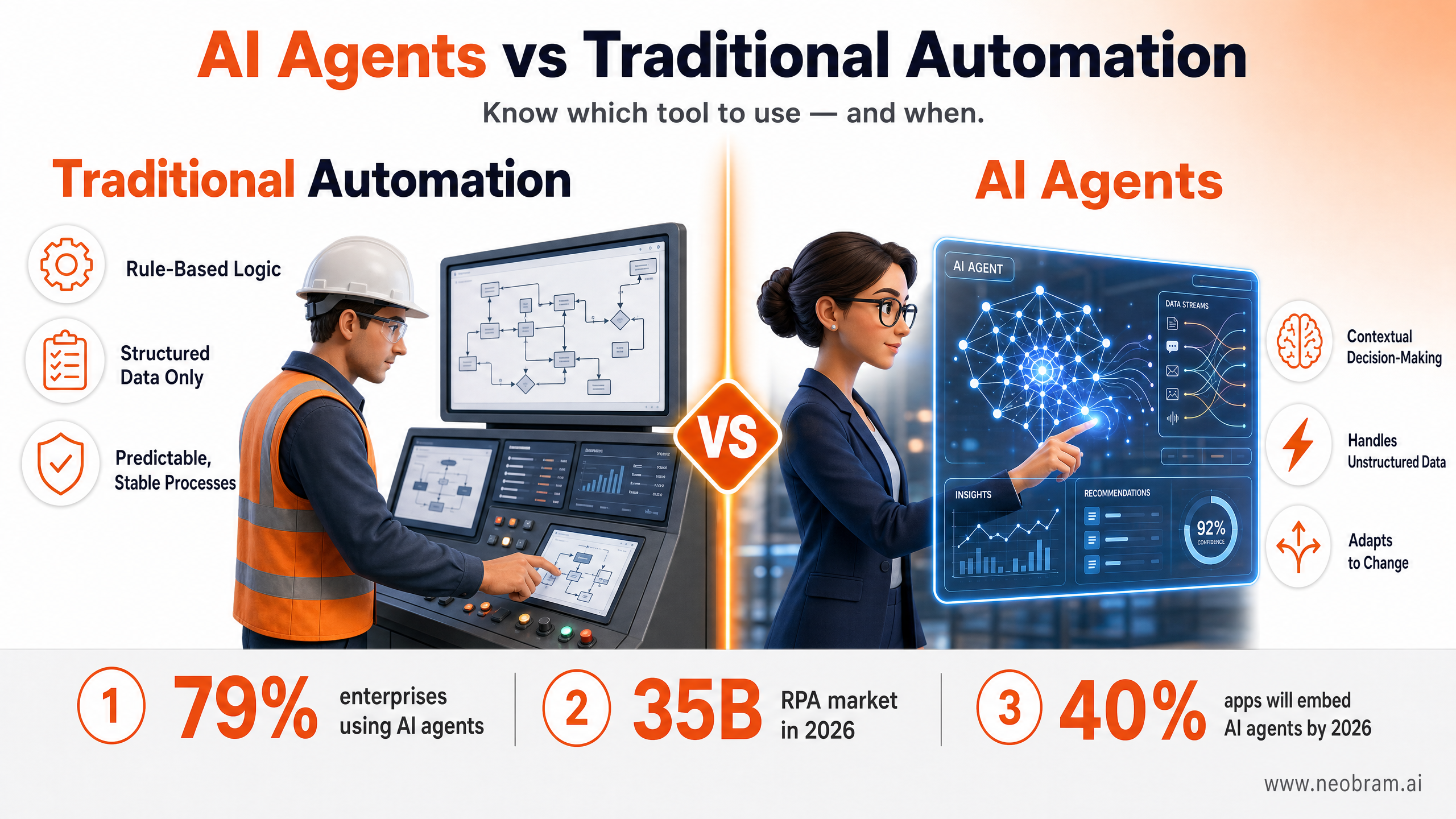
A spring 2025 survey by MIT Sloan Management Review and Boston Consulting Group found that 35% of organisations had already adopted AI agents, with another 44% planning to deploy in the near term. That means roughly 79% of companies are either using or actively moving toward agentic AI.
Gartner has made a particularly striking prediction: 40% of enterprise applications will include embedded, task-specific AI agents by the end of 2026, up from less than 5% in 2024. That is an eight-fold increase in a single year, a pace of change that has no precedent in enterprise software history.
The competitive gap is widening
66% of organisations using AI agents have already seen measurable productivity gains (PwC). 57% report significant cost savings. 55% say they are making faster decisions. Meanwhile, 40% of potential productivity gains are being missed by companies that lack a proper AI talent and training strategy (EY).
The implication is clear: companies that move now are building a compounding advantage. Those that wait are not just missing gains; they are falling behind competitors who are already operating at a structurally lower cost base.
The technology has matured enough to trust
Early AI agent deployments were fragile, unreliable, and difficult to govern. That has changed. Enterprise-grade frameworks like LangGraph, Microsoft AutoGen, and CrewAI now provide the scaffolding needed for production-ready multi-agent systems. Major software vendors, Microsoft, Salesforce, Google, ServiceNow, SAP, have embedded agentic capabilities directly into platforms enterprises already use. The barrier to entry has dropped dramatically.
The productivity case: McKinsey estimates that early agentic AI deployments deliver 3 5% annual productivity gains, while scaled multi-agent systems can drive 10%+ enterprise growth. At the macro level, AI agents and robots could generate $2.9 trillion in annual economic value in the US alone.
How Agentic AI Actually Works: The Technical Architecture (Without the Jargon)
You do not need to be an engineer to understand how AI agents work. Here is the core architecture in plain English.
The four building blocks of an AI agent
1. The reasoning engine (the LLM)
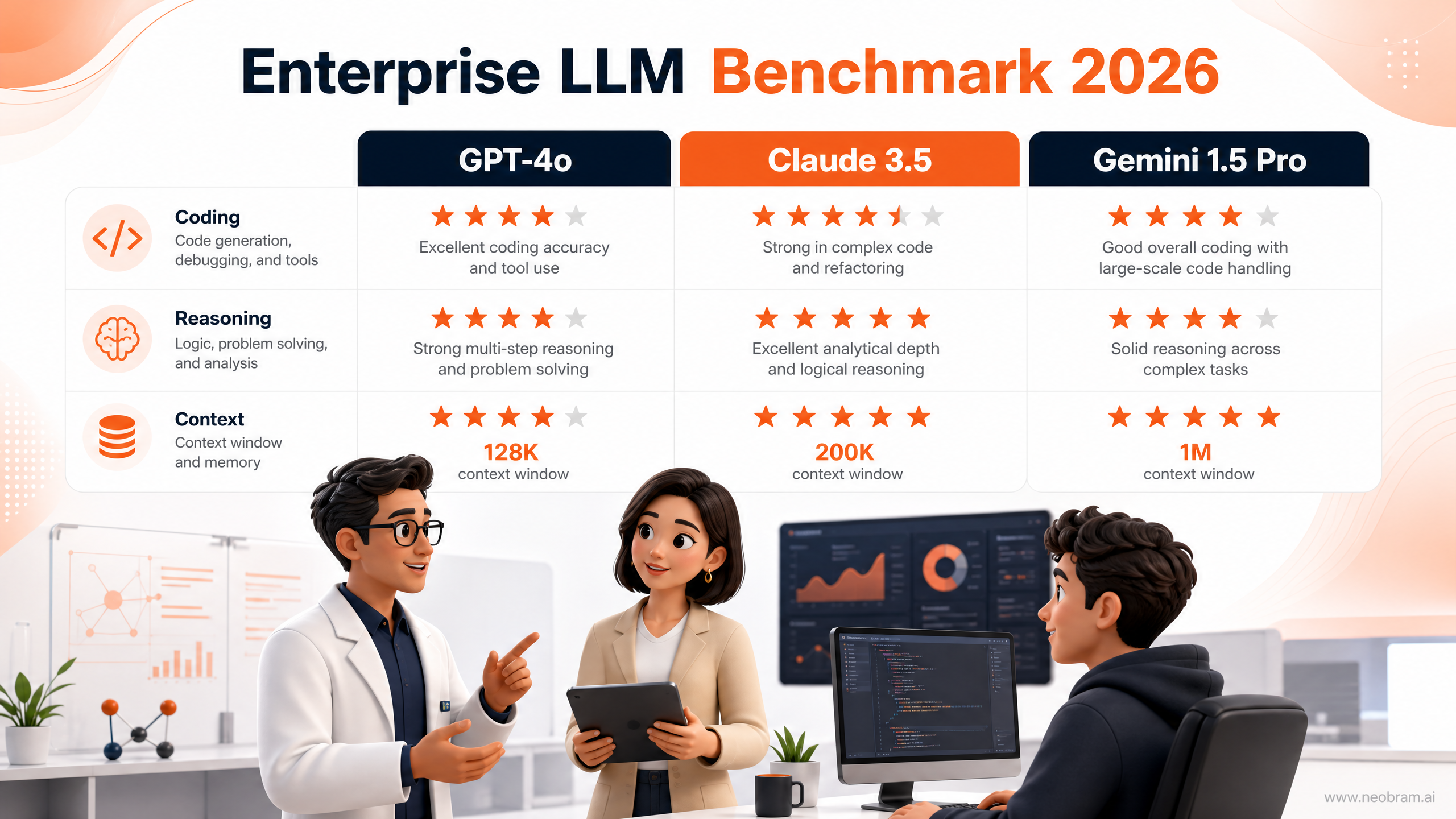
At the centre of every AI agent is a large language model: GPT-4o, Claude 3.5, Gemini 1.5 Pro, or a fine-tuned variant. This is what handles natural language understanding, planning, and decision-making. The LLM receives a goal and figures out what steps are needed to achieve it.
2. Tools and integrations
An agent without tools is just a chatbot. Tools are what give agents the ability to act. These can include database queries, API calls, web search, code execution, file operations, email sending, and any other system your enterprise uses. The agent decides which tools to use and in what order.
3. Memory
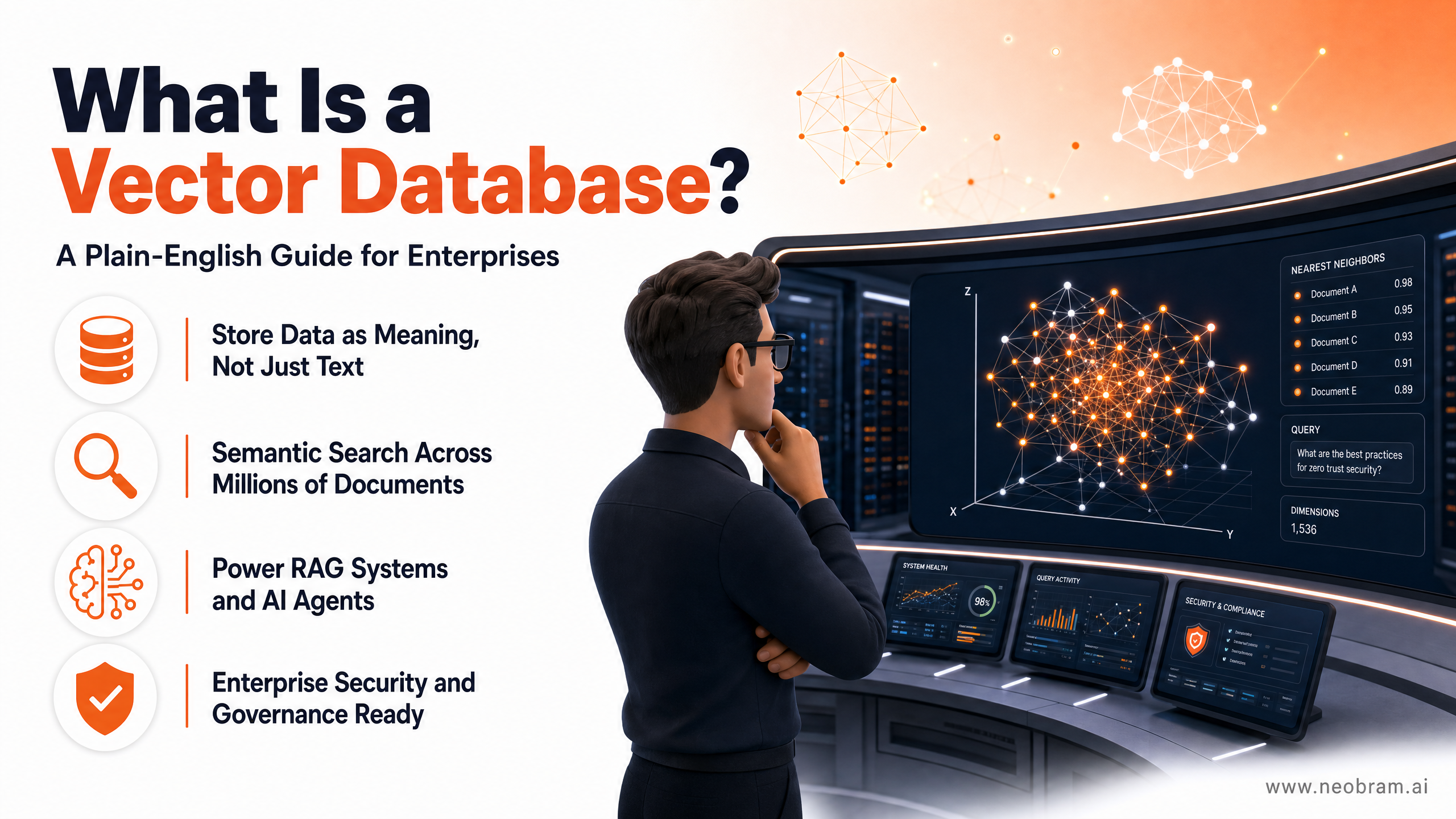
Agents need to remember what they have done and what they have learned. There are two types: short-term memory (the context of the current task) and long-term memory (stored in a vector database, allowing the agent to recall information from previous sessions or large document repositories).
4. The orchestration layer
This is the framework that coordinates everything, managing the agent's planning loop, handling errors, routing tasks to the right tools, and (in multi-agent systems) coordinating between multiple specialised agents. This is where frameworks like LangGraph and AutoGen come in.
Single agents vs multi-agent systems
A single agent handles one workflow. A multi-agent system deploys multiple specialised agents that collaborate on complex tasks. Think of it like a team: one agent handles data extraction, another handles analysis, a third handles report generation, and an orchestrator coordinates the whole process.
Multi-agent architectures are particularly powerful for enterprise use cases because they mirror how human teams actually work, with specialisation, handoffs, and parallel processing. McKinsey research shows that scaled multi-agent systems can drive 10%+ enterprise growth, compared to 3 5% for single-agent deployments.
The human-in-the-loop principle
Well-designed agentic systems are not fully autonomous. They include defined checkpoints where human approval is required, particularly for high-stakes actions like financial transactions, regulatory filings, or customer-facing communications. The goal is not to remove humans from the loop entirely, but to remove humans from the parts of the loop where their time adds no value.
The Top Enterprise Use Cases for Agentic AI in 2026
Agentic AI is not a single product or a single use case. It is a capability that can be applied across virtually every business function. Here are the highest-value applications enterprises are deploying today.
Finance and accounts payable
AI agents can process invoices end-to-end: extracting data from PDFs, matching against purchase orders, flagging discrepancies, routing for approval, and posting to the general ledger, all without human intervention for the 80 90% of invoices that follow standard patterns. The remaining edge cases are escalated to a human with full context already prepared.
Real-world impact: Enterprises automating accounts payable with AI agents report 60 80% reductions in processing time and 40 60% cost reductions in the AP function.
Customer service and support
Gartner predicts that agentic AI will autonomously resolve 80% of common customer service issues without human intervention by 2029. Salesforce is already handling approximately 32,000 customer conversations per week with AI agents, achieving an 83% resolution rate without human involvement.
The key difference from traditional chatbots is that agentic systems can actually take action, not just answer questions, but update account details, process refunds, schedule callbacks, and escalate complex cases with full context.
IT service management
AI agents are transforming IT service desks by handling the entire lifecycle of common requests: password resets, software provisioning, access management, and incident triage. 93% of IT leaders plan to introduce autonomous AI agents within the next two years (Accelirate). The business case is compelling: IT teams spend an estimated 40% of their time on repetitive, low-value tasks that agents can handle automatically.
Supply chain and procurement
AI agents can monitor supplier performance, track inventory levels, identify potential disruptions, and automatically trigger reorders or rerouting decisions. In manufacturing, 89% of executives plan to integrate AI into their operations, with supply chain optimisation as a top priority.
HR and talent management
From screening CVs and scheduling interviews to onboarding new hires and managing performance review cycles, agentic AI is automating the administrative backbone of HR. This frees HR professionals to focus on the genuinely human aspects of their role, coaching, culture, and complex employee relations.
Legal and compliance
AI agents can review contracts, flag non-standard clauses, monitor regulatory changes, and ensure that internal processes remain compliant, tasks that previously required significant attorney time. JPMorgan Chase is already exploring AI agents for legal and compliance processes, with the potential to reduce the need for junior bankers in routine review work.
Software development
By 2028, Gartner predicts that 75% of enterprise software engineers will use AI coding assistants and agents, up from less than 10% in early 2023. Agentic coding tools can write code, run tests, identify bugs, and propose fixes, compressing development cycles significantly.
Industry-specific adoption rates: Healthcare organisations are leading the charge, with 68% already deploying AI strategies focused on agentic AI for end-to-end clinical decisions (KPMG). In financial services, 70% of executives expect AI agents to drive revenue growth. In manufacturing, 89% of executives plan to integrate AI agents into operations.
The Agentic AI Frameworks: What Enterprises Are Actually Using
Choosing the right technical framework is one of the most consequential decisions in an agentic AI implementation. Here is a practical overview of the leading options.
LangGraph
LangGraph has emerged as the production standard for stateful, auditable agentic workflows in 2026. It is built on top of LangChain and provides a graph-based architecture that makes it easy to define complex, branching workflows with clear state management. Its key strengths are reliability, observability, and the ability to handle long-running processes with human-in-the-loop checkpoints.
Best for: Enterprises that need production-grade reliability, auditability, and complex multi-step workflows.
Microsoft AutoGen
AutoGen is Microsoft's open-source framework for building multi-agent conversational systems. It is particularly well-suited to scenarios where multiple specialised agents need to collaborate on a task, with each agent having a defined role and capability set. Its integration with the Microsoft Azure ecosystem makes it a natural choice for enterprises already on the Microsoft stack.
Best for: Microsoft-centric enterprises building collaborative multi-agent systems.
CrewAI
CrewAI offers the fastest path from concept to working prototype. Its role-based agent model is intuitive and its documentation is excellent. However, it has historically been less production-ready than LangGraph or AutoGen for complex enterprise deployments.
Best for: Rapid prototyping and proof-of-concept work; smaller-scale deployments.
Vendor-embedded agents
For many enterprises, the most practical path is not building custom agents from scratch but leveraging agentic capabilities embedded in platforms they already use. Microsoft Copilot Studio, Salesforce Agentforce, ServiceNow AI Agents, and Google Agentspace all offer low-code agent building tools that integrate natively with their respective ecosystems.
Best for: Enterprises that want to move fast without deep engineering investment.
| Framework | Best For | Production Readiness | Learning Curve |
|---|---|---|---|
| LangGraph | Complex, stateful workflows | High | Steep |
| Microsoft AutoGen | Multi-agent collaboration | High | Moderate |
| CrewAI | Rapid prototyping | Moderate | Low |
| Vendor platforms | Quick wins in existing stacks | High | Low |
Building Your Agentic AI Strategy: A Six-Step Framework
The biggest mistake enterprises make with agentic AI is starting with the technology rather than the business problem. Here is a proven framework for getting it right.
Step 1: Identify your highest-friction workflows
Start by mapping the workflows in your organisation that are high-volume, rule-based, and time-consuming. These are the best candidates for agentic AI. Good indicators include: processes that require data from multiple systems, tasks where humans spend most of their time on data gathering rather than decision-making, and workflows with high error rates due to manual handling.
Step 2: Score each use case on four dimensions
Before committing to any agentic AI project, evaluate it across four dimensions:
- Autonomy level: - What is the consequence if the agent makes a wrong decision? Match autonomy to consequence, not to technical capability.
- Integration complexity: - How many systems does the agent need to connect to? Each integration adds implementation complexity and potential failure points.
- Regulatory impact: - Does this use case fall under GDPR, the EU AI Act, HIPAA, or other regulations? Compliance must be designed in from the start, not bolted on.
- Data sensitivity: - What data will the agent access? Sensitive data requires narrower permissions and stronger governance.
Use cases that score low to medium across all four dimensions are the ideal first pilots.
Step 3: Define success metrics before you build
Agentic AI projects fail most often not because the technology does not work, but because success was never clearly defined. Before writing a line of code, establish: what is the current baseline (time, cost, error rate)? What does success look like at 90 days? What is the minimum acceptable ROI to justify scaling?
Step 4: Start narrow, prove value, then scale
The graveyard of enterprise AI is littered with ambitious projects that tried to automate everything at once. Start with a single, well-defined workflow. Prove the value. Build organisational confidence. Then expand.
Step 5: Build governance into the architecture
68% of organisations say they lack identity security controls for AI agents (CyberArk). This is a significant risk. Every agent should have a defined identity, a minimum-privilege access policy, an audit log of every action it takes, and a clear escalation path for edge cases. Governance is not a compliance checkbox, it is what makes agentic AI trustworthy enough to scale.
Step 6: Invest in human-AI collaboration skills
90% of organisations will face a critical AI skills shortage by 2026 (IDC). The bottleneck is not the technology; it is the human capacity to design, manage, and work alongside AI agents. Invest in upskilling your teams to understand what agents can and cannot do, how to review their outputs, and how to design workflows that leverage both human and machine strengths.
The Risks You Cannot Ignore
Agentic AI is powerful, but it is not without risk. Gartner predicts that 40% of agentic AI projects will be cancelled by 2027 due to escalating costs and unclear business ROI. Here are the risks that most commonly derail enterprise deployments.
Hallucination and error propagation
LLMs can generate plausible-sounding but incorrect outputs. In a chatbot, this is annoying. In an agent that is taking actions in real systems, it can be catastrophic. Mitigation requires clear output validation, human checkpoints for high-stakes decisions, and robust testing before production deployment.
Security and prompt injection
AI agents that interact with external data sources are vulnerable to prompt injection attacks, where malicious content in a document or website attempts to hijack the agent's behaviour. This is an emerging threat that most enterprise security teams are not yet equipped to handle.
Scope creep and runaway costs
Agents that are given broad permissions and vague goals can take unexpected actions, consume excessive API credits, or trigger unintended downstream processes. Tight scope definition, permission boundaries, and cost monitoring are essential.
The governance gap
40% of agentic AI projects fail due to unclear ROI and governance challenges. Building a governance framework, covering agent identity, access controls, audit trails, and escalation procedures, is not optional. It is the foundation that makes everything else work.
How NeoBram Can Help
Designing and deploying agentic AI at enterprise scale is not a straightforward task. It requires deep expertise across LLM selection, agent architecture, system integration, governance, and change management. Getting any one of these wrong can mean the difference between a transformative deployment and a costly failed pilot.
NeoBram specialises in end-to-end agentic AI implementation for enterprises across manufacturing, financial services, healthcare, oil and gas, and EPC. Our approach is built around three principles:
Start with business outcomes, not technology. We begin every engagement by mapping your highest-value workflows and building a rigorous business case before a single line of code is written. Our clients know exactly what success looks like before we start.
Build for production, not for demos. Many AI consultancies build impressive prototypes that fall apart in production. NeoBram's engineering team has deep experience building production-grade agentic systems with proper governance, monitoring, and fallback mechanisms.
Transfer knowledge, not dependency. We do not build black boxes. Every engagement includes knowledge transfer so your team understands how the system works, how to manage it, and how to extend it as your needs evolve.
Our agentic AI practice covers:
- Agent architecture design, selecting the right frameworks, defining agent roles, and designing multi-agent orchestration patterns
- System integration, connecting agents to your existing ERP, CRM, data warehouse, and operational systems
- Governance and security, implementing agent identity management, access controls, audit logging, and compliance frameworks
- Pilot-to-scale programmes, taking you from a validated proof of concept to enterprise-wide deployment with measurable ROI
Whether you are just beginning to explore agentic AI or you have a failed pilot you need to rescue, NeoBram can help you move from experimentation to operational excellence.
Frequently Asked Questions
The Bottom Line: Agentic AI Is Not a Future Technology
The window for treating agentic AI as a "watch and wait" technology has closed. With 79% of enterprises already adopting AI agents, 40% of enterprise applications set to include agents by end of 2026, and competitors already compounding productivity gains, the question is no longer whether to adopt agentic AI, it is how to do it well.
The enterprises that will win are not those with the biggest AI budgets. They are the ones with the clearest strategy: starting with high-value, well-scoped use cases; building governance into the architecture from day one; and treating agentic AI as a capability to develop, not a product to purchase.
The technology is ready. The market is moving. The only variable is your organisation's readiness to act.
Ready to Build Your Agentic AI Strategy?
NeoBram's team of AI architects and enterprise integration specialists has helped organisations across six industries move from agentic AI experimentation to operational deployment. We offer a free, no-obligation strategy call where we will assess your current AI maturity, identify your highest-value agentic AI opportunities, and outline a realistic roadmap to deployment.
**Book your free strategy call today**, and let's build something that actually works.