Key takeaways
- 74% of enterprise chatbots are pulled offline after launch because they escalate too many conversations to human agents.
- The conversational AI market is growing at 23.7% CAGR and will reach $41.39 billion by 2030.
- Rule-based chatbots resolve 30-40% of support tickets; conversational AI resolves 70-80% autonomously.
- 92% of companies using conversational AI in customer service report time savings in resolving customer issues.
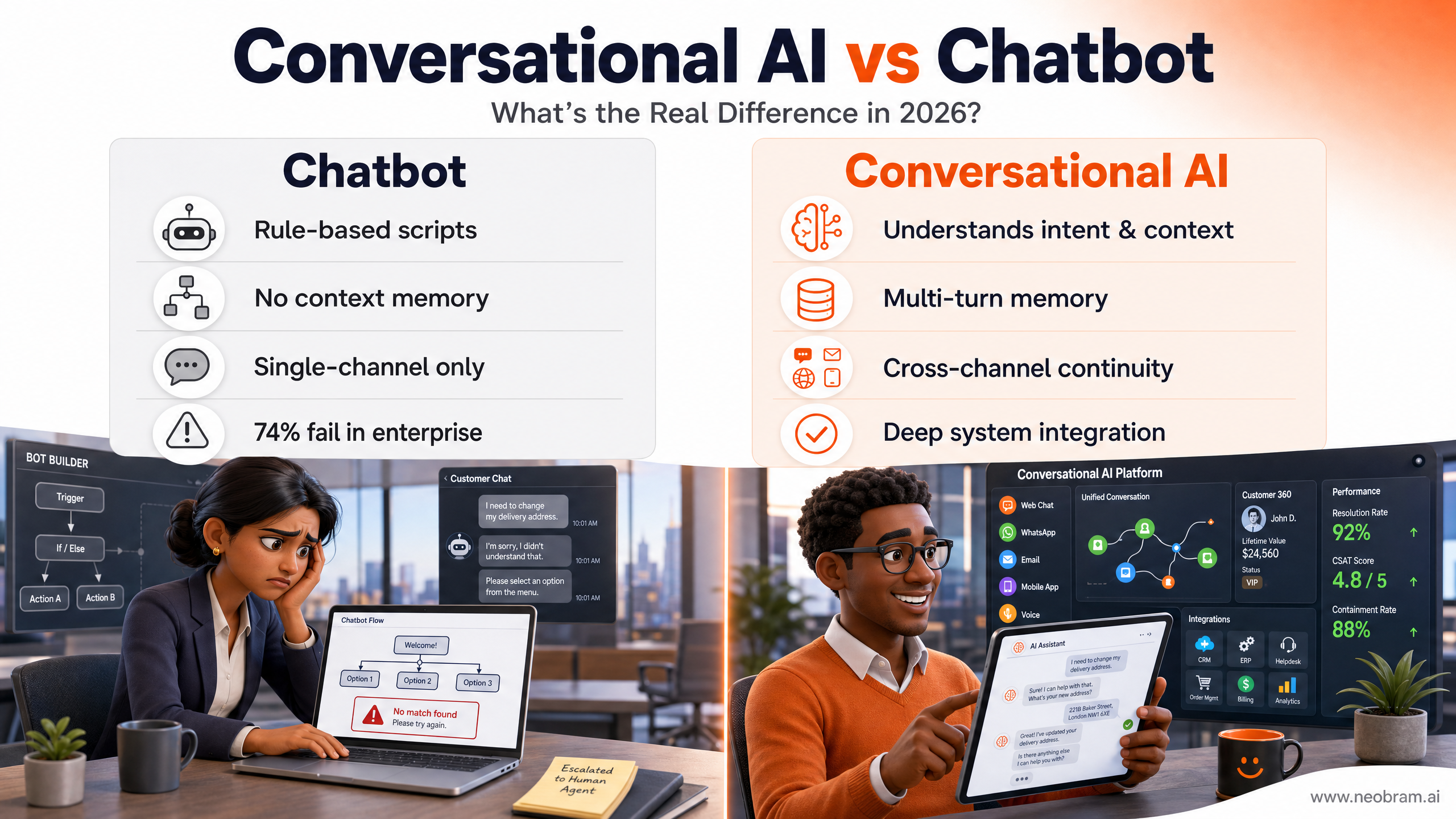
Conversational AI vs Chatbot: What's the Real Difference in 2026?
You've probably seen both terms used interchangeably. A vendor pitches you a "conversational AI solution." Another sells you a "smart chatbot." They both promise to handle customer queries, reduce support costs, and improve satisfaction scores. So what's the actual difference, and why does it matter for your enterprise?
The short answer: every conversational AI system includes chatbot-like functionality, but most chatbots are not conversational AI. The distinction is not just technical. It directly affects what you can automate, how well it works at scale, and what kind of return you'll see on your investment.
This guide cuts through the noise and gives you a clear, practical breakdown of what each technology does, where each one fits, and how to make the right choice for your organisation in 2026.
What Is a Chatbot?
A chatbot is a software program that simulates conversation with users, typically through text. The term covers a wide spectrum, from basic rule-based scripts to sophisticated AI-powered assistants.
Rule-Based Chatbots
The simplest form of chatbot follows a decision tree. You define every possible question, every possible answer, and every possible path through the conversation. If a user types something outside those predefined paths, the bot either fails, shows an error, or dumps the user into a generic fallback response.
These systems are cheap to build and easy to maintain for narrow, predictable use cases. A bot that handles "What are your opening hours?" or "How do I reset my password?" works perfectly well on a rule-based foundation. The problem starts when users deviate from the script.
A 2024 study found that 61% of users report chatbot failure due to the bot not understanding their query, while 43% cite failure to understand natural language. Rule-based chatbots are the primary culprit behind these numbers.
AI-Powered Chatbots
The second category uses natural language processing (NLP) and machine learning (ML) to interpret user intent rather than match exact keywords. These bots can handle variations in phrasing, understand context within a single conversation, and improve over time as they process more interactions.
An AI-powered chatbot is a meaningful step forward from a rule-based system. It can understand that "I can't get into my account" and "login isn't working" mean the same thing. It can handle a broader range of queries without explicit programming for each one.
But even AI-powered chatbots have limits. Most operate within a single channel, handle one task at a time, and lack persistent memory across sessions. They're better than rule-based systems, but they're still fundamentally task-oriented tools.
What Is Conversational AI?
Conversational AI is the broader technology framework that powers truly intelligent, human-like dialogue between machines and people. It combines NLP, ML, large language models (LLMs), speech recognition, and contextual understanding into a system that can hold multi-turn, multi-intent conversations across channels.
The key capabilities that distinguish conversational AI from standard chatbots are:
Context retention across turns. Conversational AI remembers what was said earlier in a conversation and uses that context to shape its next response. If you tell a conversational AI system "I need to change my delivery address" and then follow up with "actually, cancel the whole order," it understands the connection between those two statements.
Intent understanding, not keyword matching. Rather than looking for trigger words, conversational AI models understand the meaning behind what a user says. It can handle ambiguous phrasing, incomplete sentences, and colloquial language.
Multi-channel consistency. A mature conversational AI platform maintains context whether the user switches from a web chat to a mobile app to a voice interface. The conversation doesn't reset.
Action execution. Conversational AI doesn't just respond with text. It integrates with backend systems, CRMs, ERPs, and databases to take real actions: booking appointments, updating records, processing transactions, triggering workflows.
Continuous learning. The system improves with every interaction, refining its understanding of user intent and expanding its ability to handle new scenarios without manual reprogramming.
The global conversational AI market was valued at $14.3 billion in 2025 and is projected to reach $41.39 billion by 2030, growing at a CAGR of 23.7%. Enterprises are not treating this as a chatbot upgrade; they're treating it as a core infrastructure investment.
The Core Differences: A Side-by-Side Comparison
Understanding the distinction becomes clearer when you look at specific dimensions:
| Dimension | Rule-Based Chatbot | AI-Powered Chatbot | Conversational AI |
|---|---|---|---|
| Understanding | Keyword/pattern matching | NLP intent recognition | Deep contextual understanding |
| Context memory | None | Within single session | Across sessions and channels |
| Learning | Static | Improves with retraining | Continuous self-improvement |
| Integration | Limited | Moderate | Deep system integration |
| Handling complexity | Low | Medium | High |
| Setup cost | Low | Medium | Higher |
| Scalability | Limited | Good | Enterprise-grade |
| Failure mode | Falls off-script | Misinterprets edge cases | Graceful escalation |
The table above is useful, but the real difference shows up in production. A rule-based chatbot deployed for IT helpdesk support might handle 30-40% of tickets before hitting its limits. A conversational AI system handling the same use case can resolve 70-80% of tickets autonomously, with intelligent escalation for the rest.
Why Most Enterprise Chatbot Projects Fail
Here's a pattern that plays out repeatedly in enterprise technology deployments. A company buys a chatbot platform, spends three months configuring it, launches it to customers, and then watches the satisfaction scores drop. Users complain that the bot doesn't understand them. Support tickets increase because people abandon the bot and call instead. The project gets quietly shelved.
This happens because the wrong tool was chosen for the job. Rule-based chatbots work well for narrow, predictable interactions. They fail when deployed across a broad range of customer queries in a real enterprise environment where users don't follow scripts.
Research by Sinch found that 74% of enterprise AI chatbots are pulled offline after launch. The most common reason: the bot escalated 70-80% of conversations to human agents, defeating the entire purpose of the deployment.
The failure isn't always a technology problem. Often it's a scoping problem. Teams deploy a chatbot expecting conversational AI results. When the chatbot can't handle the complexity of real customer interactions, the project fails not because chatbots are bad, but because the wrong tool was selected for the use case.
When to Use a Chatbot
Chatbots, including rule-based and AI-powered variants, are the right choice in specific scenarios:
High-volume, low-complexity queries. If 80% of your support volume consists of the same 20 questions, a well-configured chatbot handles this efficiently and cheaply. FAQ bots, order status bots, and appointment schedulers fit this profile.
Structured data collection. Lead capture forms, survey bots, and intake questionnaires work well as rule-based flows. The conversation path is predictable, and deviation is rare.
Budget-constrained environments. A rule-based chatbot can be deployed for $15,000-$30,000. For small businesses or single-use-case deployments, this is often the right starting point.
Proof of concept. If you're testing whether automation can reduce support volume before committing to a full conversational AI platform, a chatbot is a reasonable first step.
The critical point is to match the tool to the task. A chatbot deployed within its appropriate scope delivers real value. The same chatbot deployed outside that scope creates frustration.
When to Use Conversational AI
Conversational AI is the right choice when your requirements exceed what a chatbot can deliver:
Multi-intent, multi-turn interactions. If your customers routinely ask follow-up questions, change their minds mid-conversation, or combine multiple requests in a single session, you need conversational AI. A user who says "I want to upgrade my plan, but first check if I have any outstanding invoices, and actually what's the difference between the Pro and Enterprise tiers?" is having a multi-intent conversation that a chatbot cannot handle.
Cross-channel customer journeys. Enterprise customers interact across web, mobile, voice, and email. Conversational AI maintains context across these channels. A chatbot typically resets with each new session.
Integration with enterprise systems. If the bot needs to pull data from your CRM, update records in your ERP, trigger workflows in your ticketing system, or process transactions in real time, you need conversational AI's integration capabilities.
High-value interactions. In industrial B2B, field-service and plant-support contexts, the cost of a poor interaction is high. Conversational AI's ability to understand nuance, maintain context, and escalate intelligently makes it the appropriate choice when the stakes are significant.
Scale. Conversational AI handles thousands of simultaneous conversations without degradation in quality. If your support volume is high and growing, a chatbot's limitations become a ceiling on your automation potential.
The Role of Large Language Models in 2026
The arrival of large language models has blurred some of the traditional distinctions between chatbots and conversational AI. An LLM-powered chatbot can handle remarkably complex queries, maintain context within a session, and generate nuanced responses that feel genuinely conversational.
This has created a new category: LLM-powered chatbots that behave more like conversational AI but lack the enterprise integration, governance, and reliability features that enterprise deployments require.
For enterprise use, the distinction still matters. An LLM-powered chatbot that generates impressive responses but occasionally hallucinates, lacks audit trails, can't integrate with your systems of record, and has no escalation logic is not a production-ready enterprise tool. Conversational AI platforms built for enterprise contexts add the governance layer, the integration layer, and the reliability layer on top of the underlying language model.
The question in 2026 is not just "does this system understand language?" It's "does this system understand language reliably, integrate with our infrastructure, comply with our data governance requirements, and escalate appropriately when it reaches its limits?"
Industry Applications: Where Each Technology Fits
Customer Service and Support
For tier-1 support handling common queries, AI-powered chatbots deliver strong ROI. For complex customer journeys spanning multiple interactions and channels, conversational AI is the appropriate choice. Enterprises running contact centres at scale typically deploy conversational AI as the primary layer, with rule-based automation handling specific structured workflows within that system.
IT Service Desk
ITSM is one of the strongest use cases for conversational AI. A user reporting a technical issue rarely describes it in structured, predictable language. They say things like "my laptop is being weird since the update" or "Teams keeps crashing when I try to join meetings." Conversational AI interprets these descriptions, maps them to known issue categories, and either resolves them automatically or routes them to the right team with full context.
HR and Employee Experience
Conversational AI in HR handles onboarding queries, policy questions, leave requests, and benefits enquiries across multiple intents in a single conversation. An employee who asks "when does my parental leave start, and can I take some of it as part-time?" is asking two related questions that require context to answer correctly. A chatbot handles the first question. Conversational AI handles both.
Sales and Lead Qualification
AI-powered chatbots work well for initial lead capture. Conversational AI takes this further by conducting genuine qualification conversations, adapting questions based on responses, integrating with CRM to check existing account data, and routing qualified leads to the right sales representative with a full conversation summary.
Plant Operations and Field Service
On a plant floor or at a remote site, an assistant that returns the wrong procedure step is a safety risk, not an inconvenience. Conversational AI that retrieves from controlled SOPs and manuals, cites its source, and escalates when evidence is missing is the appropriate pattern. Audit trails, role-based access and version control matter as much as language quality.
The Cost Equation
The cost difference between chatbots and conversational AI is real, but the ROI calculation often favours conversational AI for enterprise deployments.
A basic rule-based chatbot costs $15,000-$30,000 to build and deploy. An AI-powered chatbot platform costs $50,000-$200,000 depending on complexity and scale. An enterprise conversational AI platform can exceed $500,000 for full deployment.
But the return side of the equation changes the picture. Conversational AI that resolves 70-80% of support tickets autonomously, compared to a chatbot that resolves 30-40%, delivers dramatically different cost savings at scale. For a contact centre handling 100,000 interactions per month, the difference in automation rate translates directly to headcount and operational cost.
Research from Salesforce shows that 74% of companies using AI in customer service report increased revenue, 87% report reduced agent effort, and 92% report time savings in resolving customer issues. These numbers reflect conversational AI deployments, not basic chatbot implementations.
How NeoBram Can Help
Choosing between a chatbot and conversational AI is not just a technology decision. It's a business architecture decision that affects your customer experience, your operational costs, and your ability to scale automation over time.
NeoBram works with enterprise teams to assess their current automation landscape, identify the right technology for each use case, and design conversational AI systems that integrate with existing infrastructure. Our approach starts with your business outcomes, not with a technology pitch.
For organisations already running chatbots that aren't delivering expected results, we conduct a structured audit to identify where the technology is falling short and whether a conversational AI upgrade makes commercial sense. For organisations starting from scratch, we help define the right scope, select the right platform, and build the integration architecture that makes conversational AI actually work in production.
We've deployed conversational AI systems across manufacturing, engineering and enterprise IT environments. The patterns of what works, what fails, and what delivers genuine ROI are consistent across industries. We bring that experience to every engagement.
Book a free strategy call with the NeoBram team to discuss the right conversational AI approach for your organisation.
Key Takeaways
The distinction between chatbots and conversational AI is not a marketing nuance. It's a functional difference that determines what you can automate, how well it works, and what return you'll see.
Rule-based chatbots are the right tool for narrow, predictable, high-volume interactions. They're cost-effective within their scope and fail predictably outside it. AI-powered chatbots extend that scope meaningfully but still operate within session boundaries and lack deep enterprise integration.
Conversational AI handles multi-intent, multi-turn, multi-channel interactions with genuine contextual understanding. It integrates with enterprise systems, learns continuously, and escalates intelligently. It costs more to deploy, but for enterprise use cases with sufficient volume and complexity, the ROI case is clear.
The mistake most organisations make is deploying a chatbot for a conversational AI use case, watching it fail, and concluding that automation doesn't work. The technology works. The selection process is where the gap appears.
In 2026, the conversational AI market is growing at 23.7% annually because enterprises are learning this lesson and investing in the right tool for the job. The question is whether your organisation is ahead of that curve or still working through it.