Key takeaways
- The enterprise RAG market reached $1.94 billion in 2025 and is projected to hit $9.86 billion by 2030 at a 38.4% CAGR.
- Hybrid retrieval (vector + BM25) delivers 15-30% better recall than vector search alone; it is not optional for production systems.
- Databricks reported a 15 percentage point improvement in retrieval accuracy after adding reranking to their vector search pipeline.
- MIT's 2025 GenAI Divide report found 95% of enterprise GenAI pilots fail to reach measurable P&L impact, most due to missing evaluation frameworks.
What Is a RAG System and Why Does It Matter for Enterprise?
Most enterprise AI projects hit the same wall. You deploy a large language model, your team starts using it, and within days someone asks it a question about your internal processes, your latest product specs, or last quarter's compliance policy. The model gives a confident, plausible answer. And it's wrong.
That's the hallucination problem. LLMs are trained on public data up to a cutoff date. They don't know your company's documents, your proprietary databases, or anything that happened after their training ended. Fine-tuning helps, but it's expensive, slow, and requires retraining every time your data changes.
Retrieval-Augmented Generation (RAG) solves this differently. Instead of baking your data into the model, RAG retrieves the right information at the moment a question is asked, then passes it to the LLM as context. The model generates its answer based on your actual, current data, not its training memory.
The enterprise RAG market reached $1.94 billion in 2025 and is projected to hit $9.86 billion by 2030, growing at a 38.4% CAGR (MarketsandMarkets, 2025). This is no longer an experimental technology. It's becoming standard infrastructure for enterprise AI.
The result is an AI system that's grounded in your reality. It can answer questions about your internal knowledge base, cite the exact document it used, and update automatically when your data changes. No retraining required.
This guide walks you through how to implement a RAG system in an enterprise environment, from architecture decisions to production deployment, with the practical detail that most tutorials skip.
The Core Architecture: What a RAG System Actually Does
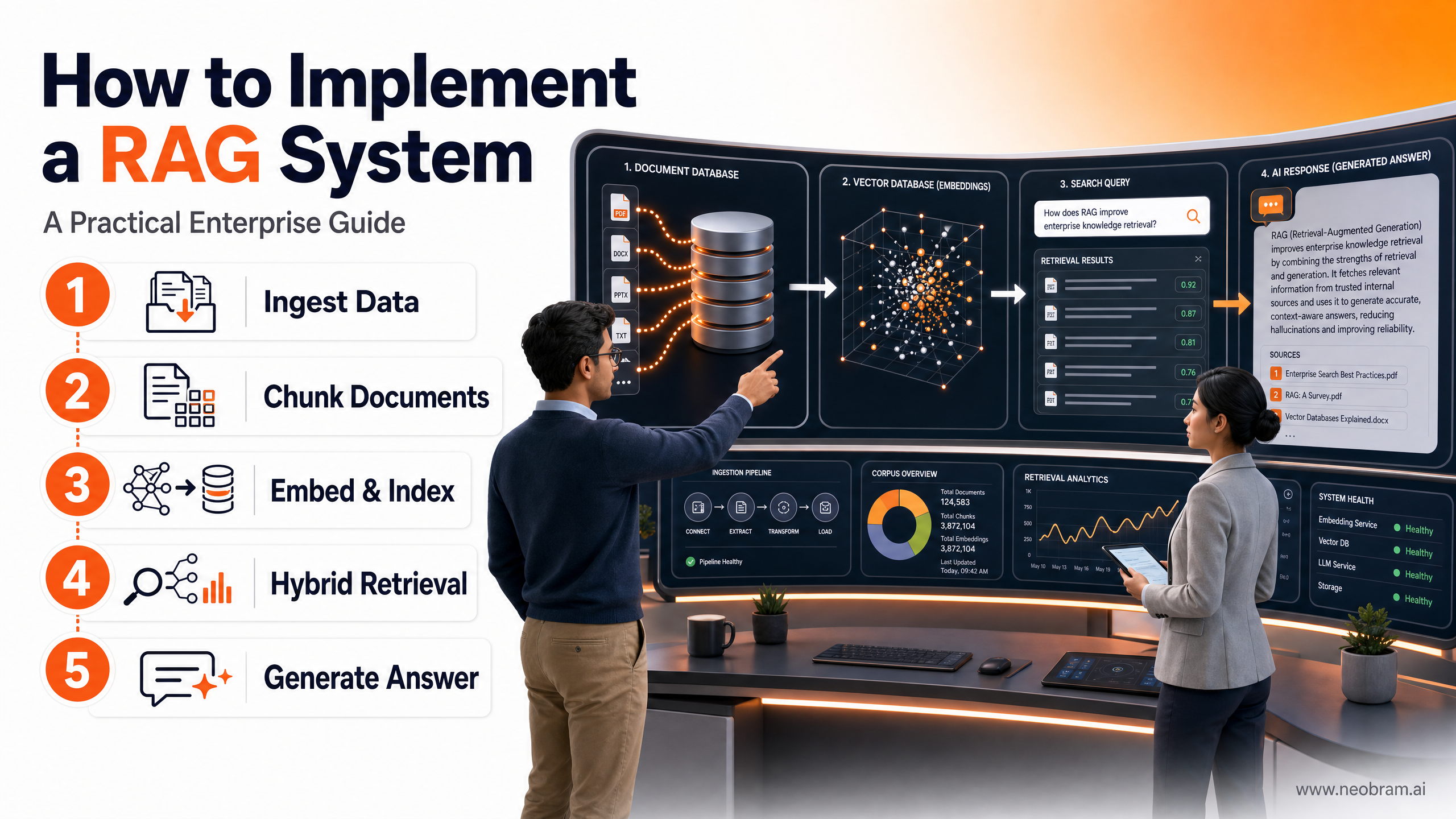
Before you write a single line of code, you need to understand the five stages every RAG system goes through. Each stage has real trade-offs that affect accuracy, cost, and maintainability.
Stage 1: Data Ingestion
Your RAG system needs a knowledge base. That means pulling in documents from wherever your enterprise data lives: SharePoint, Confluence, Google Drive, Jira, Salesforce, internal databases, PDFs, email archives.
The ingestion pipeline fetches this data, cleans it (removing duplicates, formatting noise, and irrelevant content), and prepares it for processing. Push-based ingestion updates the index in real time when documents change. Pull-based ingestion runs on a schedule. Most enterprises start with scheduled pulls and move to event-driven updates as they mature.
Stage 2: Chunking
You can't feed a 50-page PDF directly to an LLM. You break it into smaller pieces, called chunks, that can be retrieved and passed as context.
Chunking strategy matters more than most teams realise. Chunks that are too small lose context. Chunks that are too large waste the model's context window and reduce precision.
Three approaches are common:
Fixed-size chunking splits documents by token count, typically 256 to 512 tokens with a 50-token overlap between chunks. It's simple and predictable but can cut sentences mid-thought.
Semantic chunking splits at natural boundaries: paragraphs, sections, or sentence groups. It preserves context better but creates variable-sized chunks that are harder to manage.
Hierarchical chunking maintains parent-child relationships. You retrieve small, precise chunks but can pull in surrounding context when needed. It's the most accurate approach and the most complex to implement.
Start with fixed-size chunking. Iterate toward semantic or hierarchical once you can measure retrieval quality.
Stage 3: Embedding and Indexing
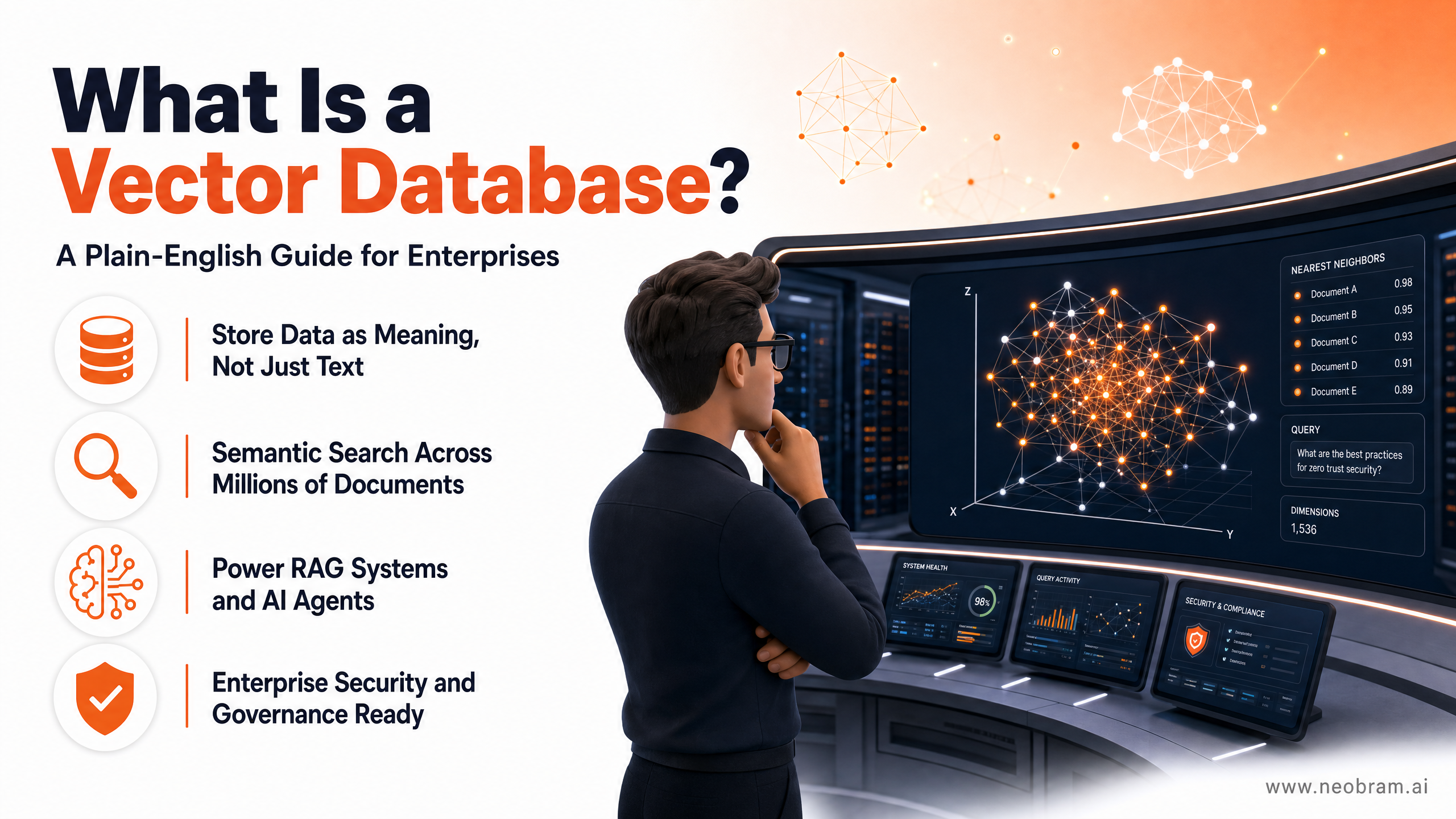
Each chunk is converted into a vector, a numerical representation that captures its semantic meaning. Similar concepts end up close together in vector space. This is what makes semantic search possible.
Your embedding model choice has long-term consequences. Switching models later means re-indexing your entire knowledge base. Popular options include OpenAI's text-embedding-3-large (high accuracy, external API dependency) and open-source models like BGE-M3 or E5-large (self-hosted, better privacy, lower ongoing cost).
These vectors are stored in a vector database: Pinecone, Weaviate, Qdrant, or pgvector if you're already on PostgreSQL. Dedicated vector databases offer better performance at scale. pgvector is fine for smaller deployments.
Stage 4: Retrieval
When a user asks a question, the system converts that query into a vector and searches the index for the most similar chunks. This is where most naive implementations fall short.
Pure vector search works well for conceptual questions but fails for specific identifiers, acronyms, and exact-phrase queries. Production systems use hybrid retrieval: combining dense vector search (semantic similarity) with sparse keyword search (BM25 exact matching), then fusing the results.
VentureBeat data shows enterprise intent to adopt hybrid retrieval tripled from 10.3% to 33.3% in a single quarter of 2025 as RAG programs hit the scale wall. Hybrid retrieval consistently delivers 15-30% better recall than vector search alone on enterprise document sets.
After retrieval, a reranker model reorders the top candidates by deeper relevance before passing them to the LLM. Databricks reported a 15 percentage point improvement in retrieval accuracy on enterprise benchmarks after adding reranking to their vector search pipeline.
Stage 5: Generation
The retrieved chunks are assembled into a prompt alongside the user's question and passed to the LLM. The model generates a grounded answer based on the provided context, not its training data.
Well-designed systems include citations: the model tells you which document or chunk it used. This is critical for enterprise use cases where auditability matters.
Step-by-Step: How to Implement a RAG System
Here's the practical implementation path for an enterprise team building a production RAG system.
Step 1: Define Your Use Case and Success Criteria
Don't start with technology. Start with the question you're trying to answer.
Common enterprise RAG use cases include:
- Internal knowledge base search (HR policies, IT documentation, product specs)
- Customer support automation (answering questions from product manuals and FAQs)
- Compliance and regulatory Q&A (querying policy documents and audit trails)
- Sales enablement (searching contracts, case studies, and pricing documents)
- Engineering documentation search (code comments, architecture docs, runbooks)
For each use case, define what "good" looks like. What accuracy rate is acceptable? What latency can users tolerate? Which documents are in scope? These decisions shape every architecture choice that follows.
Step 2: Audit and Prepare Your Data Sources
Your RAG system is only as good as the data you feed it. Before building anything, audit your knowledge base.
Questions to answer:
- Where does the relevant data live? (SharePoint, Confluence, local file shares, databases)
- How often does it change? (This determines your ingestion strategy)
- Is it structured or unstructured? (PDFs, Word docs, HTML pages, database tables)
- Are there access control requirements? (Who should be able to see what?)
- What's the quality of the data? (Outdated documents, duplicates, and noise degrade retrieval)
Permission-aware retrieval is a non-negotiable for enterprise deployments. Your RAG system should only surface documents that the querying user is authorised to see. This requires syncing access control lists from source systems into your vector index and enforcing them at retrieval time, not just at the UI level.
Step 3: Choose Your Stack
The market has split into three layers. Which one you choose depends on your team's engineering capacity and your timeline.
| Layer | What It Is | Best For |
|---|---|---|
| Turnkey RAG platform | End-to-end product with connectors, indexing, retrieval, and governance | Enterprises that need to ship quickly without a large ML team |
| Cloud RAG service | Managed RAG inside AWS, Azure, or Google Cloud | Teams already standardised on a hyperscaler |
| RAG framework | Vector DB + retrieval libraries you assemble yourself | Engineering teams building custom or customer-facing products |
MIT's 2025 GenAI Divide report found that vendor-partner deployments succeed roughly 67% of the time versus 33% for in-house builds. If your team doesn't have deep ML engineering experience, a platform or cloud service is the pragmatic choice.
For teams building custom systems, LangChain and LlamaIndex are the most widely used frameworks. Both provide abstractions for document loading, chunking, embedding, vector storage, and retrieval chains.
Step 4: Build the Ingestion Pipeline
Your ingestion pipeline is the foundation. Get this wrong and everything downstream suffers.
A production ingestion pipeline does the following:
- Fetches - documents from source systems via connectors or APIs
- Cleans - the data: removes duplicates, strips formatting noise, normalises encoding
- Chunks - documents using your chosen strategy
- Embeds - each chunk using your embedding model
- Stores - vectors and metadata in your vector database
- Schedules - re-ingestion for updated or new documents
Lock in your embedding model before you index significant data. Switching models later means re-embedding everything, which is expensive and time-consuming. If you're using a cloud-hosted model, factor in the ongoing API cost at scale.
Step 5: Implement Multi-Stage Retrieval
Standard semantic search returns high-similarity results that don't always match user intent. Production systems use a multi-stage approach:
Stage 1: Hybrid retrieval. Run both vector search and BM25 keyword search in parallel. Fuse the results using Reciprocal Rank Fusion (RRF) or a weighted combination.
Stage 2: Reranking. Pass the top 50-100 candidates to a reranker model (Cohere Rerank, BGE Reranker v2, or a self-hosted option). The reranker scores each chunk against the query for deeper relevance and reorders the list.
Stage 3: Context assembly. Take the top 3-5 reranked chunks and assemble them into the prompt. Include metadata: document title, source, date, and section heading. This helps the LLM generate more accurate, citable answers.
Step 6: Design Your Prompt Template
The prompt template is the bridge between retrieved context and the LLM. A well-designed template:
- Instructs the model to answer only from the provided context
- Tells the model to say "I don't know" if the context doesn't contain the answer
- Asks the model to cite the source document for each claim
- Sets the tone and format appropriate for your use case
Prompt engineering is iterative. Expect to refine your template significantly during testing.
Step 7: Add Evaluation and Observability
MIT's 2025 GenAI Divide report found that 95% of enterprise GenAI pilots fail to reach measurable P&L impact. The most common reason: teams ship without evaluation frameworks and can't measure whether the system is actually working.
You need to measure retrieval quality and generation quality separately.
For retrieval, track:
- Recall@k: What fraction of relevant documents appear in the top k results?
- Precision@k: What fraction of the top k results are actually relevant?
- Mean Reciprocal Rank (MRR): How high does the first relevant result rank?
For generation, track:
- Faithfulness: Does the answer accurately reflect the retrieved context?
- Answer relevance: Does the answer actually address the question?
- Hallucination rate: How often does the model add information not in the context?
RAGAS is the most widely used open-source framework for RAG evaluation. Integrate it into your CI/CD pipeline so you catch regressions before they reach production.
For observability, trace which chunks drove which answers. When a user reports a bad response, you need to diagnose whether the problem was in retrieval (wrong chunks) or generation (model misinterpreted good chunks).
Step 8: Handle Edge Cases
A production RAG system needs to handle situations that a prototype ignores:
Out-of-scope questions. When the knowledge base doesn't contain the answer, the system should say so clearly rather than hallucinating. Implement a confidence threshold: if retrieval scores are below a minimum, return a "no relevant information found" response.
Multi-hop questions. Some questions require synthesising information from multiple documents. Standard single-stage retrieval struggles with these. Agentic RAG, where the model can issue multiple retrieval queries in sequence, handles this better.
Stale data. Documents change. Your ingestion pipeline needs to detect updates and re-index changed content. Stale data in the index leads to outdated answers.
Large document sets. As your knowledge base grows, retrieval latency increases. Monitor query latency and plan for index optimisation (quantisation, approximate nearest neighbour algorithms) before you hit performance problems.
Common Mistakes That Kill RAG Projects
Most RAG failures are predictable. Here are the ones we see most often.
Skipping data quality. Garbage in, garbage out. If your knowledge base contains outdated documents, duplicates, and poorly formatted content, your retrieval quality will be poor regardless of how sophisticated your architecture is. Invest in data quality before you invest in model selection.
Using vector search only. Pure semantic search misses exact-match queries. Hybrid retrieval is not optional for production enterprise systems.
No reranking. Initial retrieval returns candidates. Reranking selects the best ones. Skipping reranking leaves significant accuracy on the table.
Ignoring permissions. Enforcing access control at the UI level is not enough. If your vector index contains documents from multiple security tiers, you must filter at retrieval time.
No evaluation framework. You can't improve what you can't measure. Ship with evaluation from day one.
Locking in too early. The embedding model and vector database you choose are long-term commitments. Test before you commit to production scale.
RAG vs. Fine-Tuning: When to Use Which
Teams often ask whether they should use RAG or fine-tune their model. The answer depends on what problem you're solving.
| Scenario | RAG | Fine-Tuning |
|---|---|---|
| Data changes frequently | Better: no retraining needed | Worse: requires retraining |
| You need citations and auditability | Better: retrieves source documents | Worse: model doesn't cite sources |
| You need the model to learn new reasoning patterns | Worse: doesn't change model behaviour | Better: changes how the model thinks |
| Budget is constrained | Better: no GPU compute for training | Worse: expensive to train |
| Data is proprietary and sensitive | Better: data stays in your systems | Worse: data must be used for training |
For most enterprise knowledge management use cases, RAG is the right starting point. Fine-tuning makes sense when you need the model to adopt a specific writing style, follow domain-specific reasoning patterns, or work in a highly specialised vocabulary that standard models don't handle well.
How NeoBram Can Help
Implementing a production-grade RAG system requires getting a lot of decisions right: data architecture, embedding model selection, retrieval strategy, permission controls, evaluation frameworks, and ongoing maintenance. Most enterprise teams underestimate the complexity until they're already in the middle of it.
NeoBram has implemented RAG systems across manufacturing, financial services, healthcare, and enterprise IT. We've seen what works at scale and what doesn't. Our approach starts with your specific use case and data landscape, not a generic template.
We help enterprises:
- Audit and prepare - their knowledge base for RAG ingestion
- Design the right architecture - for their data volume, latency requirements, and security posture
- Build or configure - the ingestion pipeline, vector store, and retrieval chain
- Implement evaluation frameworks - so you can measure and improve retrieval quality over time
- Integrate - RAG into existing enterprise systems and workflows
Whether you're starting from scratch or trying to fix a RAG system that isn't performing, we can help you get to production faster and with fewer expensive mistakes.
Getting Started: A Practical Checklist
Before you begin your RAG implementation, work through this checklist:
- [ ] Define the specific use case and success criteria
- [ ] Audit your data sources: location, format, update frequency, access controls
- [ ] Choose your stack: platform, cloud service, or custom framework
- [ ] Select and lock in your embedding model
- [ ] Design your chunking strategy
- [ ] Implement hybrid retrieval (vector + keyword)
- [ ] Add a reranker
- [ ] Build permission-aware retrieval
- [ ] Design your prompt template
- [ ] Set up evaluation with RAGAS or equivalent
- [ ] Add observability: trace which chunks drive which answers
- [ ] Test edge cases: out-of-scope questions, stale data, multi-hop queries
- [ ] Plan for scale: latency monitoring, index optimisation
RAG is not a plug-and-play technology. Done well, it's the foundation for enterprise AI that your teams will actually trust and use. Done poorly, it's another AI project that generates confident wrong answers and erodes confidence in the whole initiative.
The difference is in the implementation details. Get those right, and RAG becomes one of the highest-ROI investments your organisation can make in AI.
Ready to implement a RAG system that actually works in production? Book a free strategy call with the NeoBram team at contact us. We'll review your use case, your data landscape, and give you a clear implementation roadmap.