Key takeaways
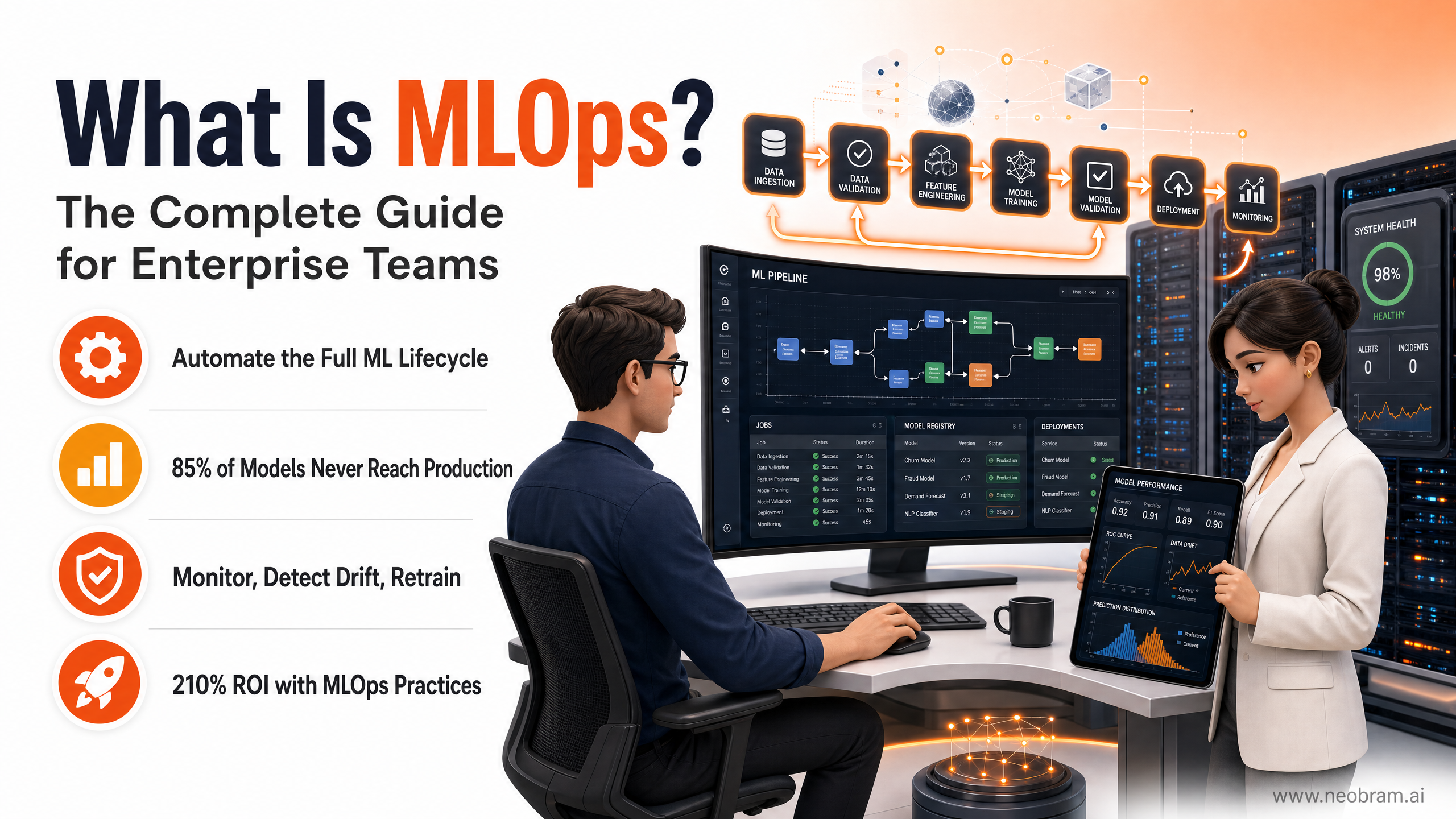
- 85% of machine learning models never make it to production without MLOps.
- Organizations implementing MLOps report 189% to 335% ROI over three years.
- MLOps extends DevOps by managing code, data, and models across the lifecycle.
- Automated retraining prevents model drift from silently killing revenue.
What Is MLOps? The Complete Guide for Enterprise Teams
Most enterprise AI projects don't fail because the models are bad. They fail because no one built a reliable system to get those models into production, keep them running, and update them when the world changes. That's the problem MLOps solves.
If your data science team is spending more time on deployment headaches than on building better models, or if your production models are quietly degrading without anyone noticing, you're dealing with an MLOps problem. This guide explains what MLOps actually is, why it matters for enterprise teams, and how to build a practice that turns machine learning experiments into reliable business assets.
What Is MLOps?
MLOps stands for Machine Learning Operations. It's the set of practices, tools, and cultural principles that bring software engineering discipline to the full lifecycle of machine learning models: from data preparation and training through deployment, monitoring, and retraining.
Think of it as the bridge between data science and production. Without MLOps, a model that performs brilliantly in a Jupyter notebook may never make it into a live system, and if it does, it often degrades silently over weeks or months as real-world data shifts away from what the model was trained on.
The global MLOps market was valued at $3.13 billion in 2025 and is projected to reach $89.18 billion by 2035, growing at a compound annual growth rate of roughly 40%. Yet 85% of ML models still never make it to production. The gap between investment and execution remains the defining challenge of enterprise AI.
MLOps borrows heavily from DevOps, the practice that transformed software delivery by combining development and operations into a single, automated workflow. But machine learning introduces unique challenges that standard DevOps doesn't address: data versioning, model drift, experiment reproducibility, feature consistency between training and serving, and the non-deterministic nature of model outputs.
MLOps vs. DevOps: Key Differences
DevOps is fundamentally code-centric. You write code, test it, deploy it, and monitor it. The artifact is deterministic: the same code produces the same output every time.
MLOps adds a third dimension: data. In machine learning, the output depends not just on the code but on the data used to train the model and the data flowing through it in production. A model that was accurate six months ago may be wrong today because customer behaviour changed, a sensor started drifting, or a supply chain disruption altered the patterns the model learned to recognise.
| Dimension | DevOps | MLOps |
|---|---|---|
| Primary artifact | Code | Code + Data + Model |
| Testing | Unit and integration tests | Code tests + data validation + model evaluation |
| Versioning | Code (Git) | Code + datasets + model weights + configs |
| Monitoring | Uptime, latency, errors | All of the above + model accuracy + data drift |
| Retraining | Not applicable | Triggered by drift or schedule |
| Reproducibility | Deterministic | Probabilistic, requires careful tracking |
Why Enterprise Teams Need MLOps Now
The business case for MLOps is straightforward. Without it, you're leaving significant value on the table and exposing the organisation to real operational risk.
The Production Gap Is Costing You
Research consistently shows that 55% of companies cite inadequate MLOps practices as a major obstacle to deploying ML models. The result is a massive waste: data science teams spend months building models that never reach customers, or that reach production once and are never updated again.
A McKinsey case study found that a large financial institution reduced the time-to-impact of ML use cases from 20 weeks to 14 weeks, a 30% improvement, simply by adopting MLOps and data engineering best practices. When you multiply that across dozens of models, the cumulative impact on competitive speed is substantial.
Model Drift Is a Silent Revenue Killer
Production models degrade. It's not a question of if, but when. Customer preferences shift. Fraud patterns evolve. Equipment wear changes sensor readings. A model trained on pre-pandemic data may perform poorly in a post-pandemic market.
Without continuous monitoring and automated retraining pipelines, you won't know your model has drifted until the business consequences become visible: rising fraud losses, falling recommendation click-through rates, or increasing prediction errors in a manufacturing quality system.
Organizations implementing comprehensive MLOps strategies report 189% to 335% ROI over three years, according to industry research. A Red Hat analysis of MLOps customers found 210% ROI, with infrastructure operations savings of 60% and data scientist time savings of 60%.
Compliance and Governance Are Non-Negotiable
In regulated industries, a model in production is a business decision that needs to be auditable. Who trained it? On what data? When was it last validated? What changed between version 2 and version 3?
Without MLOps, these questions are answered with spreadsheets and tribal knowledge. With MLOps, they're answered with automated audit trails, model registries, and documented lineage from raw data to production prediction.
The MLOps Lifecycle: End to End
Understanding MLOps means understanding the full ML lifecycle and where each component fits.
1. Data Management and Feature Engineering
Everything starts with data. MLOps treats data as a first-class engineering concern, not an afterthought. This means:
- Data versioning: Using tools like DVC (Data Version Control) to version datasets alongside code, so you can always reproduce a training run exactly.
- Feature stores: Centralised repositories that ensure the same features used during training are available at serving time, eliminating training-serving skew.
- Data validation: Automated checks that catch schema changes, unexpected distributions, or missing values before they corrupt a training run.
2. Experiment Tracking
Data scientists run dozens or hundreds of experiments before settling on a model. Without proper tracking, it's impossible to know which hyperparameters produced which result, or to reproduce a promising run from three weeks ago.
MLflow has become the dominant open-source tool for experiment tracking, used by over 55% of production ML teams. It logs parameters, metrics, and artifacts for every run, and its Model Registry provides a central source of truth for model versions and their lifecycle stages: Staging, Production, Archived.
3. CI/CD for Machine Learning
Continuous integration and continuous deployment for ML extends standard software CI/CD to handle the additional complexity of data and model artifacts.
A typical ML CI/CD pipeline looks like this:
- A data scientist commits code or a new dataset is ingested
- Automated tests run: code linting, data validation, schema checks
- The model is trained and evaluated against held-out test data
- If performance exceeds the threshold, the model is promoted to staging
- Integration tests run against the staging environment
- The model is deployed to production, replacing the previous version
Tools like GitHub Actions, GitLab CI, and Jenkins handle the orchestration. Kubeflow Pipelines or AWS SageMaker Pipelines manage the ML-specific steps.
4. Model Deployment
Deployment patterns vary by use case. The main options are:
- REST API serving: The model is wrapped in an API endpoint. Requests come in, predictions go out. Simple, flexible, and the most common pattern for batch and online use cases.
- Batch inference: The model runs on a schedule, processing large datasets and writing predictions to a database or data warehouse.
- Edge deployment: The model runs directly on a device, such as a camera, sensor, or mobile phone, without a round trip to a server.
- Streaming inference: The model processes events in real time from a message queue like Kafka.
5. Monitoring and Observability
Deployment is not the end of the ML lifecycle. It's the beginning of the operational phase.
Effective monitoring covers three layers:
- Infrastructure monitoring: CPU, memory, latency, error rates. Standard DevOps tooling (Prometheus, Grafana) handles this.
- Data quality monitoring: Are the inputs to the model consistent with what it was trained on? Tools like EvidentlyAI and WhyLabs detect distribution shifts and data quality issues.
- Model performance monitoring: Is the model still making accurate predictions? This requires ground truth labels, which may arrive with a delay (for example, a loan default prediction is only validated months later).
72% of enterprises are now adopting automation tools for ML pipelines, and 66% have integrated AI monitoring solutions into their production systems, according to Business Research Insights (2025). Yet only 57% of data leaders report being completely confident in their data quality, highlighting that monitoring remains an unsolved challenge for most organisations.
6. Automated Retraining
When monitoring detects drift or performance degradation, the system should trigger a retraining run automatically. This closes the loop on the ML lifecycle and keeps models current without requiring manual intervention.
The retraining pipeline is essentially the same as the initial training pipeline, with the addition of logic to decide when to retrain (drift threshold, schedule, or data volume trigger) and how to validate the retrained model before promoting it to production.
The MLOps Maturity Model
Not every team needs to implement everything at once. A maturity model helps you understand where you are and what to prioritise next.
Level 0: Manual Process
Data scientists work in notebooks. Deployment is a manual, one-off process. There's no versioning, no automated testing, no monitoring. This is where most ML projects start, and where 85% of them stay.
Level 1: ML Pipeline Automation
Training pipelines are automated. Experiments are tracked. Models are versioned in a registry. CI/CD is partially implemented. The team can reproduce training runs and has a clear record of what's in production.
Level 2: Full CI/CD Automation
Every code or data change triggers an automated pipeline from training through deployment. Model evaluation gates prevent underperforming models from reaching production. Champion-challenger testing is automated.
Level 3: Continuous Monitoring and Retraining
Production models are monitored continuously. Drift detection triggers automated retraining. Feature stores ensure consistency. The team can run dozens of models in production without proportional increases in operational overhead.
Level 4: LLMOps-Ready
Multi-model orchestration with guardrails. Prompt versioning and A/B testing. Cost optimisation across inference endpoints. Governance and compliance built into every stage of the pipeline.
Most enterprise teams in 2026 sit between Level 1 and Level 2. Getting from Level 0 to Level 2 delivers the highest ROI and is the right first target for most organisations.
Core MLOps Tools in 2026
The MLOps tooling landscape has matured considerably. Here's a practical overview of the key categories:
| Category | Leading Tools | Use Case |
|---|---|---|
| Experiment tracking | MLflow, Weights & Biases, Neptune | Log parameters, metrics, artifacts |
| Data versioning | DVC, LakeFS, Delta Lake | Version datasets and pipelines |
| Feature stores | Feast, Tecton, Vertex AI Feature Store | Consistent features across train/serve |
| Pipeline orchestration | Kubeflow, Airflow, Prefect, Metaflow | Automate ML workflows |
| Model registry | MLflow Model Registry, SageMaker Model Registry | Version and stage models |
| CI/CD | GitHub Actions, GitLab CI, Jenkins | Automate build, test, deploy |
| Monitoring | EvidentlyAI, WhyLabs, Arize | Detect drift, track performance |
| Serving | BentoML, Seldon, TorchServe, SageMaker | Deploy models as APIs |
| Infrastructure | AWS SageMaker, GCP Vertex AI, Databricks | Managed ML platforms |
The right stack depends on your existing infrastructure, team size, and maturity level. Starting with MLflow for experiment tracking and GitHub Actions for CI/CD is a low-friction entry point that delivers immediate value.
Common MLOps Mistakes Enterprise Teams Make
Treating MLOps as a Tool Problem
MLOps is not primarily about tools. It's about process and culture. Teams that buy an expensive MLOps platform without changing how data scientists and engineers collaborate will not see the results they expect.
The most important change is organisational: data scientists, ML engineers, and operations teams need to work together from the beginning of a project, not hand off artifacts at the end.
Skipping Monitoring
Many teams invest heavily in training and deployment pipelines but neglect monitoring. This is the equivalent of deploying software and never looking at the logs.
Model monitoring is not optional. It's the mechanism by which you learn that your model is still working, and the early warning system that tells you when it isn't.
Over-Engineering from Day One
A team that has never deployed a model in production does not need a Kubernetes-native, multi-cloud MLOps platform on day one. Start with the simplest thing that works: MLflow for tracking, a basic CI/CD pipeline, and a REST API for serving. Add complexity as you understand your actual needs.
Ignoring Data Quality
The most sophisticated model training pipeline is worthless if the data going in is unreliable. Data validation and quality monitoring should be the first thing you build, not the last.
MLOps for LLMs: What Changes
The rise of large language models has introduced a new set of operational challenges that extend traditional MLOps into what practitioners are calling LLMOps.
The core principles remain the same: version everything, automate everything, monitor everything. But several things are genuinely different:
- Prompts are code: Prompt templates need version control, testing, and A/B experimentation. A prompt change can have as much impact as a model change.
- Evaluation is harder: LLM outputs are often open-ended text. Defining and measuring quality requires specialised evaluation frameworks, not just accuracy metrics.
- Cost management matters: A single LLM inference can cost 100 times more than a traditional ML prediction. Optimising token usage, caching, and routing is an operational necessity.
- Guardrails are infrastructure: Input and output filtering, toxicity detection, and hallucination mitigation are not optional features. They're part of the serving infrastructure.
The good news is that teams with strong MLOps foundations adapt to LLMOps much faster than those starting from scratch. The discipline of versioning, monitoring, and automation transfers directly.
How NeoBram Can Help
Building an MLOps practice from scratch is a significant undertaking. Most enterprise teams face the same challenges: data science talent that's focused on modelling rather than operations, engineering teams unfamiliar with ML-specific requirements, and leadership that wants production AI without understanding what it takes to get there.
NeoBram works with enterprise teams across manufacturing, pharmaceuticals, oil and gas, and financial services to design and implement MLOps practices that match their actual scale and maturity. We don't sell platforms. We help you build the processes, pipelines, and team structures that make AI a reliable part of your operations.
Our approach starts with an honest assessment of where you are today: what models you have in production, how they're monitored, and what the biggest gaps are between your current state and a production-grade MLOps practice. From there, we build a roadmap that delivers quick wins while laying the foundation for long-term scale.
Whether you're trying to get your first model into production reliably, or you're managing dozens of models and need to reduce operational overhead, we can help you move faster and with more confidence.
Book a free strategy call at https://neobram.ai/contact to talk through your specific situation.