

01
Usage is visible. Value is harder to prove.
Tool adoption and more code do not tell you whether accepted work moves faster, with less review and rework.
For US, UK and European companies with engineering teams in India
AI SDLC
01 / The leadership question
Does your India team use AI across the lifecycle, or mainly to write code? Can you see the effect on accepted delivery?
Tool adoption and more code do not tell you whether accepted work moves faster, with less review and rework.
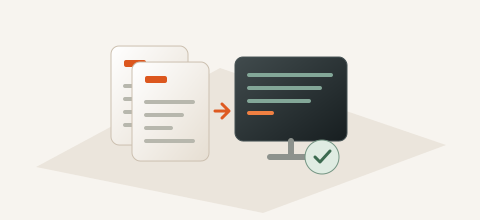
Requirements, domain knowledge and architecture decisions get explained again. Useful AI practices stay with individuals.
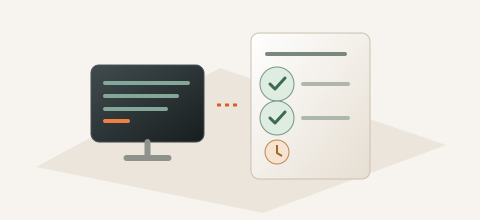
The next bottleneck may be a reviewer, an unclear acceptance criterion or missing test evidence.
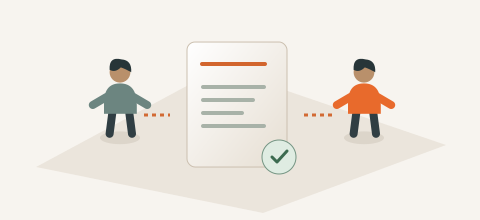
Messages, tickets and status slides need manual reconciliation. Headquarters sees the update without the delivery evidence.
02 / Less status chasing
Bring completion, forecast dates, testing, reviews and blockers into one view. Scope automatic updates from your delivery systems, with human corrections that keep the original observation and an audit trail. Trace each reported status back to requirements, code, tests and acceptance evidence.
Project / Neobram project
Proposed project-scoped capability. Connectors, automatic updates and human-edit permissions would be configured and verified for your environment.
Completion · accepted scope
67%8 of 12 agreed requirements acceptedAcceptance-based scope completion. Requirements are equally counted; this is not effort or code completion.Projected completion
19 Oct–23 Oct 2026Illustrative estimateBased on the sample acceptance history and assumptions below.Inspect forecast basisTesting progress
75%60 of 80 planned cases executedExecution progress, not code coverage or a release-readiness score.Delivery blockers
2 openEvidence and approval still neededTarget-device test evidence is missing from the connected source. Security review is still required for the event-history change.See source traceRequirement → code and review → tests → owner acceptance
Three sample records from the 12-requirement scopePassing tests do not mean accepted.
Forecast basis · synthetic example
Four remaining requirements of comparable size; illustrative history of 2–3 accepted per week; unchanged scope; device evidence available by 12 October. Re-estimate if those assumptions change.
An estimated window, not a delivery commitment. A real project without sufficient history would show ‘Insufficient evidence to forecast’.
Human correction · OVR-004
Working status only. Acceptance remains pending and the completion percentage is unchanged.
Preserve the source record. Attribute the correction, review conflicts on the next sync, and restrict edits to authorised roles.
Requirement: a support user can view device status but cannot edit access roles. Approved criterion: permissions are enforced server-side.
Code and review: PR #128 changes the server-side permission check and its role-access tests. The engineering lead reviewed the diff and recorded approval before merge.
Verification: completed build #642 records the role-access unit and integration-test results for that change. This evidence verifies the stated criterion; it does not establish full product test coverage.
Acceptance: the product owner checked that evidence against the approved requirement and recorded acceptance at 09:22 UTC. This record contributes one accepted requirement to the 8/12 completion count.
All identifiers, numbers and records here are synthetic. These links open example evidence on this page. In a configured project they would open permitted source records. This illustration is not a live integration or a customer result.
Proposed capability, illustrated with synthetic data. Completion is the share of agreed requirements with recorded owner acceptance. Testing and forecasts have their own stated scope. Connected systems, refresh intervals, permissions and correction rules are agreed and verified for each project.
03 / From adoption to a working system
NeoBram assesses the current practice, works alongside your engineers and builds project-specific skills, agents and integrations around the work you actually deliver.
01 / The engagement
We sit with your team and examine real tasks, existing tools, skills, bottlenecks and data constraints. Establish what is happening before recommending changes.
02 / The engagement
Hands-on practice in approved tools, using your project. Teach teams how to give context, check outputs and escalate uncertainty.
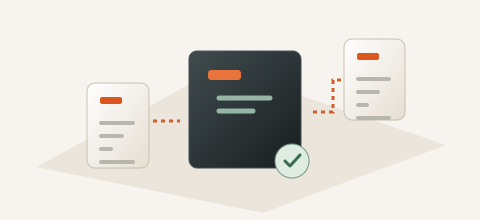
03 / The engagement
Encode domain terms, requirements, architecture, conventions and commands in versioned skills. Give agents bounded tasks and explicit review gates.
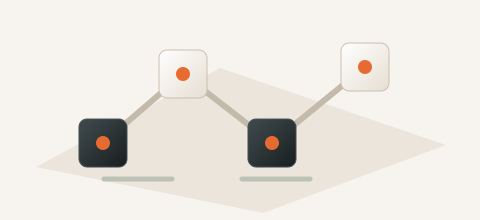
04 / The engagement
Connect backlog, repositories, reviews, tests and CI/CD where supported. Agree the integration scope, permissions and source of truth first.
05 / The engagement
Scope a project dashboard for completion, forecast dates, testing, reviews and blockers. Connect status to requirements, code and acceptance evidence, with automatic refresh and audited human corrections where supported.
06 / The engagement
Leave versioned assets, evaluation tasks, an operating guide and trained maintainers. Review what changed against the starting baseline.
04 / AI across the SDLC
Carry approved requirements, source references and outstanding decisions through each handoff. Stop rebuilding the project context at every step.
Requirements and acceptance criteria
Analysis, design and decisions
Context-aware implementation
Human review and risk checks
Tests, builds and evidence
Approval and release record
Runbooks, owners and open issues
People approve the consequential steps. Named owners approve scope, material changes, acceptance and releases. Permissions and delivery systems enforce boundaries; prompts alone do not.
05 / Measure what changes
Compare representative, comparable work before and after the pilot, or use a comparison group where practical. Include the work needed to check and correct AI output.
Lead time for comparable work and time spent waiting.
Implementation, review, testing and rework together.
Acceptance evidence, regressions and escaped defects.
Tool and operating cost, alongside the effort observed.
Report observed differences with their scope and limitations. More code, tokens or AI usage is not a productivity result. Time released is not automatically cash saved.
06 / Make the boundaries explicit
Agree the allowed data, model endpoints, processing locations, access and retention before connecting the workflow.
Selected context may be sent to approved AI providers. Examine every IDE, model endpoint, connector and logging path, including processing and retention terms.
No training does not mean no data transfer.
Separately scoped models and components run inside the agreed environment. External calls must be disabled or blocked, and the end-to-end path verified.
Customer-hosted context alone does not make processing local.
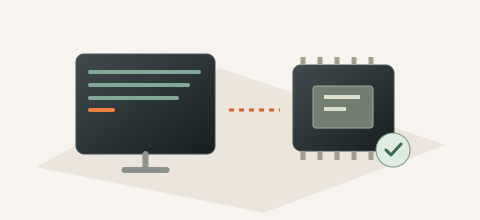
Illustrative software-to-device workflow
Beyond browser-based software
Extend the approach to embedded firmware and hardware-integrated software, with device constraints, target-test evidence and specialist review scoped to the project.
Host tests alone do not verify device behavior. Physical hardware design is outside this engagement.
Before you begin
AI SDLC applies AI-assisted workflows across the software development lifecycle: requirements, analysis and design, implementation, review, testing, release and handover. The goal is a repeatable delivery process with appropriate human decisions and traceable evidence.
Yes. The engagement can bring product owners, engineering leaders and the India delivery team around one real project, shared requirements and reviewable evidence. Working arrangements, availability and any onsite sessions are agreed during scoping.
Not necessarily. We assess the tools and development systems already in use, then agree what to keep, connect or change. Supported integrations, permissions and model choices depend on your environment and security requirements.
Agree a baseline and compare representative, comparable work. Include review and rework, delivery lead time, quality and operating cost. Report observed changes and limitations. AI usage, generated code and tokens are not a measure of accepted delivery or guaranteed savings.
That is the proposed workflow: supported connectors refresh observations from requirements, repositories, reviews and test systems; authorised people can correct the working view with a reason, owner and timestamp. The original observation stays visible, and conflicting updates are reviewed. Connector coverage, refresh intervals, access and audit rules are scoped and verified for your project. This campaign shows an illustrative dashboard, not a live connected product.
That depends on the selected setup. Approved enterprise AI providers may process selected context outside your environment. A local or offline setup must be separately scoped and verified end to end, including IDEs, model endpoints, connectors, logs and network controls. A no-training policy does not mean no data transfer.
Yes, within the agreed project scope. Firmware and device-connected software require device constraints, specialist review and target-test evidence. Host-side tests alone do not verify device behavior. This engagement does not promise physical hardware design.
Start with one real project
Discuss where delivery slows down, how your team uses AI today and what evidence would justify wider adoption.
No confidential source code needed for the first conversation.
Opens Cal.com. A link click does not confirm a booking.