Key takeaways
- Shift handover periods account for less than 5% of operational time, yet 40% of all plant incidents occur during or immediately after them, according to the American Fuel and Petrochemical Manufacturers (AFPM).
- Poor shift handover communication costs industrial manufacturers an estimated $50 billion annually in lost productivity, safety incidents, and equipment damage (AFPM / UK Health and Safety Executive).
- Verbal handovers miss 40–60% of actionable information. Paper logbook review and briefings consume 15–30 minutes per transition — AI-generated summaries reduce this to under 3 minutes (iFactory, 2026).
- Organizations implementing digital AI-powered shift handover platforms report up to 76% fewer miscommunication-related incidents and a typical ROI period of 4 to 6 months (iFactory, 2026).
The Most Dangerous 20 Minutes in Manufacturing
In 24/7 manufacturing operations, the shift handover is the critical bridge between one team's reality and the next team's responsibility. Yet, despite its importance, many facilities still rely on methods that have not changed in decades: handwritten logbooks, whiteboards, or hurried verbal briefings conducted by operators at the end of a 12-hour shift.
The consequences of this analog approach are measurable and severe. The American Fuel and Petrochemical Manufacturers (AFPM) notes that while start-up, shutdown, and shift handover periods account for less than 5% of an operation's staff time, a staggering 40% of plant incidents occur during this time. Every second incident in the process industry is related to communication errors during shift handovers. Poor shift handover communication costs industrial manufacturers an estimated $50 billion annually in lost productivity, safety incidents, and equipment damage.
When a night shift encounters an equipment issue that slows production but fails to properly document it, the morning team starts their shift blind. KPIs drop, delivery timelines suffer, and frustration spreads across teams. In the worst cases, these communication failures lead to catastrophic safety incidents.
Key Statistic: Shift handover accounts for less than 5% of operational time, yet 40% of all plant incidents occur during or immediately after it. Every second industrial accident in the process industry is linked to shift handover communication errors (AFPM / UK Health and Safety Executive).
The Lessons History Has Not Yet Learned
The consequences of poor shift handover are not theoretical. On 6 July 1988, a technician ending his shift on the Piper Alpha offshore platform was unable to speak directly with the incoming custodian. He left a note stating that a key pump was under maintenance and must not be restarted. Hours later, the second pump failed. The operations team, searching for restrictions on using the first pump, did not see the note. They restarted the offline pump, triggering a chain of events that killed 167 people in the deadliest offshore oil disaster in history.
The 2005 BP Texas City refinery explosion, which killed 15 workers and caused $1.5 billion in losses, also involved rushed and incomplete shift handovers. The 2014 DuPont La Porte toxic gas release, which killed four workers, occurred because shift instructions about a hazardous blockage were communicated only verbally, leaving the night shift team without the critical information needed to handle the situation.
Thirty-seven years after Piper Alpha, a 2025 analysis by Hexagon Asset Lifecycle Intelligence found that shift handover failures continue to feature prominently in incident reports and safety investigations. The problem is not a lack of awareness. It is a lack of the right tools and processes to ensure consistent, complete information transfer at every shift change.
Why Traditional Handovers Fail Structurally
Traditional shift handovers share a fundamental structural flaw: they depend on an exhausted outgoing crew to manually record operational context at the end of a 12-hour shift. This creates predictable failure modes that no amount of training or policy can fully overcome.
Information Loss at the Source: Outgoing operators, tired after a full shift, forget critical details. Verbal handovers miss 40–60% of actionable information. Illegible handwriting and lost pages create permanent knowledge gaps. The information that fails to transfer is often the most important: the near-miss that happened at 3 AM, the machine that has been running slightly hot for two days, the maintenance task that was deferred but not formally documented.
Time Pressure and Fatigue: Physical logbook review, verbal briefings, and Q&A sessions typically consume 15–30 minutes per handover. Research by Wilkinson and Lardner, revisiting the Buncefield disaster, recommended that a handover on a 12-hour shift may last up to 30 minutes for complex operations. In practice, most facilities allocate far less. The UK Health and Safety Executive (HSE) recommends handovers be face-to-face, two-way, and given as much time and resource as necessary — a standard that paper-based processes rarely meet.
Compliance and Audit Exposure: Paper logs cannot be easily audited, searched, or enforced. In regulated industries, incomplete documentation is a leading cause of non-compliance. When a regulator or quality auditor asks what happened at 2:47 AM on a specific date, the answer from a paper system is often "we cannot be certain."
No Accountability Loop: Without timestamped, attributed entries, it is nearly impossible to track who knew what and when. Open issues do not automatically carry forward. The incoming shift discovers problems by running into them, after production has already been impacted.
| Handover Method | Information Capture | Transition Time | Audit-Ready | Accountability |
|---|---|---|---|---|
| Verbal Only | 40–60% loss | 5–10 min | No | None |
| Paper Logbook | 60–70% capture | 15–30 min | No | Low |
| Basic Digital Form | 70–80% capture | 10–20 min | Partial | Moderate |
| AI-Powered Digital | Near 100% | Under 3 min | Full | Complete |
*Source: iFactory Industry Data (2026)*
How AI Is Transforming the Shift Handover
To address these systemic issues, leading manufacturers are adopting AI-powered digital shift handover platforms. These systems move beyond simply digitizing paper forms. They use artificial intelligence to structure, summarize, and surface critical information automatically — removing the dependency on an exhausted operator to do it manually.
Real-Time Event Logging and Context Capture
Instead of waiting until the end of the shift to reconstruct what happened, operators use mobile devices to log events as they occur: equipment alarms, production changes, maintenance actions, and safety observations. Every entry is timestamped, attributed, and searchable. Operators can attach photos, videos, and voice memos, providing context that paper never could.
AI-powered voice-to-text capabilities allow workers to capture detailed observations hands-free, even in noisy factory environments. The system understands technical terminology and adjusts for ambient noise, ensuring that the critical observation made at 4 AM is captured accurately rather than forgotten by shift end.
AI-Generated Shift Summaries
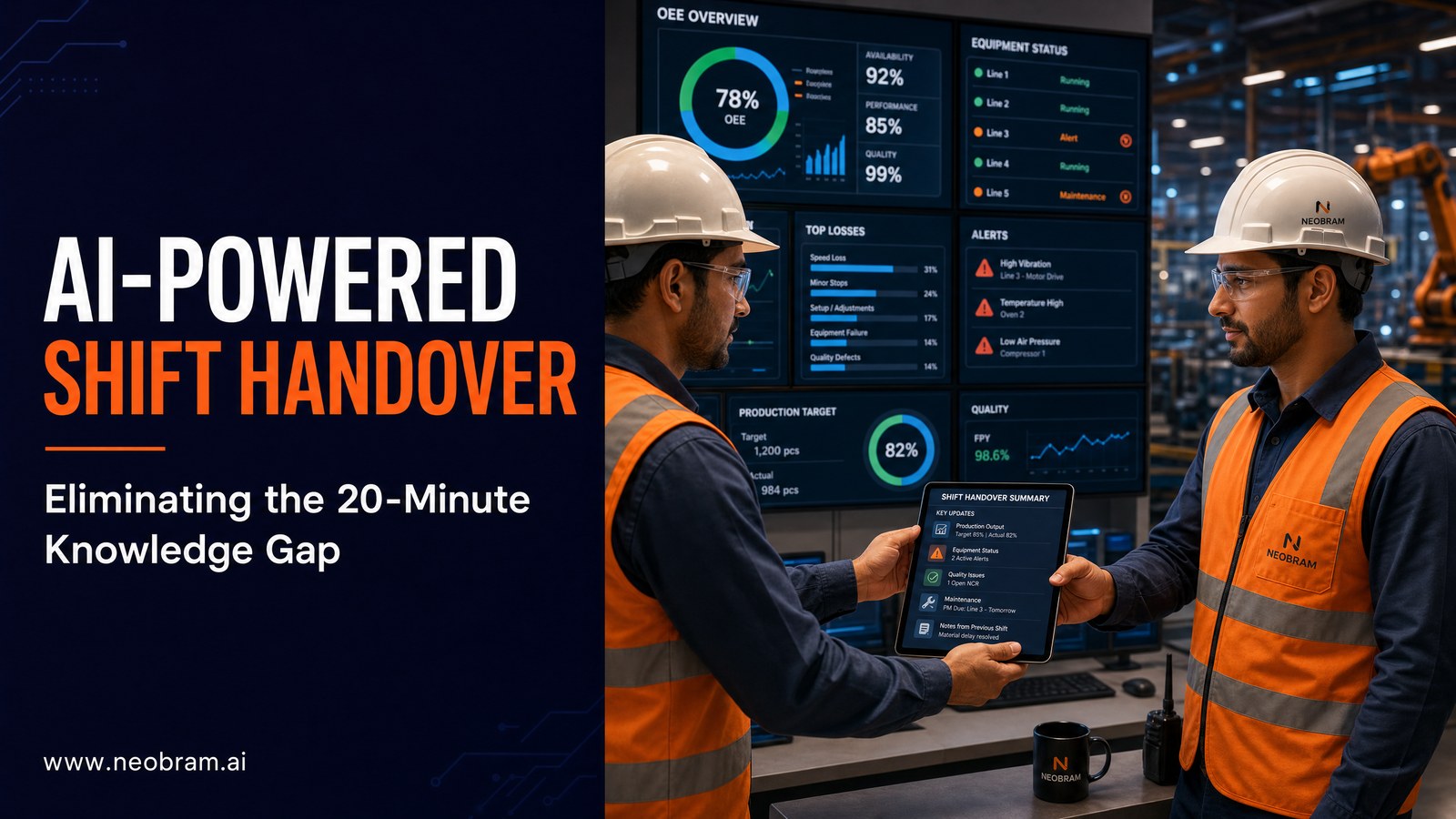
The most significant breakthrough is the use of Generative AI to create the handover report itself. Rather than asking a tired supervisor to compile notes, the AI analyzes all data logged during the shift — including operator rounds, work orders, inspections, and exception reports — and automatically generates a structured, prioritized summary. The incoming shift lead reads a clear brief highlighting the top issues, completed tasks, open work orders, and equipment flags, and acknowledges it with an electronic signature before tasks are assigned.
Handovers that previously took 20 minutes can now be completed in under three minutes. SAP Digital Manufacturing has implemented this capability within its platform, using Generative AI to extract shift data via public APIs and produce dynamic, easily consumable shift reports delivered to supervisors' mobile devices. The AI goes beyond basic reporting to spot trends and patterns, offering insights on top of the shift data that no human reviewer would have time to identify.
Live Equipment Status and System Integration
Digital handover platforms integrate directly with existing CMMS, MES, and ERP systems. The incoming shift has full visibility into live equipment status before they step onto the floor. Every machine's status — running, down, under repair, flagged for watch — is visible in real time. When equipment goes down or comes back online, the digital board updates instantly. The incoming supervisor no longer discovers a critical machine is offline by walking up to it. They already know, with full context on when it went down, what caused it, and what action is in progress.
This integration also eliminates the data silo problem that plagues standalone handover tools. When a shift log entry flags a machine issue, a work order is created automatically in the CMMS. When a work order is completed during a shift, it is auto-logged in the handover report. Equipment status, open maintenance tasks, and safety alerts flow between the logbook and the CMMS without manual data entry.
Cross-Shift Trend Analysis and Continuous Improvement
Once data accumulates across shifts, AI can identify recurring issues that human operators would miss in the day-to-day flow of operations. The system might detect that a specific piece of equipment consistently fails on the night shift, or identify safety observations that frequently precede incidents. This cross-shift intelligence transforms the logbook from a simple record-keeping tool into a driver of continuous improvement.
One pharmaceutical manufacturer reduced downtime by 30% and saved €66,000 annually at a single facility after implementing digital shift logging with full traceability integrated into their SAP environment. The cross-shift AI layer identified a recurring pattern of equipment degradation that was invisible when each shift was reviewing only its own data.
Measuring the ROI of Digital Shift Handovers
The business case for digitizing shift handovers is compelling, with organizations consistently reporting rapid returns on investment across multiple dimensions.
| Metric | Improvement with AI-Powered Digital Handover |
|---|---|
| Transition Time | Reduced by up to 50% (from 20+ minutes to under 3 minutes) |
| Incident Rate | Up to 76% fewer miscommunication-related incidents |
| Information Capture | Near 100% vs. 40–60% loss in verbal handovers |
| Annual Savings | Average $1.2M from missed handovers caught before becoming losses |
| Typical ROI Period | 4 to 6 months |
| Productivity Improvement | Up to 25% from better internal operational communication |
*Source: iFactory and Innovapptive Industry Data (2026)*
Innovapptive, recognized by Frost & Sullivan as a leader in the 2025 Frost Radar for Augmented Connected Worker Platforms, reports that its customers save an average of $1.2M annually from missed handovers caught before they become production losses or safety incidents. The platform is trusted by over 20,500 shift workers across chemicals, oil and gas, mining, and manufacturing.
One automotive plant calculated $840,000 in annual savings from eliminating duplicated troubleshooting caused by information loss at shift change alone — a single line item that justified the entire platform investment.
Best Practice: When evaluating digital shift handover platforms, prioritize real-time capture over end-of-shift entry. Any system that depends on someone reconstructing the shift from memory at the end of 12 hours will reproduce the same failure modes as paper. The system must log events as they happen.
A Practical Implementation Framework
Successfully deploying an AI-powered shift handover system requires a structured approach that addresses both the technical and human factors involved in change management.
Phase 1 — Map Information Needs: Define the critical information categories each incoming crew needs: equipment status, open work orders, safety flags, production targets, and ongoing issues. Do not simply copy the old paper form into a digital template. Conduct structured interviews with incoming shift leads to understand what information they actually need to start their shift safely and productively.
Phase 2 — Deploy Mobile-First with Offline Capability: Ensure the platform is accessible on tablets and mobile devices with offline capabilities, so operators can log entries directly from the plant floor regardless of network connectivity. Data should sync automatically when connection resumes. Any tool that requires desktop access or weeks of training will not survive a 24/7 rotating shift schedule.
Phase 3 — Mandate Acknowledgment: Configure the system to require incoming shift leads to electronically review and sign the AI-generated handover report before accessing their task list. This single step eliminates the "I didn't know" problem permanently and creates a complete audit trail of who received what information and when.
Phase 4 — Integrate with Systems of Record: Connect the handover platform bidirectionally with your CMMS and MES to avoid creating a new data silo. When a log entry flags a machine issue, a work order should be created automatically. When a work order closes, it should appear in the handover report. The handover system should be an overlay on existing infrastructure, not a replacement.
Phase 5 — Activate AI Trend Analysis: Once data has accumulated across several weeks of shifts, activate AI-powered pattern recognition to identify recurring issues. This is where digital handover systems transition from record-keeping to continuous improvement, and where the most significant long-term value is realized.
The Shift Handover Is a Strategic Asset
The shift handover has historically been treated as an administrative task — a necessary but low-value transition between crews. AI is changing this. When every shift transition is captured, structured, and analyzed, the accumulated data becomes a strategic asset: a real-time picture of operational health, a source of continuous improvement insights, and a compliance record that protects the organization.
More fundamentally, as experienced operators retire and take their institutional knowledge with them, the shift logbook becomes one of the primary mechanisms for capturing and preserving operational intelligence. The patterns that a 25-year veteran notices and logs during their shift — the subtle changes in equipment behavior, the workarounds that prevent recurring problems — are exactly the kind of tacit knowledge that AI can help capture, analyze, and make available to the next generation of operators.
The manufacturers who invest in AI-powered shift handover today are not just eliminating a 20-minute knowledge gap. They are building the operational intelligence infrastructure that will define their competitive position for the next decade.
References
[1] iFactory. "How Digital Shift Logbooks Improve Shift Handover in Manufacturing." *iFactory*, 5 March 2026, https://ifactoryapp.com/shift-logbook/digital-shift-logbook-shift-handover
[2] Innovapptive. "Digital Shift Handover: 5 Ways to Close Gaps and Cut Downtime (2026)." *Innovapptive*, 18 December 2024, https://www.innovapptive.com/blog/5-hacks-for-seamless-digital-shift-handovers-to-enhance-operational-continuity
[3] Hexagon Asset Lifecycle Intelligence. "37 Years After Piper Alpha: Why Are Shift Handovers Still Commonly Mishandled?" *Hazardex*, 4 July 2025, https://www.hazardexonthenet.net/article/216491/37-years-after-Piper-Alpha--why-are-shift-handovers-still-commonly-mishandled-.aspx
[4] SAP Community. "Generative AI in Manufacturing: Shift Report Using AI Use Case." *SAP Community*, 17 October 2023, https://community.sap.com/t5/product-lifecycle-management-blog-posts-by-sap/generative-ai-in-manufacturing-shift-report-using-ai-use-case/ba-p/13580216