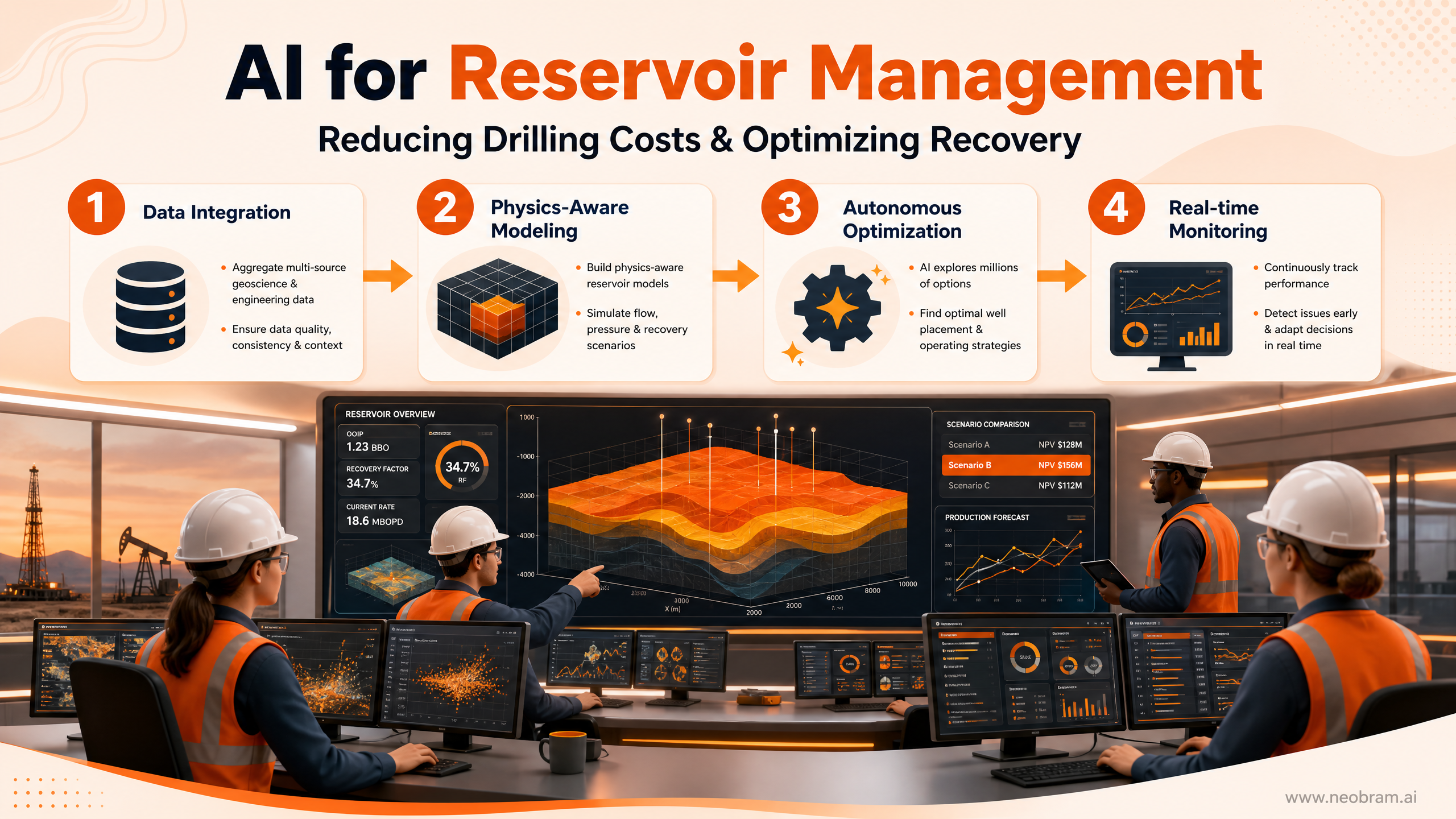

Key takeaways
- Start with a bounded surveillance decision, such as prioritising a review of an unusual pressure or flow pattern, rather than asking AI to control a well or facility.
- Combine time-aligned measurements with asset identity, operating context, maintenance history and known changes so that a signal is not mistaken for a conclusion.
- Separate normal variation, data-quality failure, investigation required and urgent escalation into explicit workflow outcomes.
- Keep the source system and accountable operations or integrity personnel in control of official decisions, work approval and safety-critical actions.
- Well integrity, emissions, reporting, data transfer and cross-border delivery obligations are jurisdiction- and operation-specific and require qualified professional review.
Upstream signals need context before they need a model
Upstream teams work with measurements that change with operating state, equipment configuration, well conditions, intervention history and environmental context. Pressure, flow, temperature, vibration, valve position and alarm records can each be useful, but an isolated change is not automatically a well-integrity failure or a production opportunity.
AI is most useful when it helps people organise evidence, identify patterns worth reviewing and prepare a consistent investigation package. It should not be presented as an autonomous well-control authority or as a replacement for approved operating, integrity, maintenance or emergency procedures.
This guide describes a bounded production-surveillance workflow. It does not determine the requirements for a particular asset, basin, country, licence, safety case or reporting regime.
Begin with one review decision
Choose a decision that a named role already owns. Examples include:
- prioritising a review of an abnormal pressure trend;
- grouping related alarms and measurements around one well or equipment context;
- identifying a change that should be checked against a recent intervention or configuration update;
- preparing an evidence package for a production, integrity or maintenance review;
- routing an emissions signal for verification through the approved measurement process.
Write down what the system may do and what it may not do. A first release may read approved data, calculate derived indicators, show comparable historical windows and draft a review package. It should not change a set point, issue a safety-critical command, approve a barrier decision, close an integrity action or override an established operating procedure.
A clear boundary also defines success. The goal may be a more complete review package, fewer disconnected screens, faster identification of relevant context or better consistency in triage. Avoid making a general claim about production, safety or environmental outcomes without a defined baseline and accepted measurement method.
Align the evidence around the asset and time
The first technical task is not model selection. It is creating a reliable event context.
At minimum, the workflow should be able to distinguish the relevant well, equipment or facility; align measurements to a trusted time basis; identify the source and quality of each signal; and show operating state, intervention history and configuration changes that could explain the observation.
Useful context may include pressure and temperature series, flow or production allocation, valve and equipment state, alarm and event records, maintenance or intervention history, test results, manual observations and approved operating envelopes. The exact data set depends on the asset and the decision. More data is not automatically better if identifiers, timestamps or permissions are unreliable.
Make missingness visible. A gap caused by a sensor outage, a delayed transfer, a changed sampling interval or a permission failure should not look like a quiet operating period. The review package should show what evidence was available, when it arrived and which sources were unavailable.
Separate four workflow outcomes
A surveillance workflow should avoid forcing every observation into normal or abnormal. Use explicit outcomes such as:
- Within the reviewed envelope: - the available evidence does not require a new investigation under the current rule.
- Data quality issue: - the signal cannot be interpreted until the source, timestamp, identifier or measurement condition is checked.
- Review required: - the pattern deserves an accountable technical review with the relevant context attached.
- Escalation under existing procedure: - the observation meets a pre-defined condition for immediate handling by the responsible operations or integrity role.
The AI system can help assemble evidence and route the case, but the meaning of each outcome must come from the approved operating and integrity process. If the evidence is incomplete or the case lies outside the evaluated range, abstention is safer than a confident label.
Use patterns to prioritise work, not to declare causes
Pattern detection can help identify changes in a signal, compare similar operating windows or find cases that deserve attention. It does not, by itself, establish the physical cause.
A useful review package might contain the relevant trend, baseline window, operating state, recent changes, data-quality flags, comparable historical context, model or rule version and suggested next questions. It should distinguish measured observations from inferred explanations and show which evidence supports each statement.
For example, a pressure change may be related to a planned operating change, a measurement issue, a flow-assurance concern, an equipment condition or a broader production event. The system should present the alternatives and the evidence gaps rather than turning a correlation into a diagnosis.
Keep thresholds and derived features under change control. A new sampling interval, sensor replacement, mapping change, configuration update or revised operating envelope can change the meaning of an alert even if the AI model itself is unchanged.
Design for well-integrity review without bypassing barriers
Integrity work depends on the condition and history of barriers, the evidence supporting their performance and the actions required when uncertainty increases. An AI workflow can help locate relevant records, compare current evidence with the approved envelope and prepare a review queue.
It should preserve the distinction between:
- a signal that merits inspection;
- evidence about the condition of a barrier or component;
- a technical assessment by the accountable integrity role; and
- an approved action under the operating and safety process.
Do not allow a recommendation to silently become a control action. A review queue should show the evidence used, its age and source, the relevant asset context, the uncertainty or missing-data conditions and the permitted next step. If a case is urgent, escalation should follow the existing procedure and named responsibility—not a new AI-generated route.
Include emissions surveillance carefully
Emissions monitoring can draw on multiple methods and data sources. A digital workflow may help combine observations, locate repeated signals, prioritise verification and preserve the context needed for follow-up. It should not convert an indicative signal into a measured quantity without an accepted method, calibration, uncertainty treatment and responsible review.
Separate detection, measurement, quantification and mitigation. They are different tasks with different evidence requirements. Record what was observed, which method produced it, when and where it was observed, what conditions applied and what verification or response followed.
Environmental claims and reporting obligations vary by operation and jurisdiction. Use current official guidance for the actual activity, and have qualified environmental, regulatory and legal professionals review any external statement or required submission.
Make the review package useful to people
A person receiving a surveillance case should not have to reconstruct the investigation from raw data. Present:
- the asset and time window;
- the observation that triggered review;
- the measurements and sources used;
- the operating state and recent changes;
- data-quality and permission limitations;
- comparable historical context;
- the system or rule version;
- suggested questions or next evidence to gather;
- the permitted disposition and accountable owner.
Record reviewer corrections and reasons, but do not treat every correction as automatic training data. A correction may reveal a source-data problem, a new operating regime, a change in procedure or a case outside the approved scope.
Keep the official record in the client’s approved system. The AI interface may be a preparation and triage layer, but the system of record, approval route and retention policy should remain explicit.
Monitor the workflow as an industrial system
Track more than alert counts. Monitor source freshness, time alignment, asset identity, missing measurements, interface errors, queue age, uncertain cases, reviewer corrections, escalation routing, configuration changes and fallback operation.
Define responses before deployment:
- investigate the data source;
- continue under observation;
- require a second review;
- restrict the workflow to a narrower scope;
- revert to a prior configuration;
- use the manual process;
- escalate under the approved procedure; or
- retire the workflow when it no longer provides dependable evidence.
Re-evaluate after a sensor change, source-schema change, intervention, operating-envelope change, model or rule update, integration change or expansion to another asset class. A model that was useful in one context is not automatically approved for another.
Plan delivery from India to international operations
A technical team delivering from India may support an upstream operator in another country, but the delivery arrangement must define the access and responsibility boundaries. Document where data is processed, who may access it, how remote support is authorised and logged, what remains in the client-controlled environment and how the client can operate the workflow if support access is unavailable.
Contracts should define client-specific deliverables such as configuration, evaluation cases, deployment files, documentation, training and any transfer or exit process. Do not imply ownership, transfer rights, regulatory acceptance or a particular security outcome without a written, reviewed basis.
Data transfer, confidentiality, cybersecurity, export controls, tax, employment, privacy, intellectual property, environmental reporting, well integrity and sector obligations require client-specific review by qualified counsel and responsible professionals in the relevant jurisdictions. This article is an implementation guide, not legal, regulatory, environmental or engineering sign-off.
A bounded implementation sequence
Use a staged path:
- Frame: - select one review decision, owner, data boundary, prohibited action and fallback.
- Map: - identify asset hierarchy, time basis, data sources, permissions, operating context and source-of-truth records.
- Baseline: - document current triage, review effort, exception handling and the evidence used today.
- Evaluate: - test normal variation, data gaps, changed operating states, known events and abstention cases.
- Shadow: - prepare cases without changing the official decision or operating control.
- Review: - let accountable personnel assess usefulness, evidence quality, routing and failure modes.
- Bounded release: - introduce a narrow production workflow with monitoring, change control and manual fallback.
- Expand carefully: - re-evaluate each new asset, signal, operating state or authority boundary.
The system is ready for the next stage when people can explain what triggered a case, which evidence supports it, what remains unknown, who owns the decision and how work continues when the AI layer is unavailable.
The practical takeaway
AI can help upstream teams turn scattered measurements and records into a reviewable work queue. The safe pattern is not “let the model run the well.” It is to connect the right asset and time context, distinguish data quality from operational change, present evidence and uncertainty, and keep approved procedures and accountable people in control.
Start with one surveillance decision. Make the event reconstructable. Separate observation from diagnosis and recommendation from action. Monitor the physical data path as well as the AI behaviour. Expand only when the evidence and the operating process support the next boundary.
That is how an upstream AI workflow becomes useful without making a consequential decision harder to understand or govern.