Key takeaways
- The 2026 Siemens story is a stack: governed orchestration and lifecycle context, digital-twin simulation, embedded domain copilots, and accelerated industrial infrastructure. The value comes from how those layers connect to real workflows.
- Intelligence Center X is positioned to coordinate people and AI agents with shared context, traceability and policy controls. Its practical differentiator is workflow integration, not simply another general-purpose model.
- Digital Twin Composer and the Siemens–NVIDIA partnership make simulation-before-change more central, but factory teams still need validated models, current plant data, explicit approvals and a safe boundary between recommendations and control actions.
- Manufacturers and EPCs should begin with one bounded workflow—such as engineering-change impact review, production-issue investigation or virtual commissioning—and measure time-to-decision, evidence quality, rework and approved outcomes.
- Several figures in the announcements are Siemens- or customer-reported outcomes, availability statements or targets. They are useful signals for an investment case, not universal benchmarks or guarantees.
Siemens’ 2026 message is bigger than a product launch
Manufacturers and engineering, procurement and construction (EPC) teams have heard many versions of the industrial-AI promise: connect engineering data, understand the plant, simulate a change, recommend an action and improve the result without adding another layer of manual coordination. In 2026, Siemens is turning that promise into a more explicit portfolio strategy.
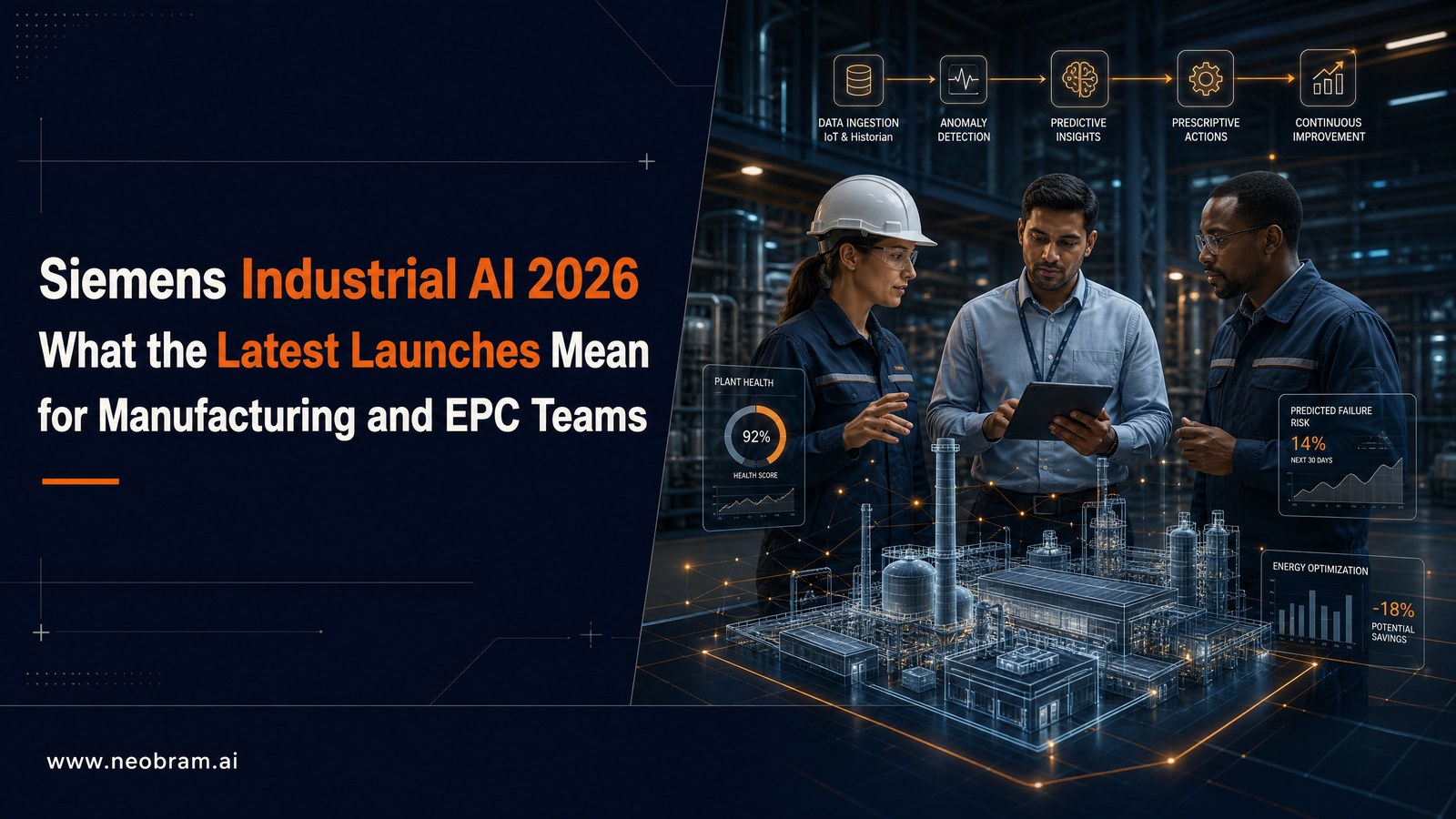
The announcements are not one product with one model. They describe a stack of capabilities: Intelligence Center X for governed orchestration and shared lifecycle context; Digital Twin Composer for building and exploring 3D digital representations; expanded AI copilots embedded in software such as Teamcenter, Polarion and Opcenter; and a Siemens–NVIDIA partnership aimed at AI-accelerated simulation, adaptive manufacturing and supply-chain workflows. [1] [2] [3] [4]
That distinction matters. A factory does not become intelligent because a chatbot can summarize a work order. It becomes more responsive when engineering intent, released product information, plant state, constraints, simulation results and approval workflows can be connected without losing provenance or operational control.
The important 2026 question is not “Does Siemens have AI?” It is “Which decision can Siemens’ new AI stack help us prepare, validate and execute—and what evidence and authority does that decision require?”
This article separates what Siemens has announced from what teams can reasonably do next. It also treats customer results and performance targets carefully: they are signals to investigate, not universal guarantees.
The 2026 Siemens portfolio in one view
The easiest way to understand the announcements is to map each layer to the industrial problem it is intended to address.
| 2026 launch or capability | Industrial problem it targets | Practical implication for a manufacturing or EPC team | Adoption question to ask |
|---|---|---|---|
| Intelligence Center X | AI pilots that cannot reliably use enterprise context or move into governed workflows. | Coordinate people, models, data and agents with traceability, lifecycle intelligence and policy controls. | Which workflow will become faster or more reliable because an agent can act on governed context? |
| Digital Twin Composer | Engineering and plant changes that are expensive to validate physically or across disconnected models. | Create and explore a 3D virtual representation of a product, process or plant and test the effects of change. | Is the digital twin current and accurate enough for the decision we want to make? |
| Nine industrial copilots | Domain teams losing time navigating product data, compliance evidence and manufacturing information. | Embed assistance into Teamcenter, Polarion, Opcenter and other software workflows rather than forcing users into a separate AI tool. | Does the copilot have the right permissions, released data and review step? |
| Siemens–NVIDIA Industrial AI Operating System | Scaling physical AI, simulation and adaptive operations across the industrial lifecycle. | Combine Siemens industrial software and expertise with NVIDIA infrastructure, Omniverse libraries, models and frameworks. | What workload benefits from GPU acceleration or physics-based simulation, and what remains a conventional business workflow? |
| Intelligence Center X deployment patterns | Industrial organizations have different OT estates, cloud policies and vendor mixes. | Layer onto Siemens AI products, run standalone for asset-intensive organizations, or use as a broader agentic-enterprise platform. | Which deployment pattern fits the site’s data residency, integration and operating model? |
The portfolio framing also suggests a shift in the unit of value. The unit is not the model. It is the closed-loop workflow: a change request becomes a traceable impact assessment; a plant issue becomes an evidence-backed investigation; a proposed production adjustment becomes a simulated and approved scenario.
Intelligence Center X: the orchestration layer for production-grade AI
Siemens announced Intelligence Center X on 1 June 2026 as industrial-AI orchestration software intended to move organizations from isolated experimentation to scalable business impact through a hybrid workforce in which people and AI agents work with shared context, workflows and lifecycle intelligence. Siemens says the platform connects data, models and workflows on a governed foundation with traceability and control. It combines the Mendix low-code platform with Graph Studio and AI Studio from the RapidMiner portfolio. [3]
For an industrial enterprise, this is a direct response to a familiar failure mode. A pilot may answer a narrow question in a notebook or demonstration environment, yet fail when it must identify the correct equipment, use the released engineering revision, respect a site-specific approval, record its evidence and hand the result to an existing workflow. Orchestration is valuable when it makes those hand-offs explicit.
The platform’s stated deployment patterns are also significant. Siemens describes a model layered on Siemens AI products, a standalone option for asset-intensive organizations using other OT vendors, and a pure agentic-enterprise platform for organizations outside asset-intensive industry. [3] For manufacturers, the middle question is not simply whether Siemens is already the dominant software vendor. It is whether the organization can expose reliable context from SAP, MES, historian, QMS, CMMS, engineering repositories and plant-edge systems through governed interfaces.
Siemens cites customer-specific outcomes to illustrate the proposition. The company reports that Vivix Vidros Planos deployed nearly 30 Mendix applications connecting OT and IT data across SAP S/4HANA, Siemens Industrial Edge and Snowflake, with an 85% reduction in production-issue resolution time, 6,000 hours of manual work recaptured in one year, and customer-complaint resolution compressed from five days to under one. [3] Those are valuable signals, but they should be read as a customer case study, not as a benchmark every plant should budget against. A responsible business case would verify the baseline, scope, measurement period, excluded work and whether the result transfers to the target site.
Digital Twin Composer: from static model to change simulation
At CES 2026, Siemens described Digital Twin Composer as a new software product targeted for availability on the Siemens Xcelerator Marketplace in mid-2026. Siemens says it brings together its digital-twin capabilities, NVIDIA Omniverse libraries and real-time engineering data so organizations can create a virtual 3D model of a product, process or plant, place it in a 3D scene and visualize the effects of changes over time. [1] [2]
For manufacturing and EPC teams, the practical promise is simulation before commitment. A proposed layout change, new line, altered material route, equipment upgrade or engineering revision can be examined in a shared environment before teams mobilize contractors, stop production or discover an interface issue during commissioning.
The value depends on the quality of the model and the decision boundary. A visually impressive scene is not automatically a validated engineering model. Teams should distinguish between geometry used for communication, physics or discrete-event models used for analysis, and operational data used to compare expected and actual performance. They should also record the model version, input snapshot, assumptions, validation status and approval owner for each decision.
Siemens’ CES newsroom describes a PepsiCo deployment in which Digital Twin Composer simulations identified up to 90% of potential issues before physical modifications, alongside an initial 20% throughput increase, nearly 100% design validation and 10–15% CapEx reductions. [1] These figures are reported for a specific customer context. The correct interpretation is that simulation may surface hidden capacity and interface issues early; the incorrect interpretation is that every digital-twin deployment will deliver the same percentages.
An EPC team can turn the announcement into a measurable use case by choosing one change class—for example, brownfield equipment replacement or utility-routing coordination—and comparing the current process with a twin-assisted process. Useful measures include late design changes, field rework, review duration, commissioning defects, unresolved interface questions and the percentage of assumptions traced to an owner.
Nine copilots: why embedded assistance matters
Siemens announced nine new AI-powered copilots across its software offerings, including Teamcenter, Polarion and Opcenter. The company describes these copilots as helping with product-data navigation, compliance and manufacturing-process work. [1] [2]
The strategic point is not the number nine. It is the decision to place assistance inside the applications where industrial work already happens. An engineer searching for a released component record, a quality specialist assembling compliance evidence or a production team investigating an exception should not have to export sensitive context into a generic chat window and then manually translate the answer back into a controlled system.
Embedded assistance still needs disciplined boundaries. A Teamcenter copilot should distinguish released from obsolete revisions. A Polarion workflow should show the requirements and evidence used to produce a compliance summary. An Opcenter assistant should explain the production context and route a recommendation to the authorized owner rather than silently alter a schedule or control parameter.
The minimum acceptance test is therefore not “does it answer naturally?” It is “does it answer with the correct object, revision, source, timestamp, confidence and next step?” If the assistant cannot provide those fields, it may still be useful for low-risk drafting, but it is not ready for an operational decision.
Siemens and NVIDIA: an industrial-AI infrastructure thesis
Siemens and NVIDIA say they are expanding their partnership to build an Industrial AI Operating System spanning design, engineering, manufacturing, production, operations and supply chains. NVIDIA’s release describes AI-native electronic design, AI-native simulation and AI-driven adaptive manufacturing and supply chain as part of the portfolio. [4]
The phrase should be understood as ecosystem positioning, not as a conventional desktop operating system. NVIDIA says the partnership will combine Siemens industrial software and expertise with NVIDIA AI infrastructure, simulation libraries, models, frameworks and blueprints. Siemens is expected to contribute industrial AI experts and leading hardware and software. [4]
The “AI Brain” concept in the NVIDIA announcement is a useful architectural shorthand: software-defined automation and industrial-operations software are combined with NVIDIA Omniverse libraries and AI infrastructure so a factory can analyze a digital twin, test improvements virtually and turn validated insights into shop-floor changes. [4] That is a compelling closed-loop aspiration, but it is not a reason to bypass plant governance. A simulated change still needs the right model, a named approver, a safe deployment mechanism and a way to compare predicted and actual results.
NVIDIA also says Siemens plans GPU acceleration across its simulation portfolio and expanded support for CUDA-X libraries and AI physics models. The release cites a target of 2–10x speedups in key electronic-design-automation workflows. [4] This target concerns specified EDA workloads; it should not be presented as a universal manufacturing-performance claim. For a plant or EPC organization, the investment question is narrower: which simulation or engineering workload is constrained by compute time, and does faster computation change a real decision cycle?
What manufacturing teams should do now
The announcements become actionable when translated into a controlled sequence rather than a broad “AI transformation” program.
| Phase | Recommended activity | Evidence of progress | Guardrail |
|---|---|---|---|
| 1. Select | Choose one workflow with a costly information delay: engineering-change review, production-issue investigation, virtual commissioning or maintenance planning. | Baseline cycle time, rework, escalations and decision quality. | Keep the first scope bounded by one site, asset family or change class. |
| 2. Contextualize | Identify the authoritative sources, identifiers, revisions, owners and freshness requirements. | A data contract and source-linked test set. | Do not treat a data lake or document dump as industrial context. |
| 3. Assist | Use an embedded copilot or retrieval workflow to find evidence and prepare a draft recommendation. | Human-reviewed accuracy, evidence coverage and time saved. | Read-only first; no direct control-system writes. |
| 4. Simulate | Where useful, compare a proposed change in a validated digital-twin or optimization environment. | Predicted-versus-actual outcomes and assumption register. | Label model confidence and keep engineering sign-off. |
| 5. Orchestrate | Route the approved action through the existing workflow with logs, permissions and rollback. | Approval latency, audit completeness and exception rate. | Separate recommendation, approval and execution identities. |
| 6. Scale | Extend to adjacent assets or sites only after measuring drift and operating cost. | Repeatable controls, stable KPIs and a named product owner. | Do not scale a demonstration before its data and model limits are known. |
This approach is consistent with the underlying principle of ISA-95 and IEC 62264: enterprise functions, manufacturing operations management and control functions have distinct responsibilities and interfaces. [6] AI can connect those layers, but it should not erase their authority boundaries. A production copilot may prepare an exception package; a control system and its authorized operator remain responsible for the command path.
What EPC teams should pay attention to
EPC organizations should focus on the design-to-commissioning thread. The most immediate opportunities are not necessarily autonomous construction decisions. They are faster evidence retrieval, design-change impact analysis, constructability review, interface coordination, virtual commissioning and handover of a trustworthy asset model to operations.
The 2026 Siemens announcements make three questions more important. First, can the project team preserve the relationship between a requirement, an engineering object, a revision, a procurement item, an installed asset and an operating procedure? Second, can a proposed change be simulated against the current plant or project context rather than against a stale model? Third, can the resulting decision be handed to the operator with assumptions, limitations and approval history intact?
A credible EPC pilot might start with one package and one interface class. For instance, it could connect released P&IDs, equipment data, vendor documents, model geometry and commissioning punch items to identify unresolved interface risks. The success measure would be fewer late clarifications and faster resolution with no increase in escaped design errors—not the number of AI-generated summaries.
Security and governance are part of the product value
Industrial AI expands the number of systems that can interpret operational data and propose actions. It should therefore be governed as an operational capability, not only as an IT experiment. NIST’s AI Risk Management Framework emphasizes trustworthiness considerations across the design, development, use and evaluation of AI systems. [7]
For a production deployment, teams should define least-privilege identities, data residency rules, model and prompt change control, retrieval boundaries, source attribution, human approvals, logging, incident response and recovery. They should also keep AI workloads outside the direct control path unless a separate safety and cybersecurity case has been approved.
| Control | Minimum question before production use |
|---|---|
| Identity | Can the system distinguish a reader, recommender, approver and executor? |
| Data | Which system is authoritative for each object, revision, state and timestamp? |
| Evidence | Can a user inspect the source records behind a recommendation? |
| Model | What happens when the model is uncertain, stale or outside its validated domain? |
| Workflow | Is every consequential action approved, logged and reversible? |
| OT boundary | Can the AI reach control systems, and if so, why is that access necessary? |
| Measurement | Are time saved and quality gains separated from novelty effects and baseline changes? |
The strongest industrial-AI architecture is not the one with the broadest access. It is the one that makes authority, evidence and failure modes visible.
Bottom line: watch the stack, start with the workflow
Siemens’ 2026 launches matter because they connect several industrial-AI directions that have often been discussed separately. Intelligence Center X addresses governed orchestration and shared context. Digital Twin Composer addresses simulation and visual validation of change. Embedded copilots bring assistance into engineering, compliance and manufacturing applications. The Siemens–NVIDIA partnership addresses accelerated simulation, physical AI and adaptive-factory infrastructure. [1] [2] [3] [4]
For manufacturing and EPC leaders, the prudent response is neither to dismiss the announcements as marketing nor to buy the whole stack before selecting a problem. Choose one decision where information latency is expensive. Baseline it. Map the authoritative data and approval path. Run a read-only, evidence-linked pilot. Add simulation when the model is fit for purpose. Then measure whether the workflow became faster, safer and more repeatable.
The industrial-AI era will not be won by the team with the most copilots. It will be won by the team that can connect engineering intent to operational context, test changes before committing them, and let people and agents collaborate without losing control of the plant.
References
[1] Siemens Newsroom: Siemens unveils industrial AI innovations at CES 2026
[3] Siemens Newsroom: Siemens powers the next phase of industrial AI with Intelligence Center X
[4] NVIDIA Newsroom: Siemens and NVIDIA Expand Partnership to Build the Industrial AI Operating System
[6] International Society of Automation: ISA-95 Series of Standards
[7] National Institute of Standards and Technology: AI Risk Management Framework